Employee Participation Under 29 CFR 1910.119(c)
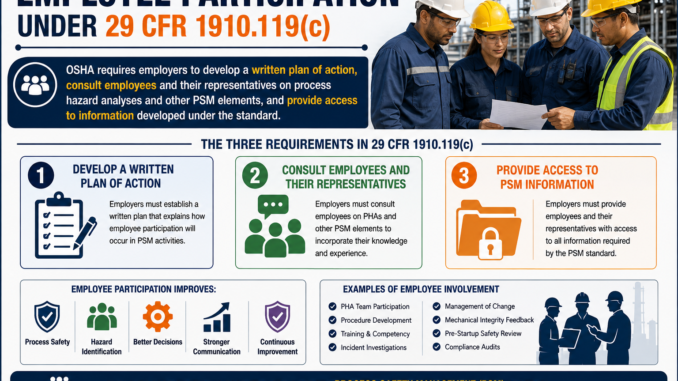
PSM employee participation requires more than giving workers a finished manual. Under 29 CFR 1910.119(c), employers must create a written plan of action, consult employees and their representatives on process hazard analyses and other PSM elements, and provide access to information developed under the standard.
Operators, maintenance employees, laboratory staff, and other affected workers often know how a process behaves during startup, upset conditions, temporary operation, repair, and shift change. A structured participation system brings that operational knowledge into hazard decisions and communicates resulting actions back to the people exposed to the process.
The three requirements in paragraph 1910.119(c)
1. Develop a written plan of action
The plan should explain how participation will occur, not simply promise that employees will be involved. It can identify:
- Covered processes and participating employee groups;
- Roles for employees and representatives;
- How PHA team members are selected;
- How employees contribute to procedures, investigations, MOC, training, and audits;
- How workers request and access PSM information;
- How recommendations and decisions are communicated;
- How participation time, records, and feedback are managed; and
- Who owns and periodically reviews the plan.
OSHA’s employee-participation interpretation describes the provision as supporting a cooperative flow of process-safety information between management and employees.
2. Consult employees and their representatives
Consultation is explicitly required for the conduct and development of process hazard analyses and development of other PSM elements. Practical participation can include:
- PHA team membership and scenario development;
- Procedure drafting and field validation;
- Identification of recurring alarms, leaks, workarounds, or difficult tasks;
- Training-needs assessment;
- Pre-startup walkdowns;
- Incident and near-miss investigations;
- Management-of-change reviews affecting work;
- Mechanical-integrity feedback; and
- Compliance-audit interviews and corrective actions.
The standard does not require every employee to sit on every team. The employer should select methods that produce meaningful input from people with relevant knowledge and ensure affected employees understand the outcome.
3. Provide access to PSM information
Employees and their representatives must have access to PHAs and all other information required to be developed under the standard. Access should be practical and timely. A record that technically exists but cannot be located, opened, understood, or reviewed during reasonable working arrangements may not support meaningful participation.
Trade-secret status under PSM does not remove required access. OSHA permits confidentiality agreements consistent with 29 CFR 1910.1200, but necessary safety information must remain available to the people performing specified PSM work.
Building participation into the PSM lifecycle
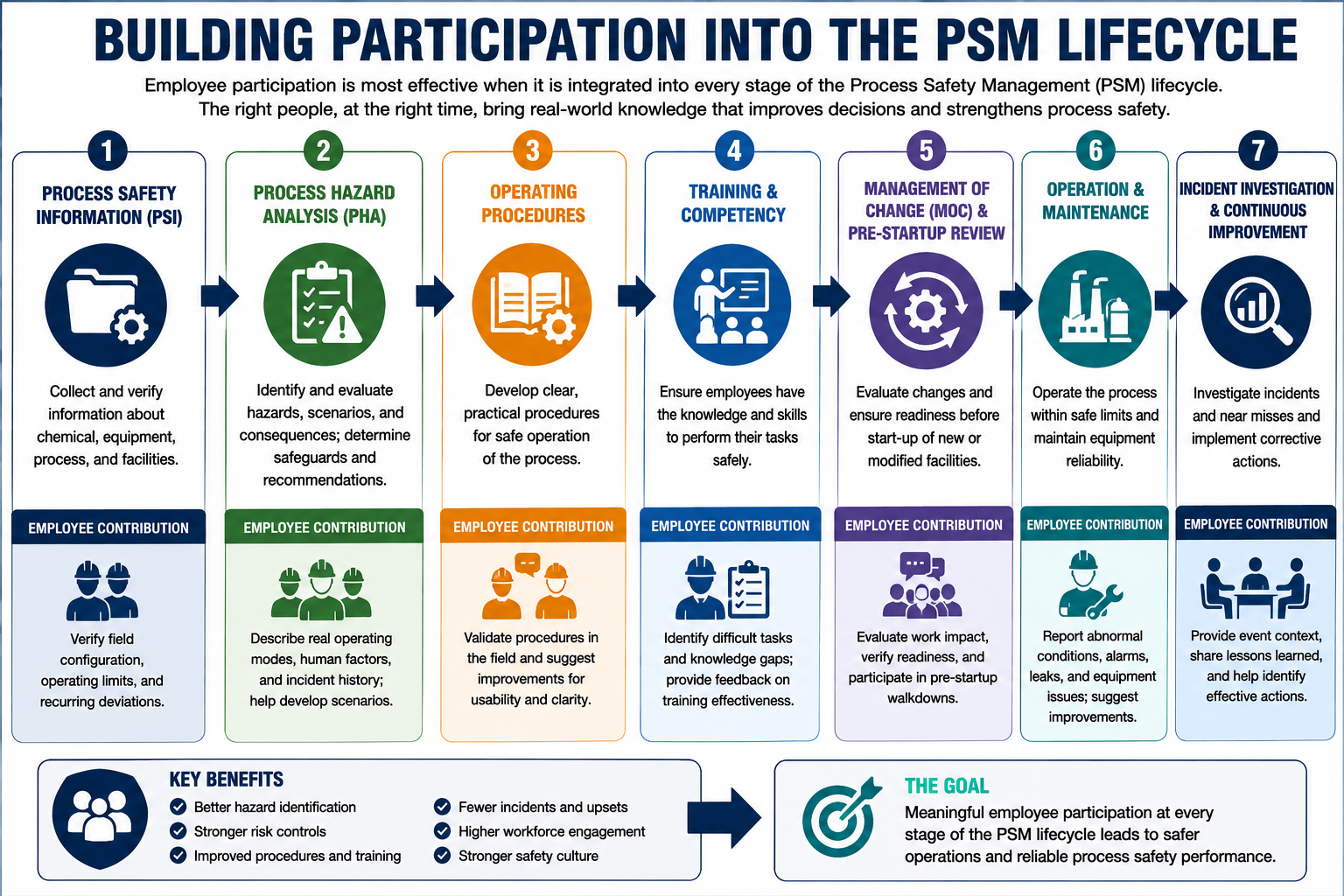
| PSM activity | Useful employee contribution | Evidence of participation |
|---|---|---|
| PSI | Verify field configuration, operating limits, and recurring deviations. | Walkdown notes, drawing markups, review comments. |
| PHA | Describe real operating modes, human factors, and incident history. | Team roster, worksheets, meeting records. |
| Procedures | Test whether instructions match the task and are usable. | Validation record, revision comments. |
| Training | Identify difficult tasks and knowledge gaps. | Needs assessment, employee feedback. |
| MOC/PSSR | Evaluate work impact and verify readiness. | Review sign-off, training record, walkdown. |
| Incident investigation | Provide event context and help evaluate corrective actions. | Interview record, team membership, report review. |
Participation is not the same as approval
Consultation does not automatically give every participant final decision authority. The written plan should distinguish who contributes information, who performs technical review, who authorizes action, and how disagreements or PSM Employee Participation unresolved concerns are recorded and elevated. This clarity protects participation from becoming symbolic while preserving accountable decision-making.
Common employee-participation weaknesses
- A one-page policy with no method, owner, or schedule;
- Inviting employees only after decisions are complete;
- Using the same representative for topics outside that person’s knowledge;
- Failing to include maintenance or contractor knowledge where relevant;
- Providing documents without time or a workable access method;
- Collecting suggestions without communicating resolution;
- Retaliation or discouragement that suppresses hazard reporting; and
- No evidence showing how participation affected the PSM work.
Employee participation checklist
- Does the written plan identify who participates, when, and how?
- Are process-specific employees included in PHAs?
- Can workers access required PSM information without unreasonable barriers?
- Are affected shifts, crafts, and contractors represented where relevant?
- Are employee concerns and management responses documented?
- Are changes and corrective actions communicated before affected work begins?
- Is the participation plan reviewed when the workforce or process changes?
How to document meaningful consultation
OSHA does not prescribe a single participation form, but the employer should be able to show how the written plan operates. Useful evidence includes team PSM Employee Participation rosters, meeting notes, marked-up procedures, PHA worksheets, employee comments, action logs, training-needs surveys, audit interviews, and records showing how concerns were resolved. The objective is not to create paperwork for every conversation. It is to preserve enough information to demonstrate that knowledgeable employees had a real opportunity to contribute before important decisions were finalized.
A practical comment log can record the date, process, issue, person or employee group consulted, proposed response, responsible owner, due date, decision, and communication-back date. Where a suggestion is not adopted, explain the technical or operational basis rather than recording only “rejected.” Sensitive reports should be handled through channels that protect employees and support candid reporting.
Participation across shifts and job roles
Participation can become unrepresentative when meetings repeatedly involve only day-shift operators or supervisors. The plan should consider night shifts, relief operators, maintenance crafts, instrument technicians, laboratory employees, emergency responders, and employees who perform infrequent operations. Remote access, paid meeting time, rotating representatives, toolbox reviews, structured interviews, and written comment periods can help facilities gather input without placing every worker on every committee.
Contract workers may also hold relevant knowledge, especially during turnarounds or specialized maintenance. Their involvement does not replace the duties assigned to the host and contract employers under paragraph (h), but it can improve hazard identification, work planning, and lessons learned.
Measuring whether participation works
Simple indicators can help management review the program: percentage of PHAs with appropriate operations and maintenance representation, employee comments resolved by the promised date, procedures field-validated by users, corrective actions communicated before startup, and recurring concerns that remain unresolved. These are management indicators, not OSHA-prescribed metrics. Use them to find barriers and improve the plan, not to discourage reporting or reward low concern counts.
Related PSM requirements
Frequently Asked Questions About PSM Employee Participation
1. What is PSM Employee Participation?
PSM Employee Participation is the process of involving employees and their representatives in activities required under OSHA Process Safety Management. It includes consultation on PHAs and other PSM elements, participation in relevant safety activities, and access to required PSM information.
2. What does OSHA 29 CFR 1910.119(c) require?
OSHA 29 CFR 1910.119(c) requires employers to develop a written plan of action for employee participation, consult employees and their representatives on PHA and other PSM elements, and provide access to information required to be developed under the PSM standard.
3. Who should participate in PSM activities?
Operators, maintenance employees, laboratory personnel, and other employees affected by covered processes may provide valuable process knowledge. Participation should include people with relevant experience and knowledge for the activity being performed.
4. Do employees have to participate in every PHA?
No. OSHA does not require every employee to participate in every PHA. Employers should select employees and representatives with appropriate knowledge of the process, operations, equipment, hazards, and work activities being evaluated.
5. What PSM information must employees be able to access?
Employees and their representatives must have access to PHAs and other information required to be developed under the PSM standard. The access system should be practical, timely, and suitable for the employees who need the information.
6. How can employers document employee participation?
Useful records can include PHA team rosters, meeting notes, employee comments, procedure review records, training feedback, MOC reviews, incident investigation participation, audit interviews, and action logs showing how employee concerns were addressed.
7. Why is employee participation important in Process Safety Management?
Effective employee participation brings practical operating knowledge into safety decisions. Employees may recognize recurring alarms, difficult procedures, abnormal conditions, equipment problems, or workarounds that may not be obvious from technical documents alone. Meaningful participation can therefore strengthen hazard identification and process safety performance.
Related Guides
- Health & Safety Risk Assessment Template: Free Construction Guide
- Block Masonry and Tiles Installation: Risk Assessment Guide
- Aramco safety officer : test preparation
- Steel Erection Safety Officer Test Preparation – Hoisting, Rigging, and Structural Stability
- Aramco safety officer : test preparation


3 Trackbacks / Pingbacks