PSM Training Requirements Under 29 CFR 1910.119(g)
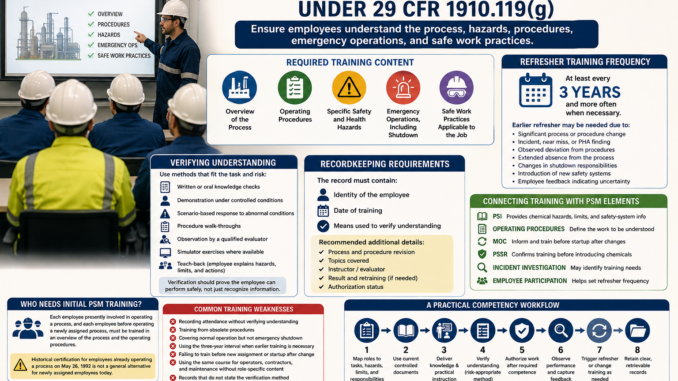
PSM training requirements are designed to ensure that employees involved in operating a covered process understand the process, its operating procedures, relevant hazards, emergency operations, and safe work practices. 29 CFR 1910.119(g) requires initial training, refresher training at least every three years and more often when necessary, and records showing how understanding was verified.
Attendance alone is not the standard’s endpoint. The employer must determine that the employee received and understood the required training.
Who needs initial PSM training?
Each employee presently involved in operating a process, and each employee before operating a newly assigned process, must be trained in an overview of the process and the operating procedures. The historical provision allowing written certification for employees already operating a process on May 26, 1992 should not be treated as a general alternative for newly assigned employees today.
Required training content
The regulation emphasizes:
- An overview of the process;
- Operating procedures for the employee’s assigned work;
- Specific safety and health hazards;
- Emergency operations, including shutdown; and
- Safe work practices applicable to the job.
A process overview should establish where the employee’s work fits within the system, what chemicals and energy are present, what the normal operating envelope is, and which protective systems matter. Procedure training should address the operating phases the employee may perform, not just normal operation.
Refresher training frequency
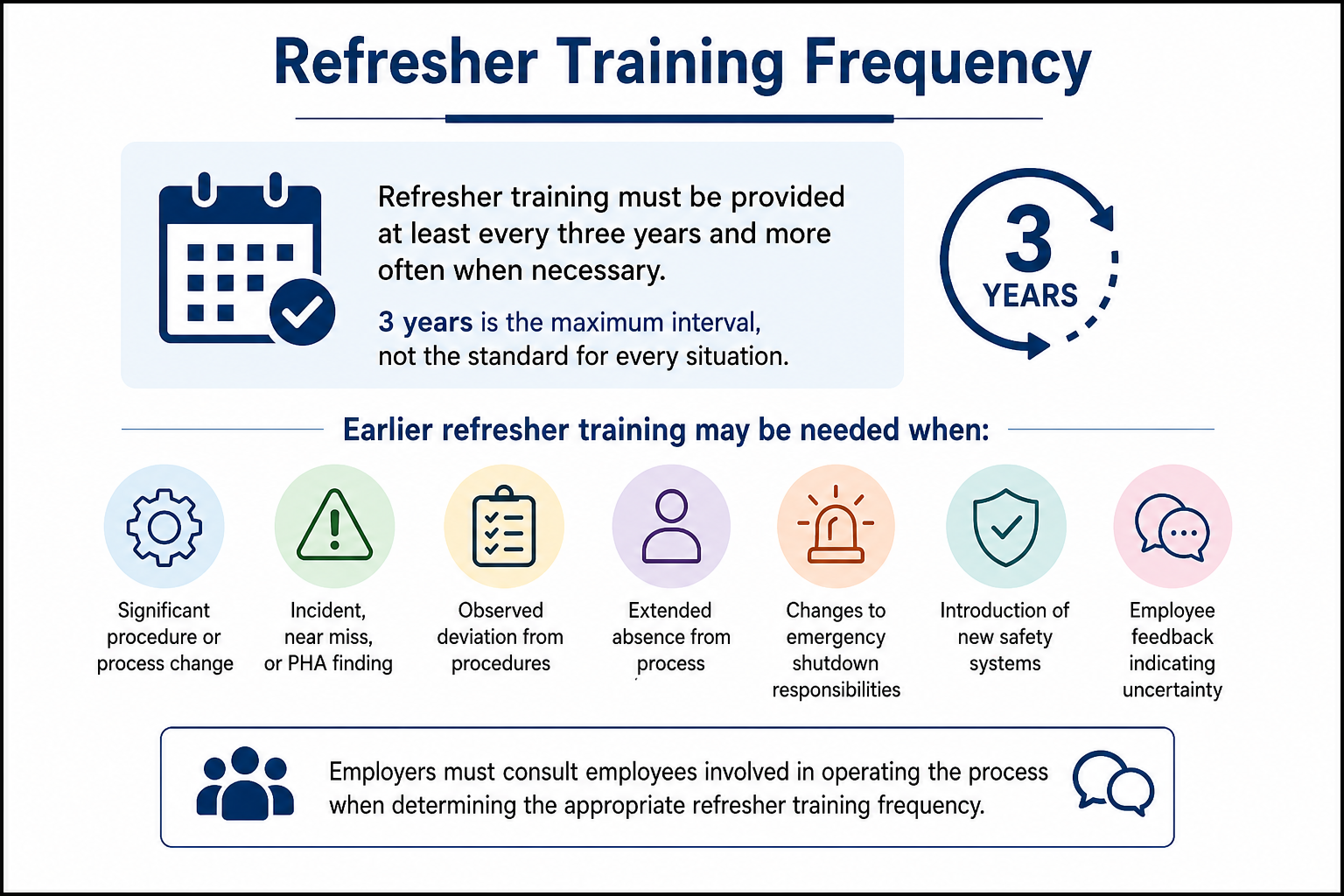
Refresher training must be provided at least every three years and more often when necessary. The employer must consult employees involved in operating the process when determining the appropriate frequency.
Three years is a maximum interval, not an automatic schedule for every topic. Earlier refresher training may be appropriate after:
- A significant procedure or process change;
- An incident, near miss, or PHA finding revealing a knowledge gap;
- Observed deviation from current procedures;
- Extended absence from an assigned process;
- Changes to emergency shutdown responsibilities;
- Introduction of new safety systems; or
- Employee feedback indicating uncertainty.
How to verify understanding
The standard does not prescribe one test. The verification method should fit the task and risk. Options include:
- Written or oral knowledge checks;
- Demonstration under controlled conditions;
- Scenario-based response to abnormal conditions;
- Procedure walk-throughs;
- Observation by a qualified evaluator;
- Simulator exercises where available; and
- Teach-back, where the employee explains hazards, limits, and actions.
A generic multiple-choice quiz may test recognition without proving that the employee can perform a critical shutdown or identify a dangerous deviation. High-consequence tasks benefit from practical verification.
Required training documentation
The employer’s record must contain:
- The identity of the employee;
- The date of training; and
- The means used to verify that the employee understood the training.
A stronger record also identifies the process, procedure revision, topics, instructor or evaluator, result, retraining needed, and authorization status. These extra fields should support management without obscuring the three regulatory requirements.
Connecting training with other PSM elements
Training must remain aligned with the current process:
- PSI: provides chemical hazards, operating limits, and safety-system information.
- Operating procedures: define the work employees must understand and follow.
- MOC: requires affected operating, maintenance, and contract employees to be informed and trained before startup of the changed process or affected part.
- PSSR: confirms training is complete before introducing highly hazardous chemicals.
- Incident investigation: may identify training or competency actions.
- Employee participation: helps determine refresher frequency and practical training needs.
Contractor and maintenance training distinctions
Contract employers must assure that contract employees are trained in work practices necessary to perform safely, instructed in relevant process hazards and emergency-plan provisions, and documented as required by paragraph (h)(3). Employees maintaining covered process equipment must receive the process overview, hazard information, and job procedures required by paragraph (j)(3). Do not assume one operator course automatically satisfies these different duties.
A practical competency workflow
- Map each role to tasks, procedures, hazards, limits, and emergency responsibilities.
- Verify that training material uses current controlled documents.
- Deliver knowledge and practical instruction appropriate to the task.
- Verify understanding using a risk-appropriate method.
- Authorize work only after required competence is demonstrated.
- Observe performance and capture employee feedback.
- Trigger refresher or change training when conditions require it.
- Retain a clear, retrievable record.
Common training weaknesses
- Recording attendance without verifying understanding;
- Training from obsolete procedures;
- Covering normal operation but not emergency shutdown;
- Using the three-year interval when earlier training is necessary;
- Failing to train employees before a new assignment or startup after change;
- Using the same course for operators, contractors, and maintenance without role-specific content; and
- Keeping records that do not state the verification method.
Building a role-based training matrix
A role-based matrix connects each covered-process job to the tasks, operating phases, procedures, hazards, safeguards, emergency duties, and verification methods that apply. It can distinguish a fully qualified console operator from an employee in supervised development and show which assignments require periodic demonstrations or authorization. The matrix should reference controlled procedure revisions so an MOC or procedure update can trigger a targeted training review.
Use the matrix as an index, not as proof of competence by itself. Evidence should still show what instruction occurred, when it occurred, who received it, and how understanding was verified. When an employee does not demonstrate understanding, document the gap, provide additional instruction, repeat an appropriate evaluation, and restrict independent work until the required competence is established.
Evaluating training effectiveness
Training effectiveness can be reviewed through field observations, simulator performance, operating-limit deviations, procedure-use feedback, incident findings, and interviews during compliance audits. A poor result does not always mean the employee failed to learn. It may reveal an unclear procedure, inaccurate PSI, difficult interface, inadequate staffing, or a change that was not communicated. Investigate the system before defaulting to retraining as the only corrective action.
For refresher planning, combine the three-year maximum interval with risk and performance signals. Critical emergency actions may need more frequent practice than routine knowledge. Employees should be consulted about the frequency, and changes affecting their work must be addressed before startup when paragraph (l) applies.
Question & Answer Session
1. What is PSM Training under 29 CFR 1910.119(g)?
PSM Training ensures that employees involved in covered processes understand process hazards, operating procedures, emergency operations, shutdown requirements, and safe work practices.
2. Who needs initial PSM Training?
Each employee involved in operating a covered process must receive PSM Training before operating a newly assigned process.
3. What topics should PSM Training cover?
PSM Training should cover the process overview, operating procedures, specific safety and health hazards, emergency operations including shutdown, and safe work practices.
4. How often is refresher PSM Training required?
Refresher PSM Training must be provided at least every three years and more often when necessary based on risk, employee feedback, changes, incidents, or identified knowledge gaps.
5. How can an employer verify PSM Training understanding?
Understanding can be verified through written or oral tests, practical demonstrations, scenario-based exercises, procedure walk-throughs, observation, simulator exercises, or teach-back methods.
6. What records are required for PSM Training?
Training records should identify the employee, training date, and means used to verify that the employee understood the training.
7. Is attendance enough to complete PSM Training?
No. Attendance alone does not demonstrate understanding. The employer must verify that the employee received and understood the required training.
8. When should additional PSM Training be provided?
Additional PSM Training may be necessary after significant process or procedure changes, incidents, near misses, PHA findings, new safety systems, or when employees demonstrate uncertainty.
9. Is PSM Training the same for operators, contractors, and maintenance employees?
No. Operators, contractors, and maintenance employees have different training requirements under the applicable PSM paragraphs. Training should therefore be role-specific.
10. Why is practical verification important in PSM Training?
Practical verification helps demonstrate that an employee can apply knowledge during abnormal conditions, identify hazards, follow procedures, and perform critical emergency actions.
11. What is the purpose of a PSM Training matrix?
A training matrix connects each job role with applicable tasks, procedures, hazards, operating limits, emergency responsibilities, and competency verification requirements.
12. How can companies improve PSM Training effectiveness?
Effectiveness can be improved through field observations, simulator exercises, employee feedback, procedure reviews, incident findings, competency evaluations, and timely refresher training.
Related PSM requirements
- PSM operating procedures
- Employee participation
- Contractor safety responsibilities
- Pre-startup safety review

1 Trackback / Pingback