
Purpose
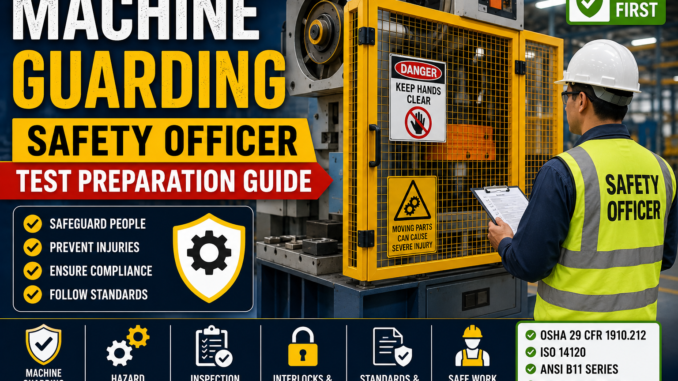
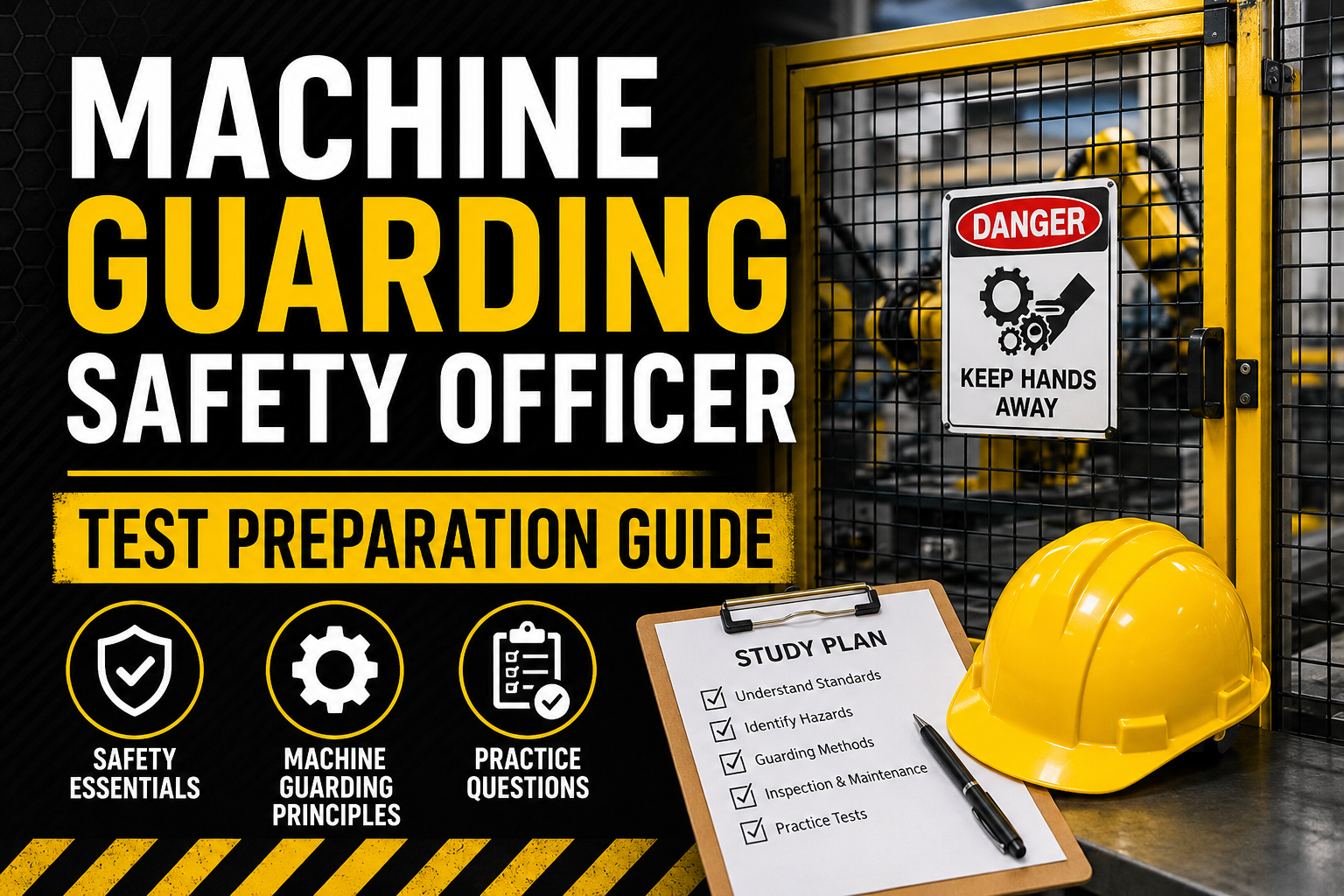
These Machine Guarding Safety Officer Test Preparation interview questions are commonly asked during Safety Officer interviews on Saudi Aramco and large-scale construction projects. This chapter covers the general requirements for guarding moving machine parts, guard construction standards, installation timing, and the maintenance protocol a Safety Officer must know before sitting a competency exam or a site interview. The content follows the structure of Saudi Aramco Construction Safety Manual (CSM) Chapter 1, “Machine Guarding,” and cross-references SAES-B-053 (Machine Safety Guarding, Elevators, Escalators, and Conveyors), the Aramco engineering standard this chapter is built on.
TL;DR: A Safety Officer verifies that any moving machine part located within 2.5 m (8.2 ft) of a floor or working surface – flywheels, shafts, pulleys, belt drives, chain drives – is fitted with a fixed guard before the machine ever produces a motion hazard. Guards go on before the equipment arrives on site, stay in place throughout operation, and get reinstalled before the machine returns to service once maintenance or repair work is finished. Guard openings cannot exceed 1.3 cm (0.5 in), the maximum gap that keeps a hand, finger, or piece of loose clothing from reaching a moving surface. All of this sits under SAES-B-053, Saudi Aramco’s engineering standard for Machine Safety Guarding, Elevators, Escalators, and Conveyors.
Purpose of CSM Chapter 1 and SAES-B-053 Reference
CSM Chapter 1 exists to eliminate the crush, entanglement, and amputation hazards created by unguarded moving machine parts on construction sites – flywheels spinning at operating speed, exposed shafts, open pulleys, and belt or chain drives running at floor level or close to it. It does this by making guarding a condition of the equipment being on site at all, not an afterthought handled once the machine is already running.
Q1: What is the purpose of the Machine Guarding chapter in the Construction Safety Manual?
A: To establish minimum requirements ensuring that moving parts of machinery – which could cause injury through contact – are guarded before that machinery is put into operation, so that no employee is exposed to a crush, entanglement, or struck-by hazard from a rotating, oscillating, or reciprocating part during normal work.
Q2: Which engineering standard does CSM Chapter 1 reference for machine guarding?
A: SAES-B-053 – Machine Safety Guarding, Elevators, Escalators, and Conveyors. This is the Saudi Aramco engineering standard that sets out design and construction criteria for guards protecting personnel from rotating equipment, prime movers, elevators, escalators, and material conveyors, and CSM Chapter 1 applies that standard’s guarding logic to construction-site machinery.
Q3: Why does a Safety Officer need to know SAES-B-053 specifically, rather than just general safe-work practice?
A: Because SAES-B-053 fixes the numeric thresholds an inspector actually checks against – the 2.5 m height trigger and the 1.3 cm opening limit – rather than leaving guarding adequacy to judgment. A Safety Officer who can only say “the machine needs a guard” without knowing the height threshold or the maximum opening size cannot properly evaluate whether an installed guard actually satisfies the standard.
General Requirements for Machine Guarding
Q4: What triggers the requirement to guard a moving machine part under CSM Chapter 1?
A: Any moving part of machinery – a flywheel, shaft, pulley, belt drive, or chain drive – located within 2.5 m (8.2 ft) of the floor or working surface must be guarded, regardless of whether it is at ground level, on a platform, or on an elevated deck. The 2.5 m figure is a working-surface measurement, not a ground-level-only rule; a shaft on a mezzanine 2 m above that mezzanine’s floor still falls inside the trigger height.
Q5: What specific machine components does the general requirement name?
A: Flywheels, shafts, pulleys, and belt or chain drives. These are named because they are the components most commonly left exposed on skid-mounted engines, generators, compressors, and pump packages delivered to a construction site, and because contact with any of them at operating speed produces an entanglement or crush injury with little warning.
Q6: Does the 2.5 m guarding requirement apply only to permanently installed plant equipment?
A: No. It applies to any machinery on the construction site with a moving part meeting the height and hazard criteria – temporary generators, portable compressors, skid-mounted pumps, and construction equipment power take-offs are all in scope, not just fixed process machinery.
Q7: When must a guard be installed relative to the equipment reaching the site?
A: Before the equipment arrives on site. Guarding is treated as a condition of the equipment’s arrival, not a task to complete after mobilization – equipment delivered without its required guards in place is not authorized to be placed into operation until the guard is fitted.
Q8: What is a Safety Officer’s responsibility when equipment arrives without guards fitted?
A: To hold the equipment out of service and refuse authorization to operate until the required guard is installed and verified against SAES-B-053 construction criteria. Accepting a verbal assurance that a guard will be fitted “once it’s running” does not satisfy the requirement – the guard has to be in place first.
Q9: Must guards be maintained in place throughout the equipment’s operating life on site, or only at initial inspection?
A: Throughout operation. A guard confirmed at initial inspection but later removed, damaged, or left off after a repair puts the machine back into a non-compliant, hazardous condition – continuous maintenance of the guard is part of the requirement, not a one-time checkbox.
Guard Construction Standards
Q10: What is the maximum permissible opening size in a machine guard?
A: 1.3 cm (0.5 in). Any opening larger than this is considered capable of allowing a finger, hand, or piece of clothing to reach the moving surface behind the guard, defeating its purpose.
Q11: Why is 1.3 cm (0.5 in) the threshold rather than a larger, more economical mesh size?
A: Because that dimension is sized to prevent body contact with the moving surface behind the guard – a larger mesh might stop a whole hand from passing through but still allow a finger to reach a pinch point or a rotating shaft. The threshold is set at the smallest body part likely to cause injury on contact, not the largest object the guard needs to visually screen out.
Q12: How does this compare with general industry practice cited in OSHA guidance for fan blade guarding?
A: OSHA’s machine guarding guidance for fan blades located less than 7 ft above the floor also caps guard openings at 1/2 inch, the same dimension SAES-B-053 applies at 2.5 m. The two figures land on the same practical principle from different regulatory paths: keep the opening small enough that a finger cannot pass through to a moving blade or surface.
Q13: What must a Safety Officer physically check on an installed guard, beyond the opening size?
A: That the guard is securely affixed to the machine or a fixed structure (not something that can be lifted off or swung aside without a tool), that it fully covers the hazard zone rather than leaving a gap at the edge, and that the guard material itself is not damaged, corroded, or bent in a way that has enlarged any opening beyond 1.3 cm.
Q14: Is a guard that only covers the top of a rotating shaft, leaving the sides open, considered compliant?
A: No. A guard has to enclose the hazard on every side from which a person could make contact with the moving part – a top-only cover leaves the sides and any walk-under or reach-around approach exposed, which does not meet the intent of a guard preventing body contact with the moving surface.
Q15: What is a frequent exam trick question about guard construction?
A: Whether a guard mesh sized to keep out debris or dust automatically satisfies the personnel-protection opening requirement. It does not – a dust screen may have openings well over 1.3 cm and serve a completely different purpose. A Safety Officer verifies the opening dimension against the 0.5 in personnel-protection threshold independently of any environmental screening the guard might also provide.
Guard Installation Timing and Maintenance Protocol
Q16: What must happen before a guard is removed for maintenance or repair work?
A: The equipment must be de-energized and isolated under the site’s lockout/tagout procedure before the guard is taken off – guard removal exposes the same moving-part hazard the guard was installed to prevent, so the machine cannot be running, or capable of starting, while the guard is off.
Q17: What is required before the machine returns to service after maintenance or repair?
A: The guard removed for that maintenance or repair must be reinstalled before the equipment resumes operation. This is a hard condition of restarting the machine, not a follow-up task to complete once production or construction activity has already resumed.
Q18: Who verifies that a guard has been reinstated before a machine is released back to service?
A: The Safety Officer, working with the maintenance supervisor or the mechanic who performed the work, confirms the guard is physically back in place, correctly secured, and undamaged before signing off on the equipment’s return to operation – not the mechanic’s word alone that the job is “done.”
Q19: What should a Safety Officer do on discovering a machine running with its guard left off after a repair?
A: Stop the machine immediately and hold it out of service until the guard is reinstalled and verified. A machine running without its required guard is treated as an active hazard regardless of how briefly it has been operating in that condition or how experienced the operator is.
Q20: Does a temporary guard – plywood, tape, or a cone placed near the hazard – satisfy the requirement while the permanent guard is off for repair?
A: No. An improvised barrier does not meet SAES-B-053’s construction and opening criteria and does not substitute for the permanent guard. If the permanent guard cannot be reinstalled immediately, the machine stays out of service rather than being run behind a makeshift barrier.
Q21: What documentation should accompany guard removal for maintenance on an Aramco site?
A: A record tied to the work permit or maintenance work order noting that the guard was removed, the reason, and confirmation of reinstallation before the permit is closed – so there is a traceable record that the guard went back on before the equipment was released, not just a general assumption that it did.
Component-Specific Guarding Applications
Q22: How does the 2.5 m guarding rule apply to a flywheel on a skid-mounted diesel generator?
A: If any part of the flywheel sits within 2.5 m of the floor or working surface the generator is installed on, the flywheel requires a fixed guard enclosing it with openings no larger than 1.3 cm – regardless of the generator’s rated output or how briefly it is expected to remain on site.
Q23: What guarding applies to an exposed drive shaft connecting a motor to a pump at floor level?
A: The full length of the shaft within the 2.5 m trigger height requires a guard – typically a shaft guard or coupling guard enclosing the rotating shaft and coupling so that no part of it is exposed to accidental contact along its run between the motor and the pump.
Q24: How is a belt drive on a compressor or air handling unit guarded?
A: With a fixed enclosure covering the belt, the pulleys at each end, and the nip points where the belt runs onto the pulley – the nip point is the specific location where a finger drawn in between the belt and pulley face causes the most severe injury, so the guard has to close off that point, not just the flat run of the belt.
Q25: What is the guarding requirement for an exposed chain drive, such as on a conveyor drive unit?
A: A chain guard enclosing the chain and sprockets along their full engagement length, with openings held to the 1.3 cm limit – chain drives carry the same nip-point hazard as belt drives at the point where the chain wraps onto the sprocket teeth.
Q26: Do conveyors themselves fall under the same guarding logic as flywheels, shafts, pulleys, and belt/chain drives?
A: Yes. Conveyors are named directly in SAES-B-053’s title alongside elevators and escalators, and the moving parts of a conveyor system – drive pulleys, take-up pulleys, and return idlers within the 2.5 m trigger height – are guarded under the same principle, consistent with conveyor design and safety criteria under ASME/ANSI B20.1.
High-Frequency Exam Scenarios
Q27: A site receives a skid-mounted compressor with its belt guard missing a bolt on one corner, leaving a small gap. Is it authorized to operate?
A: Only if the gap is measured and confirmed at or below 1.3 cm and the guard remains securely fixed on its other mounting points. A single missing bolt that lets a corner sag open beyond 0.5 in fails the opening requirement even though most of the guard is intact, and the compressor is held out of service until the fastener is replaced.
Q28: An operator reports a shaft guard was removed for repair “just for five minutes” and the machine kept running with the guard off during that window. Was this compliant?
A: No. The machine should have been isolated and stopped for the duration the guard was off – running a machine with a required guard removed, even briefly, exposes personnel to the same hazard the guard exists to prevent, and the reinstatement requirement applies before the machine resumes service, not after a short interval has passed.
Q29: A pulley sits 2.6 m above the working surface it is installed on. Does it still require a guard under the 2.5 m rule?
A: Based strictly on the 2.5 m (8.2 ft) trigger height, a pulley at 2.6 m falls just outside the named threshold. In practice, a Safety Officer still assesses whether personnel have any reach-up or platform access that brings them within contact range, since equipment layout, ladders, and adjacent platforms can put an otherwise “above-threshold” part back within reach – the numeric trigger sets the baseline, not an automatic exemption.
Q30: What is the single most commonly tested distinction in this chapter?
A: That guard installation is a pre-arrival condition and guard reinstallation is a pre-service condition – guards are not something added once equipment is already operating on site, and they are not optional to skip on a “we’ll get to it” basis once maintenance work concludes. Candidates who answer that a guard can be fitted after a machine is already running, or that operation can continue while a guard is being sourced, are marked incorrect.
FAQ: Machine Guarding Safety Officer Test Preparation
What triggers a machine guarding requirement on an Aramco construction site? Any moving part of machinery – a flywheel, shaft, pulley, or belt/chain drive – located within 2.5 m (8.2 ft) of the floor or working surface requires a fixed guard under CSM Chapter 1 and SAES-B-053.
What is the maximum allowed opening in a machine guard? 1.3 cm (0.5 in). Openings larger than this are considered capable of allowing body contact with the moving surface the guard protects.
When must a guard be installed on equipment coming to site? Before the equipment arrives on site. Equipment delivered without its required guards is not authorized for operation until the guard is fitted and verified.
What happens to a guard removed for maintenance or repair? It must be reinstalled before the equipment resumes service. Reinstatement is a condition of restarting the machine, not a follow-up task.
Which Aramco engineering standard governs machine guarding? SAES-B-053 – Machine Safety Guarding, Elevators, Escalators, and Conveyors – which sets the guarding design and construction criteria CSM Chapter 1 applies on construction sites.
Does the guarding requirement apply to temporary or skid-mounted equipment? Yes. Portable generators, compressors, and skid-mounted pump packages with an exposed flywheel, shaft, pulley, or belt/chain drive within the 2.5 m trigger height are covered the same as fixed plant equipment.
Sources
- OSHA, 29 CFR 1910.212 – General Requirements for All Machines: osha.gov/laws-regs/regulations/standardnumber/1910/1910.212
- OSHA, Machine Guarding eTool – Point of Operation and Opening Size Criteria: osha.gov/etools/machine-guarding
- OSHA Training Institute, Machine Guarding Reference Guide: oshainfo.gatech.edu
- ASME/ANSI B20.1 – Safety Standard for Conveyors and Related Equipment: asme.org/codes-standards/find-codes-standards/b20-1-safety-standard-conveyors-related-equipment
- American National Standards Institute, ANSI B11 Series – Safety of Machinery: ansi.org
This article is provided for exam and interview preparation purposes. Always verify current guarding thresholds, opening dimensions, and reinstatement requirements against the latest Saudi Aramco SAES-B-053 and CSM Chapter 1 issued for the specific project.


1 Trackback / Pingback