OSHA Process Safety Management (PSM) is a performance-based regulatory framework for preventing or minimizing catastrophic releases of highly hazardous chemicals. The federal requirements appear in 29 CFR 1910.119. OSHA Publication 3132 is an explanatory booklet, not a substitute for the current regulatory text.
PSM is concerned with events that can produce serious toxic, fire, or explosion hazards. It connects chemical and equipment information with hazard analysis, operating procedures, training, maintenance, change control, incident learning, and emergency preparation. Its elements are interdependent: incomplete process information can weaken a hazard analysis, while an unmanaged change can make approved procedures and training obsolete.
Why OSHA established the PSM standard
Unexpected releases of toxic, reactive, flammable, or explosive chemicals can escalate beyond an ordinary occupational injury. A single loss of containment may affect multiple workers, damage equipment, start a fire, produce an explosion, or expose people to a toxic cloud. OSHA published the PSM standard in 1992 after catastrophic chemical-release incidents created broad recognition that facilities needed a systematic management program, not isolated safety rules. OSHA’s current PSM rulemaking background describes this regulatory history.
OSHA 3132 discusses incidents at Bhopal, Phillips Petroleum in Pasadena, BASF in Cincinnati, and IMC in Sterlington as part of the historical context. These events should be described as history, not used as sensational imagery or proof that one control alone could have prevented every outcome.
Which processes are covered by 29 CFR 1910.119?
A process may be covered when it involves either:
- A chemical at or above the threshold quantity listed in Appendix A to 29 CFR 1910.119; or
- A Category 1 flammable gas or a flammable liquid with a flashpoint below 100°F (37.8°C), on site in one location, in a quantity of 10,000 pounds (4,535.9 kg) or more, subject to the exceptions in paragraph 1910.119(a).
The threshold question requires more than reading a chemical name. A facility must identify the process boundary, inventory, physical arrangement, applicable exceptions, and whether separate equipment could participate in the same potential release. When coverage is uncertain, consult the current standard and qualified counsel or a process-safety professional.
Exceptions stated in the standard
Paragraph 1910.119(a) contains specific exceptions for certain hydrocarbon fuels used solely for workplace consumption and certain flammable liquids stored in atmospheric tanks or transferred below their normal boiling point without chilling or refrigeration. The standard also states that it does not apply to retail facilities, oil or gas well drilling or servicing operations, or normally unoccupied remote facilities. These exceptions are fact-specific and should not be generalized beyond their wording.
What does OSHA mean by a “process”?
Under 29 CFR 1910.119(b), a process includes activities involving a highly hazardous chemical, such as use, storage, manufacturing, handling, or on-site movement. Interconnected vessels are treated as one process. Separate vessels may also be considered one process when their location means a highly hazardous chemical could be involved in a potential release.
This definition matters because coverage, process safety information, and hazard analysis depend on a defensible process boundary. Dividing inventory on paper does not necessarily create independent processes if the physical arrangement allows one release to involve other equipment.
The 14 OSHA Process Safety Management elements
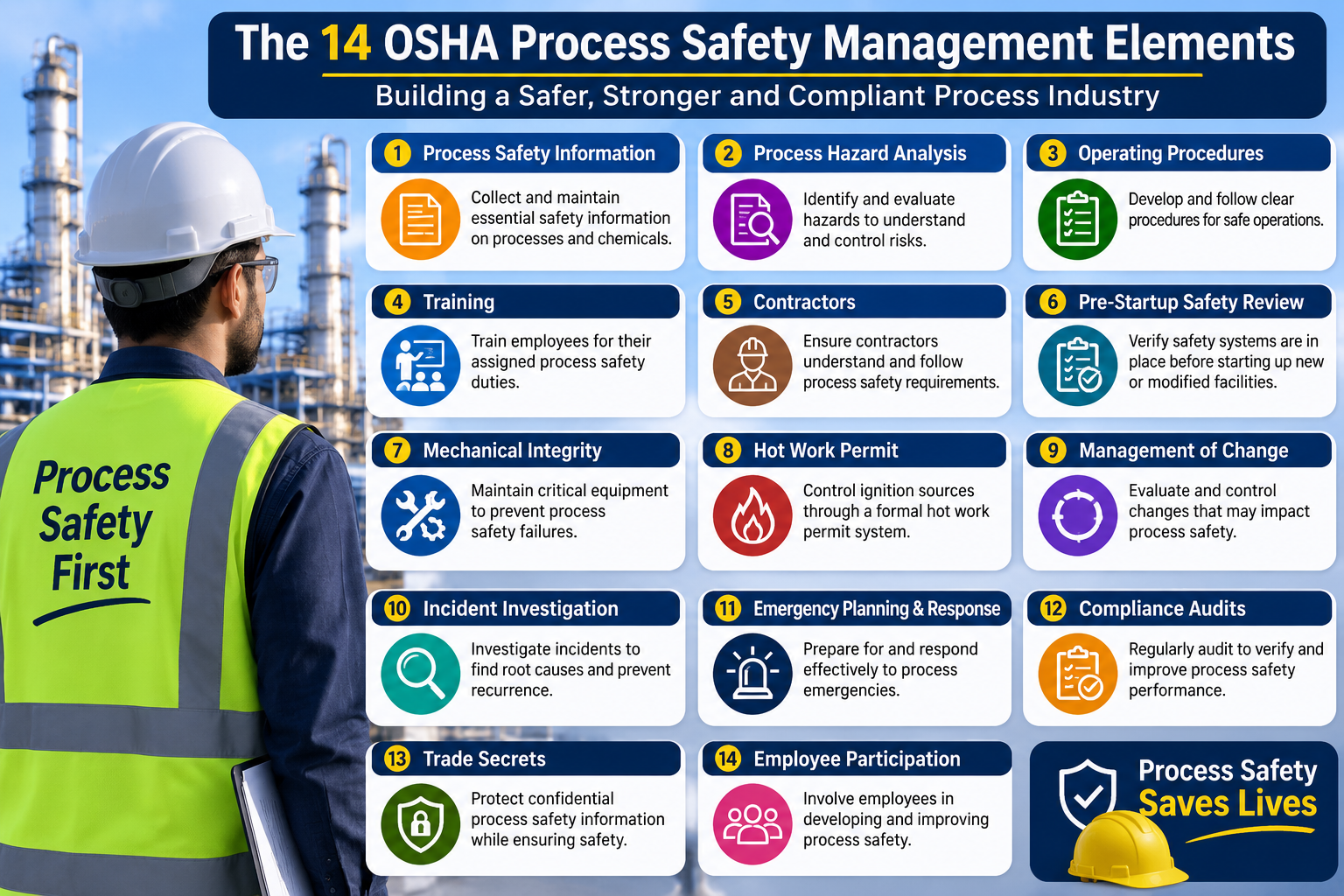
OSHA Process Safety 14 requirements or process-safety elements. They should be managed as a connected system:
- Employee participation: a written plan, consultation with employees and representatives, and access to required PSM information.
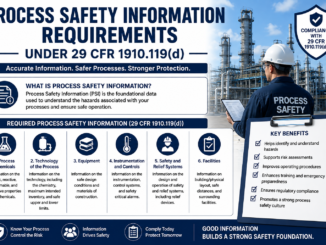
- Process safety information: written information about chemical hazards, process technology, and process equipment.
- Process hazard analysis: a team-based analysis appropriate to the process complexity that identifies, evaluates, and controls hazards.
- Operating procedures: accessible instructions covering operating phases, limits, safety considerations, and safe work practices.
- Training: initial and refresher instruction, with records showing how understanding was verified.
- Contractors: defined host-employer and contract-employer responsibilities for work on or adjacent to a covered process.
- Pre-startup safety review: confirmation that design, procedures, hazard-analysis actions, change controls, and training are ready before introducing highly hazardous chemicals.
- Mechanical integrity: procedures, training, inspection, testing, deficiency management, and quality assurance for covered equipment.
- Hot work permit: documented fire-prevention and protection controls for hot work on or near a covered process.
- Management of change: review and authorization of changes other than replacement in kind.
- Incident investigation: prompt investigation of incidents that resulted in, or could reasonably have resulted in, a catastrophic release.
- Emergency planning and response: a plant emergency action plan and procedures for small releases, with other emergency-response rules applied where relevant.
- Compliance audits: evaluation at least every three years, documented findings, responses, and retained reports.
- Trade secrets: required safety information must be available to people performing specified PSM work, although confidentiality agreements may be used.
The official OSHA PSM overview lists these 14 elements. They are different from a historical list of minimum instructions in Section 304 of the Clean Air Act Amendments. Keeping those lists distinct prevents a common error in PSM summaries.
How PSM differs from ordinary workplace safety
Occupational safety often focuses on OSHA Process Safety hazards affecting an individual task, such as a fall, electrical contact, or improper lifting. Process safety focuses on low-frequency but potentially high-consequence failures involving hazardous chemical processes. The two disciplines overlap, but one does not replace the other. A facility may need task-level controls, process-level controls, environmental requirements, and emergency arrangements at the same time.
OSHA PSM and EPA Risk Management Program coordination
OSHA’s PSM rule and the Environmental Protection Agency’s Risk Management Program are related but distinct. OSHA 29 CFR 1910.119 focuses on employee protection from covered process hazards. EPA’s Risk Management Program under 40 CFR Part 68 addresses accidental-release prevention and consequences affecting the public and environment. A facility may have obligations under both programs, but compliance with one should not be assumed to satisfy the other.
A practical starting sequence
- Determine whether the process is covered and document the basis.
- Define the process boundary and maximum intended inventory.
- Compile complete and accurate process safety information.
- Establish employee participation and assemble a competent PHA team.
- Conduct or revalidate the PHA and track recommendations to resolution.
- Align procedures, training, mechanical integrity, contractor controls, emergency arrangements, and change management with the current process.
- Audit the implemented system and correct documented deficiencies.
Documentation alone is not the objective. The records must describe the actual process, support informed decisions, and be understood and used by the people who operate, maintain, modify, and respond to it.
Official references
- OSHA: 29 CFR 1910.119
- OSHA: Process Safety Management overview
- OSHA: PSM standards and resources
- EPA: Risk Management Program
Related Guides
- Aviation Safety Officer Test Preparation
- Process Hazard Analysis Under 29 CFR 1910.119(e): Methods and Requirements
- Mechanical and Heavy Equipment Safety Officer Test Prep 2026
- Marine Operations Safety Officer Test Preparation
- Steel Erection Safety Officer Test Preparation – Hoisting, Rigging, and Structural Stability

1 Trackback / Pingback