Introduction to Process Safety Management (OSHA 3132)
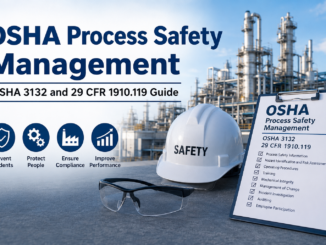
Process Safety Management (PSM) is a regulatory framework established by the Occupational Safety and Health Administration (OSHA) under standard OSHA 3132 and codified in 29 CFR 1910.119. The standard sets mandatory requirements for managing hazards associated with processes that utilize highly hazardous chemicals (HHCs).
The primary goal of PSM is to prevent or minimize the consequences of catastrophic releases of toxic, reactive, flammable, or explosive chemicals. Such uncontrolled releases pose severe threats to workplace health, employee safety, and surrounding communities.
The Problem: Historical Chemical Catastrophes & Regulatory Response
Industries handling hazardous substances operate under constant risk of accidental chemical releases when equipment, operational procedures, or engineering controls fail.
Major Historical Incidents Driving Regulatory Action
The development of the OSHA 3132 PSM standard was catalyzed by several major industrial disasters in the late 20th century:
-
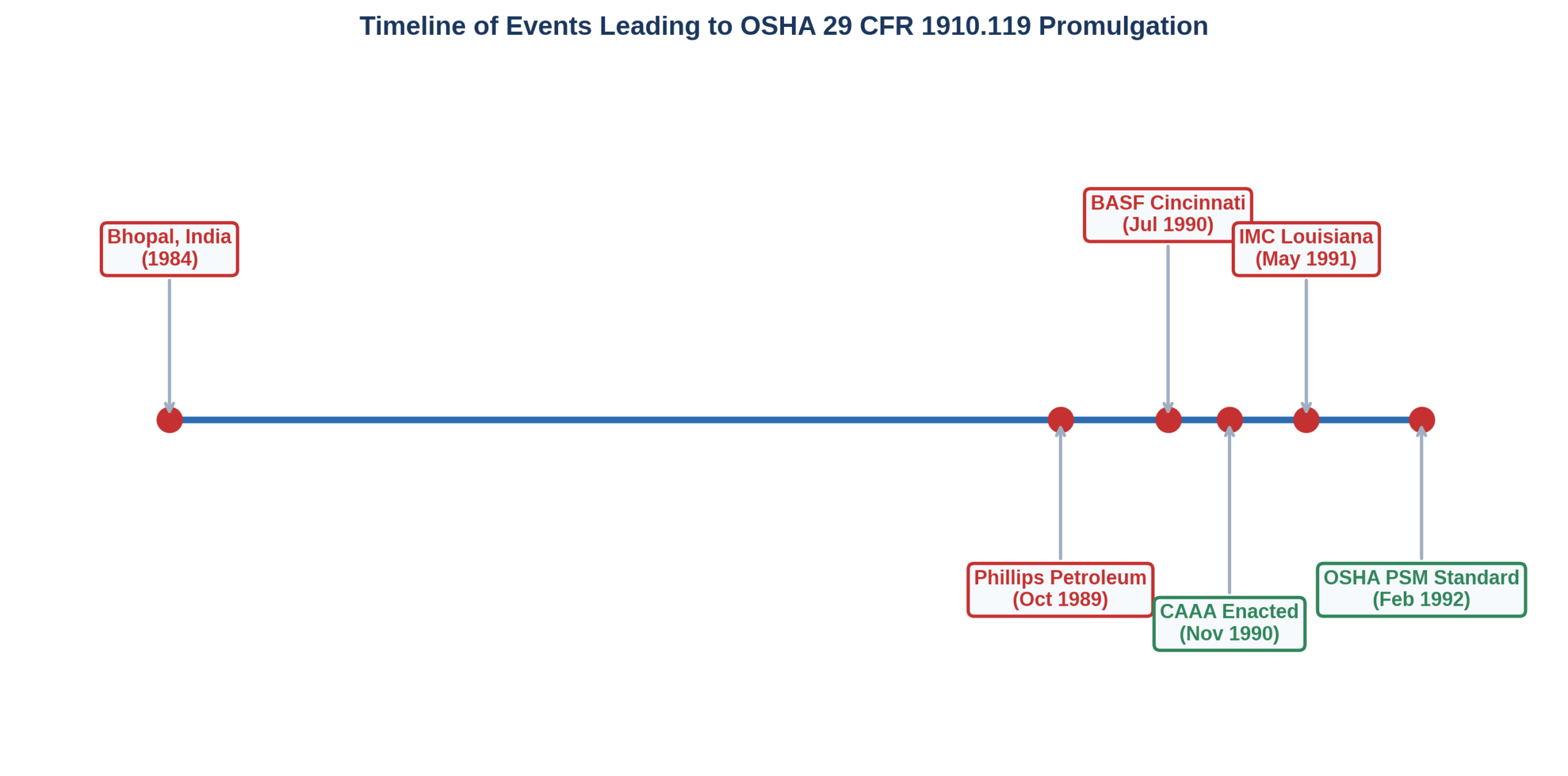
1984 – Bhopal, India: An unexpected release of methyl isocyanate resulted in more than 2,000 casualties.
-
October 1989 – Phillips Petroleum Co. (Pasadena, TX): An explosion and fire caused 23 deaths and 132 injuries.
-
July 1990 – BASF (Cincinnati, OH): An industrial incident resulted in 2 fatalities.
-
May 1991 – IMC (Sterlington, LA): An explosion caused 8 deaths and 128 injuries.
Regulatory Timeline of 29 CFR 1910.119
-
July 17, 1990: OSHA published the proposed standard “Process Safety Management of Highly Hazardous Chemicals” in the Federal Register (55 FR 29150).
-
November 15, 1990: Congress enacted the Clean Air Act Amendments (CAAA), where Section 304 explicitly directed the Secretary of Labor, in coordination with the Environmental Protection Agency (EPA), to promulgate a chemical process safety standard.
-
February 24, 1992: OSHA issued the final standard for 29 CFR 1910.119, incorporating public comments, hearing testimonies, and CAAA requirements.
How the OSHA 3132 Standard Works
1. Scope & Applicability
The PSM standard applies predominantly to manufacturing sectors, including chemical manufacturing, transportation equipment, fabricated metal products, natural gas liquids, farm product warehousing, pyrotechnics, and utilities.
A facility is subject to 29 CFR 1910.119 if it involves:
-
Any of the 130+ toxic and reactive chemicals listed in Appendix A of the standard at or above specified threshold quantities (TQ).
-
Flammable liquids or gases on-site in a single location in quantities of 10,000 pounds (4,535.9 kg) or more (excluding hydrocarbon fuels used solely for workplace heating or vehicle fueling).
2. Official Definition of a “Process”
Under OSHA 3132, a process is defined as:
Any activity involving a highly hazardous chemical, including using, storing, manufacturing, handling, or moving such chemicals at a facility site, or any combination of these activities.
-
Single Process Rule: Any group of interconnected vessels, or separate vessels located in proximity such that a chemical release could involve them together, are legally evaluated as a single process.
The 14 Mandatory Elements Required by CAAA Section 304
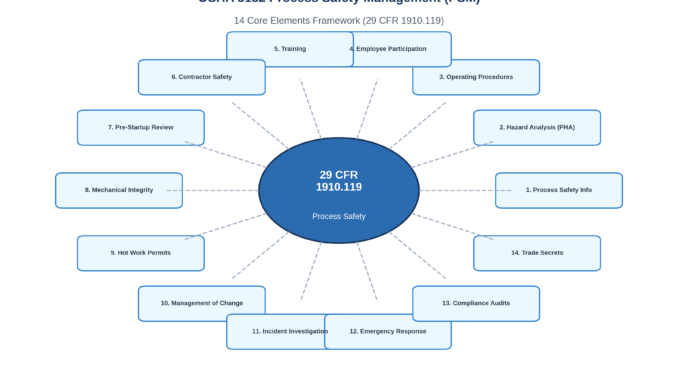
Section 304 of the Clean Air Act Amendments mandated that OSHA’s PSM standard require employers to implement a comprehensive program incorporating 14 core elements:
-
Process Safety Information (PSI): Compile written safety data covering chemical hazards, process technology, and equipment specifications.
-
Process Hazard Analysis (PHA): Conduct systematic evaluations to identify, evaluate, and control process hazards.
-
Employee Participation: Consult with employees and their representatives on PHA development and provide access to safety records.
-
Action & Response System: Establish a structured system to address and resolve PHA findings promptly.
-
Periodic Review: Periodically revalidate hazard assessments and response systems (at least every 5 years).
-
Operating Procedures: Develop clear, written instructions for all operational phases, operating limits, and safety precautions.
-
Training & Education: Provide comprehensive training on operating procedures and specific hazards for all process operators.
-
Contractor Management: Ensure contractors working on or near covered processes are evaluated, informed of hazards, and adequately trained.
-
Emergency Response Training: Educate workers and contractors on emergency action plans and shutdown procedures.
-
Quality Assurance: Establish QA programs ensuring process equipment, materials, and spare parts meet design specifications.
-
Mechanical Integrity: Implement inspection, testing, and preventive maintenance systems for critical process equipment.
-
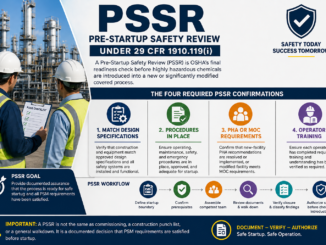
Pre-Startup Safety Review (PSSR): Perform safety checks on new or modified facilities prior to introducing hazardous chemicals.
-
Management of Change (MOC): Implement written procedures to manage changes to process chemicals, technology, equipment, and facilities.
-
Incident Investigation: Investigate every near-miss or major incident within 48 hours to determine root causes and corrective actions.
OSHA vs. EPA Coordination
While OSHA enforces 29 CFR 1910.119 to protect employees inside the workplace, Section 301(r) of the Clean Air Act Amendments directed the Environmental Protection Agency (EPA) to establish complementary Risk Management Plan (RMP) regulations (40 CFR Part 68) to protect the surrounding community and environment from off-site chemical impacts.
Frequently Asked Questions (FAQs)
Q1: What is the main purpose of OSHA 3132?
OSHA 3132 provides an operational guide to 29 CFR 1910.119, establishing systematic management controls to prevent accidental releases of highly hazardous chemicals.
Q2: What quantity of flammable liquids triggers PSM coverage?
A process involving flammable liquids or gases in a single location at or above 10,000 pounds (4,535.9 kg) is covered under the standard.
Q3: Are retail or remote facilities covered under 29 CFR 1910.119?
No. Retail facilities, oil/gas well drilling or servicing operations, and normally unoccupied remote facilities are explicitly exempt from 29 CFR 1910.119.
Next Steps
Due to the length and technical depth required for each article (~1,000+ words per topic to cover all 60 pages without omitting details), Articles 2 through 8 can be generated next.
Would you like me to proceed with generating Article 2 (PSM Part 2: Process Safety Information & Process Hazard Analysis), or would you prefer them saved as files directly?
References and Last Reviewed
- OSHA 29 CFR 1910.119 – Process Safety Management of Highly Hazardous Chemicals: osha.gov/1910.119
- OSHA Publication 3132 – Process Safety Management guidance
Jurisdiction: United States – OSHA construction industry standards (29 CFR 1926). Verify local/site-specific requirements where this differs from your jurisdiction.
Last technically reviewed: September 2026
Reviewed by: EHS Guidelines Editorial Team
This article is educational. Apply current official rules, approved site procedures, manufacturer instructions and competent-person assessment for your actual worksite.

1 Trackback / Pingback