
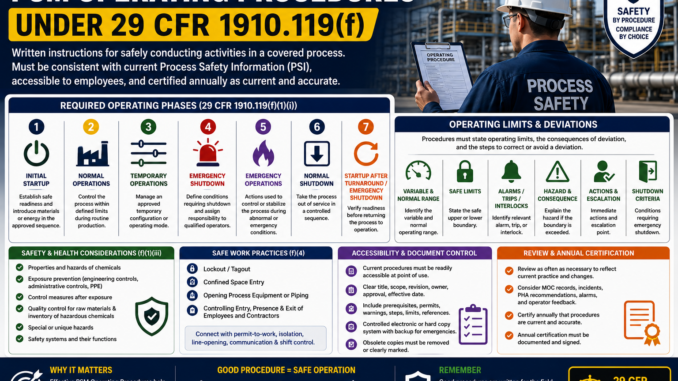
PSM operating procedures are written instructions for safely conducting activities in a covered process. Under 29 CFR 1910.119(f), they must be consistent with current process safety information, cover required operating phases and limits, remain accessible to employees, and be certified annually as current and accurate.
A procedure is useful only when a qualified user can recognize the correct operating state, understand the hazards, take the required action, and know when to stop or escalate. A generic sequence that ignores actual controls, limits, or emergency responsibilities does not meet that practical need.
Required steps for every operating phase
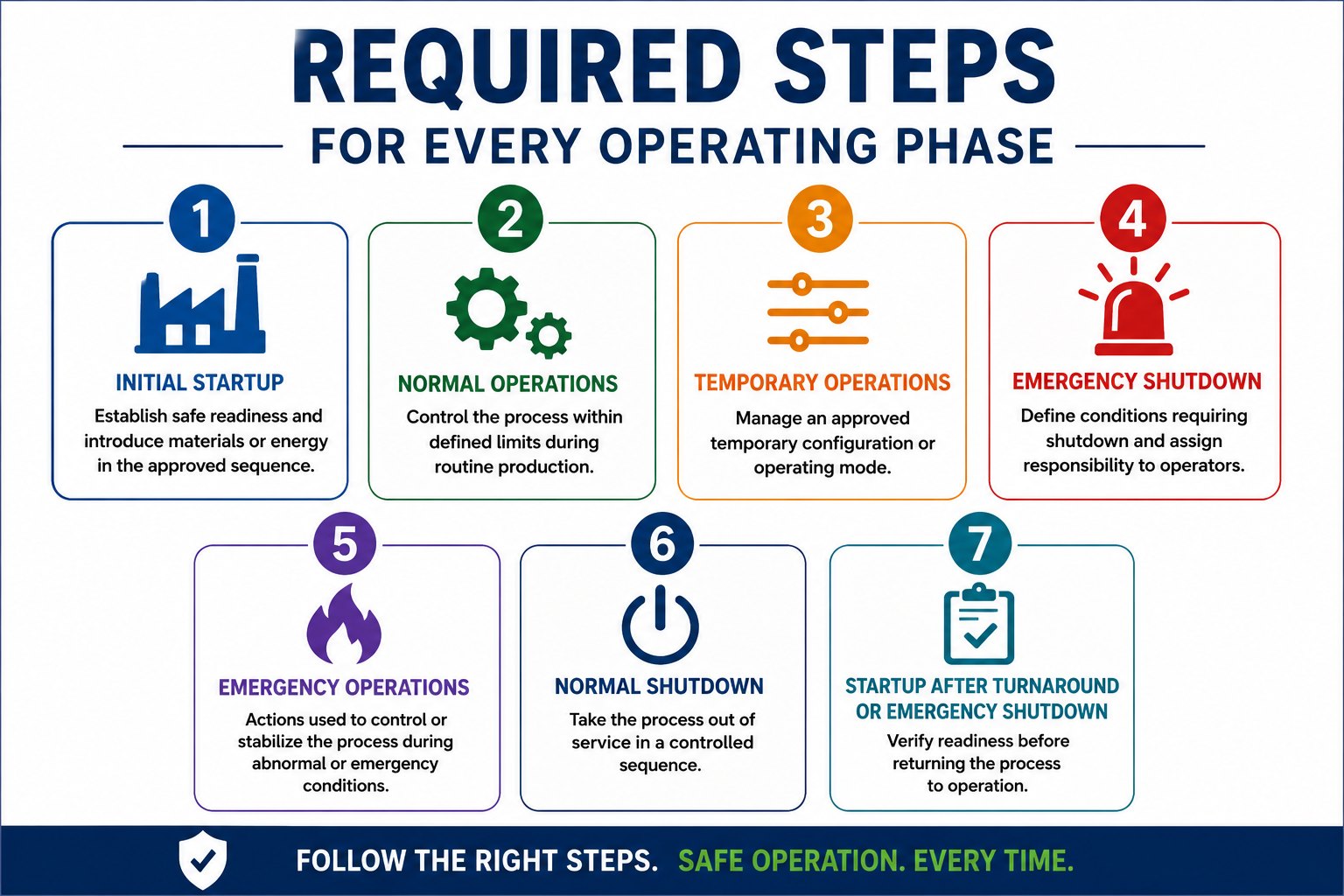
Paragraph 1910.119(f)(1)(i) requires procedures for:
- Initial startup: establishing safe readiness and introducing materials or energy in the approved sequence.
- Normal operations: controlling the process within defined limits during routine production.
- Temporary operations: managing an approved temporary configuration or operating mode.
- Emergency shutdown: defining conditions requiring shutdown and assigning responsibility to qualified operators.
- Emergency operations: actions used to control or stabilize the process during abnormal or emergency conditions.
- Normal shutdown: taking the process out of service in a controlled sequence.
- Startup after a turnaround or emergency shutdown: verifying readiness before returning the process to operation.
Combining phases into one document is acceptable when the distinctions remain clear. The user should not have to infer whether a step applies to a cold startup, routine restart, temporary bypass, or emergency condition.
Operating limits and deviations
The procedure must state operating limits, the consequences of deviation, and the steps required to correct or avoid a deviation. Limits should come from verified process safety information, not customary practice alone.
A usable limit section normally identifies:
- The variable and normal operating range;
- The safe upper or lower boundary;
- Relevant alarm, trip, or interlock;
- The hazard or consequence if the boundary is exceeded;
- Immediate operator actions and escalation point; and
- Conditions requiring emergency shutdown.
Do not instruct operators to defeat protective systems or continue beyond an approved limit. Any temporary bypass or altered limit should be evaluated through the facility’s management-of-change and authorization process.
Safety and health considerations
Paragraph 1910.119(f)(1)(iii) requires procedures to address:
- Properties and hazards of chemicals used in the process;
- Exposure-prevention precautions, including engineering controls, administrative controls, and PPE;
- Control measures following physical contact or airborne exposure;
- Quality control for raw materials and control of hazardous chemical inventory; and
- Special or unique hazards.
The procedure must also describe safety systems and their functions. An operator should understand what an alarm, interlock, shutdown, detection, ventilation, or suppression system is intended to do and what response is required.
Safe work practices required by PSM
Paragraph 1910.119(f)(4) requires safe work practices for controlling hazards during activities such as:
- Lockout/tagout;
- Confined-space entry;
- Opening process equipment or piping; and
- Controlling entry, presence, and exit of maintenance, contractor, laboratory, and other support personnel.
These practices apply to employees and contractor employees. They should connect with permit-to-work, isolation, line-opening, gas-testing, communication, and shift-control systems used at the facility.
Accessibility and document control
PSM Operating Procedures must be readily accessible to employees who work in or maintain the process. Accessibility means the current approved version can be found and used where needed, including during non-routine or emergency conditions. A controlled electronic system can work, but the facility should address power loss, access permissions, network failure, and offline availability.
Each procedure should have a clear title, process and equipment scope, revision number, owner, approval, effective date, prerequisites, required permits, warnings, steps, limits, references, and revision history. Images or screenshots should support the text without replacing critical instructions that must remain searchable and accessible.
Review and annual certification
Procedures PSM Operating Procedures must be reviewed as often as necessary to reflect current practice, including changes to chemicals, technology, equipment, and facilities. The employer must certify annually that the procedures are current and accurate.
Annual certification is stronger when supported by a documented review of recent management-of-change records, field configuration, incident actions, PHA recommendations, temporary procedures, alarm changes, and operator feedback. A signature without checking the process does not establish accuracy.
Writing a usable operating procedure
- Define the task, operating phase, boundaries, and intended user.
- Verify current PSI, diagrams, limits, and safety-system functions.
- Walk down the process with experienced operations and maintenance personnel.
- Write actions in the order they are performed, with decision points and stop conditions.
- State the reason for critical steps where understanding prevents error.
- Validate the draft through a tabletop review or controlled field verification.
- Train affected personnel and verify understanding before the procedure becomes effective.
- Control the revision and remove obsolete copies.
Common procedure weaknesses
- Copying PSM Operating Procedures equipment instructions without process context;
- Omitting temporary or emergency operating modes;
- Using vague instructions such as “adjust as needed” without limits;
- Listing an alarm without the required operator response;
- Failing to update procedures after a process change;
- Leaving outdated printed copies in the field;
- Writing procedures without operator participation; and
- Certifying annually without checking current practice.
Field validation and shift-use test
Before PSM Operating Procedures approving a new or substantially revised procedure, have a knowledgeable employee walk through it at the equipment or in a suitable simulation. The reviewer should confirm that equipment tags, valve numbers, control-system references, expected indications, prerequisites, and sequence steps match the actual installation. The review should also test whether an employee can identify the operating limit, recognize a deviation, and find the required corrective action without relying on undocumented memory.
Validate abnormal and emergency instructions with particular care. A statement such as “take appropriate action” does not tell an operator what condition triggers action, who has authority, or which safe state is intended. Effective instructions specify observable cues, immediate priorities, communication requirements, and shutdown criteria while leaving room for trained judgment where the process demands it.
Procedure-control checklist
- Does the procedure identify its process, equipment, owner, revision, and approval?
- Do steps use the same equipment identifiers shown in current PSI and field labels?
- Are warnings placed before the hazardous action rather than after it?
- Are simultaneous or independent steps clearly distinguished?
- Can the current controlled version be accessed at the point of use?
- Does the annual certification cover completeness and accuracy, not merely the date?
- Are superseded copies removed or clearly marked to prevent unintended use?
Related PSM requirements
- Process Safety Information
- PSM training requirements
- Contractor safety responsibilities
- Pre-startup safety review
- ❓ Questions:
- What are PSM Operating Procedures?
- What does OSHA require for operating procedures?
- What operating phases must PSM procedures cover?
- Why are operating limits important in PSM?
- What should an operator do when a safe limit is exceeded?
- What safety and health information must procedures include?
- What safe work practices are required under PSM?
- How often must PSM operating procedures be reviewed?
- What is the annual certification requirement for PSM procedures?
- Why is procedure accessibility important for employees?
- How should operating procedures be updated after a process change?
- How can a company validate an operating procedure in the field?


6 Trackbacks / Pingbacks