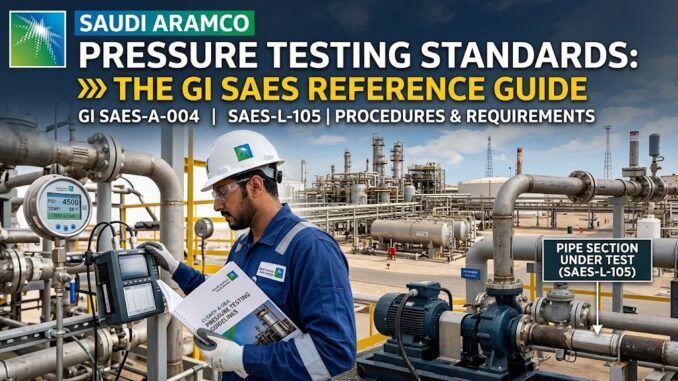
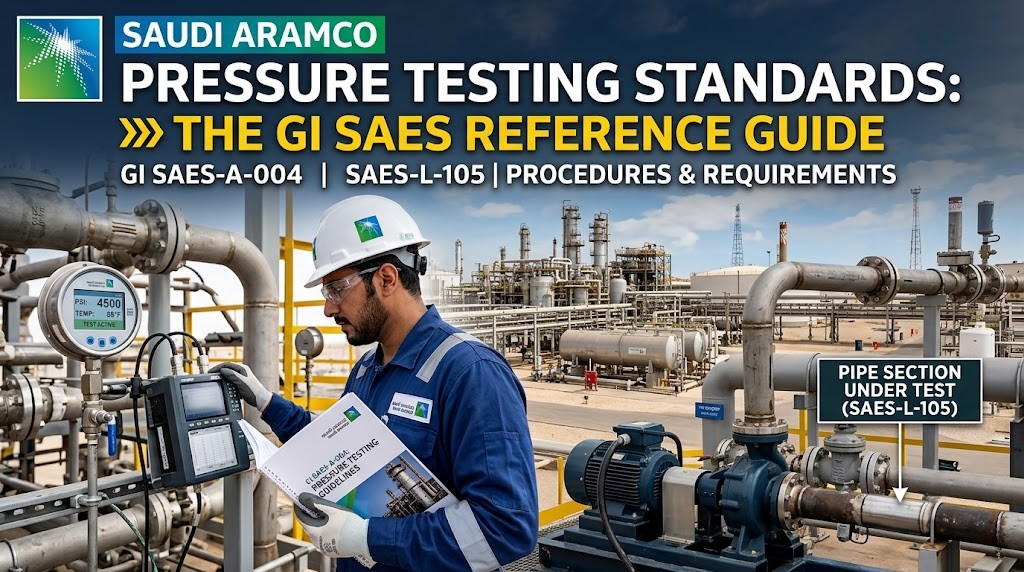
Saudi Aramco pressure testing standards
Saudi Aramco pressure testing standards sit across two document families, and an interviewer expects you to name both without hesitating.
- General Instructions (GIs) set the administrative and safety rules – the permit, the safety checklist, the sign-off, the waste disposal.
- Engineering Standards (SAES) set the technical requirements – test pressure basis, test fluid, hold times, instrument air quality.
The one every candidate must know cold is GI 2.102, Pressure Testing Safely. It’s the safety-specific instruction, and it sits alongside SAES-A-004 (the general engineering rulebook for pressure testing) and SAES-L-150 (the piping- and pipeline-specific version of the same). This chapter maps out every governing document a Saudi Aramco safety officer candidate should be able to name, state the purpose of, and place correctly in the test sequence – from work permit issue through mechanical completion.
This is a companion piece to our procedural walk-through of hydrostatic pressure test controls. That article covers how to run the test safely. This one covers which documents an interviewer expects you to cite and why – reference literacy, not procedure.
Purpose
This chapter covers the minimum safety requirements governing pressure testing of equipment and piping at Saudi Aramco facilities, and it exists so a candidate can answer the interview question “which documents govern a pressure test?” without stumbling.
Pressure testing at Saudi Aramco is not run off a single document. It’s governed by a stack of General Instructions and Saudi Aramco Engineering Standards that each cover a different slice of the job – the permit, the technical basis for the test, the fluids used, the instrument air behind the gauges, and the waste generated once the test is done.
A safety officer candidate who can only describe how to barricade a test area is halfway there. The other half – knowing which document requires the barricade, which document sets the test pressure, and which document closes the loop with mechanical completion – is what separates a pass from a maybe in an Aramco interview panel.
That’s what this chapter is for: naming every governing reference, explaining what each one actually controls, and showing how they connect end to end.
References
This section covers the two document families a candidate needs to name – Saudi Aramco General Instructions and Saudi Aramco Engineering Standards – and what each one is actually for.
Saudi Aramco organizes its internal requirements into two tiers. General Instructions (GIs) are company-wide administrative and safety-management documents – they tell you who does what, when, and under what authorization. Saudi Aramco Engineering Standards (SAES) are technical documents – they tell you what the equipment and test parameters must be. A pressure test touches both tiers simultaneously, which is exactly why interviewers ask candidates to name documents from each side.
Saudi Aramco General Instructions (GIs)
GI 2.100 – Work Permit System
This is the administrative backbone of any hazardous work at Aramco, pressure testing included. GI 2.100 sets the requirement for issuing and receiving a work permit before hazardous activity starts in a restricted area – identifying hazards, agreeing on precautions, and recording who authorized the work. No pressure test proceeds without a permit issued under this instruction. Interviewers expect this one named first because every other control in a pressure test sits inside a permit boundary set by GI 2.100.
GI 2.102 – Pressure Testing Safely
This is the document most directly tied to the keyword every candidate searches before an interview: GI 2.102 pressure testing safely. It’s the safety-specific instruction covering hydrostatic, pneumatic, and combined pressure tests – barricading, exclusion zones, gauge calibration, gradual pressurization, and safe depressurization. If SAES-A-004 and SAES-L-150 are the engineering rulebooks, GI 2.102 is the safety-officer rulebook. It’s the one document you should be able to summarize in two sentences without notes.
GI 2.710 – Mechanical Completion and Performance Acceptance of Facilities
This instruction governs what happens after a successful pressure test. It sets the requirements for certifying a facility as mechanically complete – installed, pre-commissioned, and safe to move into commissioning and start-up – before performance acceptance testing demonstrates the facility runs at design conditions. A pressure test is one of the pre-commissioning checks that has to close out clean before a Mechanical Completion Certificate can be issued.
GI 430.001 – Waste Management
Pressure testing generates waste – most commonly the test fluid itself, along with any inhibited water, chemicals, or contaminated water used for hydrostatic testing or lay-up. GI 430.001 sets the requirements for characterizing, handling, and disposing of that waste stream. It’s easy to overlook in interview prep because it feels tangential to “safety,” but disposal of test fluid is exactly the kind of detail-oriented question an assessor uses to separate candidates who’ve only read the procedure from candidates who understand the whole lifecycle of a test.
Saudi Aramco Engineering Standards (SAES)
SAES-A-004 – General Requirements for Pressure Testing
This is the master engineering standard. SAES-A-004 pressure testing requirements cover the mandatory basis for in-situ pressure testing of new and existing piping, pipelines, and pressure-containing equipment – supplementing codes like ASME B31.1, B31.3, B31.4, and B31.8 with Aramco-specific rules. It defines what’s excluded (shop-fabricated equipment tested per its own SAMSS, for example) and what pre-start-up leak testing must look like during commissioning and turnarounds. If SAES-L-150 is the piping-and-pipeline-specific standard, SAES-A-004 is the general standard everything else sits under.
SAES-A-005 – Safety Instruction Sheet
This standard governs the safety documentation that must accompany specific engineering activities, including pressure testing, so that field personnel have a clear, approved, task-specific safety reference before work begins. It’s the link between the general safety instruction (GI 2.102) and the job-specific paperwork a crew actually carries to the test site.
SAES-A-007 – Hydrostatic Testing Fluids and Lay-Up Procedures
Once a system passes its hydrostatic test, it doesn’t stay filled with plain water indefinitely – internal corrosion becomes the next risk. SAES-A-007 sets requirements for the test fluid itself and the lay-up procedures used afterward to prevent oxygen-ingress corrosion and microbially induced corrosion in the period between testing and commissioning. It applies whenever an asset is tested under SAES-A-004 or SAES-L-150. Candidates who only talk about the test itself and never mention what happens to the fluid afterward are missing this standard.
SAES-J-901 – Instrument Air Supply Systems
Pressure testing relies on calibrated gauges and, in many setups, instrument-air-driven equipment. SAES-J-901 sets the requirements for instrument air supply systems – quality, dryness, and reliability – that support instrumentation used during a test. It’s a supporting-cast standard, but naming it shows an interviewer you understand that a pressure test depends on more than the pump and the pipe; the instrumentation feeding it has its own engineering standard behind it.
SAES-L-150 – Pressure Testing of Plant Piping and Pipelines
This is the second document candidates get asked to define, right after GI 2.102: SAES-L-150 pipeline pressure testing. It covers the mandatory pressure testing requirements specifically for plant piping and pipelines – new construction before initial operation, and revalidation or post-repair testing on existing lines. Where SAES-A-004 sets the general rules, SAES-L-150 narrows the focus to piping and pipeline systems and adds requirements like extended tightness testing for buried or insulated runs.
How These References Interact in Practice
This section covers the sequence a candidate should be able to walk through end to end: permit, test, disposal, completion.
An interviewer rarely wants a list. They want to see that you understand how these documents connect on a live job. Here’s the sequence:
- The permit comes first. No pressure test starts without a work permit issued under GI 2.100. The permit records the hazards, the precautions, and who’s authorized.
- The safety instruction governs execution. Once the permit is live, GI 2.102 sets the safety controls for the test itself – barricades, exclusion zones, gauge checks, pressurization steps.
- The engineering standard sets the technical basis. SAES-A-004 (general) or SAES-L-150 (piping/pipeline-specific) defines the test pressure, test medium, and acceptance criteria the crew is testing against. SAES-A-005 supplies the task-specific safety instruction sheet that translates that basis into field paperwork.
- The test fluid gets handled correctly, during and after. SAES-A-007 governs the fluid used and the lay-up steps that protect the system from corrosion once the test is complete but before commissioning.
- The waste gets disposed of correctly. Test fluid, inhibited water, or contaminated water doesn’t get dumped on-site. GI 430.001 governs its characterization and disposal.
- A clean test closes toward mechanical completion. A successful pressure test is one of the pre-commissioning items that has to be satisfied before a facility can be certified under GI 2.710, clearing the way for commissioning, start-up, and eventually performance acceptance.
That sequence – permit, safety instruction, engineering basis, fluid/lay-up, waste, completion – is the answer an interviewer is fishing for when they ask “walk me through the documents involved in a pressure test.” It also shows why this topic overlaps with, but doesn’t duplicate, work permit and confined space material candidates review elsewhere in their prep.
Comparison Table
| Document | Type | One-line purpose |
|---|---|---|
| GI 2.100 | General Instruction | Sets the work permit requirements authorizing hazardous activity, including pressure testing |
| GI 2.102 | General Instruction | Sets the safety controls for conducting pressure tests – barricades, exclusion zones, pressurization steps |
| GI 2.710 | General Instruction | Sets requirements for certifying mechanical completion and performance acceptance after successful testing |
| GI 430.001 | General Instruction | Sets requirements for characterizing and disposing of waste, including used test fluid |
| SAES-A-004 | Engineering Standard | Sets the general technical requirements for pressure testing piping, pipelines, and equipment |
| SAES-A-005 | Engineering Standard | Sets the format and requirements for task-specific safety instruction sheets |
| SAES-A-007 | Engineering Standard | Sets requirements for hydrostatic test fluids and post-test lay-up/corrosion-prevention procedures |
| SAES-J-901 | Engineering Standard | Sets requirements for instrument air supply systems supporting test instrumentation |
| SAES-L-150 | Engineering Standard | Sets pressure testing requirements specific to plant piping and pipelines |
Interview-Prep FAQ
What does SAES-L-150 cover? It covers the mandatory pressure testing requirements for plant piping and pipelines specifically – both new construction before initial operation and revalidation or post-repair testing on existing systems. It supplements general codes like ASME B31 series with Aramco-specific rules for piping and pipelines.
What’s the difference between GI 2.102 and SAES-A-004? GI 2.102 is the safety-management document – it governs how the test is conducted safely (barricades, exclusion zones, gauge checks, personnel positioning). SAES-A-004 is the engineering standard – it governs what the test itself must technically satisfy (test pressure basis, test medium, acceptance criteria). One is procedural safety; the other is technical requirement. Interviewers ask this exact question to check candidates aren’t conflating the two documents.
Why would a safety officer interview ask about GI 2.100 if the topic is pressure testing? Because no pressure test happens without a permit first. GI 2.100 governs the work permit system, and every pressure test is executed under a permit issued through it. This is a common thread across most safety officer interview questions – assessors want to see candidates understand the permit-to-work system as the entry point for any hazardous activity, not just pressure testing.
Do I need to memorize clause numbers from these documents? No – and don’t try. What matters in an interview is knowing which document governs which aspect of the job, and being able to explain its purpose in plain terms. Quoting a specific clause number without being asked usually signals memorization rather than understanding, and the safer, stronger answer is to describe scope and intent.
How does SAES-A-007 connect to a pressure test that’s already passed? Once a hydrostatic test is complete, the system typically stays filled or gets laid up before commissioning. SAES-A-007 governs the test fluid selection and the lay-up procedures used in that gap to prevent internal corrosion – oxygen ingress and microbially induced corrosion being the two main risks it addresses.
What role does GI 430.001 play in a pressure test? It governs the disposal of the waste a test generates – mainly the test fluid, and any treated or contaminated water. It’s easy to skip in prep, but naming it shows you understand the full lifecycle of a test, not just the pressurization phase.
Useful Sources
- ASME B31.3 – Process Piping (official code page)
- API 570 – Piping Inspection Code
- OSHA General Duty Clause – Section 5(a)(1), OSH Act
- IHS Markit / S&P Global – Saudi Aramco Engineering Standards Collection
- 49 CFR Part 195 – Transportation of Hazardous Liquids by Pipeline (eCFR)

Be the first to comment