TL;DR
- A health and safety risk assessment template must document the task, hazard, who is at risk, likelihood, severity, risk rating, existing controls, and additional controls required – as mandated by 29 CFR 1910.132(d) and 29 CFR 1926.20(b).
- The free template below is fully pre-filled with five construction example rows and is ready to use on site today.
- Risk ratings are calculated by multiplying Likelihood (1–5) × Severity (1–5); scores of 15–25 are Critical and require immediate action before work proceeds.
- OSHA does not prescribe a single universal risk assessment form for construction, but 29 CFR 1926.20(b)(1) requires the employer to initiate and maintain programs – including written hazard documentation – necessary to comply with Part 1926.
- Common template errors that trigger OSHA citations include missing competent-person signatures, undated assessments, and failure to document residual risk after controls are applied.
Health and Safety Risk Assessment Template: Free Construction Guide
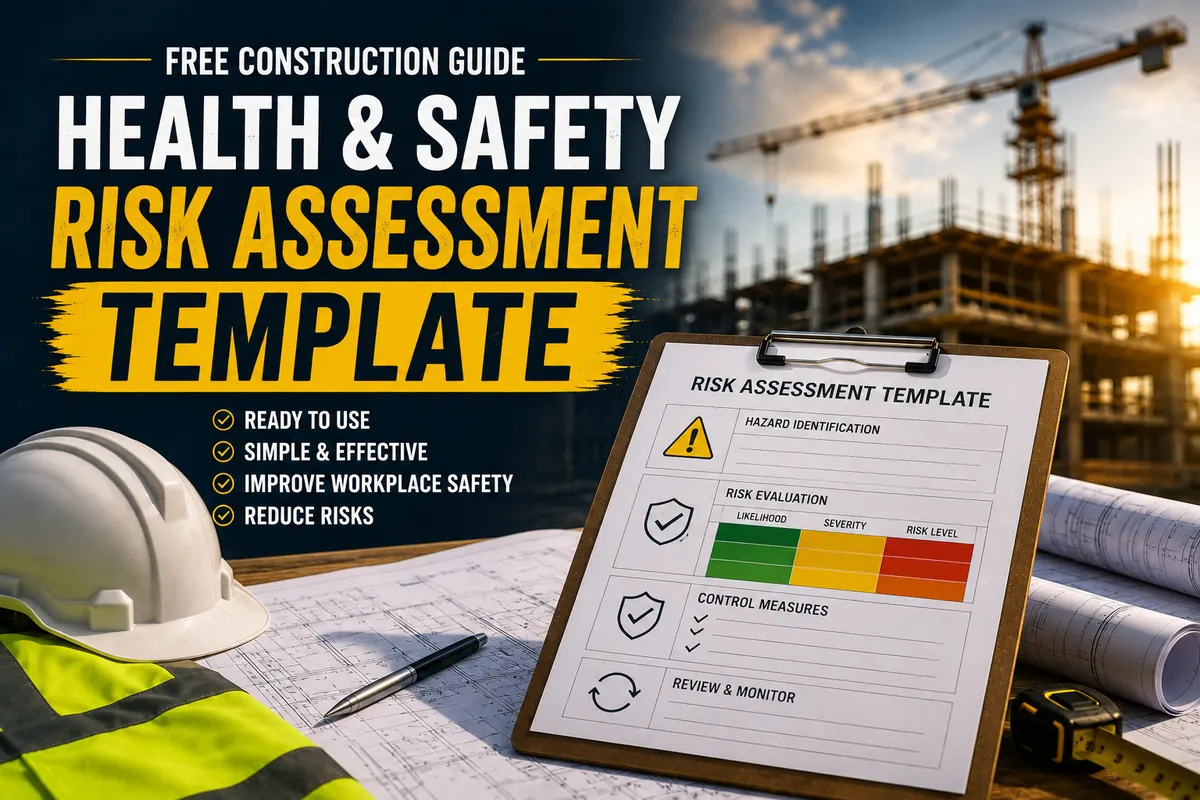
A health and safety risk assessment template is a structured written record that identifies workplace hazards, evaluates the probability and severity of harm, and documents the controls an employer must implement to protect workers. Under 29 CFR 1910.132(d)(1), the employer shall assess the workplace to determine if hazards are present, or are likely to be present, which necessitate the use of personal protective equipment (PPE). Under 29 CFR 1926.20(b)(1), the employer must initiate and maintain such programs as may be necessary to comply with OSHA’s construction standards – programs that inherently require written hazard identification and risk control documentation.
The template is not optional. It is the written evidence that a systematic hazard assessment occurred. OSHA’s Hazard Identification and Assessment guidance states that a critical element of any effective safety and health program is a proactive, ongoing process to identify and assess hazards. The template is the instrument through which that process is recorded, verified, and acted upon.
This guide provides a free, fully completed construction site risk assessment template, a step-by-step usage guide, a 5×5 risk rating matrix, activity-specific variations, and a full breakdown of OSHA documentation requirements.
What Must a Health and Safety Risk Assessment Template Include?
A compliant health and safety risk assessment template must, at minimum, identify the task or activity assessed, the hazard present, the persons at risk, the likelihood and severity of harm, the resulting risk rating, existing controls, additional controls required, the person responsible for action, and the date of completion. This requirement flows directly from 29 CFR 1910.132(d)(2), which mandates a written certification identifying the workplace evaluated, the person certifying the evaluation, the date(s) of the hazard assessment, and the document as a certification of hazard assessment.
OSHA’s Recommended Practices for Safety and Health Programs in Construction further specifies that employers must evaluate each hazard by considering the severity of potential outcomes, the likelihood that an event or exposure will occur, and the number of workers who might be exposed. Each of these factors must appear in the template.
The Eleven Required Fields
Every safety risk assessment form used on a construction site must contain the following fields:
- Reference Number – A unique identifier for tracking, revision control, and audit purposes.
- Task or Activity – A precise description of the work being assessed (e.g., “excavation of foundation trench to 2.5 m depth”).
- Hazard – The specific source of potential harm (e.g., trench collapse, struck-by, electrical contact).
- Who Is at Risk – The workers, trades, or third parties exposed to the hazard.
- Likelihood (1–5) – The probability that the hazard will result in harm, scored on a 1-to-5 scale.
- Severity (1–5) – The worst credible consequence if harm occurs, scored on a 1-to-5 scale.
- Risk Rating – Likelihood × Severity. This is the quantified risk score that drives prioritization.
- Current Controls – The controls already in place at the time of assessment.
- Additional Controls Required – The further measures the employer must implement to reduce residual risk to an acceptable level.
- Action By – The named individual responsible for implementing additional controls.
- Date – The date by which additional controls must be in place, and the date the assessment was completed.
The employer must verify the assessment in writing. 29 CFR 1910.132(d)(2) is explicit: the written certification is the legal record that the assessment occurred. An undated or unsigned form does not satisfy this requirement.
Free Health and Safety Risk Assessment Template
The table below is a complete, ready-to-use construction site risk assessment template. All five rows are pre-filled with real construction scenarios. The employer must adapt task descriptions, personnel names, and dates to site-specific conditions before use.
Construction Site Risk Assessment Form
| Field | Details |
|---|---|
| Project Name | [Insert Project Name] |
| Site Address | [Insert Site Address] |
| Assessment Completed By | [Name, Title, Qualification] |
| Competent Person Review | [Name, Signature] |
| Date of Assessment | [DD/MM/YYYY] |
| Review Date | [DD/MM/YYYY – or after any significant change] |
| Ref No. | Task / Activity | Hazard | Who Is at Risk | Likelihood (1–5) | Severity (1–5) | Risk Rating (L×S) | Current Controls | Additional Controls Required | Action By | Date |
|---|---|---|---|---|---|---|---|---|---|---|
| RA-001 | Excavation of foundation trench to 2.5 m depth | Trench collapse / soil instability | Excavation operatives, site supervisor | 3 | 5 | 15 – Critical | Competent person inspection before each shift per 29 CFR 1926.651(k)(1); spoil pile kept ≥2 ft from trench edge | Install timber shoring or trench box prior to worker entry; atmospheric test required before entry per 29 CFR 1926.651(g)(1)(i); ladder access every 25 ft | Site Supervisor | [Date] |
| RA-002 | Working at height – installation of roof trusses at 6 m elevation | Fall from height | Carpenters, steel erectors | 3 | 5 | 15 – Critical | Hard hats and safety boots worn; tool lanyards in use | Install guardrail system compliant with 29 CFR 1926.502(b) or deploy personal fall arrest system (PFAS) with full-body harness; conduct pre-task toolbox talk; inspect all anchor points before use | Safety Officer | [Date] |
| RA-003 | Manual handling – lifting and positioning concrete blocks (avg. 20 kg each) | Musculoskeletal injury (back strain, crush injury to hands/feet) | Bricklayers, general laborers | 4 | 3 | 12 – High | Workers trained in manual handling technique; steel-toe boots worn | Provide mechanical lifting aids (block clamps, pallet trucks) for loads exceeding 25 kg; enforce two-person lift protocol for awkward loads; PPE: cut-resistant gloves, safety boots per 29 CFR 1910.132(d)(1) | Foreman | [Date] |
| RA-004 | Temporary electrical installation – running 110V power tools from site distribution board | Electrical shock, electrocution, arc flash | Electricians, all trades using power tools | 2 | 5 | 10 – High | GFCI protection on all circuits per 29 CFR 1926 Subpart K; daily visual inspection of cords and plugs | Implement assured equipment grounding conductor program; remove damaged cords from service immediately; restrict access to distribution board to qualified persons only; conduct pre-use inspection of all power tools | Site Electrician | [Date] |
| RA-005 | Concrete cutting using angle grinder – slab removal | Abrasion/laceration from disc failure; silica dust inhalation; noise-induced hearing loss | Concrete cutters, adjacent workers | 3 | 4 | 12 – High | Safety glasses and gloves worn; disc inspected before use | Provide and enforce use of face shield (full-face); supply P100 respirator for silica dust control per OSHA Silica Standard (29 CFR 1926.1153); enforce hearing protection (minimum 27 dB NRR earmuffs) within 6 m of cutting; wet-cutting method preferred to suppress silica dust | Safety Officer | [Date] |
Risk Rating Key: 1–4 = Low | 5–9 = Medium | 10–14 = High | 15–25 = Critical
How to Use This Template Step by Step
The risk assessment checklist is only effective when completed systematically, before work begins, and reviewed by a competent person. The following procedure applies to every construction activity assessed using this template.
Step 1: Assemble the assessment team. The employer must designate a competent person to lead the assessment. Under 29 CFR 1926.20(b)(2), frequent and regular inspections of job sites, materials, and equipment must be made by competent persons designated by the employer. Include the crew foreman and, where possible, the workers who will perform the task.
Step 2: Define the task or activity precisely. Enter a specific description of the work in the “Task/Activity” column. Vague entries such as “groundworks” are insufficient. The entry must describe the exact operation, the location, and the equipment involved (e.g., “excavation of service trench using 3-tonne excavator, depth 1.8 m, adjacent to live gas main”).
Step 3: Identify all hazards associated with the task. Review OSHA’s Hazard Identification guidance, which directs employers to collect existing information, inspect the workplace, identify health hazards, investigate past incidents, and consider nonroutine situations. For each task, list every credible hazard – physical, chemical, biological, and ergonomic.
Step 4: Identify who is at risk. Record every worker group, trade, or third party that could be exposed to the hazard. Do not limit this to the primary crew. Adjacent workers, delivery drivers, members of the public, and supervisors may all be at risk.
Step 5: Score Likelihood (1–5). Use the following scale:
- 1 – Rare: The hazard is unlikely to result in harm under normal conditions.
- 2 – Unlikely: Harm could occur but is not expected.
- 3 – Possible: Harm may occur occasionally.
- 4 – Likely: Harm will probably occur at some point.
- 5 – Almost Certain: Harm is expected to occur without intervention.
Step 6: Score Severity (1–5). Use the following scale:
- 1 – Negligible: First aid only; no lost time.
- 2 – Minor: Medical treatment required; short-term lost time.
- 3 – Moderate: Significant injury; extended lost time (days to weeks).
- 4 – Major: Serious injury; long-term disability or hospitalization.
- 5 – Catastrophic: Fatality or permanent total disability.
Step 7: Calculate the Risk Rating. Multiply Likelihood × Severity. Enter the result in the “Risk Rating” column. Apply the risk rating key: Low (1–4), Medium (5–9), High (10–14), Critical (15–25). Critical ratings require immediate corrective action before work proceeds.
Step 8: Document current controls. Record every control already in place. Be specific. “PPE worn” is insufficient. The entry must name the PPE type, the standard it meets, and how compliance is verified (e.g., “ANSI Z89.1-compliant hard hat; inspected daily by foreman”).
Step 9: Identify and assign additional controls. For every High or Critical rating, additional controls are mandatory. Apply the hierarchy of controls in order: elimination, substitution, engineering controls, administrative controls, PPE. Assign each additional control to a named individual with a completion date.
Step 10: Obtain competent person sign-off. The assessment must be signed and dated by the competent person. Under 29 CFR 1910.132(d)(2), the written certification must identify the person certifying that the evaluation has been performed and the date(s) of the hazard assessment.
Step 11: Communicate the assessment to the crew. The employer must communicate selection decisions and control requirements to each affected employee. A pre-task toolbox talk, documented with worker signatures, satisfies this obligation.
Step 12: Review and update. The free risk assessment template is a living document. The employer must review and update it whenever site conditions change, a new task is introduced, an incident occurs, or the scheduled review date is reached.
Risk Rating Matrix Explained
The 5×5 risk rating matrix is the quantitative tool that converts qualitative hazard judgments into prioritized action scores. The matrix multiplies Likelihood (rows) by Severity (columns) to produce a Risk Rating between 1 and 25.
5×5 Risk Rating Matrix – Construction Site
| Likelihood ↓ / Severity → | 1 – Negligible | 2 – Minor | 3 – Moderate | 4 – Major | 5 – Catastrophic |
|---|---|---|---|---|---|
| 5 – Almost Certain | 5 – Medium | 10 – High | 15 – Critical | 20 – Critical | 25 – Critical |
| 4 – Likely | 4 – Low | 8 – Medium | 12 – High | 16 – Critical | 20 – Critical |
| 3 – Possible | 3 – Low | 6 – Medium | 9 – Medium | 12 – High | 15 – Critical |
| 2 – Unlikely | 2 – Low | 4 – Low | 6 – Medium | 8 – Medium | 10 – High |
| 1 – Rare | 1 – Low | 2 – Low | 3 – Low | 4 – Low | 5 – Medium |
Risk Band Definitions and Required Actions
Low (1–4): The risk is acceptable under current controls. Monitor and review at scheduled intervals. No immediate action required, but controls must be maintained.
Medium (5–9): The risk requires attention. The employer must implement additional controls within a defined timeframe. Work may proceed with existing controls while improvements are planned.
High (10–14): The risk is significant. Additional controls must be implemented before or during the task. A named responsible person must be assigned with a specific completion date. Senior management must be notified.
Critical (15–25): The risk is unacceptable. Work must not proceed until additional controls reduce the rating to High or below. The competent person must authorize resumption of work in writing. OSHA’s Hazard Identification guidance states that employers have an ongoing obligation to control all serious recognized hazards and to protect workers.
Applying the Hierarchy of Controls
The matrix score determines urgency. The hierarchy of controls determines method. The employer must apply controls in the following order of preference:
- Elimination – Remove the hazard entirely (e.g., redesign the task to avoid working at height).
- Substitution – Replace the hazard with a less dangerous alternative (e.g., use pre-cast concrete panels instead of in-situ pours at height).
- Engineering Controls – Isolate workers from the hazard (e.g., install guardrails, trench boxes, machine guarding).
- Administrative Controls – Change the way work is done (e.g., job rotation to limit silica exposure duration, permit-to-work systems).
- Personal Protective Equipment – Protect the worker from the residual hazard (e.g., hard hats, respirators, fall arrest harnesses). PPE is always the last resort, not the first.
Template Variations by Construction Activity
The core OSHA risk assessment template applies to all construction tasks. The following activity-specific variations identify the key hazards, applicable CFR standards, and critical control requirements for the four highest-risk construction operations.
Excavation and Trenching Risk Assessment Template
Excavation and trenching is the most lethal construction activity per OSHA fatality data. A trench collapse can bury a worker in seconds. The competent person must complete a dedicated excavation risk assessment before any worker enters a trench or excavation.
Key hazards to assess:
- Trench collapse and soil instability
- Struck-by from excavation equipment
- Underground utility contact (gas, electric, water)
- Hazardous atmosphere (oxygen deficiency, toxic gases)
- Water accumulation and flooding
- Fall into excavation
Applicable CFR standards:
- 29 CFR 1926.651 – Specific excavation requirements
- 29 CFR 1926.652 – Requirements for protective systems
- 29 CFR 1926.651(k)(1) – Competent person inspection before each shift and after events that could increase hazard
Critical template entries for excavation:
- Soil classification must be recorded (Type A, B, or C) per 29 CFR 1926 Subpart P Appendix B.
- Protective system type must be specified: sloping, shoring, or trench box.
- Spoil pile distance from trench edge must be documented (minimum 2 feet).
- Atmospheric testing results must be recorded for excavations exceeding 4 feet in depth.
- Ladder access location must be noted (required every 25 lateral feet in trenches 4 feet or deeper).
The construction site risk assessment template for excavation must be reviewed by the competent person at the start of every shift and after any rainfall, vibration event, or change in site conditions.
Working at Height Risk Assessment Template
Falls are the leading cause of construction fatalities in the United States. OSHA’s fall protection standard at 29 CFR 1926.502 requires fall protection for any worker exposed to a fall of 6 feet or more to a lower level. The working at height risk assessment template must address every elevated work surface on site.
Key hazards to assess:
- Fall from scaffold, roof, ladder, or leading edge
- Falling objects striking workers below
- Scaffold collapse
- Ladder instability
- Fragile roof surface failure
Applicable CFR standards:
- 29 CFR 1926.502 – Fall protection systems criteria and practices
- 29 CFR 1926.451 – Scaffold requirements
- 29 CFR 1926.1053 – Ladder requirements
Critical template entries for working at height:
- The specific fall protection system selected must be named: guardrail system, safety net system, or personal fall arrest system (PFAS).
- Anchor point load capacity must be documented (minimum 5,000 lbs per worker per 29 CFR 1926.502(d)(15)).
- Inspection status of harness, lanyard, and connectors must be recorded.
- A falling object protection plan must be documented for all overhead work.
- The competent person must sign off on scaffold inspections before each work shift.
Manual Handling Risk Assessment Template
Manual handling injuries account for a significant proportion of construction lost-time injuries. OSHA addresses materials handling in 29 CFR 1926 Subpart H. The manual handling risk assessment template must evaluate every task involving lifting, lowering, pushing, pulling, or carrying.
Key hazards to assess:
- Musculoskeletal disorders (MSDs) from repetitive or heavy lifting
- Crush injuries from dropped or unstable loads
- Slip, trip, and fall during load carrying
- Struck-by from swinging or shifting materials
Applicable CFR standards:
- 29 CFR 1926 Subpart H – Materials Handling, Storage, Use, and Disposal
- 29 CFR 1926.250 – General requirements for storage
- 29 CFR 1910.132(d) – PPE hazard assessment (applicable to hand and foot protection)
Critical template entries for manual handling:
- Maximum individual lift weight must be specified. OSHA does not prescribe a single weight limit, but NIOSH’s Recommended Weight Limit (RWL) equation provides the engineering basis for control decisions.
- Mechanical lifting aids available on site must be listed (pallet trucks, block clamps, hoists).
- Two-person lift protocols must be documented for loads exceeding site-specific thresholds.
- PPE requirements must be specified: cut-resistant gloves, safety boots with steel toe caps.
- Housekeeping requirements for the work area must be stated to eliminate slip and trip hazards during load movement.
Electrical Work Risk Assessment Template
Electrical hazards on construction sites cause electrocution, arc flash burns, and fire. OSHA’s construction electrical standard at 29 CFR 1926 Subpart K governs all electrical work on construction sites. The electrical work risk assessment template must be completed before any work on or near energized systems.
Key hazards to assess:
- Electrocution from contact with energized conductors
- Arc flash and arc blast
- Overhead power line contact from plant or equipment
- Damaged or defective power tools and extension cords
- Temporary power distribution failures
Applicable CFR standards:
- 29 CFR 1926 Subpart K – Electrical (construction)
- 29 CFR 1926.416 – General requirements for electrical work
- 29 CFR 1926.404 – Wiring design and protection (GFCI requirements)
Critical template entries for electrical work:
- Lockout/tagout (LOTO) procedure reference must be recorded for all work on de-energized systems.
- GFCI protection status must be confirmed for all temporary power circuits.
- Overhead power line clearance distances must be documented. OSHA requires a minimum 10-foot clearance from power lines up to 50 kV per 29 CFR 1926.1408.
- Qualified vs. unqualified worker designation must be recorded. Only qualified persons may work on or near energized parts.
- All power tools and extension cords must be documented as inspected before use.
OSHA Requirements for Documenting Risk Assessments
OSHA does not mandate a single universal risk assessment form for all construction activities. The documentation obligation is distributed across multiple standards. The employer must understand which standard applies to each task and ensure the written record satisfies that standard’s specific requirements.
29 CFR 1910.132(d) – Written Hazard Assessment Certification
Under 29 CFR 1910.132(d)(2), the employer shall verify that the required workplace hazard assessment has been performed through a written certification. That certification must contain four elements:
- The workplace evaluated.
- The person certifying that the evaluation has been performed.
- The date(s) of the hazard assessment.
- Identification of the document as a certification of hazard assessment.
This requirement applies wherever PPE is required. On a construction site, that means virtually every task. The risk assessment template satisfies this requirement when it includes the site address, the assessor’s name and signature, the assessment date, and a header identifying it as a hazard assessment certification.
29 CFR 1926.20(b) – Accident Prevention Program
Under 29 CFR 1926.20(b)(1), the employer must initiate and maintain such programs as may be necessary to comply with Part 1926. Under 29 CFR 1926.20(b)(2), those programs must provide for frequent and regular inspections of job sites, materials, and equipment by competent persons. Written risk assessments are the documented output of those inspections. An employer without written hazard assessments cannot demonstrate compliance with this provision.
29 CFR 1926.20(b)(4) – Qualified Operator Documentation
The employer must permit only those employees qualified by training or experience to operate equipment and machinery. The risk assessment template must record the qualification requirement for any task involving plant or powered equipment. This creates a documented link between the hazard assessment and the personnel control.
OSHA’s Hazard Identification Guidance – Documentation Obligations
OSHA’s Recommended Practices for Safety and Health Programs state that employers must document inspections so they can later verify that hazardous conditions are corrected. The risk assessment template is that documentation. OSHA further states that employers must use interim control measures to protect workers until more permanent solutions can be implemented – and that interim controls must be recorded.
Record Retention
OSHA does not specify a universal retention period for risk assessment records in Part 1926. However, OSHA’s general recordkeeping rule at 29 CFR 1904 requires retention of injury and illness records for five years. Best practice – and the standard expected during an OSHA inspection – is to retain all risk assessment documentation for the duration of the project plus five years. The employer must be able to produce the written hazard assessment on demand during an OSHA inspection.
Common Template Errors That Fail OSHA Inspections
OSHA compliance officers review written hazard assessment records during construction site inspections. The following errors are the most common causes of citation and penalty.
Error 1: Missing competent person signature. The template is unsigned or signed by a worker who does not meet OSHA’s definition of a competent person. Under 29 CFR 1926.32(f), a competent person is one who is capable of identifying existing and predictable hazards in the surroundings or working conditions which are unsanitary, hazardous, or dangerous to employees, and who has authorization to take prompt corrective measures to eliminate them. A signature from an unqualified individual does not satisfy this requirement.
Error 2: Undated assessments. 29 CFR 1910.132(d)(2) explicitly requires the date(s) of the hazard assessment to appear in the written certification. An undated form is a non-compliant form.
Error 3: Generic hazard descriptions. Entries such as “slip hazard” or “electrical hazard” without specificity are insufficient. The hazard must be described in terms of the specific source, the mechanism of harm, and the affected body part or system (e.g., “contact with energized 110V conductor from damaged extension cord – electrocution risk to hands and upper body”).
Error 4: No residual risk rating after controls. The template must show the risk rating both before and after additional controls are applied. An assessment that shows a Critical pre-control rating with no post-control rating does not demonstrate that the risk has been reduced to an acceptable level.
Error 5: Failure to update after site changes. A risk assessment completed at project mobilization and never reviewed is a compliance failure. OSHA’s guidance requires that assessments be reviewed after incidents, near misses, changes in scope, introduction of new equipment, or changes in site conditions. The review date field in the template is not optional.
Error 6: PPE listed as the primary control. PPE must appear in the hierarchy of controls only after elimination, substitution, engineering controls, and administrative controls have been considered and applied. An assessment that lists “wear hard hat and gloves” as the sole control for a Critical-rated hazard demonstrates a failure to apply the hierarchy of controls and will not withstand OSHA scrutiny.
Error 7: Failure to communicate the assessment to workers. 29 CFR 1910.132(d)(1)(ii) requires the employer to communicate selection decisions to each affected employee. The template must be accompanied by a documented toolbox talk or crew briefing record showing that workers were informed of the hazards and controls before work began.
Error 8: No action-by name or completion date for additional controls. An additional control listed without a named responsible person and a specific completion date is unenforceable. OSHA compliance officers will treat unassigned controls as controls that have not been implemented.
Frequently Asked Questions
What is a health and safety risk assessment template?
A health and safety risk assessment template is a pre-structured written form that guides the employer through the process of identifying workplace hazards, evaluating the likelihood and severity of harm, scoring the resulting risk, documenting existing controls, and assigning additional controls to a named responsible person. Under 29 CFR 1910.132(d)(2), the completed template serves as the written certification that a hazard assessment has been performed. It is a legal compliance document, not an administrative formality.
Is a risk assessment template legally required for construction sites?
Yes. 29 CFR 1926.20(b)(1) requires the employer to initiate and maintain programs necessary to comply with OSHA’s construction standards. 29 CFR 1926.20(b)(2) requires frequent and regular inspections by competent persons. 29 CFR 1910.132(d)(2) requires a written certification of hazard assessment wherever PPE is used. Together, these provisions create a legal obligation to document hazard assessments in writing on every construction site. Failure to maintain written records exposes the employer to OSHA citation under the applicable standard.
What is the difference between a risk assessment and a job hazard analysis (JHA)?
A risk assessment and a job hazard analysis (JHA) are closely related but not identical. A JHA, described in OSHA Publication 3071, breaks a job into sequential steps and identifies hazards at each step. A risk assessment goes further: it quantifies the likelihood and severity of each hazard to produce a numerical risk rating, then prioritizes controls based on that rating. A construction site risk assessment template incorporates the JHA’s step-by-step structure and adds the quantitative risk scoring required for OSHA compliance documentation.
How often must a construction site risk assessment be reviewed?
The risk assessment must be reviewed before any significant change in the scope of work, after any incident or near miss, when new equipment or materials are introduced, when site conditions change (e.g., after heavy rain affecting excavation stability), and at the scheduled review date recorded on the form. OSHA’s Hazard Identification guidance states that employers must conduct initial and periodic workplace inspections to identify new or recurring hazards. There is no fixed minimum review interval in Part 1926, but best practice is a minimum monthly review for ongoing tasks and an immediate review after any triggering event.
Can I use a free risk assessment template for OSHA compliance?
Yes, provided the template contains all required fields. OSHA does not mandate a proprietary form. The free construction site risk assessment template in this guide satisfies the written certification requirements of 29 CFR 1910.132(d)(2) when completed with site-specific information, signed by the competent person, and dated. The employer must ensure the template is adapted to the specific tasks and hazards present on the site. A generic template that is not completed with site-specific data does not constitute a compliant hazard assessment.
What risk rating score requires work to stop immediately?
A risk rating of 15–25 (Critical) requires work to stop immediately. Under OSHA’s Hazard Identification guidance, employers have an ongoing obligation to control all serious recognized hazards. A Critical rating – produced by any combination of Likelihood and Severity scores that multiply to 15 or above – indicates an unacceptable level of risk. Work must not resume until additional controls reduce the risk rating to High (10–14) or below, and the competent person must authorize resumption in writing on the risk assessment form.
Useful Sources
The following official sources were used in the preparation of this guide and are recommended for further reference.
- OSHA – 29 CFR 1910.132 (General requirements for PPE and hazard assessment): https://www.osha.gov/laws-regs/regulations/standardnumber/1910/1910.132
- OSHA – 29 CFR 1926.20 (General safety and health provisions for construction): https://www.osha.gov/laws-regs/regulations/standardnumber/1926/1926.20
- OSHA – Hazard Identification and Assessment (Recommended Practices for Safety and Health Programs): https://www.osha.gov/safety-management/hazard-identification
- OSHA – Job Hazard Analysis (Publication 3071): https://www.osha.gov/sites/default/files/publications/OSHA3071.pdf
- OSHA – Recommended Practices for Safety and Health Programs in Construction (Publication 3886): https://www.osha.gov/sites/default/files/OSHA3886.pdf
- OSHA – 29 CFR 1926.651 (Specific excavation requirements): https://www.osha.gov/laws-regs/regulations/standardnumber/1926/1926.651
- OSHA – Construction Compliance Assistance Quick Start: https://www.osha.gov/complianceassistance/quickstarts/construction

2 Trackbacks / Pingbacks