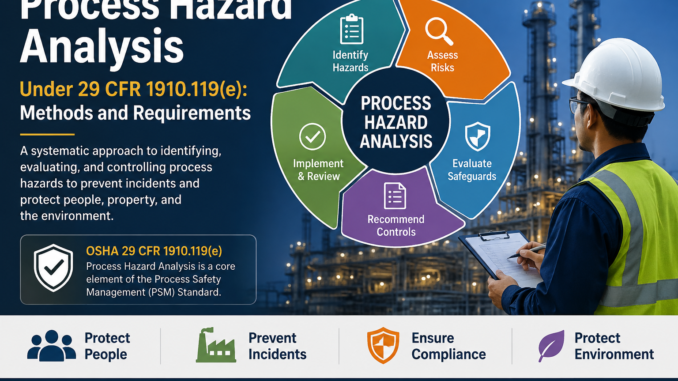
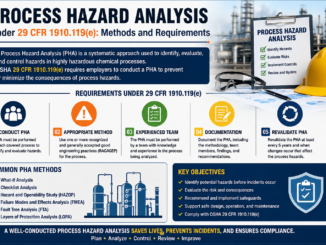
A process hazard analysis (PHA) is a structured, team-based examination used to identify, evaluate, and control hazards in a process covered by OSHA Process Safety Management. Under 29 CFR 1910.119(e), the method must be appropriate to the process complexity, the analysis must cover specified safety issues, and the employer must resolve and document the team’s recommendations.
The PHA is not a generic risk assessment copied from another facility. It must use accurate process safety information, people who understand the actual process, and a method capable of examining credible deviations and failures.
What OSHA requires a PHA to achieve
The analysis must identify, evaluate, and control hazards. OSHA requires employers to establish and document the priority order for PHAs using considerations such as the extent of process hazards, number of potentially affected employees, process age, and operating history. The initial completion dates printed in the regulation are historical implementation deadlines; covered processes now need a compliant PHA and the ongoing revalidation required by paragraph (e)(6).
Approved PHA methodologies
OSHA permits one or more appropriate methods:
| Method | How it works | Typical strength |
|---|---|---|
| What-If | Uses structured “What if…?” questions to explore deviations, failures, and errors. | Flexible screening of varied scenarios. |
| Checklist | Compares the process with a prepared list of requirements or known hazards. | Consistent review where a validated checklist fits the process. |
| What-If/Checklist | Combines scenario questions with systematic checklist coverage. | Balances flexibility and completeness. |
| HAZOP | Applies guide words to process parameters at defined nodes to identify deviations. | Detailed examination of complex continuous or batch processes. |
| FMEA | Examines component or function failure modes and their effects. | Equipment- and function-focused failure analysis. |
| Fault Tree Analysis | Works backward from an undesired event through combinations of causes. | Logical analysis of a defined top event. |
| Equivalent methodology | Uses another defensible method appropriate to the process. | Allows justified alternatives without lowering the required analysis quality. |
No method is automatically best. A simple checklist may miss complex interactions, while a detailed HAZOP may be unnecessary for a straightforward process. The employer should document why the selected method or combination fits the process.
Seven subjects every PHA must address
- Process hazards: chemical, reaction, fire, explosion, toxicity, pressure, temperature, and other credible hazards.
- Previous incidents: events with a likely potential for catastrophic workplace consequences, including relevant near misses.
- Engineering and administrative controls: safeguards and their relationships, including detection methods that provide early warning.
- Consequences of control failure: what could occur when a safeguard is unavailable, bypassed, ineffective, or overwhelmed.
- Facility siting: the location of occupied buildings, equipment, access routes, and other features relevant to consequences.
- Human factors: how interface design, workload, procedures, staffing, communication, training, and foreseeable error affect risk.
- Qualitative safety and health effects: the range of possible effects on employees if controls fail.
A PHA should show how safeguards work together rather than list them without testing their independence, availability, or failure modes.
PHA team requirements
The team must have expertise in engineering and process operations. At least one employee must have experience and knowledge specific to the process being evaluated, and at least one team member must understand the methodology being used. One person may satisfy more than one competence requirement when genuinely qualified.
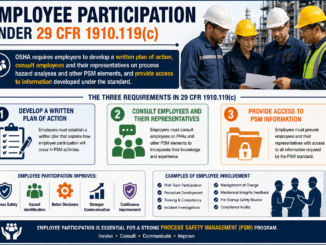
Employee participation adds operating knowledge that drawings may not reveal, such as recurring alarms, difficult startups, temporary practices, inaccessible valves, maintenance constraints, or abnormal conditions.
Preparing for the analysis
- Confirm the covered process and analysis boundary.
- Verify that chemical, technology, and equipment PSI is complete enough to support the analysis.
- Collect current P&IDs, flow diagrams, procedures, relief information, incident history, MOC records, inspection findings, and siting information.
- Select the methodology and define nodes, systems, or questions.
- Choose a team with process, operations, engineering, maintenance, and methodology knowledge appropriate to the scope.
- Define how assumptions, safeguards, recommendations, responsible owners, and due dates will be recorded.
Managing findings and recommendations
The employer must establish a system to address findings promptly, resolve recommendations in a timely manner, document the resolution, identify actions, develop a written completion schedule, complete actions as soon as possible, and communicate relevant actions to affected operating, maintenance, and other employees.
Closing an item requires more than changing its status. The record should show the decision, technical basis, person responsible, completion evidence, affected documents, required training, and whether management of change applies. When a recommendation is not adopted, the documented resolution should explain the defensible basis and any alternative controls.
Five-year revalidation and record retention
At least every five years after completion, the PHA must be updated and revalidated by a team meeting paragraph (e)(4). Revalidation should confirm that the analysis reflects the current process, changes, incident learning, operating experience, and current safeguards. It is not simply a new approval date on an old report.
Employers must retain PHAs, updates or revalidations, and documented recommendation resolutions for the life of the process.
Common PHA weaknesses
- Starting with incomplete or outdated PSI;
- Using a method that does not fit the process complexity;
- Excluding operators or maintenance knowledge;
- Treating alarms as safeguards without examining response time and reliability;
- Ignoring facility siting or human factors;
- Recording vague recommendations with no owner or schedule;
- Closing actions without evidence or MOC updates; and
- Performing a paper revalidation that does not evaluate the current process.
How to turn PHA recommendations into verified risk reduction
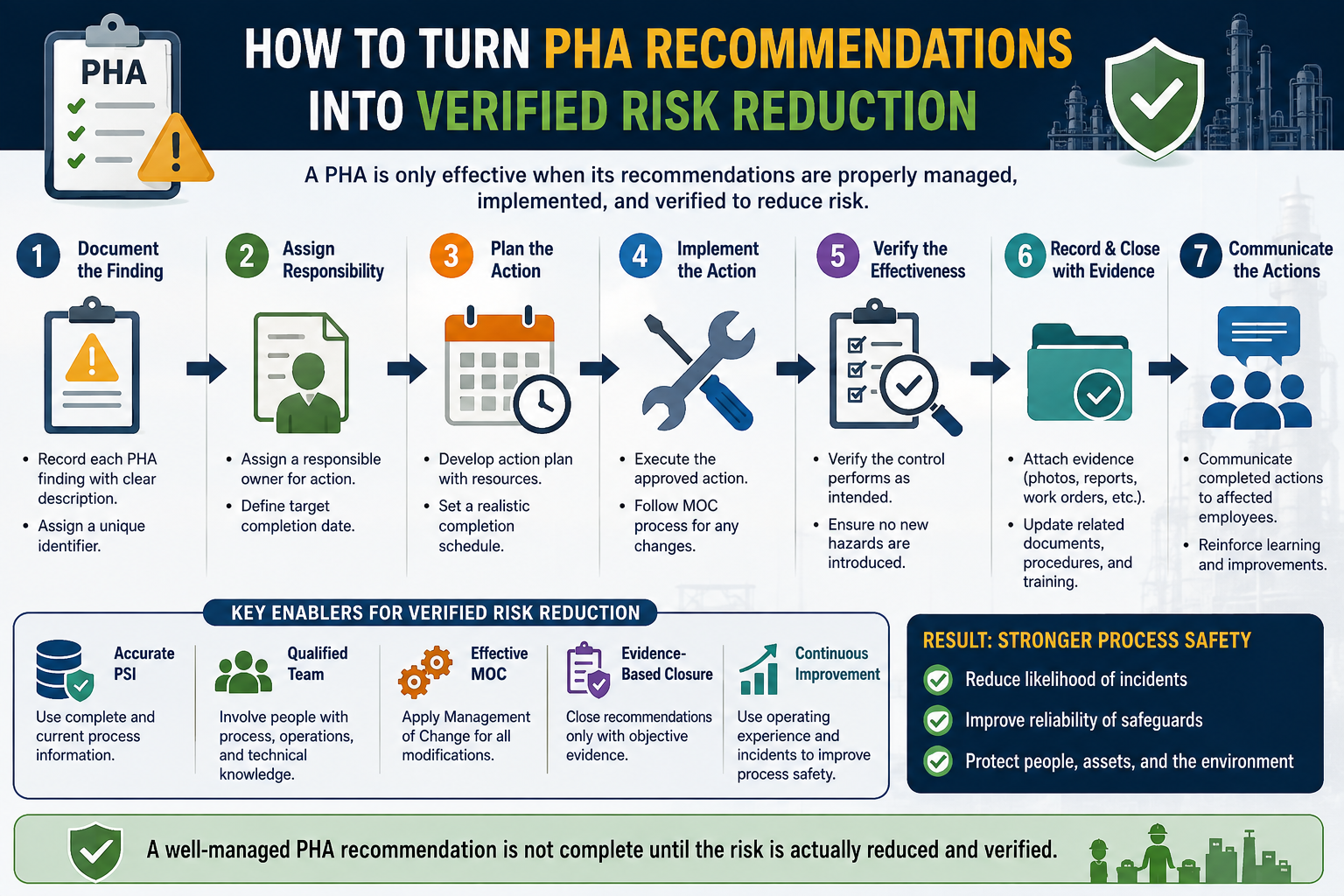
A PHA is useful only when its recommendations enter a controlled resolution process. Assign each finding a unique identifier, responsible owner, target date, and documented status. The employer must establish a system to address findings promptly, document the actions to be taken, complete actions as soon as possible, develop a written completion schedule, and communicate the actions to affected operating, maintenance, and other employees whose assignments are in the process.
Closing a recommendation should require evidence. Depending on the action, evidence may include an approved design package, revised drawing, completed work order, updated procedure, training record, inspection result, or field-verification photograph. If management resolves a recommendation through an alternative action, the record should explain the technical basis and show how the underlying hazard is controlled. Any modification to chemicals, technology, equipment, procedures, or facilities should be screened through the PSM management-of-change process before implementation.
After implementation, verify that the control performs as intended and has not introduced a new hazard. This final check connects the PHA to mechanical integrity, operating procedures, training, and pre-startup review instead of treating recommendation closure as an administrative signature.
Process Hazard Analysis Questions and Answers
1. What is Process Hazard Analysis?
Process Hazard Analysis is a structured and systematic examination used to identify, evaluate, and control hazards associated with a covered process. It helps a team understand potential deviations, failures, consequences, and safeguards before they result in a serious incident.
2. What does 29 CFR 1910.119(e) require?
Under 29 CFR 1910.119(e), employers must perform a suitable Process Hazard Analysis for covered processes. The analysis must address specified safety issues, use an appropriate methodology, involve qualified team members, and result in documented recommendations and resolutions.
3. Which methods can be used for Process Hazard Analysis?
Common Process Hazard Analysis methods include What-If, Checklist, What-If/Checklist, HAZOP, FMEA, Fault Tree Analysis, and other equivalent methodologies appropriate to the process.
4. Which team members are required for a PHA?
The Process Hazard Analysis team must include people with appropriate expertise in engineering and process operations. At least one team member must have experience and knowledge specific to the process, and at least one must understand the methodology being used.
5. What subjects must a Process Hazard Analysis address?
A Process Hazard Analysis must consider process hazards, previous incidents, engineering and administrative controls, consequences of control failure, facility siting, human factors, and qualitative safety and health effects.
6. Why are human factors important in Process Hazard Analysis?
Human factors are important because operator actions, procedures, workload, communication, staffing, training, alarms, interfaces, and foreseeable errors can influence whether a hazardous event occurs or develops into a serious incident.
7. How should PHA recommendations be managed?
Recommendations identified through Process Hazard Analysis should be documented, assigned to responsible persons, given completion schedules, resolved in a timely manner, and communicated to affected employees. Evidence should be retained to demonstrate completion.
8. How often must a PHA be revalidated?
A Process Hazard Analysis must be updated and revalidated by a qualified team at least every five years after the completion of the initial PHA or previous revalidation.
9. What is a common mistake during PHA?
One common Process Hazard Analysis mistake is relying on outdated process safety information. Other weaknesses include excluding operators, overlooking human factors, failing to evaluate safeguard failures, and closing recommendations without adequate evidence.
10. Why is Process Hazard Analysis important for process safety?
Process Hazard Analysis helps organizations systematically identify hazards and evaluate safeguards before incidents occur. When recommendations are properly implemented and verified, the PHA becomes an important part of an effective process safety management system.
Quick Revision Points
For exam or Safety Officer preparation, remember these key Process Hazard Analysis points:
- Identify and evaluate process hazards.
- Use an appropriate PHA methodology.
- Include qualified team members.
- Review previous incidents.
- Evaluate safeguards and control failures.
- Consider facility siting and human factors.
- Document recommendations and resolutions.
- Communicate relevant actions to affected employees.
- Revalidate the PHA at least every five years.
- Retain PHA records for the life of the process.
Related PSM requirements
- OSHA Process Safety Management overview
- Process Safety Information requirements
- Employee participation in PSM
- Pre-startup safety review

Be the first to comment