Safety Officer Test Preparation
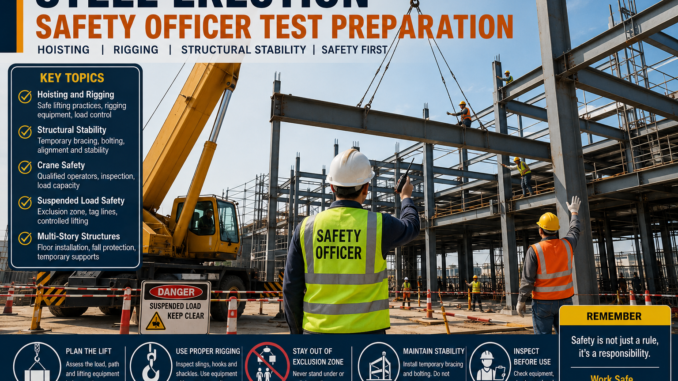
Steel Erection Safety Officer Test Preparation – Hoisting, Rigging, and Structural Stability
Steel erection is one of the most critical phases in the construction industry. During this process, heavy steel members are lifted using cranes, positioned accurately, and assembled with temporary supports before permanent connections are completed. If hoisting, rigging, or structural stability is not properly managed, serious accidents, structural collapse, and fatalities can occur.
Steel Erection Safety Officer Test Preparation is essential in monitoring lifting activities, identifying hazards, and ensuring that workers follow safe work procedures. For this reason, topics related to Hoisting, Rigging, and Structural Stability are frequently included in Safety Officer recruitment exams and competency assessments.
In this guide, you will learn these important topics in simple language and strengthen your preparation through practice questions, interview-style questions, and multiple-choice questions (MCQs).
7.7 Hoisting and Rigging
Hoisting and rigging refer to the safe lifting and moving of heavy materials using cranes or other lifting equipment. Having a powerful crane alone is not enough. The load must be properly rigged, the correct lifting accessories must be used, and only trained personnel should perform the operation.
A Safety Officer should understand lifting plans, rigging hardware, sling selection, crane load charts, and exclusion zones.
Qualified Crane Operators
Steel Erection Safety Officer Test Preparation crane should only be operated by a trained, competent, and authorized operator.
The operator should be able to:
- Understand the crane’s load chart.
- Perform daily crane inspections.
- Assess weather conditions before lifting.
- Follow the instructions of the designated signal person.
- Stop any lift immediately if it becomes unsafe.
Whenever an operator believes a lift is unsafe, safety must always take priority over production.
When Should an Unsafe Lift Be Stopped?
Steel Erection Safety Officer Test Preparation should know that a crane operator has the authority to stop lifting operations immediately if:
- The load is unstable.
- Rigging is incorrect.
- A sling is damaged.
- Wind speed exceeds safe operating limits.
- Workers are standing beneath a suspended load.
- Communication between the operator and signal person is unclear.
Safety should always come before productivity.
Suspended Load Safety
A suspended load is one of the most dangerous hazards during steel erection.
To reduce the risk:
- Never allow workers to stand or walk beneath a suspended load.
- Use tag lines to control the load.
- Lift loads slowly and smoothly.
- Avoid sudden starts or stops.
- Control any swinging load immediately.
Rigging Requirements
Rigging equipment should be selected according to the load weight and its center of gravity.
The Safety Officer should verify:
- Sling capacity
- Hook condition
- Safety latch
- Shackles
- Wire ropes
- Chain slings
- Lifting beams (when required)
Any damaged rigging equipment must be removed from service immediately.
Hook Safety
Crane hooks should be equipped with self-closing safety latches.
Safety latches help to:
- Prevent the sling from accidentally slipping off.
- Keep the load secure.
- Reduce the risk of unexpected load release.
Using an open hook without a safety latch is considered an unsafe practice.
Load Capacity
Lifting equipment must never be loaded beyond its rated capacity.
Overloading can result in:
- Crane overturning
- Boom collapse
- Wire rope failure
- Serious injuries or fatalities
The Safety Officer should verify the load weight before every lifting operation.
Improper Use of Equipment
Every lifting device should only be used for the purpose for which it was designed.
Improvised devices or unauthorized mechanical equipment should never be used for lifting because their load capacities are not certified.
7.8 Structural Stability
During Steel Erection Safety Officer Test Preparation, the structure is not yet complete.
Maintaining structural stability throughout the erection process is essential. If temporary supports are removed too early or steel members are not properly secured, the structure may collapse.
A Safety Officer must monitor both the erection sequence and temporary stability.
Temporary Bracing
After Steel Erection Safety Officer Test Preparation members are installed, temporary bracing or guy cables are used to support the structure.
The purpose of temporary bracing is to:
- Prevent structural collapse.
- Resist wind loads.
- Maintain proper alignment.
- Provide stability during installation.
Temporary supports must never be removed until permanent connections have been completed.
Responsibilities During Steel Erection
The Steel Erection Safety Officer Test Preparation erection team should ensure that:
- The structure remains stable.
- Temporary supports are adequate.
- Bolts are properly installed.
- Steel members are correctly aligned.
- Load distribution remains safe.
The Safety Officer should perform regular inspections throughout the erection process.
Multi-Story Steel Structures
Multi-story steel structures involve a greater risk of collapse.
Important safety measures include:
- Installing floors as erection progresses.
- Maintaining proper fall protection.
- Controlling material storage.
- Protecting open edges.
- Inspecting temporary work platforms.
Safe Bolting Practices
Steel members should be sufficiently bolted before final welding or permanent stabilization.
Proper bolting helps:
- Prevent member movement.
- Maintain structural alignment.
- Resist wind-induced displacement.
- Improve worker safety.
Safety Officer Inspection Checklist
During inspections, the Safety Officer should verify:
- Crane inspection completed
- Operator is authorized and competent
- Rigging equipment inspected
- Hooks equipped with safety latches
- Correct sling angles used
- Load weight verified
- Exclusion zone established
- Signal person available
- Temporary bracing installed
- Steel members properly secured
- Workers using fall protection
- Good housekeeping maintained
Important Safety Tips
- Never walk or work beneath a suspended load.
- Never overload a crane.
- Replace damaged slings immediately.
- Maintain clear communication during lifting operations.
- Never remove temporary supports without proper authorization.
- Inspect lifting equipment daily.
- Evaluate weather conditions, especially high winds, before lifting.
- Clearly establish and mark exclusion zones around lifting activities.
Safety Officer Test Preparation Questions & Answers
Q1. What is the primary purpose of hoisting?
Answer: To safely lift and move heavy materials using lifting equipment.
Q2. What should a crane operator do if an unsafe condition is identified?
Answer: Stop the lifting operation immediately.
Q3. Should workers be allowed beneath a suspended load?
Answer: No.
Q4. Why is a safety latch fitted to a crane hook?
Answer: To prevent the sling from accidentally slipping off the hook.
Q5. What is the greatest risk of overloading a crane?
Answer: Crane failure or overturning.
Q6. What is the purpose of temporary bracing?
Answer: To keep the structure stable until permanent connections are completed.
Q7. When should rigging equipment be inspected?
Answer: Before every lifting operation.
Q8. What is the purpose of a tag line?
Answer: To control a swinging load during lifting.
Q9. What should be done if a sling is damaged?
Answer: Remove it from service immediately.
Q10. When must structural stability be maintained?
Answer: Throughout the entire steel erection process.
Practice MCQs
1. A crane operator should stop lifting when:
A. The load is light
B. The weather is clear
C. Safety is doubtful ✅
D. The supervisor is absent
2. Workers should never stand:
A. Near the crane tires
B. Under a suspended load ✅
C. Near the toolbox
D. Inside the office
3. A safety latch is fitted on:
A. Ladder
B. Hook ✅
C. Helmet
D. Scaffold
4. Temporary bracing is used to:
A. Increase production
B. Decorate the structure
C. Maintain structural stability ✅
D. Reduce manpower
5. Before lifting, the Safety Officer should verify:
A. Worker attendance only
B. Load weight and rigging equipment ✅
C. Office documents
D. Paint quality
Conclusion
Hoisting, rigging, and structural stability are among the most important safety topics in steel erection. A competent Safety Officer must have a practical understanding of lifting equipment, rigging accessories, load handling procedures, temporary bracing, and structural stability requirements. By thoroughly understanding these concepts and regularly practicing the questions provided in this guide, candidates can significantly improve their performance in Safety Officer examinations and job interviews.
References and Last Reviewed
- OSHA 29 CFR 1926 Subpart R – Steel Erection: osha.gov/1926SubpartR
Jurisdiction: United States – OSHA construction industry standards (29 CFR 1926). Verify local/site-specific requirements where this differs from your jurisdiction.
Last technically reviewed: September 2026
Reviewed by: EHS Guidelines Editorial Team
This article is educational. Apply current official rules, approved site procedures, manufacturer instructions and competent-person assessment for your actual worksite.

2 Trackbacks / Pingbacks