Purpose
These Mechanical and Heavy Equipment Safety Officer Test Preparation interview questions are commonly asked during Safety Officer interviews on Saudi Aramco and large-scale construction projects. This chapter covers operator certification, work permit protocol, elevating and lifting equipment inspection cadence, forklift operations, and crane/hoist/rigging safety that a Safety Officer must know before sitting a competency exam or a site interview. The content follows the structure of Saudi Aramco Construction Safety Manual (CSM) Part III-02, “Mechanical and Heavy Equipment,” and cross-references the Aramco General Instructions and ANSI standards it invokes.
TL;DR: A Safety Officer verifies a valid SA operator certification under GI 7.025 before any heavy equipment moves on site, an approved work permit under GI 2.100 before mechanical work starts, current inspection and test documentation for elevating and lifting equipment under GI 7.030, compliance with ANSI/ASSE A92.2 for vehicle-mounted platforms and A92.3 for manually propelled platforms, forklift operation limited to certified operators per the SA Forklift Operations Guide, and marine/offshore crane and rigging work governed by GI 7.024 before any hoist cycle begins.
Note: CSM Part III-02’s Section 2.3 general requirements subsections were not fully legible in the source reference used to prepare this guide. Candidates should verify the exact 2.3.x wording against the current, complete CSM Part III-02 chapter issued by their project before an exam or interview.
Purpose of CSM III-02 and Referenced Standards
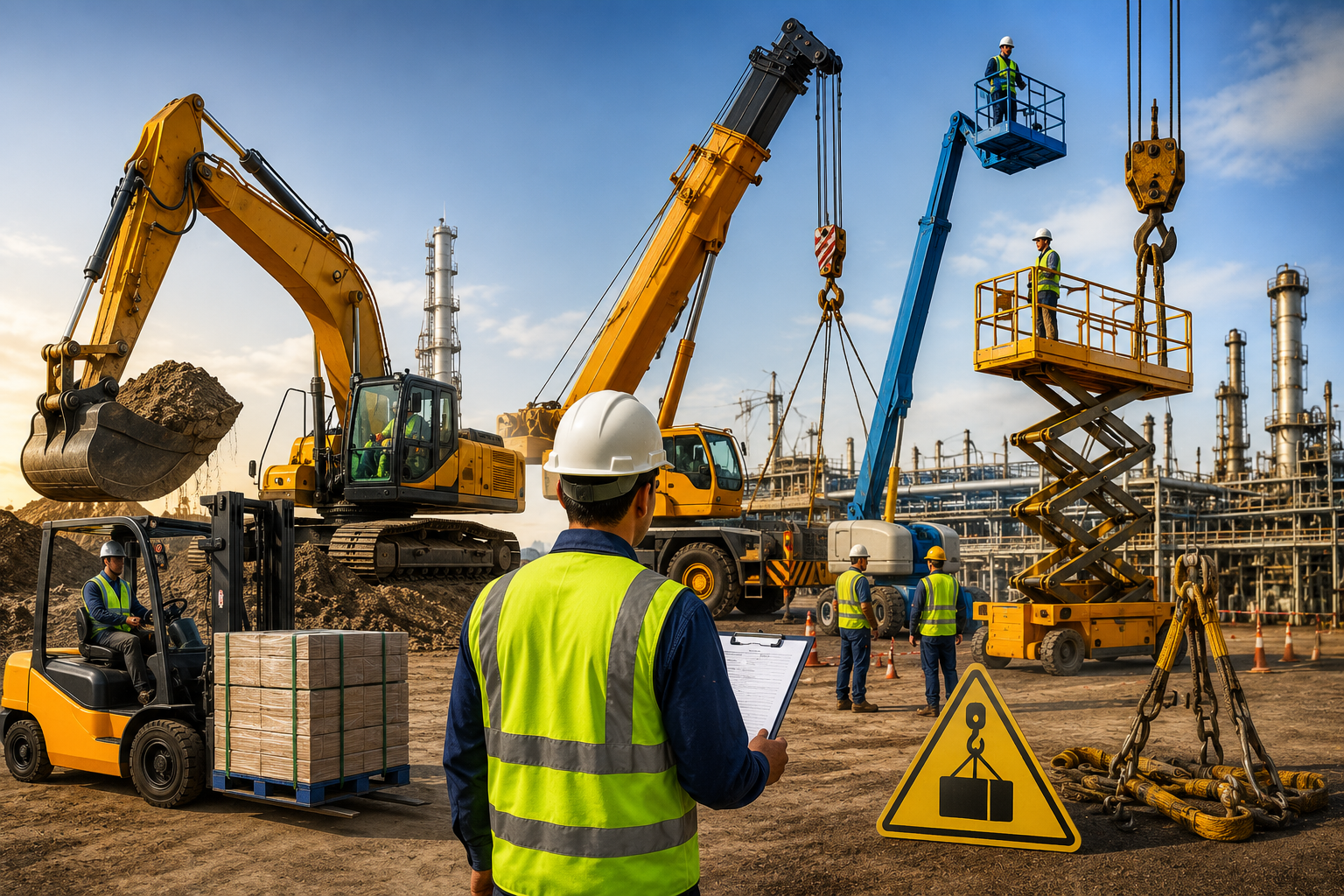
CSM Part III-02 exists to control the crush, struck-by, tip-over, fall, and electrocution hazards generated by mechanical and heavy equipment on Aramco job sites – cranes, forklifts, elevating work platforms, excavators, and rigging gear. It does this by tying operator qualification, work permit issuance, and equipment inspection to a defined set of Aramco General Instructions and external ANSI standards, rather than leaving those calls to individual crews or subcontractors.
Q1: What is the purpose of the Mechanical and Heavy Equipment chapter in the Construction Safety Manual?
A: To establish minimum requirements controlling the mechanical, structural, and human-factor hazards associated with operating heavy equipment, elevating work platforms, forklifts, and cranes/hoists on Aramco construction sites – covering operator certification, work permits, inspection and testing cycles, and rigging practice – so that mechanical and heavy equipment work is performed without injury to personnel or damage to property.
Q2: Which references does CSM III-02 draw on?
A: The chapter cross-references:
- Saudi Aramco GI 2.100 – Work Permit System
- Saudi Aramco GI 7.024 – Marine/Offshore Crane, Hoist, and Rigging Operations
- Saudi Aramco GI 7.025 – Heavy Equipment Operator Testing and Certification
- Saudi Aramco GI 7.030 – Inspection and Testing Requirements for Elevating and Lifting Equipment
- Saudi Aramco Safety Handbook – Minimum Safety Rules
- Saudi Aramco Forklift Operations Guide
- ANSI/ASSE A92.2 – Vehicle-Mounted Elevating and Rotating Work Platforms
- ANSI/ASSE A92.3 – Manually Propelled Elevating Aerial Platforms
Q3: Why does a Safety Officer need to track both Aramco General Instructions and ANSI standards for this chapter?
A: Because the GIs set the company-specific administrative controls – who is allowed to operate, which permit covers the work, and how often equipment gets tested – while the ANSI standards set the equipment design, inspection, and use criteria the GIs point back to. A Safety Officer who only knows the permit process but not the A92.2 slope and guardrail requirements for a boom lift, for instance, cannot properly evaluate whether an aerial platform is safe to authorize under that permit.
General Requirements (Section 2.3) – Verification Note
Q4: What does Section 2.3 of CSM III-02 cover?
A: Section 2.3 is expected to set out the general requirements applicable across all mechanical and heavy equipment categories in this chapter – equipment identification and licensing, minimum PPE, housekeeping around equipment, and baseline supervision expectations – mirroring how earlier CSM chapters structure their general requirements sections before moving into equipment-specific rules.
Placeholder note: the exact 2.3.x subsection numbering and wording were not visible in the source material used for this guide. Confirm the current 2.3.x requirements against the full, current CSM Part III-02 text before relying on this section in an exam.
Q5: What is the safest approach when an exam question references a specific Section 2.3 subsection number a candidate does not recognize?
A: Answer from the underlying principle – operator certification, permit coverage, and inspection currency – rather than guessing at a subsection number. Interviewers commonly accept an answer that correctly identifies the controlling requirement (for example, “no equipment operates without a current SA certification and an approved permit”) even where the exact clause number is not quoted verbatim.
Heavy Equipment Operator Certification Requirements (GI 7.025)
Q6: What does GI 7.025 require before a person operates heavy equipment on an Aramco site?
A: A current SA (Saudi Aramco) operator certification specific to the equipment category and, where applicable, the load or size class of the machine. Certification under GI 7.025 is testing-based – it requires a written and/or practical operator test administered against defined criteria, not simply prior experience or a certificate from a previous employer.
Q7: Is a valid driver’s license or a certification from a different equipment class sufficient to operate a crane, excavator, or loader?
A: No. GI 7.025 certification is equipment-specific. An operator certified on a wheel loader is not automatically qualified to operate a mobile crane or a backhoe – each equipment category, and in many cases each load class within that category, requires its own certification test.
Q8: Who verifies operator certification status before equipment is mobilized?
A: The Safety Officer, working with the project’s equipment control or heavy equipment coordinator, confirms the certification card or record is current, matches the specific equipment being assigned, and has not expired or been suspended – before the equipment moves onto the work site, not after work has already started.
Q9: What happens if an operator’s SA certification expires mid-project?
A: The equipment cannot be authorized for that operator until re-certification is completed. A Safety Officer flags expired certifications during routine site checks and stops the equipment from being dispatched to a new task until the operator is re-tested and re-certified under GI 7.025.
Work Permit Protocol for Mechanical and Heavy Equipment (GI 2.100)
Q10: What work permit requirement applies before mechanical or heavy equipment work begins?
A: An approved work permit issued under GI 2.100, identifying the equipment to be used, the operator’s certification status, the work location and scope, and any special precautions – overhead line clearance, underground utility checks, or exclusion zones – specific to that task.
Q11: Does a single work permit cover equipment relocation across a large site?
A: Not automatically. A permit issued for one location and scope does not extend to a new position or task that changes the hazard picture – proximity to overhead lines, ground bearing conditions, or nearby personnel exposure. A new or revalidated permit is required when the equipment moves to a materially different work location.
Q12: What is a common exam question about the relationship between GI 2.100 and GI 7.025?
A: Whether a valid work permit alone is sufficient to authorize equipment operation. It is not – the permit under GI 2.100 and the operator’s SA certification under GI 7.025 are two separate, independent requirements. Both must be current and matched to the task before work starts; a valid permit with an uncertified operator does not satisfy the requirement, and a certified operator without an approved permit does not either.
Inspection and Testing Requirements for Elevating and Lifting Equipment (GI 7.030)
Q13: What does GI 7.030 govern?
A: The inspection and testing cycle for elevating and lifting equipment – cranes, hoists, elevating work platforms, and related lifting gear – covering pre-use daily checks, periodic inspections, and load testing intervals required before this equipment is certified fit for continued use on an Aramco site.
Q14: What is the difference between a daily pre-use inspection and a periodic inspection under GI 7.030?
A: The daily pre-use inspection is performed by the operator (or a competent person) before each shift, checking controls, safety devices, tires or tracks, and visible structural condition. The periodic inspection is a more detailed, scheduled inspection – often involving a qualified inspector and, for lifting equipment, load testing – conducted at defined intervals regardless of how the equipment performed on any single shift.
Q15: Why does a Safety Officer check inspection documentation rather than relying on the equipment’s physical condition alone?
A: Because structural fatigue, wire rope degradation, and hydraulic system wear are not always visible on a walk-around inspection. GI 7.030’s testing intervals exist precisely to catch deterioration that a visual check would miss – a Safety Officer who authorizes equipment based on appearance alone, without confirming the test record is current, is not meeting the requirement.
Q16: What should a Safety Officer do if a crane or elevating platform’s periodic test certificate has expired?
A: Stop the equipment from being placed into service and hold the applicable work permit until a current, documented inspection or load test is completed and the certificate is renewed. An expired test record is treated the same as a failed inspection for authorization purposes.
Elevating Work Platform Safety (ANSI/ASSE A92.2 and A92.3)
Q17: What does ANSI/ASSE A92.2 cover?
A: Design, testing, inspection, and safe-use requirements for vehicle-mounted elevating and rotating work platforms – boom lifts and similar aerial devices mounted on a vehicle chassis. It sets stability and slope limits, platform load ratings, and daily inspection expectations a Safety Officer checks before authorizing use.
Q18: What does ANSI/ASSE A92.3 cover, and how does it differ from A92.2?
A: A92.3 covers manually propelled elevating aerial platforms – typically scissor lifts and similar platforms moved by hand or self-propelled without a separate vehicle chassis. Where A92.2 addresses vehicle-mounted booms with rotating capability, A92.3 addresses platforms that elevate vertically and are propelled at ground level, with its own set of stability, guardrail, and load requirements.
Q19: What are core safe-use requirements common to both standards that a Safety Officer verifies on site?
A: Trained and authorized operators only, daily function checks of lift controls before use, guardrails and toe boards intact on the platform, load limits posted and respected, outriggers or stabilizers deployed where required by the manufacturer, and no use of planks, ladders, or the guardrail top rail to gain additional height.
Q20: What is a frequent exam trick question about elevating work platform standards?
A: Whether A92.2 and A92.3 are interchangeable simply because both cover “elevating work platforms.” They are not – A92.2 applies to vehicle-mounted, boom-type units, and A92.3 applies to manually propelled platforms such as scissor lifts. A Safety Officer must match the correct standard to the actual equipment type on site, since the stability and guardrail criteria differ between the two categories.
Q21: Why is fall protection still required on a scissor lift with intact guardrails?
A: Because guardrails alone address the fall hazard from the platform edge under normal conditions, but a sudden stop, tip, or structural failure can still eject an occupant. Project-specific rules and manufacturer instructions may require a travel-restraint or fall-arrest system tied off inside the platform in addition to the guardrail system, particularly on platforms operating near edges, openings, or on uneven ground.
Forklift Operations Safety (SA Forklift Operations Guide)
Q22: What certification requirement applies to forklift operators under the SA Forklift Operations Guide?
A: Only personnel holding a current, equipment-specific operator certification are authorized to operate a forklift on an Aramco site – mirroring the certification principle under GI 7.025 and applied specifically to powered industrial trucks through the SA Forklift Operations Guide.
Q23: What are core forklift safe-operation rules a Safety Officer checks during a site walk?
A: Rated capacity plate posted and legible, load carried at the lowest safe travel height, forks and mast in good visible condition with no cracked welds, seat belt worn where fitted, horn sounded at blind corners and intersections, and travel speed matched to congestion and pedestrian exposure in the work area.
Q24: Is it acceptable to lift a person on forklift forks using a pallet as an improvised platform?
A: No. Personnel may only be elevated using a purpose-built, securely attached safety platform where the forklift’s own operating instructions permit personnel lifting; an improvised platform made from a pallet or similar does not meet the requirement and exposes personnel to a fall and crush hazard if the load shifts.
Q25: What should a Safety Officer verify about pedestrian separation around active forklift operations?
A: That designated pedestrian routes are physically separated from forklift travel and loading areas wherever practical, that warning signage and barriers mark active forklift zones, and that forklift operators maintain a clear line of sight (or use a spotter) when visibility is obstructed by the load or by the layout of the work area.
Marine/Offshore Crane, Hoist, and Rigging Operations (GI 7.024)
Q26: What does GI 7.024 govern?
A: Requirements specific to marine and offshore crane, hoist, and rigging operations – lifts performed from or onto vessels, platforms, or marine structures, where sea state, deck motion, and load dynamics add hazards not present in land-based crane work.
Q27: What additional factors does a marine/offshore lift require compared to a land-based lift?
A: Assessment of sea state and vessel motion before and during the lift, coordination between the crane operator and the vessel or platform crew, verification that rigging is rated for dynamic loading (not just static capacity), and a defined lift plan that accounts for the load swinging or shock-loading if the vessel moves during the hoist cycle.
Q28: What certification does the crane operator on a marine/offshore lift need?
A: A current SA certification issued under GI 7.025, matched to the specific crane type and load class, in addition to the GI 7.024 requirements governing the marine or offshore aspects of the lift itself. Certification on a land-based crane does not automatically extend to marine or offshore crane operation.
Q29: What rigging inspection requirement applies before a hoist cycle begins?
A: All rigging gear – slings, shackles, hooks, and wire rope – is inspected before use for wear, deformation, or damage, with rated capacity confirmed against the actual load weight, consistent with the inspection principles carried through GI 7.030 for lifting equipment generally and applied specifically to rigging gear under GI 7.024 for marine and offshore work.
Q30: What is a common exam question distinguishing GI 7.024 from GI 7.030?
A: Whether GI 7.030’s inspection and testing cycle for lifting equipment replaces the need for GI 7.024’s marine/offshore-specific requirements. It does not – GI 7.030 sets the baseline inspection and testing cadence for elevating and lifting equipment generally, while GI 7.024 layers marine and offshore-specific lift planning, vessel coordination, and dynamic loading considerations on top of that baseline for lifts performed in a marine or offshore setting.
Minimum Safety Rules for Mechanical and Heavy Equipment
Q31: What do the SA Safety Handbook’s Minimum Safety Rules require regarding equipment exclusion zones?
A: Personnel are kept clear of the swing radius, working radius, or travel path of operating heavy equipment unless their task specifically requires proximity, and in that case, positive communication (radio, hand signals, or a dedicated signal person) is established with the operator before entering that zone.
Q32: What does the Minimum Safety Rules set require for equipment left unattended?
A: Controls neutralized or locked out, parking brake set, attachments or buckets lowered to the ground, and the key removed or the equipment otherwise secured against unauthorized use – an unattended machine with the engine running and controls live is treated as a live hazard, not a parked one.
High-Frequency Exam Hazards and Standards
Q33: What are the principal hazard categories addressed across CSM III-02’s referenced standards?
A: Struck-by and crush hazards from swinging booms, loads, or forks; tip-over from inadequate stability on slopes or soft ground; falls from elevating work platforms; electrocution from equipment contact with overhead lines; and dynamic loading hazards specific to marine and offshore lifts.
Q34: What is the single most commonly tested distinction in this chapter?
A: That a work permit under GI 2.100 and an operator certification under GI 7.025 are independent, both-required conditions – neither one substitutes for the other, and candidates who answer that a valid permit alone authorizes equipment operation are marked incorrect.
Q35: What is a typical exam scenario testing knowledge of A92.2 versus A92.3?
A: A scenario describing a self-propelled scissor lift being used for interior fit-out work, asking which standard applies. The correct answer is A92.3, since the unit is manually propelled and elevates vertically rather than being a vehicle-mounted, boom-type device covered by A92.2.
FAQ: Mechanical and Heavy Equipment Safety Officer Test Preparation
What certification is required to operate heavy equipment on an Aramco site? A current SA operator certification issued under GI 7.025, specific to the equipment category and load class, verified before the equipment is mobilized.
What Aramco General Instruction governs work permits for mechanical and heavy equipment work? GI 2.100 governs the work permit system, requiring an approved permit specifying location, equipment, operator certification, and precautions before work starts.
Which standard applies to vehicle-mounted boom lifts versus scissor lifts? ANSI/ASSE A92.2 applies to vehicle-mounted elevating and rotating work platforms (boom lifts); ANSI/ASSE A92.3 applies to manually propelled elevating platforms such as scissor lifts.
What governs inspection and testing of cranes, hoists, and elevating equipment? GI 7.030, which sets daily pre-use inspection and periodic/load-test intervals for elevating and lifting equipment before it is fit for continued use.
What certification applies specifically to forklift operators? An equipment-specific operator certification under the SA Forklift Operations Guide, applying the same certification principle used across GI 7.025 for heavy equipment generally.
What Aramco General Instruction covers marine and offshore crane and rigging work? GI 7.024, addressing crane, hoist, and rigging operations performed from or onto vessels or offshore structures, layered on top of the general lifting equipment inspection requirements in GI 7.030.
Sources
- OSHA, 29 CFR 1926.602 – Material Handling Equipment: osha.gov/laws-regs/regulations/standardnumber/1926/1926.602
- OSHA, 29 CFR 1926 Subpart CC – Cranes and Derricks in Construction: osha.gov/laws-regs/regulations/standardnumber/1926/1926SubpartCC
- OSHA, Powered Industrial Trucks – Loading and Unloading: osha.gov/powered-industrial-trucks/loading-unloading
- American Society of Safety Professionals, ANSI/ASSE A92.2 – Vehicle-Mounted Elevating and Rotating Work Platforms: assp.org/standards
- OSHA, 29 CFR 1910.67 – Vehicle-Mounted Elevating and Rotating Work Platforms (referencing ANSI A92.2): law.cornell.edu/cfr/text/29/1910.67
This article is provided for exam and interview preparation purposes. Always verify current operator certification, work permit, and inspection/testing requirements against the latest Saudi Aramco General Instructions and CSM Part III-02 issued for the specific project.

2 Trackbacks / Pingbacks