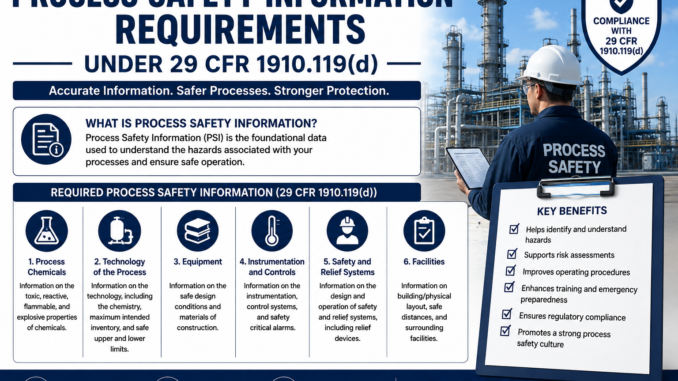
Process safety information (PSI) is the written technical foundation of an OSHA Process Safety Management program. Under 29 CFR 1910.119(d), an employer must compile information about chemical hazards, process technology, and process equipment before conducting a required process hazard analysis.
PSI is not a single binder or one safety data sheet. It is a controlled body of information that allows employees and the PHA team to understand what the process contains, how it should operate, which equipment contains or controls it, and what can happen when conditions deviate from safe limits.
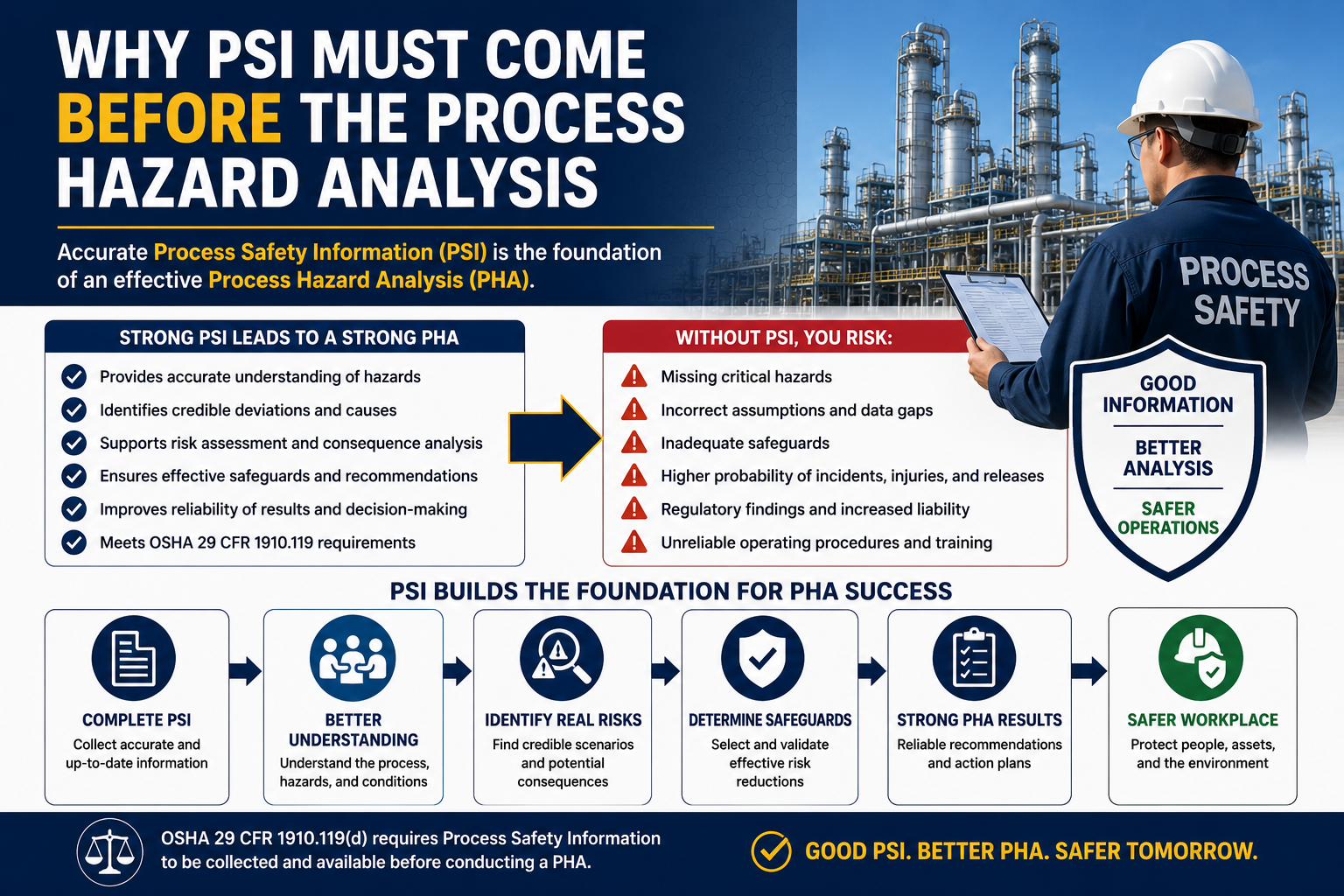
Why PSI must come before the process hazard analysis
A process hazard analysis depends on accurate design, chemistry, equipment, and operating-limit information. Without it, a team may miss an incompatible chemical reaction, an incorrect relief basis, an undocumented process connection, or the consequence of exceeding a temperature or pressure limit.
OSHA’s nonmandatory Appendix C guidance explains that complete written information is also needed by people developing procedures and training, contractors working with the process, pre-startup review teams, emergency planners, insurers, and enforcement personnel.
The three required categories of process safety information
1. Information about highly hazardous chemical hazards
At minimum, paragraph 1910.119(d)(1) requires:
- Toxicity information;
- Permissible exposure limits;
- Physical data;
- Reactivity data;
- Corrosivity data;
- Thermal and chemical stability data; and
- The hazardous effects of foreseeable inadvertent mixing.
A safety data sheet meeting 29 CFR 1910.1200(g) may be used to the extent it contains the required information. The phrase “to the extent” is important: an SDS may not contain enough process-specific information to evaluate runaway reaction, decomposition, overpressure, contamination, or the effect of actual operating conditions. Missing information must be supplemented with reliable technical data.
For a searchable list of covered substances and federal threshold quantities, use the current official Appendix A. Do not rely on a copied table when determining legal coverage.
2. Information about process technology
Paragraph 1910.119(d)(2) requires at least:
- A block flow diagram or simplified process flow diagram;
- Process chemistry;
- Maximum intended inventory;
- Safe upper and lower limits for temperature, pressure, flow, composition, or other relevant variables; and
- An evaluation of the consequences of deviation, including safety and health effects on employees.
A diagram should help the reader identify the major equipment, flows, feeds, products, and significant control relationships. OSHA’s Appendix B provides examples, but a facility diagram must reflect the actual process. A simplified diagram does not remove the need for detailed piping and instrumentation diagrams where paragraph (d)(3) requires them.
Safe limits should be paired with the consequence of deviation. A number without meaning is difficult to act on. For example, a high temperature limit should be connected to the relevant hazard, alarm, interlock, response step, and affected procedure. The operating procedures then tell the operator how to correct or avoid the deviation.
If original process-technology information no longer exists, OSHA permits it to be developed with the PHA in enough detail to support the analysis. This is not permission to guess. The reconstruction should use competent engineering methods, verified field information, equipment records, calculations, and documented assumptions.
3. Information about process equipment
Paragraph 1910.119(d)(3) Process Safety Information Process Safety Informationrequires information about:
- Materials of construction;
- Piping and instrument diagrams (P&IDs);
- Electrical classification;
- Relief-system design and design basis;
- Ventilation-system design;
- Design codes and standards used;
- Material and energy balances for processes built after May 26, 1992; and
- Safety systems such as interlocks, detection, and suppression systems.
This information supports more than compliance. Materials of construction help identify corrosion or compatibility problems. P&IDs reveal valves, instruments, connections, isolation points, and protective functions. Relief design information helps establish what scenario the system was designed to handle. Electrical classification supports appropriate equipment selection in hazardous locations.
RAGAGEP and older equipment
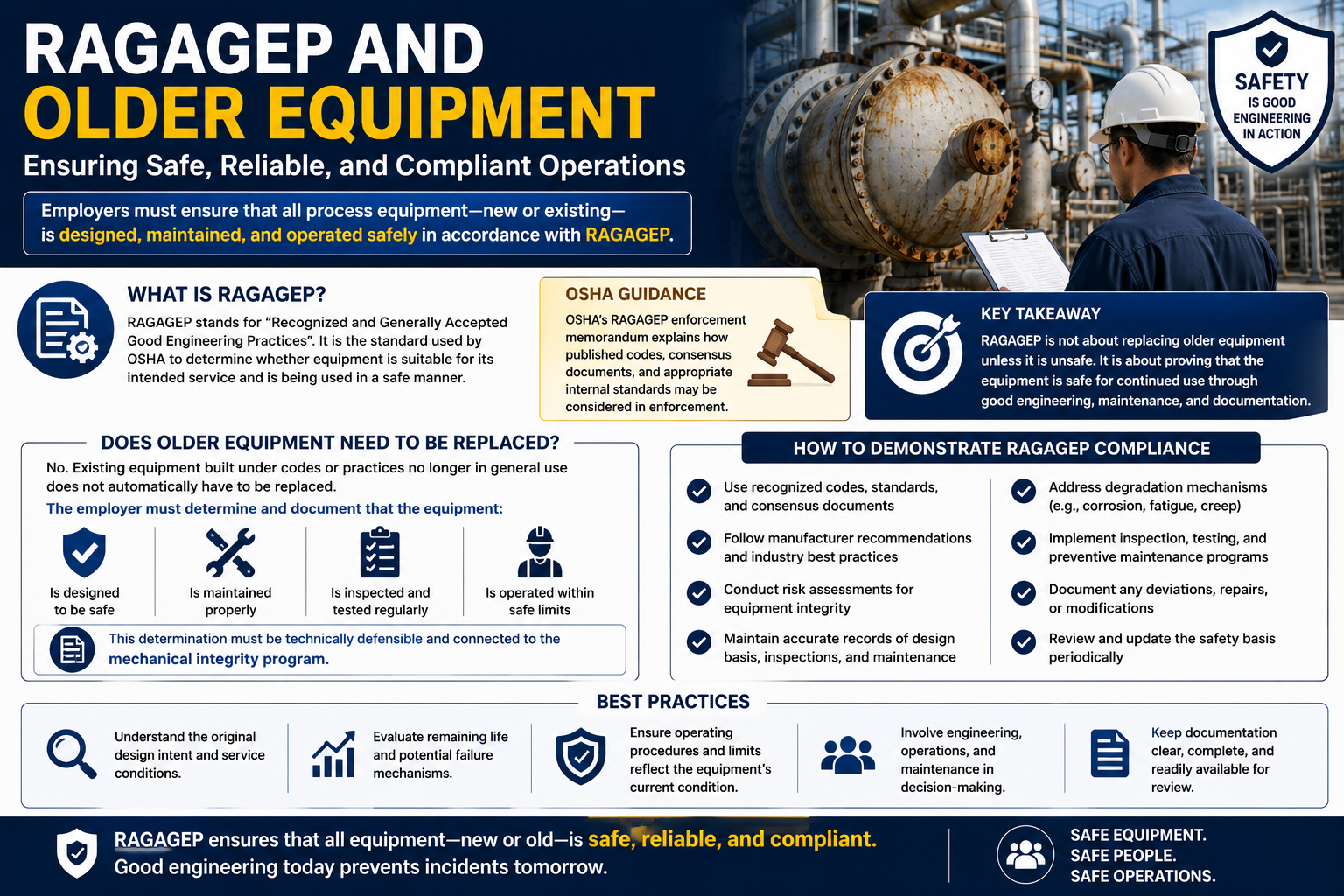
The employer must document that process equipment complies with recognized and generally accepted good engineering practices, commonly abbreviated as RAGAGEP. OSHA’s RAGAGEP enforcement memorandum explains how published codes, consensus documents, and appropriate internal standards may be considered in enforcement.
Existing equipment built under codes or practices no longer in general use does not automatically have to be replaced. The employer must determine and document that it is designed, maintained, inspected, tested, and operated safely. That determination should be technically defensible and connected to the mechanical integrity program.
How to organize a PSI file
A practical PSI index can be Process Safety Information organized by process and document owner:
- Coverage and boundary: process description, equipment list, inventories, and coverage basis.
- Chemical hazards: current SDSs, exposure limits, reactivity, stability, compatibility, and mixing hazards.
- Technology: chemistry, flow diagrams, inventories, safe limits, and deviation consequences.
- Equipment: specifications, materials, P&IDs, classifications, relief and ventilation design, balances, codes, and safety systems.
- Verification: field checks, approvals, assumptions, calculations, source references, and RAGAGEP basis.
- Change control: revision number, owner, approval date, affected documents, and links to management-of-change records.
Keeping PSI accurate after changes
PSI must describe the current process. When a change covered by management of change affects required PSI, paragraph 1910.119(l)(4) requires the information to be updated. The update should occur as part of the change workflow, before outdated diagrams or limits are used for operation, training, maintenance, or a pre-startup review.
Useful controls include a document owner, revision history, approval workflow, field-verification status, controlled distribution, and a periodic check against actual equipment. A clean file structure is not enough if a field modification was never marked on the P&ID.
Common PSI failure points
- Treating the SDS as the entire chemical-hazard record;
- Using an outdated P&ID after equipment changes;
- Listing operating limits without explaining deviation consequences;
- Keeping relief calculations without identifying the design scenario;
- Failing to document the safety basis for older equipment;
- Allowing temporary changes to remain undocumented; and
- Completing a PHA with unresolved or assumed technical information.
PSI readiness checklist
- Is the process boundary and maximum intended inventory documented?
- Are chemical-hazard records complete beyond the SDS where necessary?
- Do diagrams match the field configuration?
- Are safe limits and consequences of deviation defined?
- Are relief, ventilation, electrical, and safety-system design bases available?
- Is RAGAGEP compliance or the safe basis for older equipment documented?
- Can operators, maintenance personnel, and the PHA team find the current version?
- Does management of change trigger all necessary PSI updates?
Related PSM requirements
- OSHA Process Safety Management overview
- Process Hazard Analysis requirements
- PSM operating procedures
- Mechanical integrity requirements



1 Trackback / Pingback