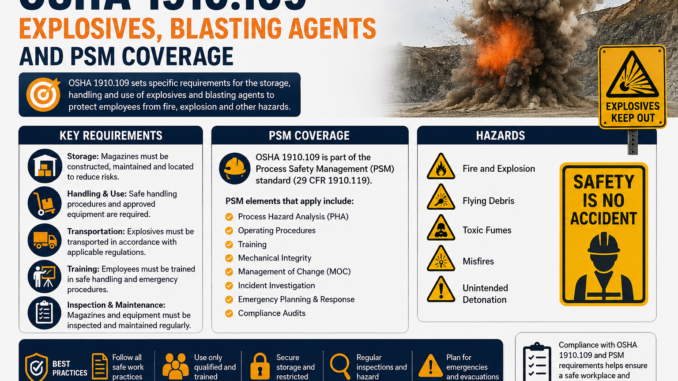
OSHA 1910.109 and Process Safety Management intersect most directly in paragraph 1910.109(k). Under 29 CFR 1910.109(k)(2) and (k)(3), the manufacture of explosives and the manufacture of pyrotechnics must comply with 29 CFR 1910.119.
This is a narrow but important relationship. Section 1910.109 contains requirements addressing explosives and blasting agents more broadly, while paragraphs (k)(2) and (k)(3) bring explosives and pyrotechnics manufacturing into the PSM system. Coverage should be determined from the actual materials and activities, not from an informal product label alone.
What 1910.109(k) requires
Paragraph 1910.109(k) addresses the scope of the explosives standard. Its PSM connection is:
- 1910.109(k)(2): the manufacture of explosives must comply with 1910.119; and
- 1910.109(k)(3): the manufacture of pyrotechnics must comply with 1910.119.
OSHA explained in the 1992 PSM final rule that it placed these manufacturing requirements in 1910.109 so the significant requirements concerning explosives and blasting agents would be referenced together. Do not treat Appendix A chemical thresholds as the only route for evaluating the manufacturing activities described in paragraph (k).
Manufacturing is broader than final formulation
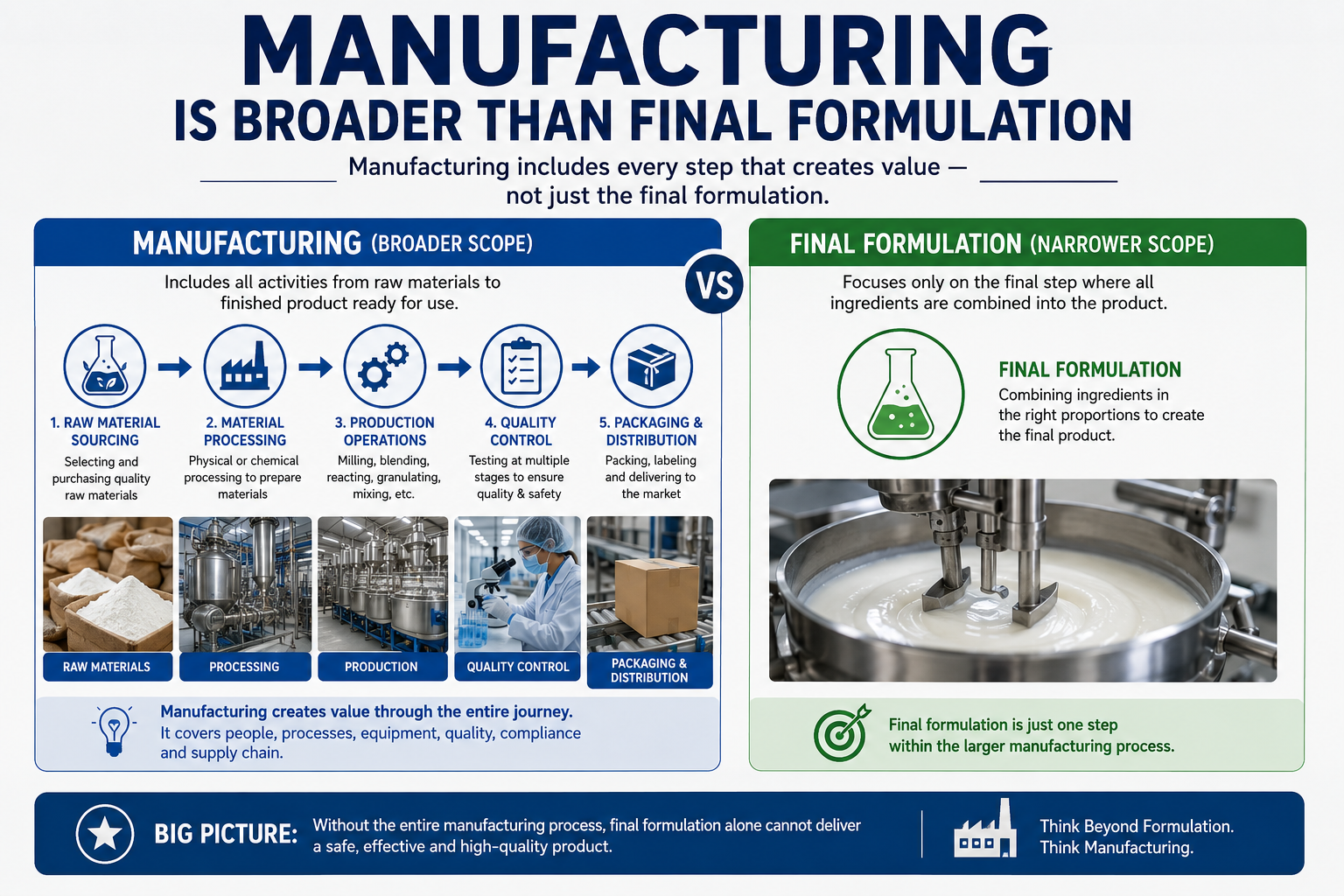
OSHA’s 1998 explosives and pyrotechnics interpretation describes explosives manufacturing as activities involved in making a chemical compound, mixture, or device intended to explode. The interpretation identifies activities such as mixing, blending, extruding, synthesizing, assembling, and disassembling.
Whether a particular operation is manufacturing depends on the facts. A facility should map each step, material, intermediate, device, rework activity, and support system rather than evaluating only the packaged final product. Specialized counsel and technical review may be needed where classification or scope OSHA 1910.109 is uncertain.
Pyrotechnics manufacturing
OSHA defines pyrotechnics in 1910.109 as combustible or explosive compositions, or manufactured articles designed and prepared to produce audible or visible effects commonly referred to as fireworks. Paragraph (k)(3) connects their manufacture to PSM.
The PSM system does not replace the other controls in 1910.109. It adds a management framework connecting employee participation, process information, hazard analysis, procedures, training, contractor controls, pre-startup review, mechanical integrity, hot work, change management, incident learning, emergency planning, audits, and access to necessary OSHA 1910.109 information.
DOT classification does not always end the OSHA analysis
A 2021 OSHA interpretation addressed articles or devices classified by the U.S. Department of Transportation as “Not in the explosive class” or “Not regulated.” OSHA explained that manufacturing articles or devices using explosive or pyrotechnic materials, as defined in 1910.109, can still be regulated under 1910.109 and PSM.
Transportation classification and workplace-process coverage serve different regulatory purposes. Do not assume that a DOT shipping result automatically determines every OSHA obligation. Evaluate the materials and manufacturing process under the applicable OSHA language and interpretations.
Manufacturing, storage, and use are not interchangeable
Section 1910.109 regulates multiple activities, including manufacture, keeping, storage, sale, transportation, and use. The specific PSM cross-references in paragraphs (k)(2) and (k)(3) concern explosives and pyrotechnics manufacturing. Other activities can remain subject to applicable 1910.109 requirements even when that manufacturing cross-reference is not the basis.
A process may also require a separate coverage analysis under 1910.119 based on listed highly hazardous chemicals, flammable gases, or flammable liquids at applicable quantities and subject to the standard’s exceptions. Because proximity, interconnection, and process boundaries matter, coverage should be documented by OSHA 1910.109 qualified personnel.
How the 14 PSM elements apply as a system
For covered manufacturing, the 14 PSM elements should operate as one system:
- Employee participation: involve knowledgeable employees in PHA and other element development.
- Process safety information: document hazards, technology, equipment, limits, and safeguards.
- PHA: analyze credible fire, explosion, reaction, ignition, human-factor, and siting scenarios.
- Procedures and training: provide controlled instructions and verify employee understanding.
- Contractors: coordinate hazards, emergency provisions, performance, training, and work practices.
- PSSR and mechanical integrity: verify readiness and maintain process equipment.
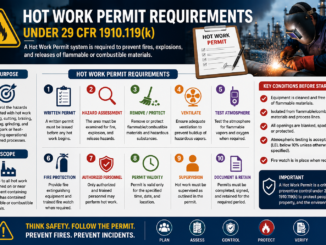
- Hot work and MOC: control ignition-producing work and changes to the covered process.
- Incident, emergency, audit, and access systems: prepare, learn, verify, and provide OSHA 1910.109 necessary information.
Coverage-review questions
A documented review should ask:
- What compounds, mixtures, devices, intermediates, and wastes are present?
- Which activities constitute manufacture, assembly, disassembly, rework, testing, or support?
- Do 1910.109 definitions and paragraphs (k)(2) or (k)(3) apply?
- Does a separate 1910.119 coverage route apply based on an Appendix A chemical or flammable material?
- What equipment and activities form the covered process through interconnection or proximity?
- Which other OSHA, DOT, ATF, environmental, fire-code, state, or local requirements apply?
- Who approved the determination, and what current evidence supports it?
This review is an applicability analysis, not a substitute for the required PSM program. Revisit it when materials, products, equipment, process boundaries, classifications, or regulatory interpretations OSHA 1910.109 change.
Common coverage mistakes
- Assuming PSM applies only when an Appendix A threshold is exceeded;
- Evaluating only the finished product and ignoring manufacturing intermediates or activities;
- Treating DOT shipping classification as the complete OSHA determination;
- Assuming storage, use, and manufacture have identical PSM treatment;
- Applying PSM while overlooking other applicable parts of 1910.109;
- Using obsolete material names, classifications, or process boundaries;
- Failing to assess changes through MOC; and
- Using a generic program without process-specific hazard analysis and OSHA 1910.109 information.
Keep the applicability record current
An applicability record should identify the regulatory provisions reviewed, the materials and activities evaluated, the process boundary, the evidence used, responsible reviewers, assumptions, and approval date. Attach current process descriptions and classifications where appropriate. A short conclusion without the underlying OSHA 1910.109 facts becomes unreliable when personnel, products, suppliers, or terminology change.
Trigger a new review when the facility introduces a new formulation or device, changes an assembly or disassembly activity, alters explosive or pyrotechnic material, receives a different transportation classification, modifies connected equipment, or changes the process location. Route covered-process changes through MOC before startup. If the review concludes that PSM no longer applies, preserve the technical and regulatory basis and confirm that all other applicable explosives, fire, environmental, transportation, and licensing duties remain addressed.
Because consequences can be severe, unresolved scope questions should be escalated before work proceeds. The conservative action is to pause the affected decision and obtain qualified technical and legal interpretation, not to infer an exemption from an incomplete label or threshold OSHA 1910.109 comparison.
Related PSM requirements
- OSHA PSM overview
- Appendix A chemicals and threshold quantities
- Process Hazard Analysis
- Management of Change


Be the first to comment