
osha-1910-119-appendix-a
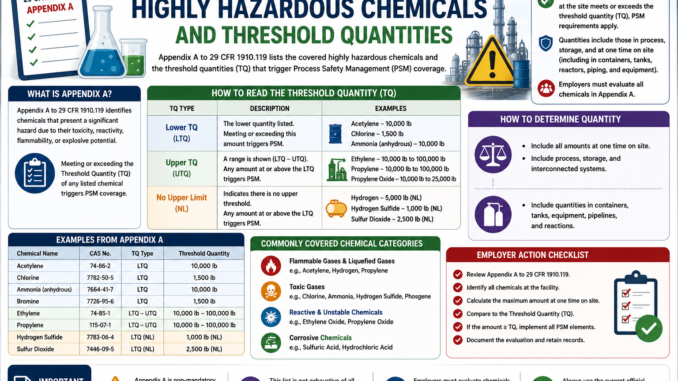
OSHA 1910.119 Appendix A provides the threshold quantities used for one important PSM coverage route. The official table identifies each entry by chemical name, Chemical Abstracts Service number where available, and threshold quantity in pounds.
Use the searchable table below as a working reference, then verify every coverage decision against OSHA’s live Appendix A table and the complete 29 CFR 1910.119 standard. Chemical identity, concentration, inventory, process boundaries, interconnection, proximity, and exceptions can all affect the analysis.
OSHA 1910.119 Appendix A and PSM Coverage
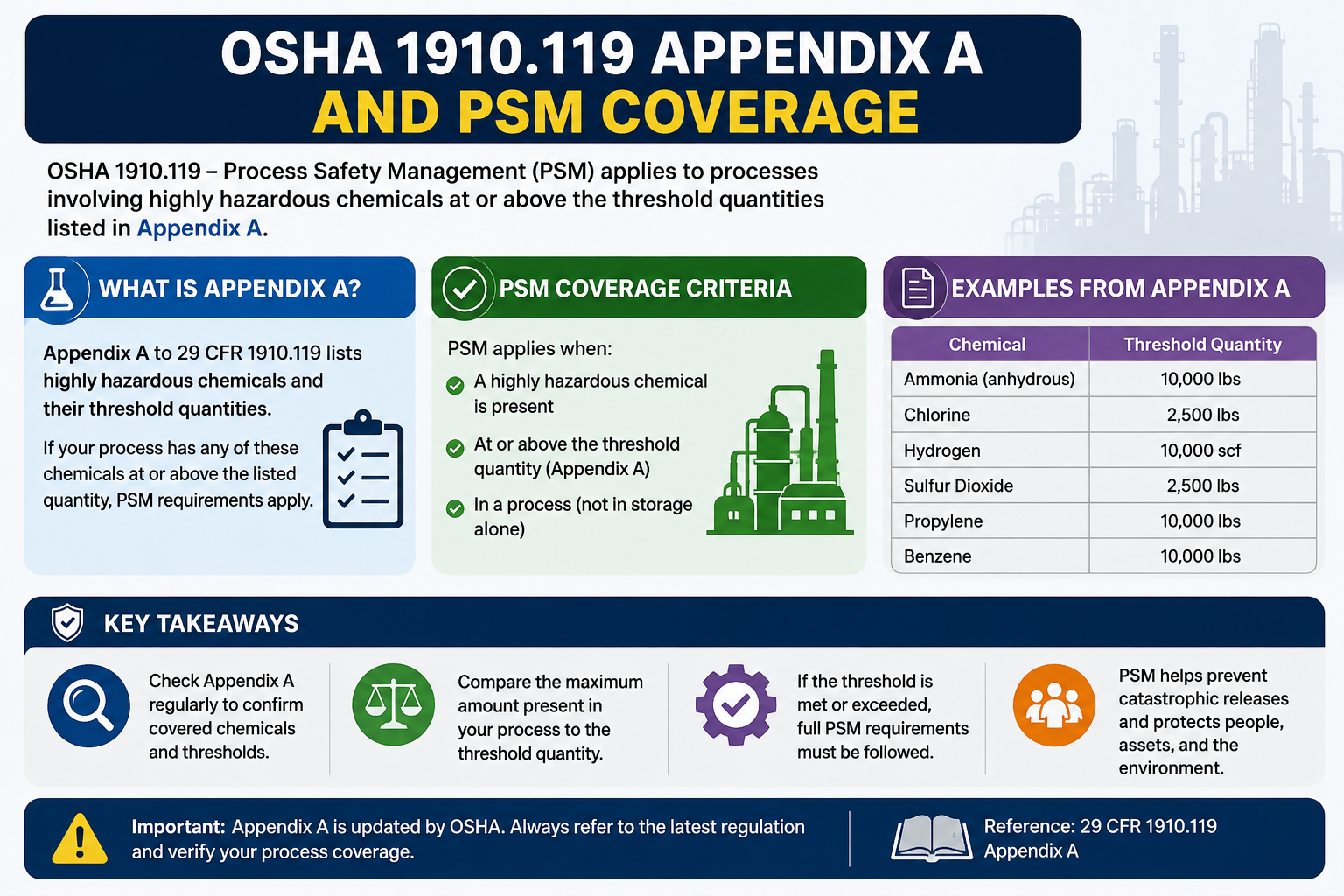
Paragraph 1910.119(a)(1)(i) applies PSM to a process involving a chemical at or above the threshold quantity specified in Appendix A. Appendix A is one coverage route. Paragraph (a)(1)(ii) separately addresses certain quantities of Category 1 flammable gases and flammable liquids with flashpoints below 100°F (37.8°C), subject to stated exceptions. Explosives and pyrotechnics manufacturing also has a specific PSM connection through 1910.109(k).
Appendix A quantities are not workplace exposure limits. They are threshold quantities used for PSM applicability. Exposure limits, environmental-reporting thresholds, fire-code limits, and EPA Risk Management Program thresholds serve different purposes and should not be substituted OSHA 1910.119 Appendix A automatically.
How to use the chemical table
- Build an inventory of chemicals and mixtures associated with the process.
- Verify chemical identity using the name, synonyms, Safety Data Sheet, and CAS number.
- Check whether Appendix A specifies a concentration.
- Determine the maximum quantity that could be involved in the process, not only the average daily inventory.
- Evaluate interconnected vessels and separate vessels located so a highly hazardous chemical could be involved in a potential release.
- Compare the covered amount with the listed threshold quantity.
- Evaluate other PSM coverage routes and exceptions.
- Document data sources, assumptions, calculations, process boundary, and OSHA 1910.119 Appendix A approval.
Chemical name, CAS number, and concentration
Names can vary across purchasing records, SDSs, laboratory systems, and operating documents. The CAS number helps distinguish substances with similar names, but some Appendix A entries state “None” or “Varies.” Use the entire entry, including synonyms and concentration language.
Several entries specify a concentration, such as ammonia solutions above 44 percent ammonia by weight, hydrogen peroxide at 52 percent by weight or greater, or nitric acid at 94.5 percent by weight or greater. Do not drop the concentration qualifier when screening OSHA 1910.119 Appendix A inventory.
Mixtures and commercial-grade chemicals
Mixture analysis can be complex. OSHA’s 1994 threshold-quantity interpretation discusses commercial-grade concentrations, entries with stated weight percentages, and examples of how amounts in mixtures may be evaluated. Older interpretations should be read with the current regulatory text because interpretations explain specific circumstances and can be affected by later developments.
Do not use a universal formula for every mixture without verifying the applicable entry and OSHA guidance. Record the composition source, concentration basis, maximum credible amount, calculation units, and treatment OSHA 1910.119 Appendix A of all connected OSHA 1910.119 Appendix A inventory.
Process boundaries, interconnection, and proximity
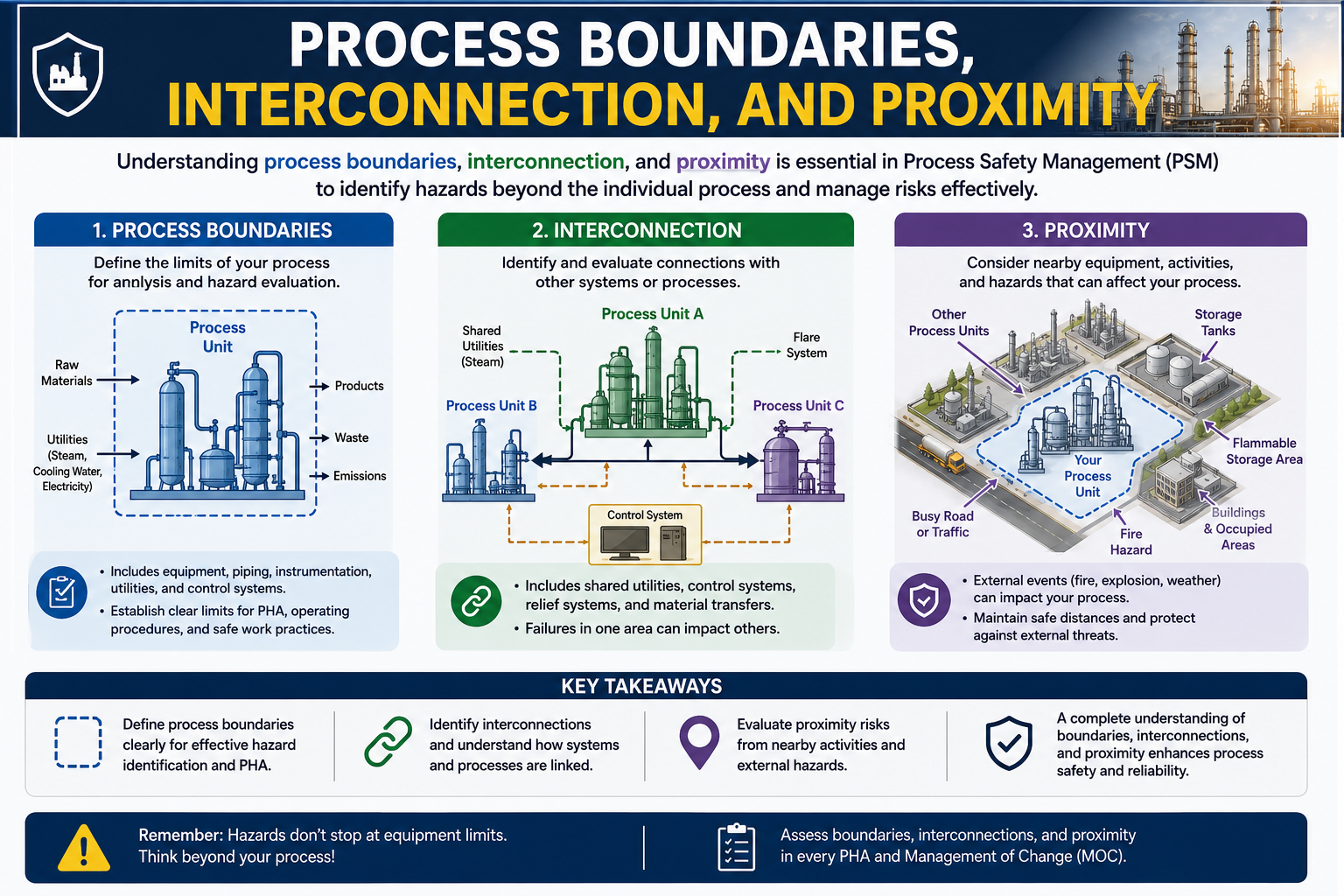
The threshold analysis applies to a “process,” not automatically to each vessel in isolation. Under the PSM definition, interconnected vessels are considered a single process. Separate vessels can also be considered a single process when located so that a highly hazardous chemical could be involved in a potential release.
Use current block flow and process flow diagrams, P&IDs, inventories, transfer arrangements, and facility layouts to define the boundary. Document shared piping, temporary connections, common containment areas, and credible release OSHA 1910.119 Appendix A interactions.
Current OSHA Appendix A chemical table
The OSHA 1910.119 Appendix A table identifies chemicals by name, CAS number, and threshold quantity. The table is reproduced from OSHA’s current online Appendix A page as reviewed on 11 August 2026. TQ means threshold quantity in pounds. Use your browser’s page-search function to find a chemical name or OSHA 1910.119 Appendix A CAS number.
+
| CHEMICAL name | CAS* | TQ** |
|---|---|---|
| Acetaldehyde | 75-07-0 | 2500 |
| Acrolein (2-Propenal) | 107-02-8 | 150 |
| Acrylyl Chloride | 814-68-6 | 250 |
| Allyl Chloride | 107-05-1 | 1000 |
| Allylamine | 107-11-9 | 1000 |
| Alkylaluminums | Varies | 5000 |
| Ammonia, Anhydrous | 7664-41-7 | 10000 |
| Ammonia solutions (>44% ammonia by weight) | 7664-41-7 | 15000 |
| Ammonium Perchlorate | 7790-98-9 | 7500 |
| Ammonium Permanganate | 7787-36-2 | 7500 |
| Arsine (also called Arsenic Hydride) | 7784-42-1 | 100 |
| Bis(Chloromethyl) Ether | 542-88-1 | 100 |
| Boron Trichloride | 10294-34-5 | 2500 |
| Boron Trifluoride | 7637-07-2 | 250 |
| Bromine | 7726-95-6 | 1500 |
| Bromine Chloride | 13863-41-7 | 1500 |
| Bromine Pentafluoride | 7789-30-2 | 2500 |
| Bromine Trifluoride | 7787-71-5 | 15000 |
| 3-Bromopropyne (also called Propargyl Bromide) | 106-96-7 | 100 |
| Butyl Hydroperoxide (Tertiary) | 75-91-2 | 5000 |
| Butyl Perbenzoate (Tertiary) | 614-45-9 | 7500 |
| Carbonyl Chloride (see Phosgene) | 75-44-5 | 100 |
| Carbonyl Fluoride | 353-50-4 | 2500 |
| Cellulose Nitrate (concentration >12.6% nitrogen) | 9004-70-0 | 2500 |
| Chlorine | 7782-50-5 | 1500 |
| Chlorine Dioxide | 10049-04-4 | 1000 |
| Chlorine Pentrafluoride | 13637-63-3 | 1000 |
| Chlorine Trifluoride | 7790-91-2 | 1000 |
| Chlorodiethylaluminum (also called Diethylaluminum Chloride) | 96-10-6 | 5000 |
| 1-Chloro-2,4-Dinitrobenzene | 97-00-7 | 5000 |
| Chloromethyl Methyl Ether | 107-30-2 | 500 |
| Chloropicrin | 76-06-2 | 500 |
| Chloropicrin and Methyl Bromide mixture | None | 1500 |
| Chloropicrin and Methyl Chloride mixture | None | 1500 |
| Cumene Hydroperoxide | 80-15-9 | 5000 |
| Cyanogen | 460-19-5 | 2500 |
| Cyanogen Chloride | 506-77-4 | 500 |
| Cyanuric Fluoride | 675-14-9 | 100 |
| Diacetyl Peroxide (Concentration >70%) | 110-22-5 | 5000 |
| Diazomethane | 334-88-3 | 500 |
| Dibenzoyl Peroxide | 94-36-0 | 7500 |
| Diborane | 19287-45-7 | 100 |
| Dibutyl Peroxide (Tertiary) | 110-05-4 | 5000 |
| Dichloro Acetylene | 7572-29-4 | 250 |
| Dichlorosilane | 4109-96-0 | 2500 |
| Diethylzinc | 557-20-0 | 10000 |
| Diisopropyl Peroxydicarbonate | 105-64-6 | 7500 |
| Dilaluroyl Peroxide | 105-74-8 | 7500 |
| Dimethyldichlorosilane | 75-78-5 | 1000 |
| Dimethylhydrazine, 1,1- | 57-14-7 | 1000 |
| Dimethylamine, Anhydrous | 124-40-3 | 2500 |
| 2,4-Dinitroaniline | 97-02-9 | 5000 |
| Ethyl Methyl Ketone Peroxide (also Methyl Ethyl Ketone Peroxide; concentration >60%) | 1338-23-4 | 5000 |
| Ethyl Nitrite | 109-95-5 | 5000 |
| Ethylamine | 75-04-7 | 7500 |
| Ethylene Fluorohydrin | 371-62-0 | 100 |
| Ethylene Oxide | 75-21-8 | 5000 |
| Ethyleneimine | 151-56-4 | 1000 |
| Fluorine | 7782-41-4 | 1000 |
| Formaldehyde (Formalin) | 50-00-0 | 1000 |
| Furan | 110-00-9 | 500 |
| Hexafluoroacetone | 684-16-2 | 5000 |
| Hydrochloric Acid, Anhydrous | 7647-01-0 | 5000 |
| Hydrofluoric Acid, Anhydrous | 7664-39-3 | 1000 |
| Hydrogen Bromide | 10035-10-6 | 5000 |
| Hydrogen Chloride | 7647-01-0 | 5000 |
| Hydrogen Cyanide, Anhydrous | 74-90-8 | 1000 |
| Hydrogen Fluoride | 7664-39-3 | 1000 |
| Hydrogen Peroxide (52% by weight or greater) | 7722-84-1 | 7500 |
| Hydrogen Selenide | 7783-07-5 | 150 |
| Hydrogen Sulfide | 7783-06-4 | 1500 |
| Hydroxylamine | 7803-49-8 | 2500 |
| Iron, Pentacarbonyl | 13463-40-6 | 250 |
| Isopropylamine | 75-31-0 | 5000 |
| Ketene | 463-51-4 | 100 |
| Methacrylaldehyde | 78-85-3 | 1000 |
| Methacryloyl Chloride | 920-46-7 | 150 |
| Methacryloyloxyethyl Isocyanate | 30674-80-7 | 100 |
| Methyl Acrylonitrile | 126-98-7 | 250 |
| Methylamine, Anhydrous | 74-89-5 | 1000 |
| Methyl Bromide | 74-83-9 | 2500 |
| Methyl Chloride | 74-87-3 | 15000 |
| Methyl Chloroformate | 79-22-1 | 500 |
| Methyl Ethyl Ketone Peroxide (concentration >60%) | 1338-23-4 | 5000 |
| Methyl Fluoroacetate | 453-18-9 | 100 |
| Methyl Fluorosulfate | 421-20-5 | 100 |
| Methyl Hydrazine | 60-34-4 | 100 |
| Methyl Iodide | 74-88-4 | 7500 |
| Methyl Isocyanate | 624-83-9 | 250 |
| Methyl Mercaptan | 74-93-1 | 5000 |
| Methyl Vinyl Ketone | 78-94-4 | 100 |
| Methyltrichlorosilane | 75-79-6 | 500 |
| Nickel Carbonly (Nickel Tetracarbonyl) | 13463-39-3 | 150 |
| Nitric Acid (94.5% by weight or greater) | 7697-37-2 | 500 |
| Nitric Oxide | 10102-43-9 | 250 |
| Nitroaniline (para Nitroaniline | 100-01-6 | 5000 |
| Nitromethane | 75-52-5 | 2500 |
| Nitrogen Dioxide | 10102-44-0 | 250 |
| Nitrogen Oxides (NO; NO2; N204; N203) | 10102-44-0 | 250 |
| Nitrogen Tetroxide (also called Nitrogen Peroxide) | 10544-72-6 | 250 |
| Nitrogen Trifluoride | 7783-54-2 | 5000 |
| Nitrogen Trioxide | 10544-73-7 | 250 |
| Oleum (65% to 80% by weight; also called Fuming Sulfuric Acid) | 8014-95-7 | 1,000 |
| Osmium Tetroxide | 20816-12-0 | 100 |
| Oxygen Difluoride (Fluorine Monoxide) | 7783-41-7 | 100 |
| Ozone | 10028-15-6 | 100 |
| Pentaborane | 19624-22-7 | 100 |
| Peracetic Acid (concentration >60% Acetic Acid; also called Peroxyacetic Acid) | 79-21-0 | 1000 |
| Perchloric Acid (concentration >60% by weight) | 7601-90-3 | 5000 |
| Perchloromethyl Mercaptan | 594-42-3 | 150 |
| Perchloryl Fluoride | 7616-94-6 | 5000 |
| Peroxyacetic Acid (concentration >60% Acetic Acid; also called Peracetic Acid) | 79-21-0 | 1000 |
| Phosgene (also called Carbonyl Chloride) | 75-44-5 | 100 |
| Phosphine (Hydrogen Phosphide) | 7803-51-2 | 100 |
| Phosphorus Oxychloride (also called Phosphoryl Chloride) | 10025-87-3 | 1000 |
| Phosphorus Trichloride | 7719-12-2 | 1000 |
| Phosphoryl Chloride (also called Phosphorus Oxychloride) | 10025-87-3 | 1000 |
| Propargyl Bromide | 106-96-7 | 100 |
| Propyl Nitrate | 627-3-4 | 2500 |
| Sarin | 107-44-8 | 100 |
| Selenium Hexafluoride | 7783-79-1 | 1000 |
| Stibine (Antimony Hydride) | 7803-52-3 | 500 |
| Sulfur Dioxide (liquid) | 7446-09-5 | 1000 |
| Sulfur Pentafluoride | 5714-22-7 | 250 |
| Sulfur Tetrafluoride | 7783-60-0 | 250 |
| Sulfur Trioxide (also called Sulfuric Anhydride) | 7446-11-9 | 1000 |
| Sulfuric Anhydride (also called Sulfur Trioxide) | 7446-11-9 | 1000 |
| Tellurium Hexafluoride | 7783-80-4 | 250 |
| Tetrafluoroethylene | 116-14-3 | 5000 |
| Tetrafluorohydrazine | 10036-47-2 | 5000 |
| Tetramethyl Lead | 75-74-1 | 1000 |
| Thionyl Chloride | 7719-09-7 | 250 |
| Trichloro (chloromethyl) Silane | 1558-25-4 | 100 |
| Trichloro (dichlorophenyl) Silane | 27137-85-5 | 2500 |
| Trichlorosilane | 10025-78-2 | 5000 |
| Trifluorochloroethylene | 79-38-9 | 10000 |
| Trimethyoxysilane | 2487-90-3 | 1500 |
Coverage-review checklist
- Has each substance been checked by name, synonym, and CAS number?
- Are concentration qualifiers preserved?
- Does the quantity represent the maximum amount that could be involved?
- Are interconnected and proximate inventories included in the process analysis?
- Have mixtures and commercial-grade concentrations been evaluated using applicable guidance?
- Have flammable-material and 1910.109 manufacturing routes also been checked?
- Are all claimed exceptions supported by current facts?
- Is the determination documented and approved by qualified OSHA 1910.119 Appendix A personnel?
Common Appendix A mistakes
- Searching only by a familiar product name and missing the listed chemical identity;
- Ignoring a concentration qualifier;
- Using average inventory instead of the amount that can be involved in the process;
- Dividing interconnected equipment into artificial smaller inventories;
- Assuming every mixture is treated by the same calculation;
- Confusing a PSM threshold with an occupational exposure limit;
- Ignoring a separate flammable-material or explosives-manufacturing coverage route; and
- Relying on an old copied table instead of verifying the official OSHA 1910.119 Appendix A current source.
Related PSM requirements
- OSHA Process Safety Management overview
- Process Safety Information
- OSHA 1910.109 explosives and PSM coverage
- Block flow and process flow diagrams



1 Trackback / Pingback