
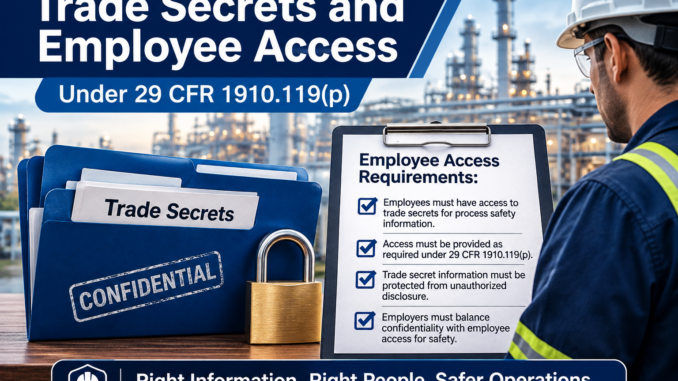
PSM trade secrets cannot be used to withhold information needed to perform specified Process Safety Management duties. Under 29 CFR 1910.119(p), employers must make all information necessary for designated PSM work available without regard to its possible trade-secret status.
The employer may require confidentiality agreements as permitted by OSHA’s Hazard Communication Standard, but confidentiality controls must not prevent required safety-information access. The practical goal is controlled disclosure, not a blanket denial or uncontrolled publication.
Who must receive necessary PSM information?
Paragraph 1910.119(p)(1) identifies the people responsible for or involved in:
- Compiling process safety information under paragraph (d);
- Assisting in the development of the process hazard analysis under paragraph (e);
- Developing operating procedures under paragraph (f);
- Conducting incident investigations under paragraph (m);
- Emergency planning and response under paragraph (n); and
- Compliance audits under paragraph (o).
The employer must make all information necessary to comply with those provisions available to those persons. Access should be sufficient for the assigned work. A PHA team cannot evaluate chemistry, reaction hazards, limits, or safeguards accurately if essential technical facts are removed from PSM Trade Secrets its review.
Confidentiality agreements are allowed
Paragraph (p)(2) states that the employer may require people receiving information under paragraph (p)(1) to enter confidentiality agreements not to disclose it, as set forth in 29 CFR 1910.1200. A confidentiality agreement can define authorized use, handling, storage, transmission, return, and disposal of protected information.
The agreement should not be written or administered in a way that blocks the safety work for which access is required. The people developing a PHA, procedure, emergency plan, investigation, or audit need enough time, context, and practical access to understand and use the PSM Trade Secrets information.
Employee and representative access
Paragraph (p)(3) states that employees and their designated representatives shall have access to trade-secret information contained in the PHA and other documents required by the PSM standard, subject to the rules and procedures in 29 CFR 1910.1200(i)(1) through (i)(12).
This access requirement also supports employee participation. Employees cannot meaningfully contribute to hazard analysis, procedure development, incident learning, or other PSM work if material safety information is PSM Trade Secrets inaccessible.
Trade-secret status does not erase required content
Marking an entire drawing, chemical description, PHA, or procedure as proprietary does not remove the underlying PSM obligation. The facility still needs complete and accurate information about chemical hazards, process technology, equipment, operating limits, safeguards, procedures, events, and other required subjects.
A public-facing document may be redacted when lawfully appropriate, while the controlled internal version remains complete for authorized PSM use. The employer should distinguish public disclosure from access by employees, representatives, contractors, reviewers, or officials under applicable PSM Trade Secrets requirements.
Build a practical access-control system
A workable system begins by classifying the information and mapping it to the people and tasks that require it. Useful controls can include:
- Role-based access to controlled digital repositories;
- Secure review rooms or managed physical copies;
- Confidentiality agreements matched to applicable requirements;
- Document identifiers, revision status, and distribution records;
- Watermarking or download restrictions where they do not impair use;
- Procedures for contractor and temporary-team access;
- Secure return, archival, and disposal processes; and
- An escalation path when a person believes necessary information is missing.
Security controls should preserve availability during normal work and credible emergencies. A repository that becomes unavailable during a power, network, or control-system outage may need a suitable contingency method for critical PSM Trade Secrets information.
Match access to the PSM lifecycle
| PSM activity | Information that may be necessary | Access objective |
|---|---|---|
| PSI | Chemistry, hazards, equipment design, limits, proprietary process details. | Compile a complete and accurate technical basis. |
| PHA | Reactions, inventories, controls, incidents, process conditions. | Identify credible hazards and evaluate safeguards. |
| Operating procedures | Limits, sequences, safety systems, exposure controls. | Create instructions consistent with actual technology and hazards. |
| Incident investigation | Design, data, procedures, change records, vendor information. | Establish contributing factors and corrective actions. |
| Emergency planning | Chemicals, inventories, release behavior, isolation and protection systems. | Plan protective actions using credible process information. |
| Compliance audit | Program records, findings, procedures, evidence of implementation. | Evaluate adequacy and PSM Trade Secrets actual conformance. |
Requests, denials, and disputes
The access procedure should identify how employees or designated representatives request information, who evaluates the request, the expected response time, and how disputed restrictions are reviewed. A denial should not rely only on a generic proprietary label. Record the basis, applicable rule, information provided, protective conditions, and escalation route.
Do not ask employees to work from an incomplete safety document while a dispute remains unresolved. Where immediate access is necessary for safe operation, emergency action, investigation, or change review, the system should provide an appropriately controlled way to PSM Trade Secrets proceed.
Document-control and cybersecurity considerations
Confidentiality and accuracy are separate control objectives. A protected document can still be obsolete, and an accurate document can still be distributed insecurely. Track revision, approval, effective date, owner, access, and retention. Remove or clearly mark obsolete copies so trade-secret controls do not preserve unsafe versions at the point of use.
For digital systems, use access logs, authentication, backups, recovery testing, and least-privilege design appropriate to the risk. Avoid access designs that require employees to share accounts or bypass controls to perform routine PSM tasks. Cybersecurity changes affecting covered-process technology or procedures may also need management-of-change PSM Trade Secrets review.
Common PSM trade-secret mistakes
- Withholding information needed for PSI, PHA, procedures, investigations, emergency planning, or audits;
- Using a blanket “confidential” label instead of identifying specific controls;
- Providing a heavily redacted copy that cannot support the assigned safety work;
- Confusing public disclosure with required employee or representative access;
- Using confidentiality agreements to discourage hazard reporting or participation;
- Failing to provide controlled access to contractors or specialists whose tasks require it;
- Keeping protected but obsolete documents in circulation; and
- Having no contingency access method for critical information during PSM Trade Secrets an emergency.

1 Trackback / Pingback