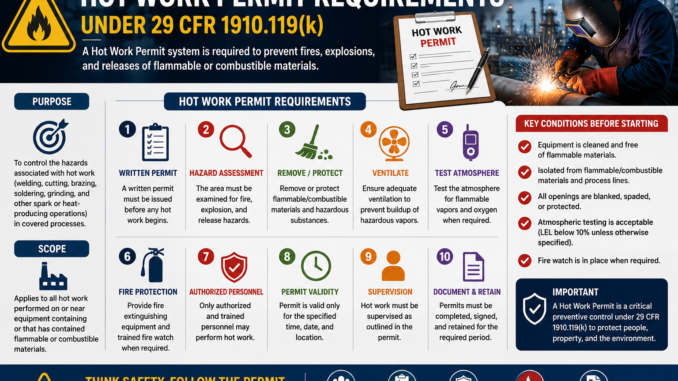
Hot Work Permit Requirements Under 29 CFR 1910.119(k)
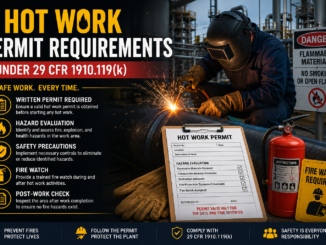
A PSM hot work permit is required for hot work performed on or near a process covered by OSHA Process Safety Management. Under 29 CFR 1910.119(k), the permit must document that applicable fire-prevention and protection requirements have been implemented, state the authorized date or dates, identify the object on which hot work will be performed, and remain on file until the work is complete.
The permit is evidence of a pre-work decision. It does not make welding, cutting, brazing, or another spark-producing activity safe by itself. Conditions must be verified in the field and remain controlled for the permit’s duration.
What OSHA defines as hot work
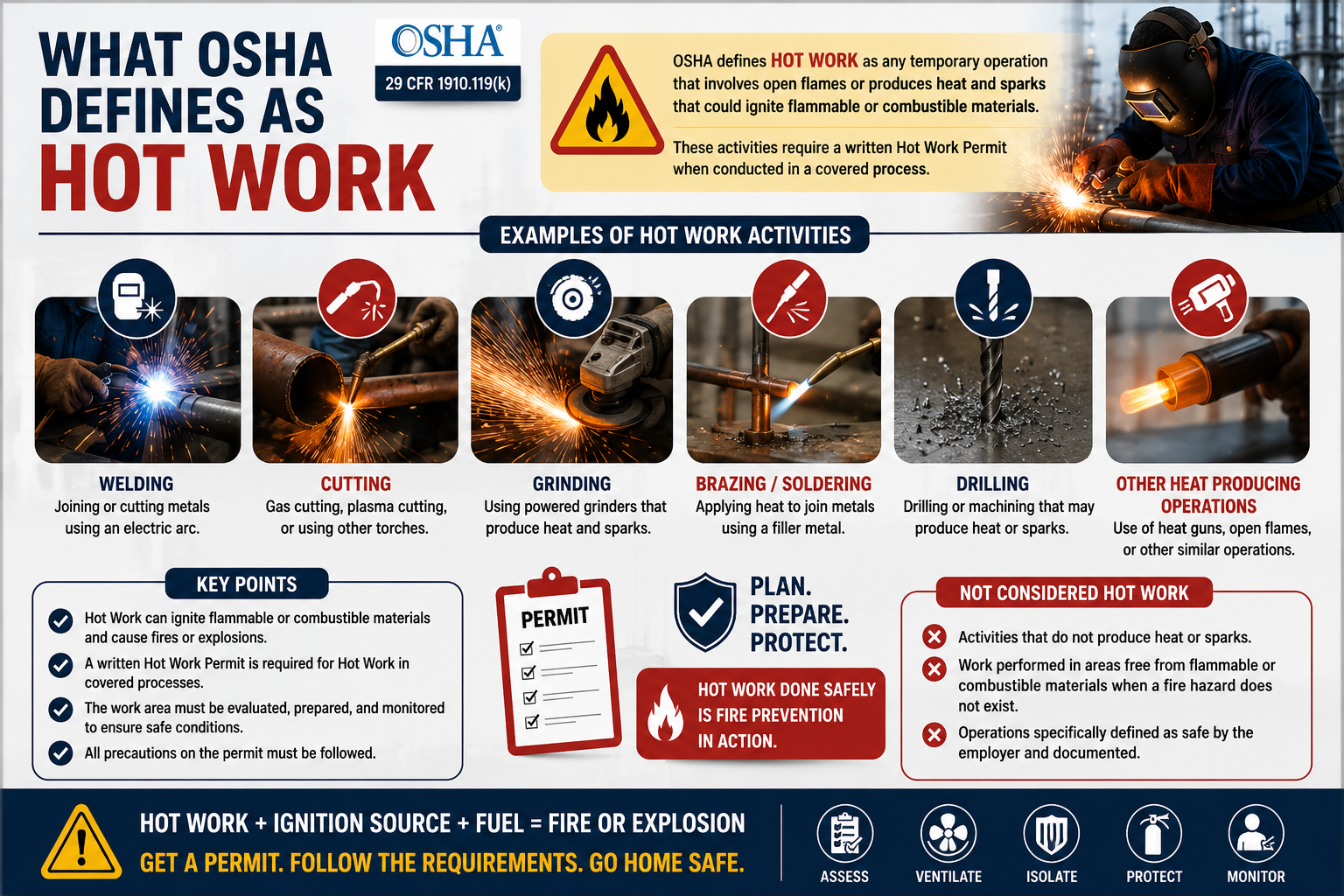
Paragraph 1910.119(b) defines hot work as work involving electric or gas welding, cutting, brazing, or similar flame- or spark-producing operations. The deciding issue is the ignition potential, not the name written on the work order.
Examples may include welding, torch cutting, brazing, soldering, grinding, and other operations capable of producing sparks, flame, or enough heat to ignite a hazardous atmosphere or combustible material. The facility’s permit system should define its covered activities using the applicable standards and site hazards.
When is a PSM hot-work permit required?
The employer must issue a permit when hot work is conducted on or near a covered process. “Near” should be evaluated based on where sparks, slag, heat, or flame could interact with process equipment, flammable material, vents, drains, openings, combustible construction, or a possible release. An arbitrary distance should not replace a hazard assessment.
The work may also involve contractor responsibilities, facility-entry controls, equipment opening, isolation, confined-space entry, or simultaneous operations. These controls should be coordinated rather than issued as disconnected permits.
What the permit must document
Paragraph 1910.119(k)(2) requires the permit to:
- Document implementation of the fire-prevention and protection requirements in 29 CFR 1910.252(a) before hot work begins;
- Indicate the date or dates authorized for hot work;
- Identify the object on which hot work is to be performed; and
- Be kept on file until completion of the hot-work operation.
A site may add fields needed to manage its hazards, but Hot Work Permit it should not omit these required elements.
Useful permit controls
Depending on the work and applicable rules, a practical permit may address:
- Exact process area, equipment, and job scope;
- Process status and operating approval;
- Isolation, lockout/tagout, draining, cleaning, purging, and line-opening status;
- Combustible-material removal or protection;
- Atmospheric testing, tester, instrument, readings, locations, and frequency;
- Fire watch and post-work monitoring;
- Extinguishers or other fire-protection equipment;
- Control of openings, drains, vents, and adjacent levels;
- Weather or ventilation conditions where relevant;
- Other simultaneous work;
- Authorized start and expiry; and
- Suspension, revalidation, and closeout conditions.
These fields are not a universal substitute for a job-specific assessment. The permit issuer must verify Hot Work Permit which controls apply.
A practical permit sequence
- Define the work: identify the exact object, method, location, and duration.
- Review process hazards: identify contained chemicals, nearby release points, ignition pathways, and changing conditions.
- Consider alternatives: use a cold-work method or move the work when feasible.
- Prepare equipment and area: complete required shutdown, isolation, cleaning, purging, combustible control, and access restrictions.
- Verify conditions: perform required inspection and atmospheric testing with suitable equipment.
- Authorize the permit: confirm controls, responsible persons, duration, and stop conditions.
- Monitor the work: maintain fire watch, testing, communication, and process awareness as required.
- Suspend when conditions change: stop work after an alarm, release, process change, permit expiry, loss of control, or other defined trigger.
- Close the permit: inspect the area, complete post-work monitoring, restore systems through authorization, and retain the permit until completion.
Atmospheric testing and changing conditions
A single gas reading does not prove that conditions will remain safe. Test location, instrument capability, calibration or bump-test status, sampling method, process configuration, ventilation, nearby work, and the possibility of renewed release all matter. Continuous or repeated monitoring may be necessary when conditions can change.
Personnel should know the limits that require work to stop and who can reauthorize it. The permit should not remain valid after a scope, location, process state, or environmental condition changes beyond Hot Work Permit what was evaluated.
Hot work by contractors
The host employer must communicate known fire, explosion, or toxic-release hazards and applicable emergency-plan provisions. The contract employer must assure employees are trained in necessary safe work practices, instructed in relevant hazards, and follow facility rules. A toolbox talk does not replace either employer’s PSM duties.
For task-level information, see the site’s grinding and welding risk assessment and welding and grinding JSA. Those resources should be checked against current site conditions and applicable standards.
Common hot-work permit failures
- The permit identifies an area but not the object being worked on;
- Authorization dates are missing or extended informally;
- Fire-prevention controls are checked without field verification;
- Isolation or gas testing does not match the actual work boundary;
- Nearby drains, vents, floors, or process openings are overlooked;
- The permit remains active after process or weather conditions change;
- Fire-watch responsibilities and post-work monitoring are unclear; and
- The record is discarded before the operation is Hot Work Permit complete.
When conditions change during the job
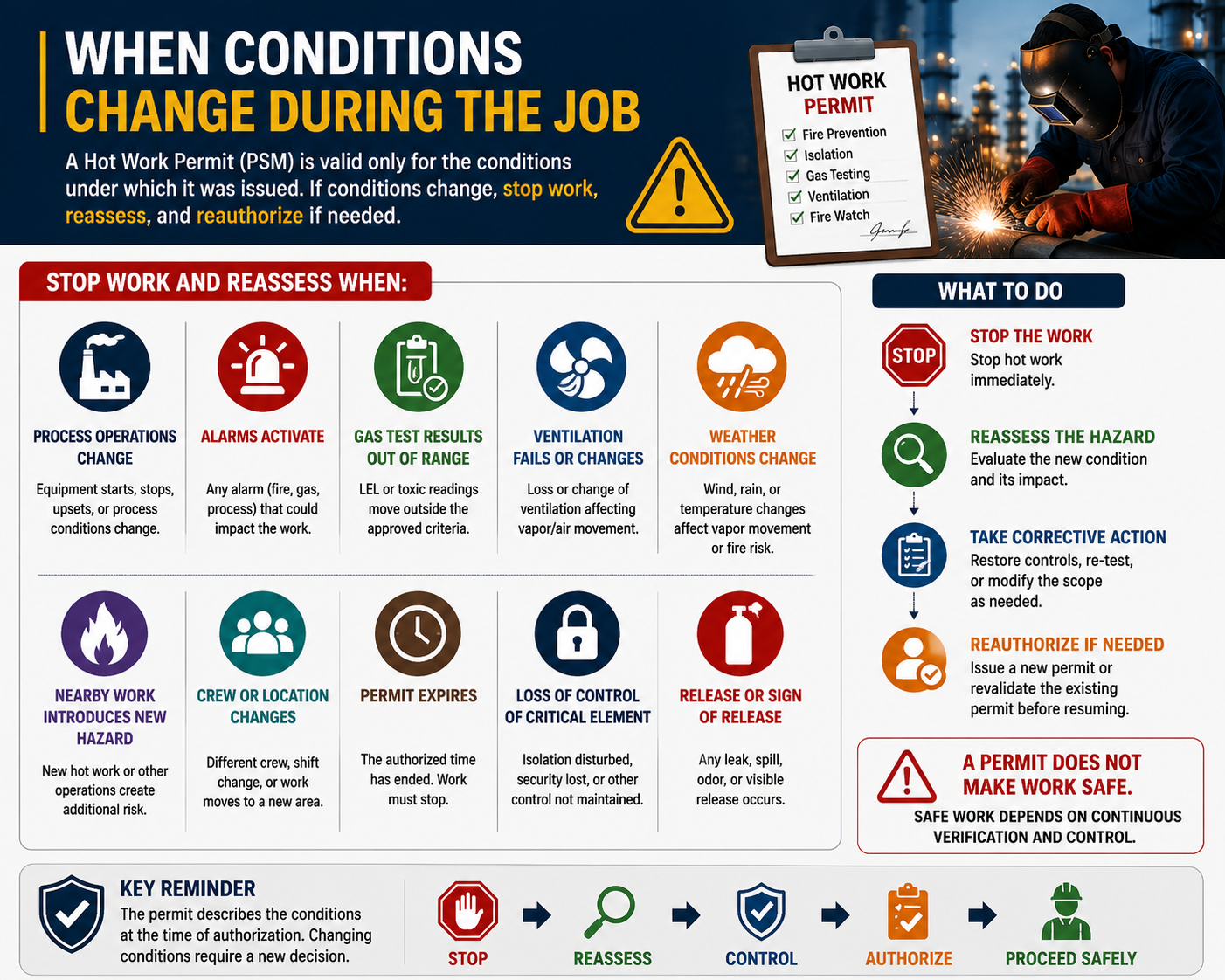
A permit describes the conditions under which the work was authorized. Stop and reassess when process operations change, alarms activate, gas-test results move outside the approved criteria, ventilation fails, weather affects vapor movement, nearby work introduces a new hazard, the crew or location changes, or the permit expires. The reassessment may require new testing, restored controls, a revised scope, or a new permit.
Shift handover deserves explicit control. The incoming issuer and work crew should verify the job status, isolations, surrounding operations, fire-watch arrangements, testing frequency, and emergency actions rather than relying on an unattended permit. The facility’s permit procedure should state Hot Work Permit whether permits may cross shifts and what reauthorization is required.
Permit closeout and return to service
At completion, inspect the work area for sparks, hot material, slag, smoldering insulation, damaged fire protection, open drains, removed covers, and temporary equipment. Maintain fire-watch monitoring for the period required by the applicable welding and cutting controls and site assessment. Record suspension or completion, remove temporary barriers when safe, and coordinate the release of isolations through the facility’s energy-control and operating procedures.
If hot work altered covered process equipment, do not treat permit closeout as authorization to operate. Mechanical-integrity inspection, pressure or leak testing, quality assurance, procedure updates, MOC, training, or PSSR may also be required before the equipment returns Hot Work Permit to service.
Related PSM requirements
- OSHA Process Safety Management overview
- PSM contractor safety
- PSM safe work practices
- Mechanical integrity requirements

Be the first to comment