Safety Officer Test Preparation
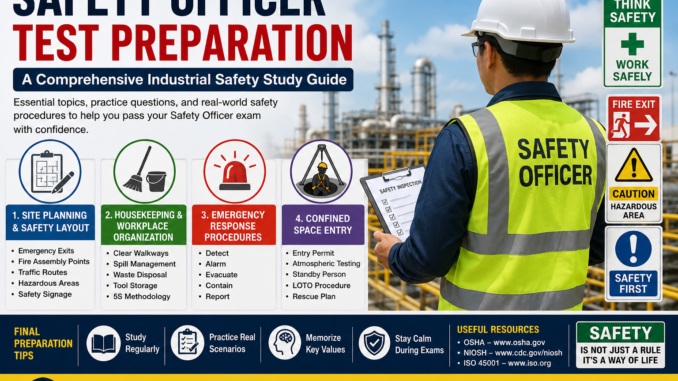
A Comprehensive Industrial Safety Study Guide
Introduction
Safety Officer Test Preparation is essential for candidates preparing for industrial safety certification exams in large organizations and construction environments. This guide covers major industrial safety topics including site planning, housekeeping, emergency response, and confined space entry.
The purpose of this Safety Officer Test Preparation guide is to help safety professionals understand practical workplace safety procedures while improving their exam performance. By practicing real-world safety scenarios and reviewing key concepts regularly, candidates can build confidence for both written tests and workplace responsibilities.
Section 1: Safety Officer Test Preparation for Site Planning & Safety Layout
Site planning is one of the most important parts of industrial safety management. A properly organized site reduces accidents, improves emergency response, and protects workers from hazards.
Key Concepts in Site Planning
Emergency Exit Planning
Emergency exits must remain clearly marked, unlocked, and accessible during all work operations.
Fire Assembly Points
Assembly points should be positioned away from hazardous areas and easily accessible during evacuations.
Vehicle and Pedestrian Traffic Control
Separate traffic routes reduce collision risks and improve workplace safety.
Hazardous Material Storage
Dangerous chemicals and flammable materials must be stored in designated restricted areas.
Safety Signage Requirements
Safety signs must be visible at entrances, exits, confined spaces, and hazardous zones.
Practice Questions — Site Planning
Q: What is the main objective of site planning in industrial safety?
A: The main objective is to organize work areas and emergency systems to reduce workplace hazards and improve safe operations.
Q: Who approves the site safety layout?
A: The Safety Officer and project management team approve the site layout before work begins.
Q: What should be inspected first at a new site?
A: Emergency exits, fire extinguishers, first aid stations, and hazardous storage areas should be inspected first.
Section 2: Safety Officer Test Preparation for Housekeeping
Good housekeeping is a major part of industrial safety and accident prevention. Poor housekeeping increases slip, trip, fall, and fire hazards in workplaces.
Key Housekeeping Standards
Clear Walkways
Emergency exits and walkways must remain free from obstacles and waste materials.
Proper Tool Storage
All equipment and tools should be returned to designated storage locations after use.
Spill Management
Oil, water, and chemical spills must be cleaned immediately using approved absorbent materials.
Waste Disposal
Waste bins should be available throughout the facility to encourage proper disposal practices.
FIFO Storage Method
First-In-First-Out inventory systems prevent material deterioration and improve workplace organization.
Practice Questions — Housekeeping
Q: What hazards are caused by poor housekeeping?
A: Poor housekeeping can cause slips, trips, falls, fires, and unsafe working conditions.
Q: What should workers do after discovering an oil spill?
A: Workers should secure the area, report the spill, and clean it immediately using proper materials.
Q: What is the purpose of the 5S system?
A: The 5S system improves workplace safety, efficiency, and organization through systematic housekeeping.
Section 3: Safety Officer Test Preparation for Emergency Response
Emergency response procedures are heavily included in Safety Officer Test Preparation exams because they are essential in industrial operations.
Emergency Response Process
Detect
Identify emergencies quickly using alarms, sensors, or visual inspection.
Alarm
Activate alarms immediately to notify all personnel.
Evacuate
Move workers safely toward emergency exits and assembly points.
Contain
Control the incident only if it is safe to do so.
Report
Notify emergency services and document the incident properly.
Practice Questions — Emergency Response
Q: What is the first action during a fire emergency?
A: Activate the alarm system and begin evacuation procedures immediately.
Q: What are the duties of a Safety Officer during evacuation?
A: The Safety Officer ensures safe evacuation, conducts headcounts, communicates with responders, and prevents unauthorized entry.
Q: How often should emergency drills occur?
A: Emergency drills should be conducted at least twice every year.
Section 4: Safety Officer Test Preparation for Confined Space Entry
Confined space entry is one of the most dangerous industrial activities and an important topic in Safety Officer Test Preparation.
What is a Confined Space?
Examples include:
- Storage tanks
- Pipelines
- Silos
- Underground manholes
- Trenches deeper than 1.2 meters
- Tunnels and vaults
Confined Space Entry Requirements
Entry Permit
A valid confined space permit must be approved before entry.
Atmospheric Testing
Test oxygen levels, toxic gases, and flammable vapors before entry.
Standby Person
A trained standby person must remain outside the confined space continuously.
Lockout/Tagout (LOTO)
All energy sources must be isolated before work begins.
PPE Requirements
Workers must wear proper PPE including respirators where necessary.
Rescue Planning
A rescue plan must be available before confined space entry starts.
Practice Questions — Confined Space Entry
Q: What is the minimum safe oxygen level?
A: The minimum acceptable oxygen level is 19.5%.
Q: What does LOTO stand for?
A: LOTO stands for Lockout/Tagout.
Q: Is a permit required for short confined space work?
A: Yes. A permit is mandatory regardless of work duration.
Q: What should happen if a gas detector alarms?
A: Workers must exit immediately and stop all work until the area is declared safe.
Final Preparation Tips for Safety Officer Test Preparation
Study Regularly
Review each section repeatedly to improve memory and understanding.
Practice Real Scenarios
Think practically about how safety procedures apply in real industrial workplaces.
Memorize Important Values
Remember critical values such as oxygen levels, evacuation procedures, and drill frequencies.
Stay Calm During Exams
Read every question carefully before answering.
Conclusion
This Safety Officer Test Preparation guide covers four major industrial safety topics commonly included in certification exams: Site Planning, Housekeeping, Emergency Response, and Confined Space Entry.
Understanding these topics not only helps candidates pass examinations but also prepares them for real workplace responsibilities. Industrial safety is about protecting workers, preventing incidents, and creating a safe working environment every day.
Consistent study, practical understanding, and workplace awareness are the keys to becoming a successful Safety Officer.
Good luck with your Safety Officer Test Preparation journey.
Be the first to comment