
TL;DR
- Dewatering in construction excavations is governed by 29 CFR 1926.651(h). Employees shall not enter an excavation with accumulated or accumulating water unless adequate precautions are in place.
- The six primary dewatering hazards are: soil instability and cave-in, electrical shock from submersible pumps, confined space atmospheric hazards, chemical/contaminated water exposure, noise and vibration, and flooding from uncontrolled water ingress.
- A competent person, as defined under 29 CFR 1926.650, must monitor all water removal equipment and inspect the excavation before each shift, after every rainstorm, and as conditions change.
- Every dewatering operation requires a site-specific dewatering risk assessment and a written safety procedure before workers enter the excavation.
- Protective systems required under 29 CFR 1926.652 – sloping, shoring, or shielding – must be reassessed whenever water is present or accumulating, because water fundamentally changes soil classification.
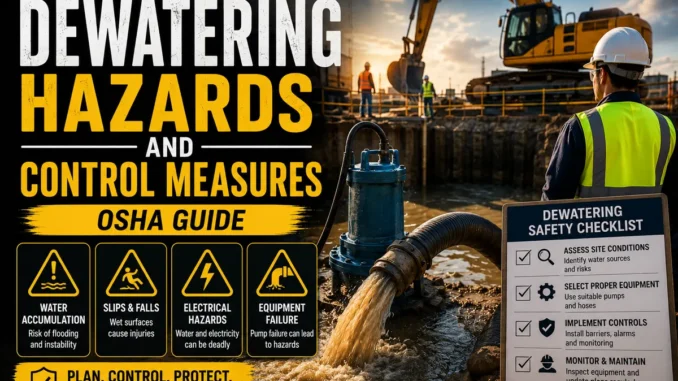
Dewatering Hazards and Control Measures: OSHA Construction Safety Guide
What Is Dewatering in Construction?
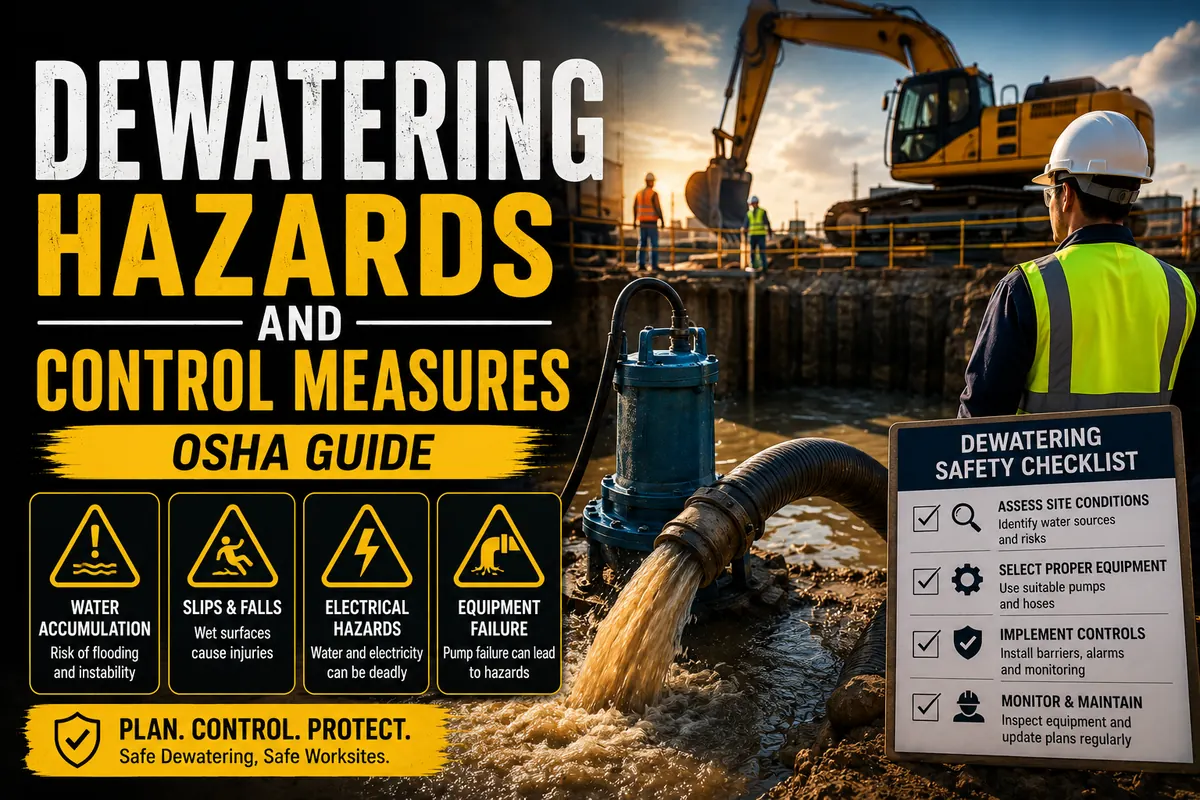
Construction dewatering is the controlled removal of groundwater, surface water, or accumulated water from an excavation, trench, or other below-grade work area to create safe and stable working conditions. Under 29 CFR 1926 Subpart P – Excavations, dewatering is not a standalone operation. It is an integral component of excavation hazard control. Any excavation that encounters groundwater or surface water runoff triggers the water accumulation provisions of 29 CFR 1926.651(h) and the protective system requirements of 29 CFR 1926.652.
Dewatering methods used in construction include:
- Sump pumping – submersible or centrifugal pumps placed at low points in the excavation to remove accumulated water.
- Wellpoint systems – a series of closely spaced shallow wells connected to a header pipe and vacuum pump to lower the water table around the excavation perimeter.
- Deep wells – drilled wells with submersible turbine pumps used to lower the water table for large or deep excavations.
- Eductor (jet) systems – high-pressure water jets that create a vacuum to extract groundwater from fine-grained soils.
- Surface water diversion – diversion ditches, berms, and dikes used to prevent runoff from entering the excavation, as required by 29 CFR 1926.651(h)(3).
The method selected determines the hazard profile. All methods share a common regulatory baseline: the employer must protect employees from every hazard that dewatering creates or modifies.
OSHA Requirements for Dewatering Operations
OSHA’s excavation standard, 29 CFR 1926 Subpart P, contains the binding requirements for construction dewatering. The following provisions apply directly.
29 CFR 1926.651(h) – Protection from Hazards Associated with Water Accumulation
This is the primary dewatering regulation. Three paragraphs govern employer obligations:
1926.651(h)(1): Employees shall not work in excavations in which there is accumulated water, or in excavations in which water is accumulating, unless adequate precautions have been taken to protect employees against the hazards posed by water accumulation. Those precautions may include special support or shield systems to protect from cave-ins, water removal to control the level of accumulating water, or use of a safety harness and lifeline.
1926.651(h)(2): If water is controlled or prevented from accumulating by the use of water removal equipment, the water removal equipment and operations shall be monitored by a competent person to ensure proper operation.
1926.651(h)(3): If excavation work interrupts the natural drainage of surface water, diversion ditches, dikes, or other suitable means shall be used to prevent surface water from entering the excavation and to provide adequate drainage of the area adjacent to the excavation. Excavations subject to runoff from heavy rains require an inspection by a competent person and compliance with paragraphs (h)(1) and (h)(2).
29 CFR 1926.651(g) – Hazardous Atmospheres
Where oxygen deficiency (below 19.5% oxygen) or a hazardous atmosphere exists or could reasonably be expected to exist, the atmosphere in excavations greater than 4 feet in depth shall be tested before employees enter. Dewatering with gasoline-engine-driven pumps creates exhaust hazards in the excavation. This provision applies.
29 CFR 1926.651(k) – Inspections
Daily inspections of excavations, adjacent areas, and protective systems shall be made by a competent person. Inspections are required prior to the start of work, as needed throughout the shift, and after every rainstorm or other hazard-increasing occurrence. A dewatering pump failure is a hazard-increasing occurrence. The competent person must re-inspect immediately.
29 CFR 1926.652 – Requirements for Protective Systems
Each employee in an excavation shall be protected from cave-ins by an adequate protective system. Water presence or accumulation degrades soil classification. A soil classified as Type B in dry conditions may reclassify as Type C when saturated. The competent person must reassess the protective system – sloping, shoring, or shielding – whenever dewatering conditions change.
29 CFR 1926.651(i) – Stability of Adjacent Structures
Where dewatering lowers the water table, the resulting reduction in pore water pressure can cause consolidation settlement in adjacent soils. Where the stability of adjoining buildings, walls, or other structures is endangered by excavation operations, support systems shall be provided to ensure the stability of such structures.
Dewatering Hazards: Complete Identification
The following six hazard categories represent the complete dewatering hazard profile for construction excavation work. Each category is tied to the regulatory provision that governs it.
Soil Instability and Excavation Collapse
Water is the primary driver of excavation instability. Saturated soil loses cohesive strength. The angle of internal friction decreases. Hydrostatic pressure builds against trench walls. The result is an elevated cave-in risk that 29 CFR 1926.652 directly addresses.
Specific mechanisms include:
- Piping and boiling: Upward groundwater seepage through the excavation floor creates a “quick” condition in which soil particles are carried upward by water flow, undermining the base of the excavation and any shoring.
- Slope failure: Saturated slopes lose the shear strength required to remain stable. A slope acceptable for Type B soil must be reclassified to Type C (maximum 1½H:1V) when fissured, subject to water seepage, or previously disturbed. Under 29 CFR 1926 Subpart P Appendix B, water seepage is an explicit indicator of Type C soil.
- Heave: Soft or loose soils at the base of a deep excavation can heave upward when the weight of surrounding saturated soil exceeds the bearing capacity of the excavation floor.
- Surcharge loading: Dewatering equipment – pumps, generators, hose reels – placed at the excavation edge adds surcharge load that increases lateral earth pressure on shoring systems.
The employer must not allow employees to enter an excavation where piping, boiling, or heave is observed. The competent person shall remove workers immediately and reassess the protective system before re-entry.
Electrical Hazards from Submersible Pumps
Submersible and centrifugal pumps used in excavation dewatering operate in the most electrically hazardous environment possible: standing water, wet soil, and confined access. OSHA accident records document fatal electrocutions from submersible pump circuits where ground-fault protection was absent and wiring was reversed.
Specific hazards include:
- Ground faults in wet conditions: Water provides a low-resistance path for fault current. A pump with damaged insulation or a reversed wiring connection can energize the water column itself, creating a shock hazard for any worker in contact with the water or wet soil.
- Damaged extension cords and cable jackets: Mechanical damage from excavation equipment, abrasion on trench walls, and repeated flexing degrade insulation. Damaged insulation in a wet excavation is a life-safety defect.
- Generator hazards: Portable generators used to power dewatering pumps introduce carbon monoxide, electrical bonding, and grounding hazards simultaneously.
- Improper grounding: The pump motor frame must be connected to the supply ground. An ungrounded pump frame in contact with water creates an energized water hazard.
Regulatory basis: Under 29 CFR 1926.404(b)(1), ground-fault circuit interrupter (GFCI) protection is required for all 120-volt, single-phase, 15- and 20-ampere receptacle outlets used in construction that are not part of the permanent wiring of the building. All submersible pump circuits in construction dewatering operations shall be GFCI-protected. The employer shall inspect all cords, plugs, and cable jackets before each use.
Confined Space Hazards
An excavation greater than 4 feet in depth that has restricted entry and exit, and in which a hazardous atmosphere exists or could reasonably be expected to exist, meets the criteria for a permit-required confined space under 29 CFR 1910.146 (general industry) or the construction confined space standard 29 CFR 1926 Subpart AA. Dewatering operations intensify confined space atmospheric hazards in three ways:
- Gasoline-engine pump exhaust: Carbon monoxide (CO) from gasoline-driven pumps accumulates rapidly in below-grade excavations. CO is odorless and colorless. Concentrations above 35 ppm (OSHA PEL) can develop within minutes in a poorly ventilated trench.
- Oxygen displacement: Decomposing organic material in waterlogged soils consumes oxygen. Groundwater dewatering can expose previously submerged organic layers. Oxygen-deficient atmospheres (below 19.5% O₂) are immediately dangerous to life and health.
- Release of trapped gases: Dewatering near landfills, contaminated sites, or areas with underground utilities can release methane, hydrogen sulfide, or other toxic gases as the water table is lowered and previously saturated soils are exposed.
Under 29 CFR 1926.651(g)(1)(i), the atmosphere in excavations greater than 4 feet in depth shall be tested before employees enter when a hazardous atmosphere exists or could reasonably be expected to exist. Testing shall be conducted as often as necessary to ensure the atmosphere remains safe per 1926.651(g)(1)(iv). Emergency rescue equipment – breathing apparatus, safety harness and line, or basket stretcher – shall be readily available per 1926.651(g)(2)(i).
Chemical and Contaminated Water Exposure
Groundwater dewatering hazards include exposure to chemically or biologically contaminated water. Construction sites located near industrial facilities, former landfills, underground storage tanks, or agricultural land may encounter groundwater containing:
- Petroleum hydrocarbons (benzene, toluene, ethylbenzene, xylene – BTEX compounds)
- Heavy metals (lead, arsenic, chromium)
- Pesticides and herbicides
- Biological pathogens (Leptospira, E. coli) in sites with sewage contamination
The employer must determine the nature of the groundwater before dewatering begins. Under 29 CFR 1926.651(b), underground installations – including contaminated soil and groundwater plumes – shall be identified prior to opening an excavation. Where contamination is suspected or confirmed, the employer shall conduct a site-specific dewatering risk assessment that includes groundwater sampling, PPE selection, and discharge management.
Contaminated dewatering effluent is also subject to EPA National Pollutant Discharge Elimination System (NPDES) permit requirements under the Clean Water Act. Discharge of contaminated water to storm drains, surface water, or the ground without a permit is a separate legal violation. The employer must coordinate with the project environmental manager before discharging any dewatering effluent.
Noise and Vibration from Pumping Equipment
Dewatering pumps, generators, and compressors operate continuously, often for extended shifts. Diesel and gasoline generators routinely produce sound levels of 85–100 dBA at 7 meters. Workers performing maintenance, monitoring, or adjacent excavation work within that radius are subject to noise exposure that triggers regulatory requirements.
Under 29 CFR 1926.52, when employees are exposed to sound levels exceeding the permissible exposure limits in Table D-2 (90 dBA for an 8-hour TWA), the employer shall implement feasible engineering or administrative controls. Where such controls fail to reduce exposure to permissible levels, personal protective equipment (hearing protection) shall be provided and used.
Vibration from pumping equipment and wellpoint systems also poses a structural risk. Continuous vibration can:
- Loosen shoring connections and reduce the effectiveness of hydraulic shoring systems
- Cause densification or liquefaction in loose, saturated granular soils adjacent to the excavation
- Accelerate fatigue in hose fittings and pump connections, increasing the risk of sudden discharge failure
The competent person shall inspect shoring connections and pump fittings at the start of each shift and after any significant change in vibration levels.
Flooding and Uncontrolled Water Ingress
Pump failure, power loss, blocked discharge lines, or a sudden rise in groundwater level can result in rapid flooding of the excavation. Workers in a flooded trench face drowning, hypothermia, and entrapment hazards. The speed of flooding in a deep, narrow trench can be lethal within minutes.
Causes of uncontrolled water ingress include:
- Pump mechanical failure or clogged intake
- Loss of generator power or electrical supply failure
- Discharge hose blockage or rupture causing backflow
- Sudden groundwater inflow from a fractured utility line or underground water main
- Extreme rainfall event exceeding the pumping system capacity
- Failure of a surface water diversion dike or berm
Under 29 CFR 1926.651(h)(3), the employer must use diversion ditches, dikes, or other suitable means to prevent surface water from entering the excavation. The dewatering safety procedure must include a documented emergency response plan for pump failure, including the evacuation route, backup pumping capacity, and communication protocol.
Control Measures for Each Dewatering Hazard
The following table maps each excavation dewatering hazard to its required control measure, the governing CFR reference, and the responsible party. This table constitutes the core of a compliant dewatering safety procedure.
| Hazard | Control Measure | CFR Reference | Responsible Party |
|---|---|---|---|
| Soil instability / cave-in from saturated soil | Reassess soil classification when water is present; implement or upgrade sloping (max 1½H:1V for Type C), shoring, or shielding; monitor for piping, boiling, or heave; remove workers immediately if observed | 29 CFR 1926.652(a); 1926 Subpart P Appendix A & B | Competent Person; Employer |
| Excavation collapse from surcharge loading | Keep all dewatering equipment at least 2 feet from the excavation edge; use retaining devices where setback is not achievable | 29 CFR 1926.651(j)(2) | Competent Person; Site Supervisor |
| Electrical shock from submersible pump | GFCI protection on all 120V pump circuits; inspect all cords and plugs before use; ensure pump motor frame is properly grounded; de-energize before servicing | 29 CFR 1926.404(b)(1) | Employer; Qualified Electrician |
| Generator CO exposure in excavation | Use electric-drive pumps where feasible; position gasoline/diesel generators upwind and outside the excavation; test atmosphere for CO before entry and continuously during pump operation | 29 CFR 1926.651(g)(1)(i) & (iv) | Competent Person |
| Oxygen deficiency / hazardous atmosphere | Atmospheric testing before entry in excavations >4 ft where hazardous atmosphere is possible; continuous monitoring; ventilation; emergency rescue equipment on site | 29 CFR 1926.651(g)(1)(i); 1926.651(g)(2)(i) | Competent Person |
| Contaminated water exposure | Pre-excavation groundwater sampling; PPE selection based on contaminant profile (chemical-resistant gloves, boots, eye protection); decontamination station at excavation egress | 29 CFR 1926.651(b); 29 CFR 1926 Subpart E (PPE) | Employer; Site Safety Officer |
| Contaminated effluent discharge | Obtain NPDES permit or equivalent; use sediment basins, filter bags, or treatment systems before discharge; coordinate with environmental manager | EPA 40 CFR 122 (NPDES); State environmental regulations | Employer; Environmental Manager |
| Noise exposure from pumps / generators | Engineering controls first (equipment selection, barriers); administrative controls (exposure rotation); hearing protection when TWA exceeds 90 dBA | 29 CFR 1926.52 | Employer; Site Supervisor |
| Vibration damage to shoring | Inspect shoring connections at start of each shift and after vibration events; tighten or replace loose connections immediately | 29 CFR 1926.652(d)(1) | Competent Person |
| Pump failure / flooding | Maintain backup pump on site; establish emergency evacuation plan; monitor water levels continuously; install high-water alarm | 29 CFR 1926.651(h)(1) & (h)(2) | Competent Person; Employer |
| Surface water ingress | Install diversion ditches, dikes, or berms before excavation opens; inspect after every rainfall; re-inspect with competent person before re-entry | 29 CFR 1926.651(h)(3) | Competent Person; Employer |
| Inadequate egress during flooding | Provide stairway, ladder, or ramp within 25 lateral feet of all workers; keep egress clear of hoses and equipment | 29 CFR 1926.651(c)(2) | Employer; Site Supervisor |
| Adjacent structure settlement from dewatering | Lower water table gradually; monitor ground movement with settlement points; coordinate dewatering with shoring design; engage RPE where structures are at risk | 29 CFR 1926.651(i)(1) | Employer; Registered Professional Engineer |
Dewatering Safety Procedure: Step-by-Step
The following numbered procedure constitutes a compliant dewatering safety procedure for construction excavation work. The employer shall document each step and retain records for the duration of the project.
Step 1 – Pre-Excavation Site Assessment
Determine the depth to groundwater, estimated groundwater flow rate, and soil classification through a geotechnical investigation or review of available boring logs. Identify underground utilities within the dewatering influence zone. Determine whether the groundwater or soil is contaminated. Assign a competent person to the dewatering operation before any excavation begins.
Step 2 – Dewatering Risk Assessment
Complete a written dewatering risk assessment (see worked example in the next section). Identify all hazards, assign likelihood and severity ratings, calculate risk scores, and specify control measures for each hazard. The risk assessment shall be reviewed by the competent person and signed by the employer’s authorized representative before work begins.
Step 3 – Select and Install Dewatering Method
Select the dewatering method appropriate to the soil type, groundwater depth, and excavation geometry. Install the system – sump pumps, wellpoints, or deep wells – before workers enter the excavation. Verify that all electrical connections are GFCI-protected and that pump motor frames are properly grounded.
Step 4 – Surface Water Diversion
Install diversion ditches, dikes, or berms on the uphill side of the excavation to intercept surface runoff before it reaches the excavation perimeter. Verify that the diversion system has adequate capacity for the design storm event for the project location. Document installation per 29 CFR 1926.651(h)(3).
Step 5 – Pre-Entry Inspection by Competent Person
Before any worker enters the excavation, the competent person shall inspect:
- The excavation walls and floor for evidence of piping, boiling, heave, or slope failure
- The protective system (shoring, shielding, or sloping) for adequacy given current water conditions
- The dewatering equipment for proper operation
- The atmosphere (in excavations >4 feet where hazardous atmosphere is possible) using a calibrated multi-gas detector
- Access and egress routes for clearance and safety
The competent person shall document the inspection and shall not permit worker entry if any hazardous condition is found.
Step 6 – Establish Continuous Monitoring
Assign the competent person or a designated monitor to observe dewatering equipment operation throughout the shift. Monitor water levels in the excavation continuously. Install a high-water alarm set to trigger before water reaches a level that would compromise worker safety. Conduct atmospheric monitoring at the frequency required to ensure the atmosphere remains safe per 29 CFR 1926.651(g)(1)(iv).
Step 7 – Control Electrical Hazards
Inspect all pump cords, plugs, and cable jackets before each shift. Test GFCI devices before each use. Position generators upwind and outside the excavation. Do not allow workers to handle energized pump components in standing water. De-energize and lock out the pump before any maintenance or service work.
Step 8 – Implement PPE Program
Select PPE based on the dewatering risk assessment. At minimum, workers in dewatering excavations shall wear:
- Hard hat
- High-visibility vest (where mobile equipment is present)
- Steel-toed, waterproof boots
- Chemical-resistant gloves and boots where contaminated water is present
- Hearing protection where noise exposure exceeds 90 dBA TWA
- Respiratory protection where atmospheric hazards are confirmed or cannot be excluded
Step 9 – Post-Rainfall Re-Inspection
After every rainstorm or other hazard-increasing event, the competent person shall re-inspect the excavation, adjacent areas, and the protective system before workers re-enter. This requirement is non-negotiable under 29 CFR 1926.651(h)(3) and 1926.651(k)(1). Workers shall not re-enter until the competent person has confirmed safe conditions in writing.
Step 10 – Discharge Management
Discharge dewatering effluent only to approved locations under the applicable NPDES permit or state equivalent. Apply sediment and turbidity controls – filter bags, sediment basins, or treatment systems – before discharge. Document discharge volumes and locations. Notify the environmental manager immediately if contaminated water is encountered.
Step 11 – Emergency Response
Maintain a documented emergency response plan for pump failure, flooding, cave-in, or atmospheric emergency. The plan shall include: evacuation signal, evacuation route, backup pump deployment procedure, emergency contact numbers, and nearest hospital location. Conduct a pre-work briefing on the emergency plan with all workers before each shift.
Step 12 – Backfill and System Removal
Decommission the dewatering system only after backfill has progressed to a level that eliminates the risk of excavation flooding. Remove wellpoints, pumps, and discharge lines in a sequence that does not create a sudden groundwater rebound hazard. Confirm that the water table has stabilized before completing backfill.
Dewatering Risk Assessment Example
The following worked risk assessment uses a 5×5 likelihood-severity matrix. Risk ratings: 1–4 = Low; 5–9 = Medium; 10–16 = High; 17–25 = Critical. The employer shall adapt this table to site-specific conditions.
| Activity | Hazard | Likelihood (1–5) | Severity (1–5) | Risk Rating | Control Measure |
|---|---|---|---|---|---|
| Workers in open trench during pump operation | Excavation cave-in from saturated Type C soil | 4 | 5 | 20 – Critical | Reclassify soil to Type C; install hydraulic shoring or trench box; competent person inspection before entry; continuous monitoring |
| Submersible pump installation and operation | Electrical shock / electrocution | 3 | 5 | 15 – High | GFCI protection on all circuits; inspect cords before use; proper grounding; de-energize before servicing |
| Gasoline generator powering dewatering pump | CO accumulation in excavation | 4 | 5 | 20 – Critical | Position generator upwind outside excavation; atmospheric testing before entry and continuously; CO alarm; switch to electric pump where feasible |
| Dewatering near contaminated soil/groundwater | Skin/eye contact with hazardous chemicals | 3 | 4 | 12 – High | Groundwater sampling before work; chemical-resistant PPE; decontamination station; contaminated effluent management plan |
| Continuous pump and generator operation | Noise-induced hearing loss | 4 | 3 | 12 – High | Measure noise levels; engineering controls; hearing protection when TWA >90 dBA; exposure rotation |
| Heavy rainfall event during excavation | Rapid flooding of trench / drowning | 3 | 5 | 15 – High | Diversion ditches and berms installed; backup pump on site; high-water alarm; documented evacuation plan; egress within 25 ft |
| Dewatering lowering water table adjacent to building | Settlement and structural damage | 2 | 4 | 8 – Medium | Gradual drawdown; settlement monitoring; RPE review of dewatering plan; shoring of adjacent structures if required |
| Workers handling pump hoses and fittings | Slip, trip, and fall on wet surfaces | 4 | 2 | 8 – Medium | Secure hoses with clips; maintain clear egress routes; non-slip footwear; housekeeping at start and end of shift |
| Post-rainfall re-entry without inspection | Cave-in from rain-softened slopes | 3 | 5 | 15 – High | Mandatory competent person re-inspection after every rainfall before re-entry; no exceptions |
Competent Person Requirements for Dewatering
Under 29 CFR 1926.650(b), a competent person is defined as “one who is capable of identifying existing and predictable hazards in the surroundings, or working conditions which are unsanitary, hazardous, or dangerous to employees, and who has authorization to take prompt corrective measures to eliminate them.”
This definition has three operative components, each of which applies directly to dewatering operations:
1. Capability to identify existing and predictable hazards. For dewatering, this requires demonstrated knowledge of:
- Soil classification under 29 CFR 1926 Subpart P Appendix A, including the effect of water on soil type
- The mechanics of piping, boiling, heave, and slope failure in saturated soils
- Electrical hazards associated with submersible pumps and GFCI requirements under 29 CFR 1926.404
- Atmospheric hazard recognition and gas detector operation per 29 CFR 1926.651(g)
- The operational characteristics of the dewatering system in use on the project
2. Knowledge of OSHA requirements. The competent person must be familiar with the full text of 29 CFR 1926 Subpart P, including:
- 1926.650 – Definitions
- 1926.651(g) – Hazardous atmospheres
- 1926.651(h) – Water accumulation
- 1926.651(i) – Adjacent structure stability
- 1926.651(k) – Inspection requirements
- 1926.652 – Protective systems
3. Authority to take prompt corrective measures. The competent person must have the organizational authority to stop work, remove workers from the excavation, and require corrective action without delay. An individual who must seek approval from a supervisor before removing workers from a hazardous excavation does not meet the OSHA definition of a competent person.
Competent Person Duties Specific to Dewatering
The competent person shall:
- Conduct and document pre-entry inspections before each shift
- Monitor dewatering equipment operation or designate a qualified monitor under their direct supervision
- Re-inspect the excavation after every rainstorm, pump failure, or other hazard-increasing event before workers re-enter
- Reassess the soil classification and protective system whenever water conditions change
- Order immediate worker evacuation if piping, boiling, heave, slope cracking, or pump failure is observed
- Verify that atmospheric testing is conducted at the required frequency
- Verify that GFCI protection is in place and functional before pump operation begins
The competent person designation is site-specific and task-specific. The employer shall designate the competent person in writing and ensure that designation is communicated to all workers on the dewatering operation.
Dewatering Equipment Safety Checklist
The following checklist is copy-ready for use as a pre-shift inspection form. The competent person shall complete this checklist before workers enter the excavation and after any hazard-increasing event.
Dewatering System – General
- Dewatering risk assessment is current, site-specific, and available on site
- Competent person is designated in writing and present on site
- Emergency response plan is posted and all workers have been briefed
- Backup pump is on site and operational
Pumps and Mechanical Equipment
- Submersible pump intake is clear of debris and sediment
- Pump discharge hose is routed to an approved discharge location
- Discharge hose is secured and free of kinks, blockages, and damage
- Pump is operating at the correct flow rate for current water level
- High-water alarm is installed and tested
- Pump vibration is within normal range; no unusual noise or vibration
Electrical Safety
- All pump circuits are GFCI-protected; GFCI devices tested before use
- All extension cords and cable jackets inspected – no cuts, abrasions, or exposed conductors
- Pump motor frame is properly grounded
- Generator is positioned upwind and outside the excavation
- Generator exhaust is directed away from the excavation opening
- All electrical connections are rated for wet/outdoor use
Atmospheric Monitoring
- Multi-gas detector is calibrated and bump-tested before use
- Pre-entry atmospheric test completed and results recorded
- O₂ ≥ 19.5%; CO ≤ 35 ppm; LEL ≤ 10%; H₂S ≤ 1 ppm (or site-specific limits)
- Continuous monitoring plan is in place for the duration of the shift
- Emergency rescue equipment (SCBA, harness, lifeline) is on site and accessible
Excavation and Protective System
- Soil classification has been assessed under current wet conditions
- Protective system (sloping, shoring, or shielding) is adequate for Type C soil if water is present
- No evidence of piping, boiling, heave, or slope cracking
- Shoring connections are tight; no loose or displaced members
- Spoil pile is at least 2 feet from the excavation edge
- Access and egress (ladder, ramp, or stairway) is within 25 lateral feet of all workers and clear of obstructions
Surface Water Control
- Diversion ditches, dikes, or berms are installed and intact
- No surface water is entering the excavation
- Post-rainfall re-inspection completed by competent person (if applicable)
PPE
- Hard hats worn by all workers
- Waterproof, steel-toed boots worn by all workers
- Chemical-resistant PPE in use where contaminated water is present
- Hearing protection available and in use where noise exceeds 90 dBA TWA
- High-visibility vests worn where mobile equipment is operating
Frequently Asked Questions
Q1: What are the main dewatering hazards in construction excavations?
The six primary dewatering hazards in construction excavations are: (1) soil instability and cave-in caused by water-saturated soil losing shear strength; (2) electrical shock or electrocution from submersible pumps operating in wet conditions without GFCI protection; (3) confined space atmospheric hazards including carbon monoxide from engine-driven pumps and oxygen deficiency from decomposing organic soils; (4) chemical and contaminated water exposure where groundwater contains petroleum hydrocarbons, heavy metals, or biological pathogens; (5) noise and vibration from continuous pump and generator operation exceeding the 90 dBA TWA limit under 29 CFR 1926.52; and (6) flooding from pump failure, power loss, or uncontrolled surface water ingress. Each hazard requires specific control measures tied to the applicable CFR provision.
Q2: What does OSHA require for dewatering in excavations under 29 CFR 1926.651(h)?
Under 29 CFR 1926.651(h)(1), employees shall not work in excavations with accumulated or accumulating water unless adequate precautions protect them from water accumulation hazards. Those precautions may include special support or shield systems, water removal equipment, or a safety harness and lifeline. Under 1926.651(h)(2), if water removal equipment is used, a competent person must monitor that equipment and its operation to ensure proper function. Under 1926.651(h)(3), if excavation work interrupts natural surface water drainage, diversion ditches, dikes, or other suitable means must prevent surface water from entering the excavation. Excavations subject to heavy rain runoff require a competent person inspection before re-entry.
Q3: Who is the competent person for dewatering operations, and what are their duties?
Under 29 CFR 1926.650(b), a competent person is one capable of identifying existing and predictable hazards and who has authorization to take prompt corrective measures. For dewatering, the competent person must: conduct pre-entry inspections before each shift; monitor water removal equipment operation; re-inspect after every rainstorm or pump failure; reassess soil classification and the protective system when water conditions change; verify atmospheric testing is completed; confirm GFCI protection is functional; and order immediate worker evacuation if hazardous conditions are observed. The employer must designate the competent person in writing.
Q4: Does water in an excavation require a change to the protective system?
Yes. Water fundamentally changes soil classification under 29 CFR 1926 Subpart P Appendix A. Soil that exhibits water seepage, a soft or plastic consistency, or fissuring must be classified as Type C – the least stable classification. Type C soil requires sloping at a maximum angle of 1½H:1V, or an equivalent shoring or shielding system designed for Type C conditions. The competent person must reassess the protective system whenever water is present or accumulating in the excavation, and must upgrade the system before workers re-enter.
Q5: What is a dewatering risk assessment, and is it required by OSHA?
A dewatering risk assessment is a systematic evaluation of the hazards associated with a specific dewatering operation, including likelihood, severity, risk rating, and control measures for each identified hazard. OSHA does not use the term “dewatering risk assessment” in the CFR, but the requirement to identify and control hazards before employees enter an excavation is embedded throughout 29 CFR 1926 Subpart P. The competent person’s pre-entry inspection duties, the water accumulation precautions under 1926.651(h), and the protective system requirements under 1926.652 collectively require the employer to assess and document dewatering hazards before work begins. A written risk assessment is the practical mechanism for demonstrating compliance.
Q6: What are the OSHA electrical requirements for submersible dewatering pumps in construction?
Under 29 CFR 1926.404(b)(1)(ii), all 120-volt, single-phase, 15- and 20-ampere receptacle outlets used in construction that are not part of the permanent wiring shall be protected by ground-fault circuit interrupters. All submersible pump circuits in construction dewatering operations must be GFCI-protected. Additionally, the pump motor frame must be properly grounded, all cords and cable jackets must be inspected before each use, and the pump must be de-energized and locked out before any maintenance or servicing. Workers shall not handle energized pump components in standing water.
Useful Sources
The following authoritative sources were used in the preparation of this guide and are recommended for further reference:
- OSHA 29 CFR 1926 Subpart P – Excavations: The primary regulatory framework for all construction excavation and dewatering work. Includes 1926.650 (definitions), 1926.651 (specific requirements including water accumulation), and 1926.652 (protective systems). https://www.osha.gov/laws-regs/regulations/standardnumber/1926/1926.651
- OSHA Construction eTool – Trenching and Excavation: OSHA’s interactive guidance on the five key trench safety requirements, including standing water, atmospheric hazards, and competent person inspection duties. https://www.osha.gov/etools/construction/trenching
- OSHA Publication 2226 – Trenching and Excavation Safety: OSHA’s primary public guidance document on excavation safety, covering cave-in protection, water accumulation, hazardous atmospheres, and competent person requirements. https://www.osha.gov/sites/default/files/publications/OSHA2226.pdf
- OSHA CPL 02-00-161 – National Emphasis Program on Trenching and Excavation: OSHA’s enforcement directive describing inspection procedures and citation policies for excavation and trench work, including water accumulation violations. https://www.osha.gov/enforcement/directives/cpl-02-00-161
- 29 CFR 1926.650 – Scope, Application, and Definitions (LII/Cornell): Full text of the definitions section of OSHA’s excavation standard, including the regulatory definition of “competent person,” “cave-in,” “hazardous atmosphere,” and “protective system.” https://www.law.cornell.edu/cfr/text/29/1926.650
- EPA Construction General Permit (CGP) – Dewatering Inspection and Monitoring Guide: EPA guidance on NPDES permit requirements for construction site dewatering discharge, including inspection, monitoring, and sediment control requirements. https://www.epa.gov/system/files/documents/2022-01/cgp-inspection-and-monitoring-guide-for-dewatering.pdf
Related Guides
- Hazard Identification & Risk Assessment (HIRA) for Rebar Fixing & Assembly Work
- OSHA: Scaffold Use in the Construction Industry part 2
- Appendix A to 1910.119: Highly Hazardous Chemicals and Threshold Quantities
- Hot Work Permit Requirements Under 29 CFR 1910.119(k)
- Contractor Safety Under 29 CFR 1910.119(h)


Be the first to comment