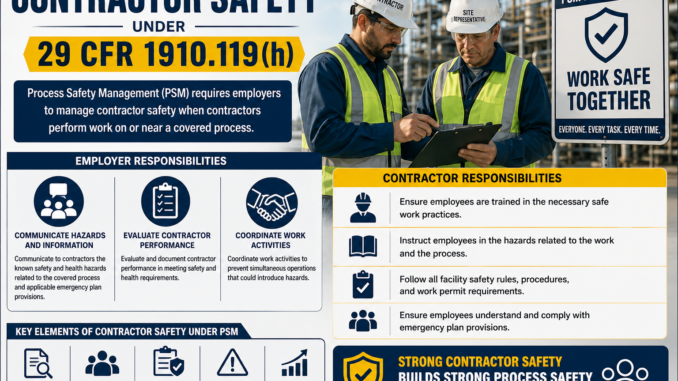
PSM contractor safety divides important duties between the host employer and the contract employer when contractors perform work on or adjacent to a covered process. Under 29 CFR 1910.119(h), the host evaluates and communicates process-related conditions, while the contract employer assures job training, hazard instruction, documentation, rule compliance, and communication of hazards created or discovered by the work.
Contract work can introduce ignition sources, open process equipment, disturb containment, bypass safeguards, change process conditions, or place unfamiliar workers near toxic, fire, or explosion hazards. Clear interfaces are therefore as important as each employer’s individual program.
Which contractors are covered?
Paragraph (h) applies to contractors performing maintenance or repair, turnaround, major renovation, or specialty work on or adjacent to a covered process. It excludes incidental services that do not influence process safety, such as janitorial, food and drink, laundry, delivery, or other supply services.
The work’s potential effect on process safety is more important than its job title. OSHA’s compliance guidance explains that construction, demolition, installation, and subcontractor activities may be included when they can affect a covered PSM contractor safety process.
Host-employer responsibilities
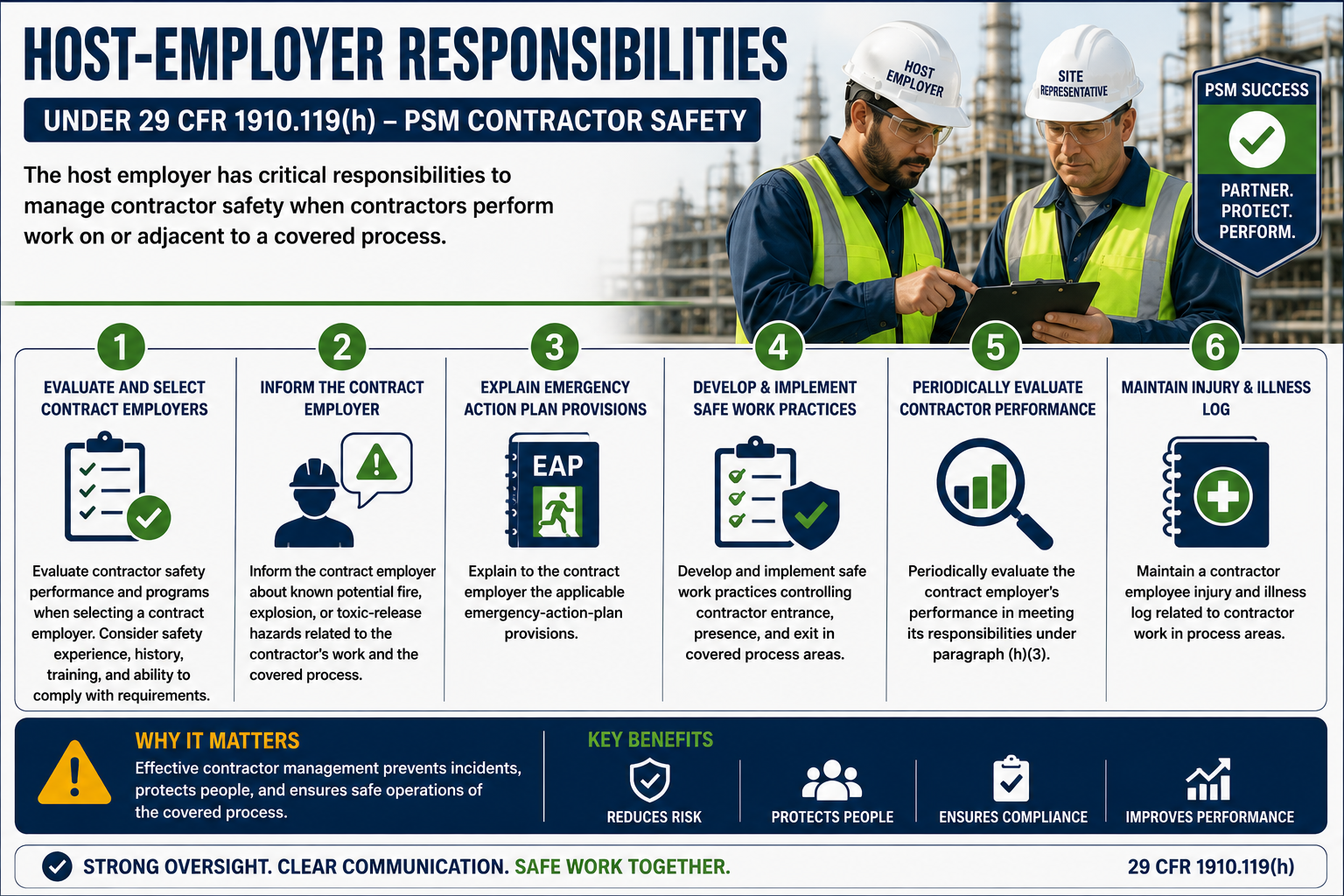
The host employer must:
- Evaluate contractor safety performance and programs when selecting a contract employer.
- Inform the contract employer about known potential fire, explosion, or toxic-release hazards related to the contractor’s work and the process.
- Explain applicable emergency-action-plan provisions.
- Develop and implement safe work practices controlling contractor entrance, presence, and exit in covered process areas.
- Periodically evaluate contractor performance against paragraph (h)(3) obligations.
- Maintain a contractor employee injury and illness log related to contractor work in process areas.
Selection should examine information relevant to the proposed work, such as safety programs, experience, incident history, training system, supervision, subcontractor control, and ability to comply with facility procedures. It should not be reduced to one lagging-rate PSM contractor safety number.
Contract-employer responsibilities
The contract employer must:
- Assure each contract employee is trained in work practices necessary to perform the job safely.
- Assure each employee is instructed in known fire, explosion, or toxic-release hazards related to the job and process, and in applicable emergency-plan provisions.
- Document the employee’s identity, training date, and method used to verify understanding.
- Assure contract employees follow facility safety rules, including safe work practices under paragraph (f)(4).
- Advise the host employer about unique hazards created by the contractor’s work and hazards found during the work.
A 2022 OSHA interpretation clarifies that training tasks may be coordinated, but the contract employer remains responsible for assuring that required training and documentation are PSM contractor safety adequate.
Host-versus-contractor responsibility matrix
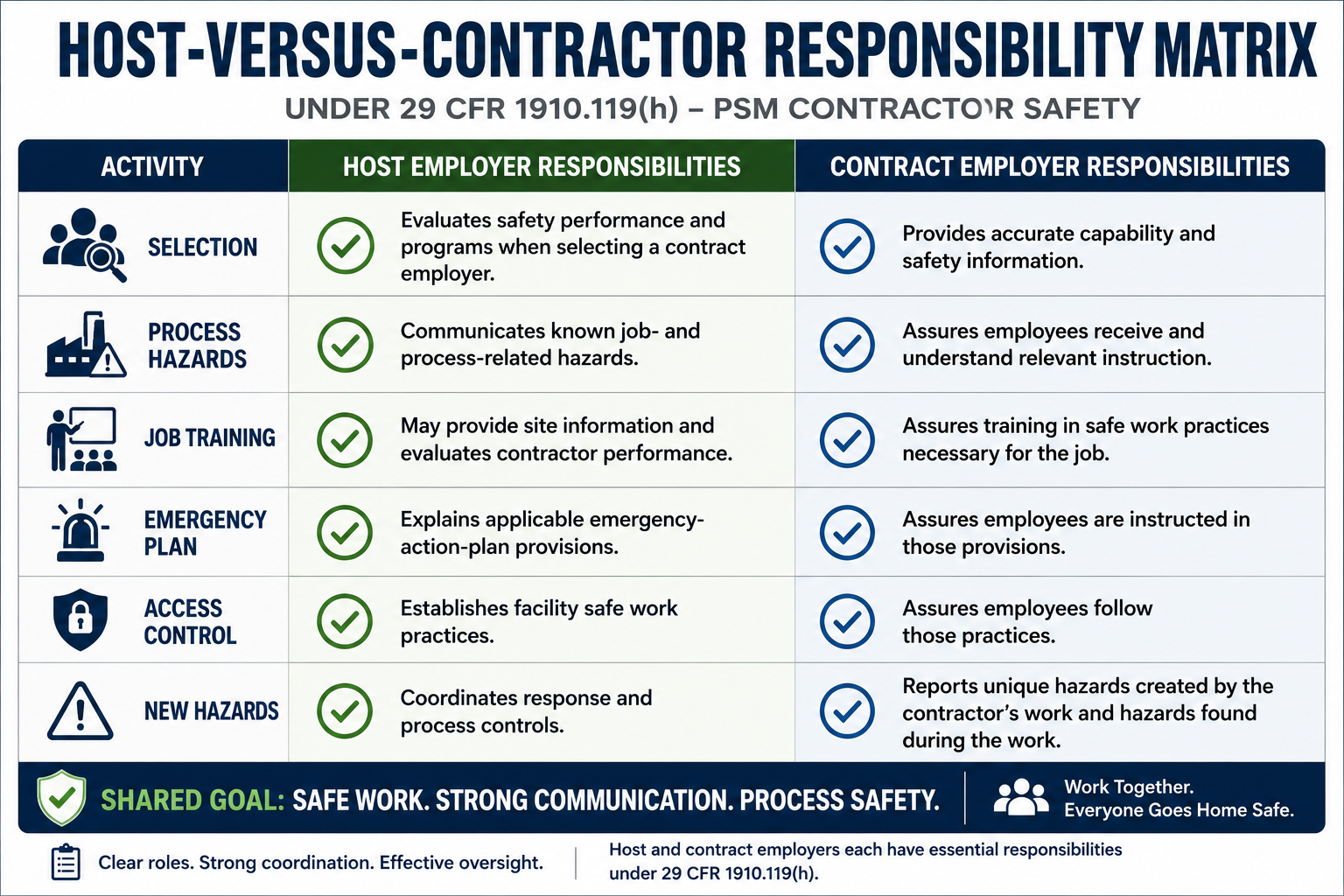
| Activity | Host employer | Contract employer |
|---|---|---|
| Selection | Evaluates safety performance and programs. | Provides accurate capability and safety information. |
| Process hazards | Communicates known job- and process-related hazards. | Assures employees receive and understand relevant instruction. |
| Job training | May provide site information and evaluates performance. | Assures training in safe work practices necessary for the job. |
| Emergency plan | Explains applicable provisions. | Assures employees are instructed in those provisions. |
| Access control | Establishes facility safe work practices. | Assures employees follow them. |
| New hazards | Coordinates response and process controls. | Reports unique hazards created or hazards found. |
Before contractor work begins
- Define the job scope, location, affected equipment, process state, and interfaces.
- Evaluate the contractor’s relevant safety capability.
- Communicate known process hazards and emergency arrangements.
- Identify required permits, isolations, gas tests, PPE, access controls, and simultaneous-operation restrictions.
- Confirm employee training and how understanding was verified.
- Establish communication between operations, maintenance, contractor supervision, and permit issuers.
- Confirm how scope changes, discovered conditions, and stop-work decisions will be handled.
High-risk tasks may connect with hot-work permits, lockout/tagout, confined-space entry, line opening, lifting, excavation, or electrical PSM contractor safety controls.
Monitoring work and closing the job
The host’s periodic evaluation should examine actual field performance, not only paperwork. Observations may include permit compliance, isolation integrity, housekeeping, PPE, communication, response to alarms, and supervision. Deficiencies should be communicated and corrected according to their risk.
At job completion, verify equipment condition, remove temporary materials and isolations under authorization, update affected records, report hazards or incidents, and restore the process only through approved readiness controls.
Common contractor-management weaknesses
- Selecting contractors without evaluating relevant safety programs;
- Giving a generic orientation that omits process-specific hazards;
- Assuming the other employer completed all training;
- Training records that do not show verification of understanding;
- Poor control of subcontractors;
- Uncommunicated scope changes or simultaneous work;
- No field evaluation after mobilization; and
- Failure to report hazards discovered during the PSM contractor safety work.
Contractor orientation and job-specific coordination
A site orientation cannot replace job-specific coordination. Before work starts, the host should explain known fire, explosion, and toxic-release hazards related to the contractor’s work and the applicable emergency-action provisions. The contract employer must then assure that its employees understand the safe work practices needed for their tasks, relevant process hazards, and emergency requirements. Language, literacy, crew changes, and subcontracting should be addressed so the information reaches the people actually entering the process area.
Coordination should identify who controls isolations, permits, gas testing, equipment return to service, simultaneous operations, and stop-work decisions. When several employers share an area, define how they exchange status changes at shift turnover and how one crew’s work could affect another. These arrangements supplement, rather than replace, applicable OSHA requirements outside PSM contractor safety PSM.
Records that support contractor oversight
Useful records include contractor selection criteria, injury and illness performance information, orientation rosters, training assurances, hazard communications, permit records, daily coordination notes, safe-work-practice observations, contractor injury and illness logs associated with work in process areas, and post-job evaluations. Paragraph (h) assigns specific duties to both employers, so records should make ownership visible rather than placing every item in one generic contractor file.
If a contractor’s work changes process chemicals, technology, equipment, procedures, or facilities, route the change through the facility’s MOC system. Before affected equipment is returned to service, verify required inspections, tests, procedure updates, training, and pre-startup review. A signed work-completion ticket alone does not establish process PSM contractor safety readiness.
Related PSM requirements
- Safe work practices in PSM operating procedures
- PSM training requirements
- Hot-work permit requirements
- Pre-startup safety review
Related Guides
- OSHA Housekeeping: Workplace Compliance
- Appendix A to 1910.119: Highly Hazardous Chemicals and Threshold Quantities
- Who Is Responsible for Scaffold Safety Under OSHA Regulations?
- PSM Part 1 – Comprehensive Guide to OSHA 3132 Process Safety Management
- Hazard Identification & Risk Assessment (HIRA) for Rebar Fixing & Assembly Work

Be the first to comment