Introduction
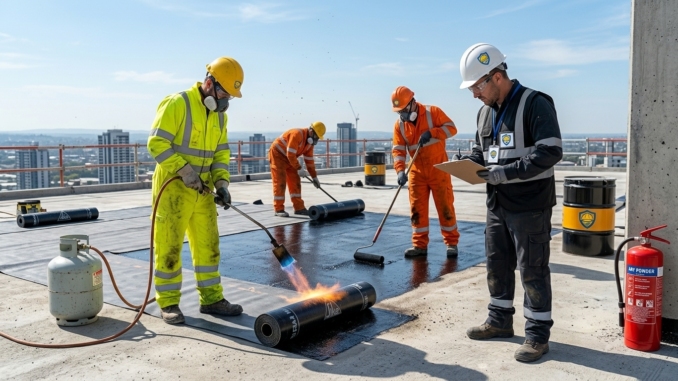
First, prioritizing construction waterproofing safety is undeniably crucial for maintaining a hazard-free work environment. Specifically, applying bituminous coatings and heat-applied membranes presents unique chemical and thermal risks. Therefore, executing a structured Job Safety Analysis (JSA) protects your workforce and ensures complete site compliance. To enhance your site’s overall protocols, review our comprehensive EHS guidelines for construction sites.
Consequently, supervisors must rigorously enforce active safety controls during these critical tasks. Furthermore, handling hazardous materials requires specific personal protective equipment (PPE) and strict adherence to established safety procedures. Additionally, referencing global standards ensures baseline protection; you can learn more by reading OSHA’s official guidelines on hazardous material handling.
Finally, the following procedural checklist outlines the required steps, potential hazards, and preventive measures for these operations. Ultimately, deploying these exact construction waterproofing safety methods will significantly minimize operational risks and safeguard all personnel on-site.
1. Preparation of Permit for Waterproofing Operations
| Hazards | Risks Issue | Existing Controls Checklist | Risk Reduction Action Plan |
|
Miscommunication
|
Loss of work
|
• First, designate a competent permit receiver to strictly handle the permit . • Next, verify the exact location prior to signing the work permit . • Additionally, conduct a mandatory toolbox meeting prior to starting the activity . • Finally, mandate that a competent equipment inspector complete the initial crane inspection before permit sign-off. |
• Routine monitoring and compliance |
2. Mobilization of Materials for Construction Waterproofing Safety
| Hazards | Risks Issue | Existing Controls Checklist | Risk Reduction Action Plan |
|
Over speeding
Manual handling
|
Collision with other vehicle/structure Muscular strain, Back issue |
• First, secure a permit to work before starting any material movement . • Furthermore, prohibit the operation or movement of equipment without an active flagman • Specifically, train the flagman adequately for site operations . • Next, inspect the equipment and verify its back alarm system thoroughly . • Additionally, install proper barricades around the primary activity area . • Moreover, apply proper methods and techniques for all material handling operations . • Consequently, utilize mechanical lifting equipment for heavy materials to prevent strain . • Therefore, execute proper stretching, lifting, bending, and moving techniques continuously . • Specifically, avoid storing paint materials near high-temperature conditions . • Finally, strictly prohibit hot work activities near painting areas and provide local MSDS availability. |
• Routine monitoring and compliance |
3. Application of Bitumen and Waterproofing Safety Protocols
| Hazards | Risks Issue | Existing Controls Checklist | Risk Reduction Action Plan |
|
Direct contact to bitumen paint
|
Skin injury
|
• First, announce the nearest eye wash station location during the toolbox meeting . • Furthermore, equip workers with appropriate PPE, including suits, boots, goggles, and masks . • Next, instruct workers to wash their hands and face routinely, especially before eating, drinking, or smoking . • Additionally, mandate the vacuuming or removal of contaminated work clothes before breaks . • Moreover, require the use of proper hand gloves during all painting tasks . • Finally, ensure all involved workers undergo formal Chemical Handling training. |
• Routine monitoring and compliance |
4. Heat Membrane Sheet Application and Thermal Safety
| Hazards | Risks Issue | Existing Controls Checklist | Risk Reduction Action Plan |
|
Working near open hole / pit
USE of LPG tank/ Open Flame Poor illumination Exposure to direct sunlight
|
Fall from height
Fire produced on torch supplied Trip and fall Failure to provide sunshades protection
|
• First, maintain three-point contact while facing the ladder at all times . • Furthermore, install specific ladders and temporary facilities strictly according to safety regulations . • Next, deploy only trained and certified workers for these tasks . • Additionally, enforce ladder safety by keeping hands free of materials during ascent and descent . • Specifically, obtain a hot work permit before igniting any equipment . • Moreover, assign only competent personnel to handle the waterproofing torch . • Consequently, maintain a trained fire watchman on-site continuously . • Therefore, position active fire extinguishers directly at the workplace . • Furthermore, enforce continuous, proper supervision across the site . • Next, mandate appropriate hand gloves to prevent burn injuries . • Additionally, secure all cylinders firmly in an upright direction . • Specifically, remove LPG cylinders from the site and return them to the store post-activity . • Moreover, utilize only inspected equipment bearing valid color-coding tags . • Consequently, eliminate all potential ignition sources from the immediate area . • Therefore, install highly visible ‘no smoking’ signage . • Furthermore, install proper lighting around the site and workplace access paths . • Next, mandate clear safety glasses inside buildings or dark zones . • Additionally, supply sufficient cool water strictly within the work area . • Moreover, rotate shifts routinely for workers engaged in heavy tasks . • Finally, erect temporary rest shelters to mitigate heat exposure. |
• Routine monitoring and compliance |
5. Working in Energized Areas During Waterproofing
| Hazards | Risks Issue | Existing Controls Checklist | Risk Reduction Action Plan |
|
Live areas
LOTO of hazardous energy sources (hot water, steam, gas, oil)
|
Electrocution
Slip, trip and fall
Burn
Explosion
|
• First, confirm workers hold valid LOTO training and commissioning permits . • Furthermore, prohibit work entirely in commissioning areas marked with blue and white barricades . • Next, lock out, tag out, and verify the isolation of all hazardous energy sources . • Specifically, forbid any attempts to alter equipment tagged with “Danger” or “Do not operate” labels . • Additionally, mandate hand gloves at all times to prevent pinch point and moving machinery injuries . • Moreover, restrict entry into energized areas without prior authorization from the HSE department . • Consequently, enforce strict coordination between the LOTO coordinator, job supervisor, and safety personnel . • Therefore, strictly prohibit drawing power supplies from energized panel boards . • Finally, execute mandatory gas testing before initiating any hot work. |
• Routine monitoring and compliance |
6. Additional Industry Best Practices: VOC and Confined Space Management
(Note: Incorporating crucial industry knowledge beyond the base document to ensure complete construction waterproofing safety.)
| Hazards | Risks Issue | Existing Controls Checklist | Risk Reduction Action Plan |
|
High Volatile Organic Compounds (VOC) emission Confined space entry |
Asphyxiation Toxic inhalation |
• First, mandate continuous mechanical ventilation when applying primers and bitumen in basements or tanks. • Furthermore, conduct pre-entry gas testing to ensure oxygen levels remain between 19.5% and 23.5%. • Next, require the use of active organic vapor respirator cartridges for all application personnel. • Finally, station a dedicated hole-watch attendant immediately outside any confined space entry points. |
• Routine monitoring and compliance |

Be the first to comment