Risk Assessment: Sand Blasting Operations
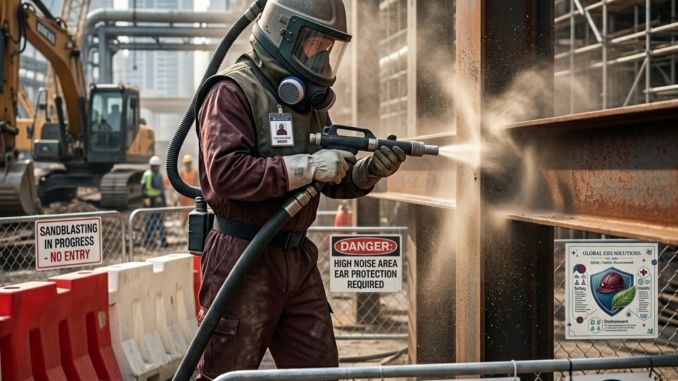
First, executing a comprehensive Sand Blasting Risk Assessment is critical for maintaining absolute workplace safety. Consequently, safety managers must rigorously evaluate all potential hazards before commencing any high-pressure abrasive work. Therefore, understanding these specific risks allows site teams to prevent severe respiratory injuries, auditory damage, and costly property destruction.
Furthermore, implementing strict control measures ensures total regulatory compliance across all project phases. Specifically, you can review our core PPE guidelines for abrasive blasting to understand the baseline protective requirements. Additionally, consulting the official OSHA standards for crystalline silica provides broader industry context for managing airborne dust. Ultimately, thorough preparation and this Sand Blasting Risk Assessment save lives and keep projects running efficiently.
Core Hazard Categories in a Sand Blasting Risk Assessment
To address what safety professionals commonly search for when developing a Sand Blasting Risk Assessment, you must consider these critical industry standards:
-
First, equip the blast gun with a functional emergency release handle (dead man’s switch) to immediately halt operations if the worker loses control.
-
Next, mandate that all operators wear a dedicated sand blasting hood connected to a continuous supply of clean breathing air to prevent deadly suffocation or respiratory damage.
-
Furthermore, completely enclose the blasting area with heavy-duty tarpaulins or green mesh to prevent hazardous dust from escaping into adjacent work zones.
-
Finally, strictly prohibit any unauthorized personnel from entering the barricaded zone during active pressure holding.
General Information
| Field | Details |
| Task / Activity Name | Sand Blasting Operation / HVDC |
| Document Number | PE-317-HSE-RA-054 |
| Date | 18-01-2026 |
| RA/HIRA Team | Diaa eldin khaled, George Atif, Taif Zaman |
| Reviewed By | Mohd Zahid Akhtar |
| Approved By | Omar Kamal |
| Next Review Date | 18-01-2027 |
1. Obtain Permit to Work
| Hazards | Risks Issue | Existing Controls Checklist | Risk Reduction Action Plan |
|
Unauthorized work to be performed Uncontrolled personnel entering a restricted location Unidentified hazards with unplanned safety mitigating measures Inadequate coordination and area control protocol |
Accident resulting serious injury or death Loss of production Significant property and appurtenances damage Governmental violation Environmental complaint |
• First, the manager must train and authorize the Permit Receiver to receive a Permit to Work. • Next, you must obtain a Permit to Work as a strict pre-requisite to perform the job. • Furthermore, do not start work until you receive the duly approved permit. • Additionally, conduct a daily Safety Toolbox meeting. • Consequently, the Permit Receiver must oversee the safety of all workers under his permit. • Moreover, the Permit Receiver and Permit Issuer must visit the site together to identify workplace hazards. • Finally, mandate that all workers sign the attendance sheet attached to the specific permit. • Specifically, display the active Permit to Work directly at the worksite. |
• First, mandate the physical presence of the Permit Receiver overseeing the activity.
• Next, the Permit Receiver must account for all workers before the start of work.
• Furthermore, prohibit all workers from starting the work without written approval.
• Finally, establish accurate and appropriate control measures during the joint site visit. |
2. Preparing Tools for Sand Blasting Risk Assessment
| Hazards | Risks Issue | Existing Controls Checklist | Risk Reduction Action Plan |
|
Wrong tools Defective tool |
Property damage Accident resulting injury to worker |
• First, inspect all tools meticulously before bringing them to the work site. • Next, ensure workers strictly use the correct tools for the specific job. |
• First, subject all tools and equipment to a thorough inspection prior to site use. • Next, the Foreman must ensure workers receive proper and adequate tools. • Finally, train workers comprehensively in using specific tools and equipment. |
3. Executing Sand Blasting Risk Assessment Controls
| Hazards | Risks Issue | Existing Controls Checklist | Risk Reduction Action Plan |
|
Exposure to dust / Inhallation of dust Exposure to excessive noise High Pressure |
Injury or ill-health to personnel Respiratory, skin and eye irritation Tinnitus or chronic hearing loss Personal injury/ property loss |
• First, provide adequate barricades entirely around the working area. • Next, immediately remove defective or makeshift tools from the work site. • Furthermore, ensure tools remain in good working condition. • Additionally, provide workers with adequate respiratory protection to prevent inhalation. • Moreover, provide adequate hearing protection to reduce noise to a permissible exposure level. • Consequently, inspect all tools prior to arranging equipment and related accessories. • Specifically, install safety pins and whip lashes at all hose couplings and connections. • Finally, restrict the unauthorized movement of personnel in the job area. |
• First, ensure all involved workers receive adequate training and awareness regarding sand blasting. • Next, provide and mandate the use of ear plugs or ear muffs. • Furthermore, physically inspect hoses and check the whip lash mechanisms. • Additionally, utilize certified and calibrated grit blasting equipment exclusively. • Moreover, minimize and manage hose layouts to proactively reduce tripping hazards. • Consequently, use high-pressure industrial hoses according to their exact pressure rating. • Finally, train personnel for proper positioning during grit blasting and establish an emergency switch-off communication protocol. |
4. Housekeeping and Clearing the Work Area
| Hazards | Risks Issue | Existing Controls Checklist | Risk Reduction Action Plan |
|
Unsafe placement of compressor Manual handling (unsafe) Scattered tools, excess materials Protruding object/materials Uncollected/scattered rubbish Poor housekeeping / Inadequate communication |
Equipment roll over, Hit people, equipment damage Hand injuries due to contact with sharp tools Slip and trip Fire Environmental complaint Accident resulting serious injury or death |
• First, enforce the safe placement of equipment behind barricades. • Next, remove all unwanted or protruding materials and objects from the site. • Furthermore, mandate the use of cotton gloves with rubber palms. • Additionally, observe proper posture during all manual lifting, pushing, and pulling. • Moreover, implement and discuss proper housekeeping daily during the Tool Box Talk. • Consequently, label storage boxes clearly by capacity, designating good items and scrap items. • Specifically, hold regular coordination meetings to maintain robust communication. • Finally, dispose of all generated waste properly so nothing is left behind. |
• First, strictly place the equipment at a plane location. • Next, facilitate formal training for manual handling procedures. • Furthermore, provide active supervision and consistent monitoring. • Additionally, post visible caution and safety signs around the zone. • Moreover, provision sufficient color-coded waste bins in strategic locations at the site. • Consequently, direct supervisors to monitor their respective areas for housekeeping before and after activity. • Finally, practice constant communication between the project management team. |
5. Closing of Permit to Work
| Hazards | Risks Issue | Existing Controls Checklist | Risk Reduction Action Plan |
|
Unattended unsafe condition Unsecured electrical equipment, energized equipment |
Loss of production Accident resulting serious injury or death to worker Significant property and appurtenances damage |
• First, the safety representative must identify and rectify all unsafe conditions right away. • Next, visibly identify any area containing unattended unsafe conditions. • Furthermore, the Permit Receiver must ensure housekeeping is done before, during, and after work. • Additionally, secure all electrical equipment tightly. • Moreover, close and properly padlock the distribution board. • Finally, make the LOTO (Lockout/Tagout) procedure available and properly implemented. |
• First, conduct a TBT to discuss any pending unsafe open observations. • Next, the Supervising Engineer and Foreman must adhere to the proper rectification of hazards. • Furthermore, the Site Manager must maintain responsibility for the effective implementation of the Permit to Work. • Additionally, the Permit Receiver must account for all workers and ensure they have signed out and cleared the area. • Moreover, implement monthly inspections using a strict color code. • Finally, continuously update the electrical equipment checklist and registry. |


Be the first to comment