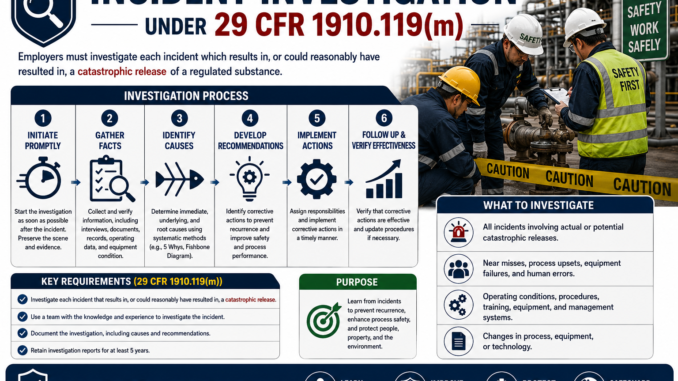
A PSM incident investigation is required for each incident that resulted in, or could reasonably have resulted in, a catastrophic release of a highly hazardous chemical in the workplace. Under 29 CFR 1910.119(m), the investigation must start promptly and no later than 48 hours after the incident.
The trigger is broader than an event that produced injuries, property loss, or an actual major release. A near miss can require investigation when the event could reasonably have produced a catastrophic release. A facility’s reporting and screening procedure should therefore capture loss-of-containment events, safeguard demands, abnormal reactions, serious operating-limit excursions, and other warning events early enough for a timely decision.
Which PSM Incident Investigation and the 48-Hour Rule
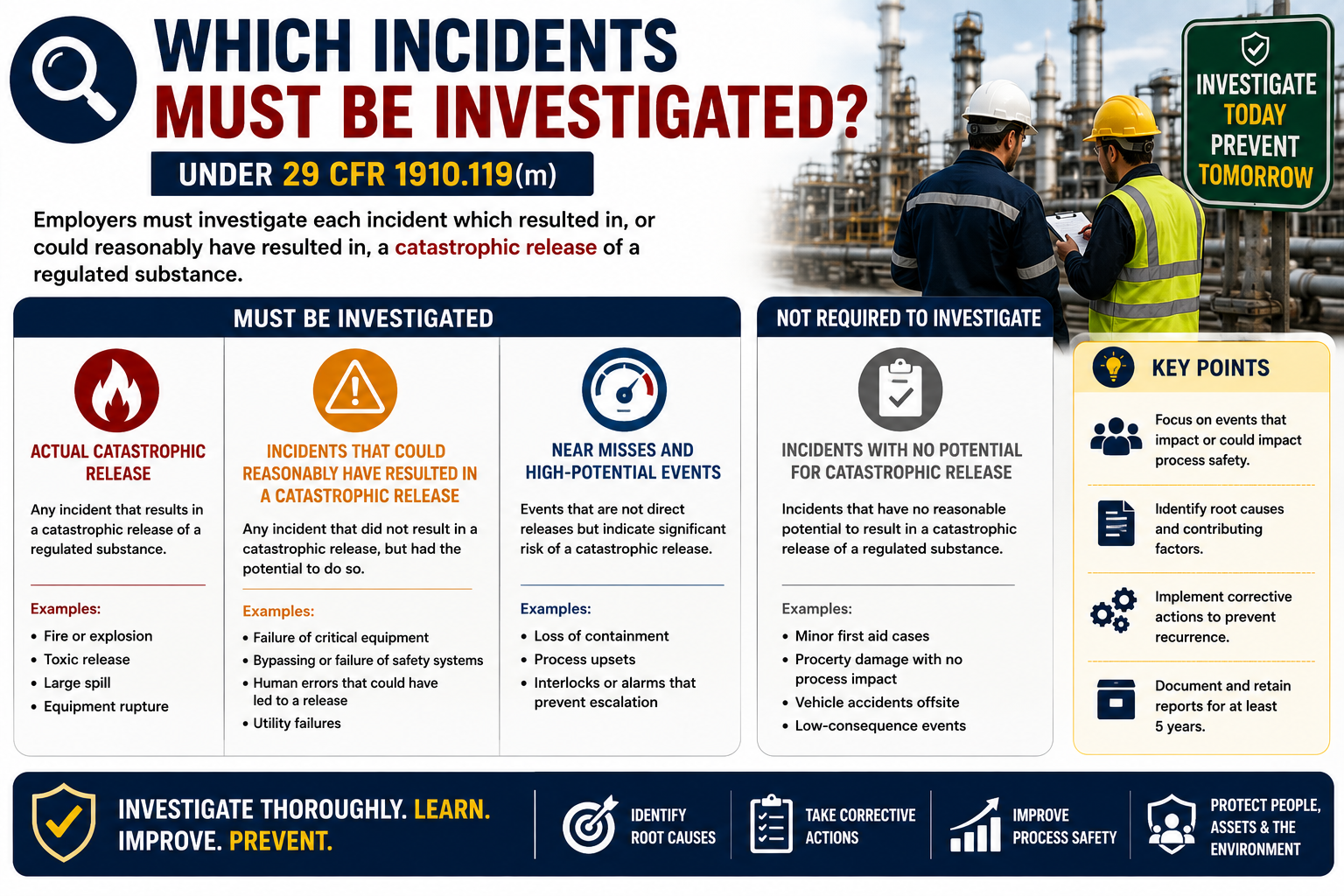
Paragraph (m)(1) uses a consequence-based test: did the event result in, or could it reasonably have resulted in, a catastrophic release of a highly hazardous chemical? The standard’s definition of catastrophic release refers to a major uncontrolled emission, fire, or explosion involving one or more highly hazardous chemicals PSM incident investigation that presents serious danger to employees.
Facilities should avoid screening solely by the quantity actually released or the absence of injury. Examples that may require evaluation include:
- A relief device lifting because a process exceeded its intended operating envelope;
- A runaway reaction stopped by an independent protection layer;
- A significant leak isolated before escalation;
- Unexpected mixing of incompatible materials;
- Failure of a safety-critical instrument during demand;
- A fire, explosion, or toxic event involving the covered process;
- Loss of utilities that could have defeated containment or safeguards; and
- Contract work that damaged or nearly damaged covered process equipment.
These examples are screening prompts, not automatic legal conclusions. Document why the facility classified a borderline event inside or outside paragraph (m).
The 48-hour initiation requirement
The investigation must be initiated as promptly as possible, but no later than 48 hours following the incident. Initiation is more than waiting for a final team meeting. Early actions normally include making the area safe, notifying responsible personnel, preserving perishable evidence, identifying witnesses, securing relevant records, defining the initial scope, and appointing the investigation team.
Emergency response and care for injured people come first. Evidence collection must not interfere with scene safety or official investigations. When equipment must be moved or altered for safety, record its condition PSM incident investigation and the reason where practicable.
Incident investigation team requirements
The team must include at least one person knowledgeable in the process involved. If the incident involved a contractor’s work, the team must include a contract employee. Other members need appropriate knowledge and experience to investigate and analyze the event thoroughly.
Depending on the incident, the team may need expertise in operations, process engineering, maintenance, controls, metallurgy, industrial hygiene, human factors, emergency response, or the analytical method used. A supervisor-only team can miss how work is actually performed. Include people who understand the process and PSM incident investigation evidence while managing conflicts of interest openly.
Five items required in the investigation report
At the conclusion of the investigation, the report must include at least:
- The date of the incident;
- The date the investigation began;
- A description of the incident;
- The factors that contributed to the incident; and
- Recommendations resulting from the investigation.
A useful report can also describe the scope, team, evidence reviewed, event timeline, process conditions, immediate actions, analytical method, relevant safeguards, uncertainties, and attachments. Keep fact, analysis, and recommendation clearly distinguishable. Do not add unsupported certainty simply to make the PSM incident investigation report appear complete.
Focus on contributing factors, not a single blame label
The regulatory wording calls for factors that contributed to the incident. An employee action can be part of the event sequence without being the complete explanation. Examine procedure quality, process design, alarm and interface behavior, training, workload, staffing, supervision, maintenance, inspection, change management, communications, contractor coordination, and prior warnings where relevant.
Build a verified timeline using interviews, control-system data, alarms, work orders, permits, laboratory results, drawings, photographs, procedures, training records, and physical evidence. Test competing explanations against the evidence. If an important fact remains uncertain, state the limitation and identify whether further PSM incident investigation examination is needed.
Address findings and recommendations promptly
The employer must establish a system to address and resolve report findings and recommendations promptly, and document the resolutions and corrective actions. Each action should have an owner, target date, status, and objective closure evidence. If the employer chooses an alternative to a team recommendation, document how the underlying finding was resolved.
Corrective changes to process chemicals, technology, equipment, procedures, or facilities should be screened through management of change. Actions may also require updated process hazard analysis, PSI, operating procedures, training, mechanical-integrity tasks, or emergency PSM incident investigation arrangements.
Review the report with affected personnel
The report must be reviewed with all affected personnel whose job tasks are relevant to the findings, including contract employees where applicable. The review should communicate what happened, contributing factors, changes to work, interim controls, and lessons that apply to the audience. Protect appropriate personal or confidential information without withholding the process-safety information employees need.
A signature sheet can show attendance, but the employer should use a method suitable for the significance of changed tasks. When a corrective action modifies work, the MOC and training requirements may PSM incident investigation require more than an awareness briefing.
Five-year retention and organizational learning
Incident investigation reports must be retained for five years. Retention makes the record available for PHAs, compliance audits, recurring-event analysis, and employee access under applicable PSM provisions. Index reports by process, event type, equipment, contributing factor, and action status so earlier learning can be found.
Do not wait for another major event to use the information. Periodically review open actions, repeated failure modes, overdue recommendations, and similar events across units. Where an incident reveals a credible scenario not adequately addressed, feed it back into the PHA and relevant PSM incident investigation procedures.
Practical investigation workflow
- Protect people, stabilize the situation, and complete required notifications.
- Screen the event promptly against the paragraph (m)(1) trigger.
- Initiate the investigation within 48 hours.
- Appoint the required knowledgeable team, including a contractor employee when applicable.
- Preserve evidence and establish a fact-based timeline.
- Identify and test contributing factors.
- Develop specific recommendations linked to the findings.
- Issue the report with all minimum required information.
- Assign, resolve, document, and verify corrective actions.
- Review findings with relevant affected personnel and retain the report PSM incident investigation for five years.
Common incident-investigation weaknesses
- Ignoring near misses because no injury or major release occurred;
- Starting the investigation after the 48-hour limit;
- Failing to include a contractor employee when contractor work was involved;
- Stopping at “operator error” without examining system contributors;
- Recommendations that are vague, unassigned, or unrelated to findings;
- Closing actions without verifying the result;
- Failing to review the report with relevant affected personnel; and
- Discarding reports before the five-year retention period PSM incident investigation ends.

2 Trackbacks / Pingbacks