Purpose
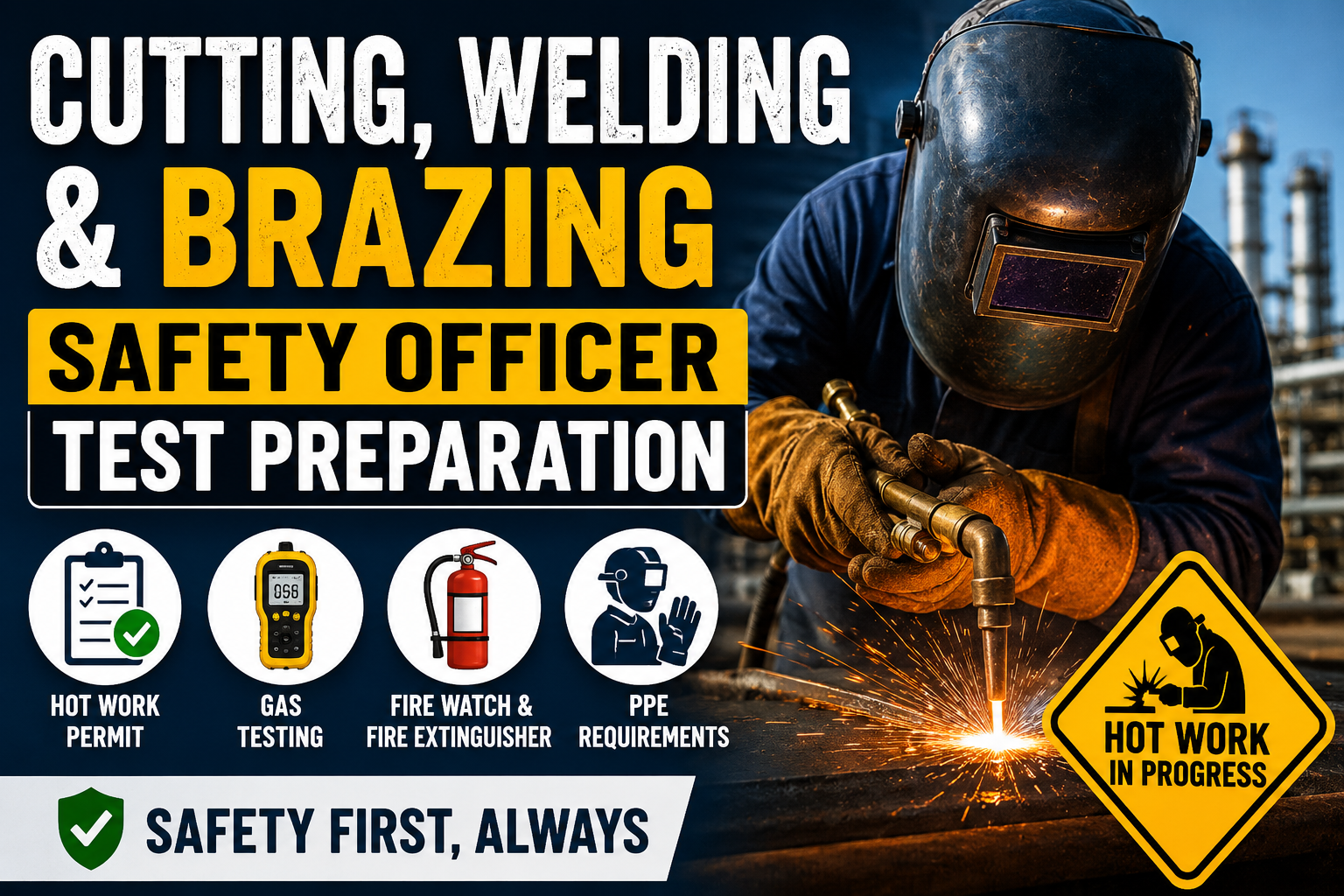
These Cutting, Welding and Brazing Safety Officer Test Preparation interview questions are commonly asked during Safety Officer interviews on Saudi Aramco and large-scale construction projects. This chapter covers the general requirements, PPE standards, hot work permit protocol, and fire watch procedures a Safety Officer must know before sitting a competency exam or a site interview. The content follows the structure of Saudi Aramco Construction Safety Manual (CSM) II-10, “Cutting, Welding and Brazing,” and cross-references the OSHA, ANSI, and ACGIH standards it invokes.
TL;DR: A Safety Officer must verify SA-certified welders/brazers, an approved hot work permit under GI 2.100, a gas test under GI 2.709, removal or shielding of combustibles within 35 feet (10.7 m), a trained fire watch that stays on post for a minimum of 30 minutes after work stops, and a charged fire extinguisher at the work location before any cutting, welding, or brazing operation begins.
Purpose of CSM II-10 and Referenced Standards
CSM II-10 exists to control the fire, burn, electrical shock, and toxic-fume hazards generated by cutting, welding, and brazing activities on Aramco job sites. It does this by tying permit issuance, welder qualification, and PPE selection to a defined set of external standards rather than leaving judgment calls to individual crews.
Q1: What is the purpose of the Cutting, Welding and Brazing chapter in the Construction Safety Manual?
A: To establish minimum requirements for controlling fire and health hazards during hot work – covering welder/brazer certification, hot work permits, gas testing, fire watch duties, and PPE – so that cutting, welding, and brazing operations are performed without injury to personnel or damage to property.
Q2: Which external standards does CSM II-10 reference?
A: The chapter draws on:
- ANSI/AWS Z49.1 – Safety in Welding, Cutting, and Allied Processes
- ANSI/ISEA Z87.1 – Occupational and Educational Personal Eye and Face Protection Devices
- ACGIH Threshold Limit Values (TLVs) – for welding fume and gas exposure limits
- 29 CFR 1926, Subpart J – Welding and Cutting (OSHA construction standard)
- Saudi Aramco GI 2.100 – Work Permit System
- Saudi Aramco GI 2.709 – Gas Testing
Q3: Why does a Safety Officer need to know both OSHA and Aramco-specific standards?
A: Because Aramco General Instructions (GIs) build on top of OSHA’s baseline. 29 CFR 1926 Subpart J sets the federal floor for welding and cutting safety in construction, but GI 2.100 and GI 2.709 add company-specific permit and gas-testing steps that go further – for example, mandatory pre-work gas testing in any enclosed or semi-enclosed space, regardless of whether OSHA would strictly require it for that task.
Core Hot Work Safety Standards
Q4: What are the general requirements under CSM II-10, Section 10.3?
A: The core requirements a Safety Officer verifies before authorizing hot work are:
- Welder/brazer certification – only personnel holding a valid SA certification for the specific process and position may perform cutting, welding, or brazing.
- Approved hot work permit – issued per GI 2.100 before work starts, specifying location, duration, and precautions.
- Gas testing – performed and documented per GI 2.709 prior to permit issuance, and re-tested if conditions change.
- Combustible material control – removal, or fire-resistant shielding, of combustibles within a 35-foot (10.7 m) radius of the work.
- Fire watch assignment – a trained fire watcher present during the work and for a minimum of 30 minutes after work is completed.
- Fire extinguisher availability – a suitable, charged extinguisher staged at the work location before cutting, welding, or brazing begins.
Q5: Who is authorized to perform welding or brazing on an Aramco site?
A: Only welders and brazers holding current SA (Saudi Aramco) certification for the specific welding process, material, and position they will be working in. An expired certificate, or a certificate for the wrong process (e.g., SMAW certification used to justify GTAW work), is grounds for stopping the job.
Q6: What does the hot work permit under GI 2.100 need to specify?
A: The permit identifies the exact work location, the scope and duration of the hot work, the names of the welder and fire watch, the gas test results, the combustible-material control measures in place, and the authorizing signatures. A permit issued for one location or shift does not automatically cover a relocated work area or an extended shift – a new or revalidated permit is required.
Q7: When is gas testing required under GI 2.709, and how often?
A: Gas testing is required before the hot work permit is issued whenever the work is performed in a confined space, near process piping, in areas with potential hydrocarbon or flammable vapor presence, or in any location where the Safety Officer cannot rule out an explosive atmosphere. Testing must be repeated if work is interrupted, if conditions in the area change, or after a set validity period defined on the permit – continuous monitoring is required in higher-risk confined spaces.
PPE Requirements for Cutting, Welding and Brazing
Q8: What eye and face protection standard applies to welding and cutting operations?
A: ANSI/ISEA Z87.1, which governs occupational and educational eye and face protection. Under this standard, welders and helpers must use filter lenses matched to the specific process and amperage – a lens shade adequate for oxyfuel cutting is not automatically adequate for shielded metal arc welding or plasma cutting, which produce higher-intensity arc radiation.
Q9: What PPE, beyond eye protection, does a welder need before starting hot work?
A: Flame-resistant clothing free of oil or grease, welding gloves, a welding helmet or shield appropriate to the process, safety footwear, and hearing protection where grinding or plasma cutting noise levels warrant it. Loose clothing, cuffed trousers, and synthetic fabrics that melt are specifically prohibited because they increase burn severity from spark contact.
Q10: How do ACGIH TLVs apply to welding fume exposure?
A: ACGIH Threshold Limit Values set the airborne concentration limits for welding fume constituents (such as manganese, hexavalent chromium, and total particulate) that a worker can be exposed to during a shift without expected adverse health effects. A Safety Officer uses these TLVs, together with local exhaust ventilation or respiratory protection, to determine whether additional controls are needed for a specific base metal, coating, or confined-space welding task.
Q11: What respiratory protection is required for welding in a confined space?
A: Where natural or mechanical ventilation cannot keep fume and gas concentrations below ACGIH TLVs – a common situation in tanks, vessels, and pipe interiors – supplied-air respirators or other appropriate respiratory protection are required, in addition to continuous atmospheric monitoring under GI 2.709.
Fire Watch and Hot Work Permit Protocol
Q12: What is a fire watch, and when is one required?
A: A fire watch is a person specifically assigned to observe the hot work area for fire hazards during the operation and to remain on post after work stops. A fire watch is required whenever combustible materials are present within 35 feet of the work that cannot be fully removed, when openings in walls or floors could allow sparks to travel to an adjacent area, or when combustibles on the other side of a metal partition, wall, or ceiling could ignite by conduction.
Q13: How long must a fire watch remain after cutting, welding, or brazing work is completed?
A: A minimum of 30 minutes after the work is finished, per ANSI Z49.1 and the OSHA fire watch requirement referenced in 1926.352. The Safety Officer should not release the fire watch early simply because the welder has packed up – smoldering fires from trapped sparks can develop well after visible work has stopped, and 30 minutes is the floor, not a fixed ceiling for higher-risk jobs.
Q14: What must be confirmed before a fire watch is released from post?
A: The fire watch, or the Safety Officer, must confirm the full 30-minute period has elapsed, that no smoke, smoldering material, or heat is detected in the surrounding area, and that a final walk-through of the work area and any spaces below or adjacent to it shows no fire hazard remains.
Q15: What responsibilities does a fire watch have during the operation itself?
A: The fire watch maintains a fire extinguisher or hose at the ready, watches for sparks or slag reaching combustibles outside the immediate work area, sounds an alarm or activates the fire suppression response if a fire starts, and has no other duties assigned during the watch period – the role cannot be combined with welding, helping, or other tasks.
Q16: What happens if the hot work permit expires mid-task?
A: Work must stop immediately. The Safety Officer re-verifies site conditions, repeats gas testing under GI 2.709 if the permit validity period required it, and reissues or revalidates the permit under GI 2.100 before hot work resumes. Continuing to weld or cut on an expired permit is a stop-work violation regardless of how close the task is to completion.
Q17: Where should the fire extinguisher be positioned relative to the hot work?
A: Close enough for the fire watch or welder to reach and deploy it within seconds – typically within the immediate work area, not stored in a vehicle or a toolbox elsewhere on site. The extinguisher type and rating must match the combustible materials present (for example, a Class ABC extinguisher for mixed combustible and electrical hazards).
High-Frequency Exam Hazards & Regulations
Q18: Under 29 CFR 1926 Subpart J, what are the principal hazard categories from welding and cutting?
A: Fire and explosion, burns, electric shock, toxic fume and gas inhalation, and eye/skin injury from arc radiation and ultraviolet exposure. Subpart J addresses these through requirements for fire prevention, ventilation, protective equipment, and confined-space precautions.
Q19: What combustible-material distance triggers fire watch and shielding requirements?
A: 35 feet (10.7 meters) is the standard reference distance under ANSI Z49.1 and OSHA guidance. Combustibles within that radius that cannot be relocated must be protected with fire-resistant covers or blankets, and a fire watch is assigned.
Q20: What should a Safety Officer check on a compressed gas cylinder before gas welding or cutting begins?
A: Cylinders must be secured upright, valve protection caps in place during transport and storage, regulators and hoses free of oil or grease, no leaks detectable by soap-solution test, and oxygen and fuel-gas cylinders separated per storage distance requirements when not in use.
Q21: What is the difference between welding, cutting, and brazing for exam purposes?
A: Welding joins two metal pieces by melting the base metal (with or without filler) to form a fused joint. Cutting uses heat – from an oxyfuel flame, plasma arc, or similar process – to sever or remove metal. Brazing joins metals using a filler metal with a melting point below that of the base metals, without melting the base metal itself. A Safety Officer should recognize that all three processes fall under the same hot work permit and fire watch requirements because all three generate ignition sources.
Q22: What ventilation controls does CSM II-10 expect in a confined space welding job?
A: Forced mechanical ventilation sized to the space and the fume-generating process, continuous atmospheric monitoring under GI 2.709, and a standby attendant outside the confined space in addition to the fire watch, since confined-space entry procedures apply in parallel with hot work permit requirements.
Q23: What is a common exam trick question about fire watch duration?
A: Candidates are often asked whether 30 minutes is “the maximum” fire watch time. It is not – 30 minutes is the minimum. Higher-hazard conditions, such as work near insulation, void spaces, or heavy accumulations of combustible dust, may require the Safety Officer to extend the fire watch well beyond 30 minutes.
FAQ: Cutting, Welding and Brazing Safety Officer Test Preparation
What is the minimum fire watch time required after hot work? A minimum of 30 minutes after cutting, welding, or brazing operations are completed, per ANSI Z49.1 and OSHA’s fire watch provisions under 29 CFR 1926.352. Longer periods may be required based on site-specific fire risk.
What certification must a welder hold on a Saudi Aramco project? A current SA (Saudi Aramco) certification specific to the welding or brazing process, material, and position being performed. Certifications are process-specific and do not transfer automatically between welding methods.
What Aramco General Instructions govern hot work permits and gas testing? GI 2.100 governs the work permit system, including hot work permit issuance, and GI 2.709 governs gas testing requirements before and during hot work in confined or hazardous atmospheres.
What standard governs eye and face protection during welding? ANSI/ISEA Z87.1 sets the requirements for eye and face protection devices, including the filter lens shades required for different welding and cutting processes.
What distance defines the combustible-material control zone for hot work? 35 feet (10.7 meters) is the reference distance under ANSI Z49.1 for identifying combustibles that must be removed or shielded before hot work begins.


Be the first to comment