Table of Contents
- Introduction to Industrial Safety Testing
- Core Abrasive Blasting Safety Standards
- High-Frequency Exam Hazards & Regulations
- Confined Space Complications & Protocols
- Total Operator PPE Ensemble Matrix
- High-Yield Practice Exam Questions
- Frequently Asked Questions
Introduction to Industrial Safety Testing introduction
Are you gearing up for your next big site evaluation? Mastering Aramco Safety Officer Test Preparation requires a deep, technical understanding of multi-layered hazard controls, strict regulatory thresholds, and site-specific permitting workflows. When preparing for this crucial certification, candidates often feel overwhelmed by the sheer volume of compliance standards.
Abrasive blasting sits directly at the intersection of respiratory, noise, fire, and confined space hazards. Because a single blasting operation can trigger multiple regulatory standards simultaneously, exam writers heavily favor this topic.
This comprehensive guide serves as your ultimate, high-quality preparation resource for the exam category. Reviewing these core principles, technical thresholds, and scenario-based questions repeatedly is the most effective approach to Aramco Safety Officer Test Preparation to build absolute confidence for your upcoming evaluation.
1. Core Abrasive Blasting Safety Standards blasting-standards
Abrasive blasting—commonly referred to as grit blasting or sandblasting—is the forcible application of an abrasive medium to a surface using pneumatic pressure, hydraulic pressure, or centrifugal force. The primary objective is to clean, de-rust, remove scale, or profile a substrate before applying protective industrial coatings.
Because of the extreme velocities and materials involved, it is recognized as one of the most hazardous routine industrial maintenance activities on any project site. Understanding these mechanical controls is a vital element of your Aramco Safety Officer Test Preparation strategy.
Mechanical Safety Controls
-
Deadman Switch: A deadman switch (trip handle) must be physically fitted to the blast nozzle. The moment the operator releases their grip, the flow of abrasive material stops instantly to prevent uncontrolled hose whiplash.
-
Whip Checks: Safety cables (whip checks) must be securely installed on all pressurized hose-to-hose and hose-to-equipment connections to prevent injury if a coupling fails.
-
Area Isolation: The blasting zone must be completely barricaded and marked with clear warning signs to exclude unauthorized personnel.
-
Pre-Use Inspections: All system components—including hoses, nozzles, couplings, and the blast pot—must be thoroughly inspected for wear before every shift.
Material Restrictions & Approved Alternatives
-
The Silica Sand Prohibition: The use of silica sand is strictly prohibited across all facilities and construction projects. Fractured silica sand generates respirable crystalline silica dust, causing silicosis—an irreversible, progressive, and fatal lung disease. The Permissible Exposure Limit (PEL) for respirable crystalline silica is strictly capped at an 8-hour Time-Weighted Average (TWA) of 50 µg/m³.
-
Combustible Abrasive Restrictions: Organic materials (such as certain nut shell products) that can ignite or sustain combustion are prohibited. These can form highly explosive dust clouds in confined or poorly ventilated areas.
-
Approved Mediums: Safe, silica-free alternatives must be used, including aluminum oxide grit (the industrial standard), steel grit, steel shot, garnet, crushed glass, and approved synthetic or ceramic beads.
2. High-Frequency Exam Hazards & Regulations exam-hazards
To master Aramco Safety Officer Test Preparation, you must learn the precise global safety standards that govern high-risk work. Examiners routinely test whether you can match specific field situations to their regulatory thresholds.
Breathing Air Infrastructure & Compressor Safety
-
Upwind Intake Placement: The breathing air compressor intake must always be positioned upwind of the blasting zone and all internal combustion engines (including the compressor’s own engine). This absolute rule prevents toxic carbon monoxide ($CO$) and exhaust fumes from contaminating the worker’s air supply.
-
Air Quality Standards: Supplied air must strictly meet Grade D breathing specifications. This means Carbon Monoxide ($CO$) concentrations must be $le$ 10 ppm, and oil mist must be $le$ 5 mg/m³.
-
Continuous Monitoring: Oil-lubricated compressors must feature a continuously operating $CO$ monitor and alarm wired directly into the air supply line. Filter cartridges must be replaced every 3 months or 400 operating hours, whichever comes first.
-
Respirator Mandate: Standard N95 dust masks, half-face respirators, or basic air-purifying masks are completely unapproved. Operators must exclusively wear a NIOSH-approved Type CE supplied-air respirator (a full-head, positive-pressure blasting helmet).
Hot Work & Restricted Area Constraints
-
Permit Trigger: When blasting takes place in a restricted area—such as near pipelines, hydrocarbon vessels, or tanks where flammable vapors may be present—the operation is classified as HOT WORK due to static electricity and frictional spark generation.
-
Atmospheric Testing: Continuous gas testing is mandatory before and during the work. The localized atmosphere must remain completely safe and well below 10% of the Lower Explosive Limit (LEL).
-
System Grounding: All blasting equipment, nozzles, and the substrate being blasted must be fully bonded and grounded to eliminate static discharge risks.
Noise Hazards
Abrasive blasting operations typically generate sound levels between 90–115 dB(A). The action level that triggers a mandatory, legal Hearing Conservation Program is 85 dB(A) as an 8-hour TWA. Factoring acoustic limits into your Aramco Safety Officer Test Preparation is vital because a Type CE blasting helmet alone does not provide adequate acoustic protection; operators must wear earplugs or earmuffs with a high Noise Reduction Rating (NRR) underneath the helmet.
3. Confined Space Complications & Protocols confined-spaces
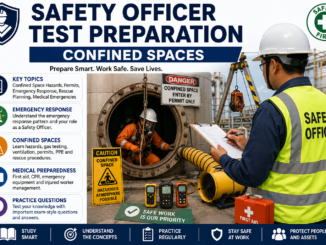
Blasting inside storage tanks, pressure vessels, or ship holds introduces compounding hazards, such as immediate loss of visibility, rapid accumulation of toxic dust, and potential oxygen deficiency. Success in your Aramco Safety Officer Test Preparation depends entirely on your knowledge of these specific permit triggers.
-
Dual-Permit Requirement: Blasting inside an enclosed structure requires both a Permit-Required Confined Space Entry Permit and a Hot Work Permit running concurrently.
-
Forced Ventilation: Mechanical forced-air ventilation must run continuously to maintain a safe atmosphere.
-
Standby Man: A trained entry attendant must remain stationed outside the space at all times to monitor the safety log and manage emergency communication.
Training & Operator Qualifications
-
Industrial Coating Certification: For industrial coating applications, general safety training is insufficient. A foundational pillar of Aramco Safety Officer Test Preparation is knowing that operators must be formally tested and certified by a Certified Coatings Inspector (Level II) or an equivalent recognized authority to validate their competency in surface profiles and safety protocols.
-
Disciplinary Documentation: All initial training, weekly toolbox talks, and safety violations must be documented in writing.
4. Total Operator PPE Ensemble Matrix ppe-matrix
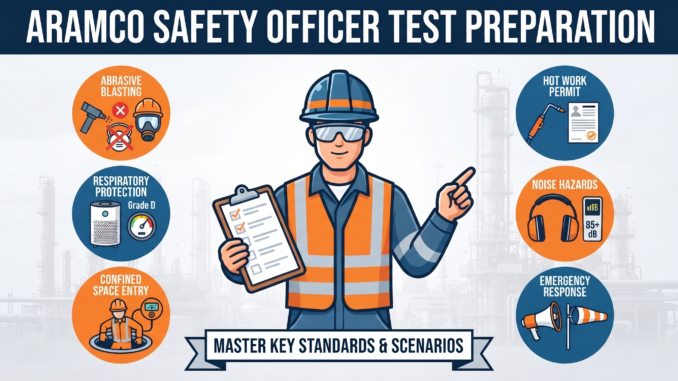
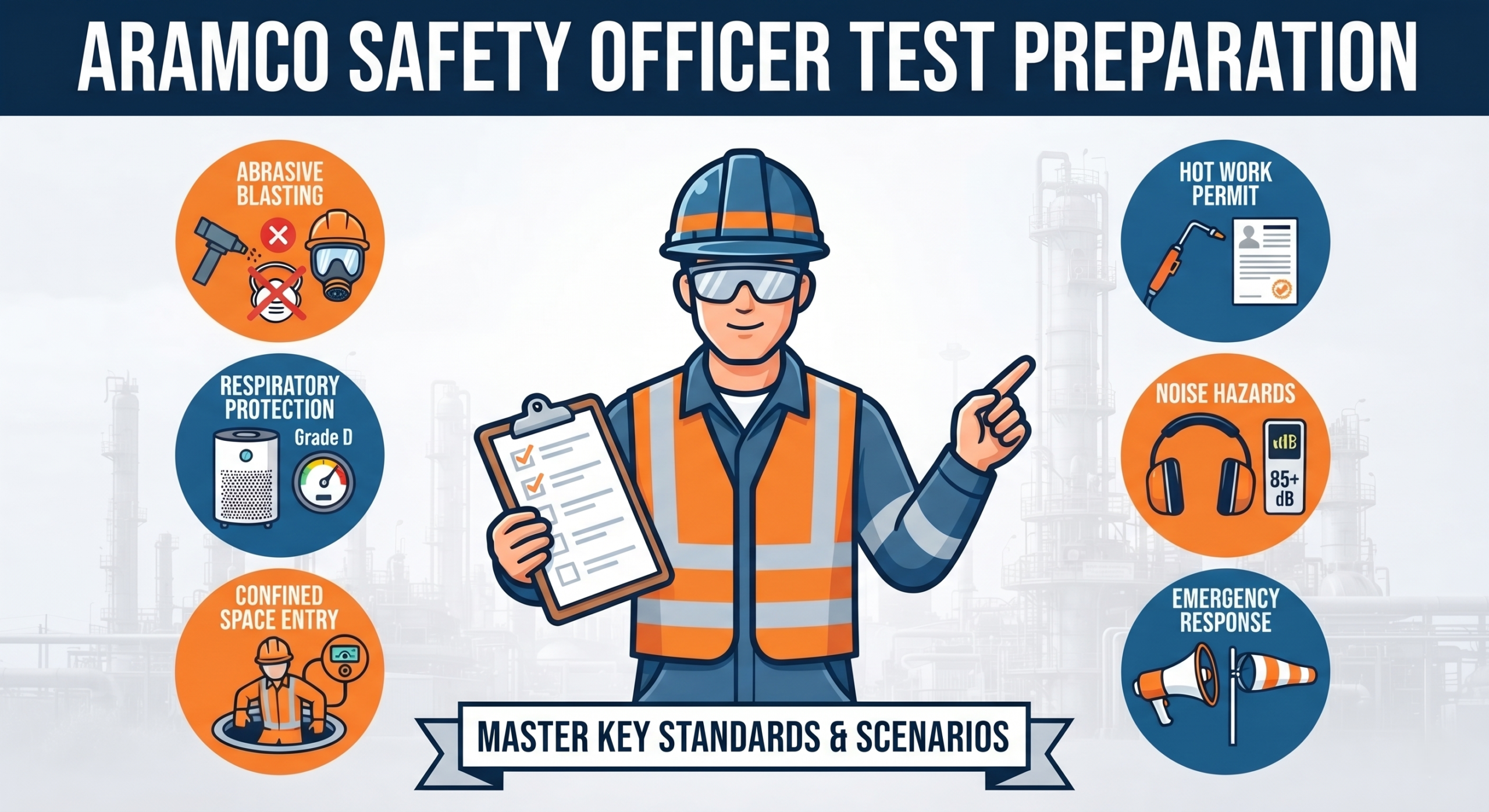
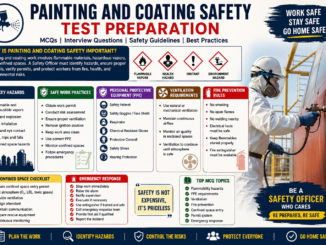
A blast helmet alone does not constitute complete protection. Safety officers must enforce the use of the complete multi-layered ensemble to remain compliant with international safety guidelines. As a note for comprehensive Aramco Safety Officer Test Preparation, make sure to memorize this complete baseline checklist:
(Note to Admin: Use the Focus Keyword “Aramco Safety Officer Test Preparation” as the image ALT text when uploading this graphic to your site.)
| PPE Item | Technical Requirement & Certification |
| Respiratory Protection | NIOSH-approved Type CE supplied-air blasting helmet (positive-pressure) |
| Hearing Protection | Earplugs or earmuffs with a verified NRR worn underneath the blast helmet |
| Eye & Face Protection | Integrated inner and outer impact-resistant lenses within the Type CE helmet structure |
| Body Protection | Full-body blast suits constructed from heavy-duty leather or tough synthetic fibers |
| Hand & Foot Protection | Heavy-duty, abrasion-resistant leather or neoprene gloves; steel-toe safety boots |
| Additional Shielding | A heavy-duty protective apron worn over coveralls during high-intensity profiling |
5. High-Yield Practice Exam Questions practice-questions
Test your knowledge with these core, exam-style questions developed specifically to align with standard Aramco Safety Officer Test Preparation criteria.
Q1: Which of the following materials is strictly prohibited for use as an abrasive blasting medium across company project sites?
-
A) Aluminum oxide grit
-
B) Steel shot
-
C) Silica sand
-
D) Garnet
-
Answer: C — Silica sand is strictly prohibited because it breaks down into crystalline silica dust, leading to silicosis, a progressive and fatal lung disease.
Q2: Where must a breathing air compressor intake be positioned during abrasive blasting operations?
-
A) Downwind of the blasting area to capture overspray
-
B) Inside the blasting containment enclosure for accessibility
-
C) Upwind of all combustion engines and the active blasting zone
-
D) Directly adjacent to the blast pot for pressure efficiency
-
Answer: C — Positioning the intake upwind prevents the compressor from drawing in carbon monoxide ($CO$), engine exhaust, or ambient blasting dust into the operator’s breathing loop.
Q3: Abrasive blasting inside a restricted industrial area containing operational hydrocarbon pipelines is classified as:
-
A) Cold work, requiring only a standard maintenance log
-
B) Hot work, requiring a formal hot work permit and atmospheric gas testing
-
C) Specialized work exempt from local permitting standards
-
D) Confined space entry work exclusively
-
Answer: B — Blasting generates high-velocity friction sparks and heavy static electricity, making it Hot Work. A permit must be posted and gas testing conducted to ensure volatile vapors stay below 10% LEL.
Q4: Under occupational noise exposure regulations, what precise 8-hour TWA decibel threshold triggers a mandatory Hearing Conservation Program?
-
A) 75 dB(A)
-
B) 80 dB(A)
-
C) 85 dB(A)
-
D) 90 dB(A)
-
Answer: C — An 8-hour TWA exposure at or above 85 dB(A) legally requires a Hearing Conservation Program, regular audiometric testing, and mandatory hearing protection.
Q5: What type of respiratory protection is NIOSH-approved for workers performing routine abrasive blasting operations?
-
A) An N95 filtering facepiece respirator
-
B) A half-face air-purifying respirator with P100 particulate filters
-
C) A Type CE supplied-air blasting respirator (full-head, positive-pressure helmet)
-
D) A standard dust-filter mask fitted with an exhaust valve
-
Answer: C — Only a Type CE supplied-air blasting helmet provides an isolated, positive-pressure environment capable of protecting the respiratory system from high-concentration mixed dust.
Q6: For industrial coatings applications, who is authorized to test and certify that a blasting operator is fully competent?
-
A) Any experienced site supervisor or foreman
-
B) A Certified Coatings Inspector (Level II) or recognized equivalent authority
-
C) The facility’s general Human Resources manager
-
D) Any third-party basic orientation trainer
-
Answer: B — Industry standards demand that operators applying high-spec industrial coatings undergo rigorous competency verification by a Level II certified coatings inspector.
Q7: What safety device must be physically integrated onto the blasting nozzle to halt the flow of media instantly if the operator loses control?
-
A) A pressure relief pop-off valve
-
B) A whip check cable
-
C) A deadman switch (trip handle)
-
D) An automatic inline moisture trap
-
Answer: C — The deadman switch is a critical spring-loaded trip mechanism that instantly cuts off air and media flow the exact moment the operator releases their grip.
Q8: A safety officer is preparing a safety plan for abrasive blasting inside an enclosed fuel storage tank. Which permits are legally required to be active?
-
A) A hot work permit only
-
B) A confined space entry permit only
-
C) Both a permit-required confined space entry permit and a hot work permit
-
D) A cold work permit running alongside a general excavation log
-
Answer: C — A storage tank fits the criteria for a permit-required confined space, and blasting within it generates sparks, triggering hot work rules. Both permits must run concurrently.
Frequently Asked Questions faq
Q: Why are internal and external safety links so vital during exam evaluation prep?
-
A: Incorporating recognized regulatory resources ensures your baseline data matches actual field criteria perfectly. For more foundational guides on chemical handling, read our Internal Permit-Required Guide on ehsguidelines.net or check out the official OSHA Abrasive Blasting Standards. Integrating these references is highly recommended for professional Aramco Safety Officer Test Preparation.
Q: Can a standard dust mask be used for blasting?
-
A: Absolutely not. The high velocity and concentration of toxic particles quickly compromise standard filters, making a Type CE positive-pressure helmet the only choice.
Q: Where can I find more resources for my Aramco Safety Officer Test Preparation?
-
A: Utilizing a structured study blueprint that focuses on the combination of hot work rules, compressed air parameters, and protective equipment is the ideal approach for candidates aiming to pass on their first attempt.

1 Trackback / Pingback