Purpose
These Piling Operations and Cofferdams Safety Officer Test Preparation interview questions are commonly asked during Safety Officer interviews on Saudi Aramco and large-scale construction projects. This chapter covers the general requirements, heavy equipment and crane operator certification, work permit protocol, PPE standards, and hose/hammer securing rules a Safety Officer must know before sitting a competency exam or a site interview. The content follows the structure of Saudi Aramco Construction Safety Manual (CSM) II-12, “Piling Operations and Cofferdams,” and cross-references the ANSI and OSHA standards it invokes.
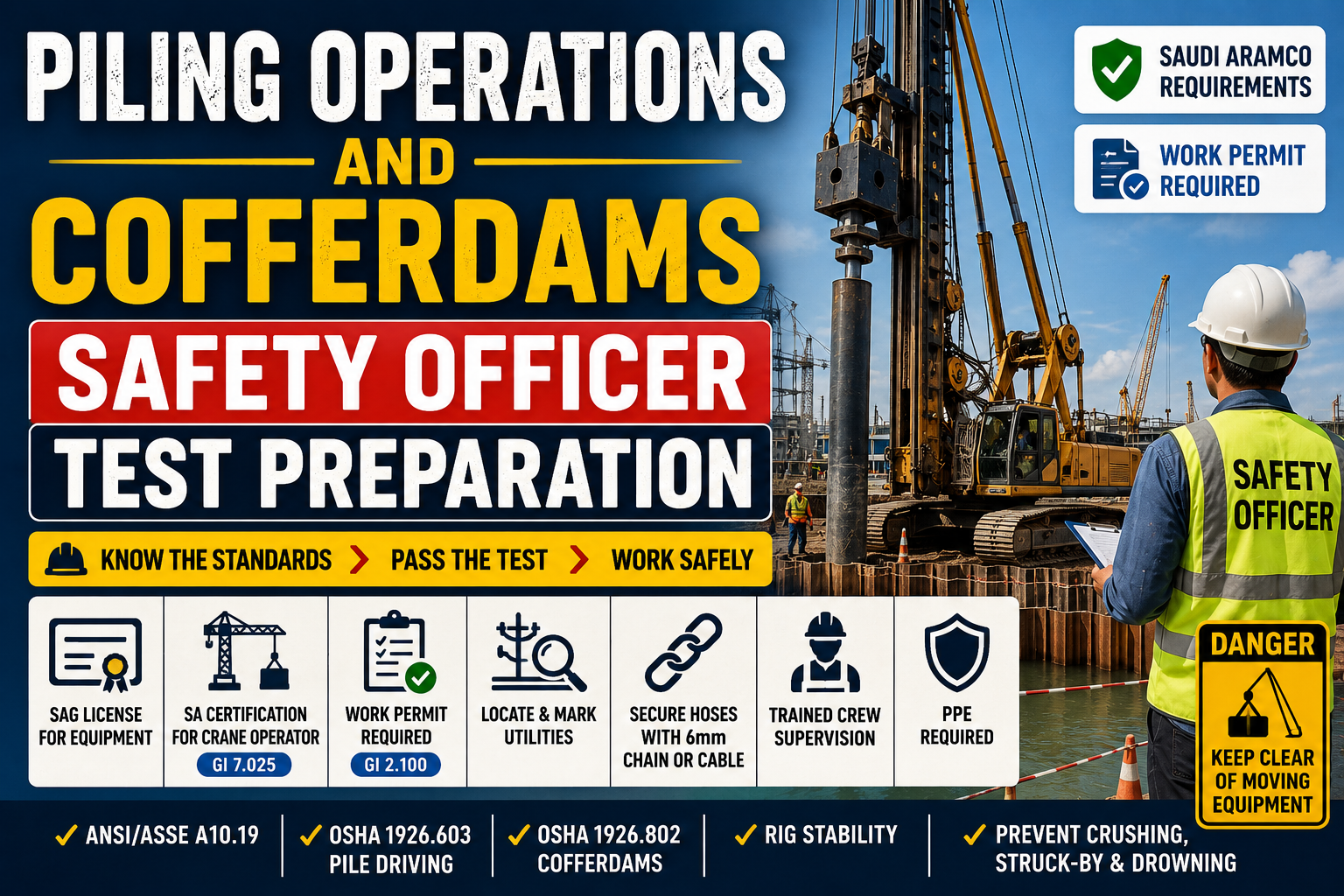
TL;DR: A Safety Officer must verify a valid SAG heavy equipment license for pile driving rigs, SA certification for crane operators under GI 7.025, an approved work permit under GI 2.100, overhead and underground utilities located and marked before piling starts, a 6mm (1/4 inch) chain or cable securing every steam or air hose to the hammer to prevent whipping, and continuous supervision by a trained crew before any pile is driven or cofferdam entered.
Purpose of CSM II-12 and Referenced Standards
CSM II-12 exists to control the crushing, struck-by, electrocution, and drowning hazards generated by pile driving rigs and cofferdam work on Aramco job sites. It does this by tying equipment operator qualification, permit issuance, and stability requirements to a defined set of external standards rather than leaving judgment calls to individual crews.
Q1: What is the purpose of the Piling Operations and Cofferdams chapter in the Construction Safety Manual?
A: To establish minimum requirements for controlling the mechanical, electrical, and drowning hazards associated with driving piles and building cofferdams – covering equipment operator licensing, work permits, utility clearance, PPE, hose and hammer securing, and supervision – so that piling and cofferdam operations are performed without injury to personnel or damage to property.
Q2: Which external standards does CSM II-12 reference?
A: The chapter draws on:
- ANSI/ASSE A10.19 – Safety Requirements for Pile Installation and Extraction Operations
- 29 CFR 1926.603 – Pile Driving Equipment (OSHA construction standard)
- 29 CFR 1926.802 – Cofferdams (OSHA construction standard, Subpart S)
- Saudi Aramco GI 7.025 – Heavy Equipment and Crane Operator Certification
- Saudi Aramco GI 2.100 – Work Permit System
- Saudi Aramco Construction Safety Manual, Chapter I-3 – Personal Protective Equipment
Q3: Why does a Safety Officer need to know both OSHA and Aramco-specific standards?
A: Because Aramco General Instructions build on top of the OSHA floor. 29 CFR 1926.603 sets the federal baseline for pile driving equipment – boiler and pressure vessel compliance, overhead protection, blocking devices, stability – but GI 7.025 and GI 2.100 add company-specific licensing and permit steps that go further. For example, GI 7.025 requires a documented SA certification for the crane operator on a piling crew even where the equipment itself already carries a valid SAG heavy equipment license, and a permit under GI 2.100 is still required before the rig can be mobilized on-site regardless of the operator’s certification status.
Core Piling and Cofferdam Safety Standards
Q4: What are the general requirements under CSM II-12, Section 12.3?
A: The core requirements a Safety Officer verifies before authorizing piling or cofferdam work are:
- SAG heavy equipment license – the pile driving rig, crane, or hammer must be operated only under a valid Saudi Aramco Government (SAG) heavy equipment license.
- SA certification for the crane operator – issued per GI 7.025, specific to the equipment type and load class being operated.
- Approved work permit – issued per GI 2.100 before piling or cofferdam work starts, specifying location, scope, and precautions.
- Utility location and marking – overhead power lines and underground utilities located, verified, and marked before any pile is driven or excavation for a cofferdam begins.
- PPE compliance – hard hats, safety shoes, safety glasses, gloves, and hearing protection worn per Chapter I-3.
- Hose and hammer securing – steam or air hoses secured to the hammer with a 6mm (1/4 inch) chain or cable to prevent whipping if a coupling fails.
- Continuous supervision – a trained crew supervises piling and cofferdam operations at all times work is in progress.
- Rig stability – guys, outriggers, or counterbalances used as needed to keep the piling rig stable throughout the driving cycle.
Q5: Who is authorized to operate a pile driving rig or crane on an Aramco site?
A: Only equipment carrying a current SAG heavy equipment license, operated by a crew member holding a valid SA certification issued for that specific equipment class under GI 7.025. An operator certified on a smaller crawler crane cannot be assumed competent on a larger pile driving rig without the matching certification – the certificate is equipment-specific, not a general license to operate any crane on site.
Q6: What does the work permit under GI 2.100 need to specify for piling operations?
A: The permit identifies the exact work location, the type of piling or cofferdam activity, the equipment to be used and its SAG license number, the crane operator’s SA certification, the results of the overhead and underground utility check, and the authorizing signatures. A permit issued for one pile location does not automatically cover a relocated rig position – a new or revalidated permit is required each time the rig moves to a new driving point that changes the utility or overhead-line clearance picture.
Q7: Why is overhead and underground utility location a distinct step before piling begins?
A: Because a pile driving rig’s leads and boom present an electrocution risk near overhead power lines, and pile driving vibration or excavation for a cofferdam can rupture underground gas, water, or electrical services. The Safety Officer confirms utility drawings have been reviewed, underground services are physically located and marked (not just assumed from a drawing), and overhead line clearance distances are established and maintained before the rig is positioned.
PPE Requirements for Piling Operations and Cofferdams
Q8: What PPE is required for personnel working on a piling or cofferdam crew?
A: Per Chapter I-3 of the Construction Safety Manual:
- Hard hats – worn at all times within the piling rig’s working radius or inside a cofferdam.
- Safety shoes – to protect against dropped sections of pile, cribbing, or hand tools.
- Safety glasses – to protect against flying debris from pile driving impact or cutting operations.
- Gloves – for handling hoses, chains, cables, and pile sections.
- Hearing protection – required near the hammer and compressor, where impact and engine noise routinely exceed safe exposure limits over a driving shift.
Q9: Why is hearing protection specifically called out for piling crews rather than left as a general PPE item?
A: Because pile driving hammers – whether diesel, air, or steam-powered – generate high-intensity impact noise on every blow cycle, often for sustained periods. A crew member standing near the leads or the compressor during a driving sequence can be exposed to noise levels well above what a single shift of hearing protection use is designed to manage, which is why the requirement is written into CSM II-12 rather than assumed under a general site PPE policy.
Q10: What is the risk if a crew member removes gloves to handle a hose coupling or securing chain?
A: Pinch points at hose couplings, chain shackles, and cable clamps can crush or lacerate bare hands, particularly under tension when a hose is being connected or disconnected from a hammer under residual air or steam pressure. Gloves are required for this task specifically, not just as a general site rule.
Equipment and Hose Safety Requirements
Q11: What is the specific requirement for securing a steam or air hose to a pile driving hammer?
A: The hose supplying steam or air to the hammer must be secured to the hammer with a 6mm (1/4 inch) chain or cable to prevent the hose from whipping if the coupling fails or separates under pressure. A hose connection relying on the coupling alone, without a mechanical secondary restraint, does not meet this requirement.
Q12: Does the same securing rule apply to other hose connections on the rig, not just the hammer connection?
A: Yes. A safety chain or cable is required at other hose connections as well – not only the point where the hose enters the hammer – so that any coupling failure along the line is contained by a mechanical restraint rather than allowed to whip freely under pressure.
Q13: What stability devices does a Safety Officer verify are in place on a pile driving rig?
A: Guys, outriggers, and counterbalances, sized and positioned according to the rig manufacturer’s specifications and the ground conditions at the driving location. A rig standing on soft or uneven ground, or driving battered piles at an incline, needs additional stabilization beyond what is adequate on firm, level ground – the Safety Officer checks this against actual site conditions, not just a generic checklist item.
Q14: What does 29 CFR 1926.603 require for boilers and pressure systems on steam-powered pile driving equipment?
A: Boilers and unfired pressure vessels used with pile driving equipment must comply with the applicable ASME Boiler and Pressure Vessel Code sections. A Safety Officer verifying a steam-powered rig confirms current inspection documentation for the boiler and pressure system before authorizing use, in addition to the hose-securing and PPE checks already covered.
Q15: What overhead protection requirement applies to pile driving rig operators?
A: Operators must be protected by overhead protection equivalent to 2-inch planking or material of equal strength, positioned so it does not obscure the operator’s view of the leads and the work area – a requirement carried from 29 CFR 1926.603 into the equipment inspection a Safety Officer performs before authorizing a rig for use.
Supervision and Cofferdam-Specific Requirements
Q16: What level of supervision does CSM II-12 require for piling and cofferdam operations?
A: Continuous supervision by a trained crew for the full duration of piling or cofferdam work. This means a competent person remains present and actively monitoring the operation – not periodically checking in – because pile driving and cofferdam conditions can change rapidly with each blow cycle, water level, or excavation step.
Q17: What does 29 CFR 1926.802 require specifically for cofferdams?
A: Under OSHA’s cofferdam standard, the employer must provide a means of controlled flooding if high water could overtop the cofferdam, post warning signals for employee evacuation, equip walkways and ramps with guardrails and at least two means of rapid exit, and protect cofferdams near navigable shipping channels from vessel traffic where possible. A Safety Officer checks that these evacuation and exit provisions are physically in place before personnel are allowed to enter or work inside the cofferdam.
Q18: Why does a cofferdam need at least two means of rapid exit rather than one?
A: Because a single exit route can be blocked by equipment, debris, or a rising water condition at the exact moment personnel need to leave quickly. Two independent means of rapid exit ensure a workable escape route remains available even if one path is obstructed – this is a direct requirement under 29 CFR 1926.802, not a discretionary site enhancement.
High-Frequency Exam Hazards & Regulations
Q19: Under ANSI/ASSE A10.19, what are the principal hazard categories in pile installation and extraction?
A: Struck-by hazards from swinging leads and pile sections, crushing hazards at hose and chain connections, electrocution from proximity to overhead lines, rig instability from inadequate guying or outriggering, and drowning or engulfment hazards specific to cofferdam work near water. A10.19 addresses these through equipment inspection, operator qualification, and site-specific stability requirements.
Q20: What is the exact chain or cable dimension required for securing a hose to a pile driving hammer?
A: 6mm, or 1/4 inch. This is a specific, testable figure – candidates should not round it to “a small chain” or confuse it with cable sizing used elsewhere on the rig for lifting or rigging purposes.
Q21: What is a common exam trick question about crane operator certification on a piling crew?
A: Candidates are often asked whether a valid SAG heavy equipment license on the rig itself is sufficient to authorize operation. It is not – the rig’s SAG license and the operator’s individual SA certification under GI 7.025 are two separate requirements, and both must be current and matched to the specific equipment before work begins.
Q22: What should a Safety Officer check regarding rig stability before driving begins on soft ground or at an angle?
A: Whether guys, outriggers, or counterbalances have been adjusted for the actual ground bearing conditions and pile angle at that specific location, rather than relying on the setup used at the previous driving point. Ground conditions and batter angle both change the load path through the leads, and a stability configuration adequate for vertical piles on firm ground may be inadequate for battered piles on soft fill.
Q23: What is the difference in hazard focus between the pile driving equipment standard and the cofferdam standard?
A: 29 CFR 1926.603 focuses on the mechanical integrity and stability of the driving rig itself – boilers, leads, blocking devices, stabilization. 29 CFR 1926.802 focuses on the cofferdam structure and the personnel inside or near it – flooding control, evacuation signals, exit routes, and protection from vessel traffic. A Safety Officer working a combined piling-and-cofferdam scope needs both standards, applied to different parts of the same job site.
FAQ: Piling Operations and Cofferdams Safety Officer Test Preparation
What certification is required for a crane operator on a piling crew? A current SA certification issued under GI 7.025, specific to the equipment type and load class, in addition to the pile driving rig itself holding a valid SAG heavy equipment license.
What is the required chain or cable size for securing a hose to a pile driving hammer? 6mm (1/4 inch) chain or cable, used to prevent the hose from whipping if the coupling connecting it to the hammer fails under pressure.
What Aramco General Instruction governs work permits for piling operations? GI 2.100 governs the work permit system, including the permit required before piling or cofferdam work begins, covering location, equipment, and utility clearance details.
What PPE is mandatory for piling and cofferdam crews under Chapter I-3? Hard hats, safety shoes, safety glasses, gloves, and hearing protection, worn throughout the piling rig’s working radius or inside the cofferdam.
What OSHA standard governs cofferdam-specific safety requirements? 29 CFR 1926.802, covering controlled flooding provisions, evacuation warning signals, guardrails, minimum two means of rapid exit, and protection from vessel traffic near shipping channels.
Why must overhead and underground utilities be located before piling starts? To prevent electrocution from contact between the rig and overhead power lines, and to prevent rupture of underground gas, water, or electrical services from driving vibration or cofferdam excavation.
Sources
- OSHA, 29 CFR 1926.603 – Pile Driving Equipment: osha.gov/laws-regs/regulations/standardnumber/1926/1926.603
- OSHA, 29 CFR 1926.802 – Cofferdams: osha.gov/laws-regs/regulations/standardnumber/1926/1926.802
- OSHA, 29 CFR 1926 Subpart S – Underground Construction, Caissons, Cofferdams, and Compressed Air: osha.gov/laws-regs/regulations/standardnumber/1926/1926SubpartS
- OSHA Standard Interpretation, pile driving hammer hose safety chain requirements under 1926.603(a)(9) and (a)(10): osha.gov/laws-regs/standardinterpretations/2000-10-17-0
- American Society of Safety Professionals, ANSI/ASSE A10.19 – Safety Requirements for Pile Installation and Extraction Operations: assp.org
This article is provided for exam and interview preparation purposes. Always verify current work permit, licensing, and certification requirements against the latest Saudi Aramco General Instructions issued for the specific project.
Be the first to comment