Purpose
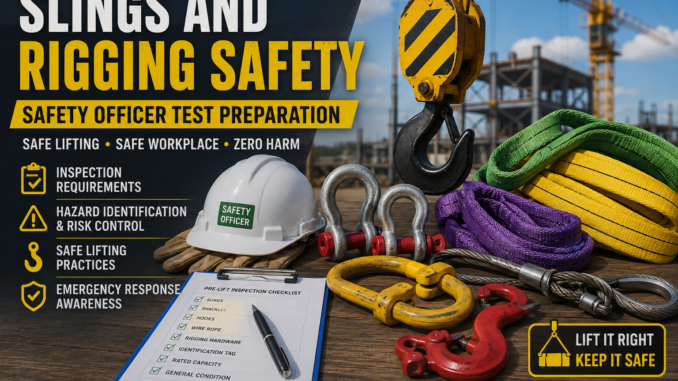
**Slings and Rigging Safety** is one of the most important topics in Safety Officer Test Preparation. Every Safety Officer must understand how to inspect slings, rigging hardware, identify lifting hazards, and ensure safe lifting operations. This guide explains the essential safety requirements, inspection procedures, hazard controls, emergency response, and scenario-based questions to help candidates prepare confidently for their Safety Officer examination.
This Safety Officer Test Preparation guide is designed to help candidates understand the minimum safety requirements for slings and rigging hardware used by company and contractor personnel. The guide focuses on practical knowledge required for workplace inspections, lifting operation supervision, hazard identification, emergency response awareness, and examination preparation.
Rather than memorizing answers, candidates should use this resource to understand how rigging equipment is selected, inspected, used safely, and removed from service when defects are identified.
Slings and Rigging Safety Overview Learning Objectives
After studying this guide, a Safety Officer should be able to:
-
Identify different types of slings and rigging hardware.
-
Recognize inspection requirements before use.
-
Understand safe working load limitations.
-
Identify common rigging hazards.
-
Verify proper load control procedures.
-
Understand emergency response actions during lifting incidents.
-
Answer test questions confidently using practical reasoning.
Types of Slings
Wire Rope Slings
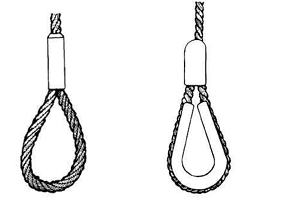
Used for heavy lifting operations and resistant to abrasion and high temperatures.
Common hazards: broken wires, kinks, birdcaging, corrosion, crushed sections.
Chain Slings
Suitable for rugged industrial environments.
Common hazards: stretched links, cracks, excessive wear, unauthorized welding repairs.
Synthetic Web Slings
Lightweight and flexible, commonly used for delicate loads.
Common hazards: cuts, chemical damage, burns, broken stitching, UV degradation.
Round Slings
Provide good load distribution and flexibility.
Common hazards: cover damage, internal fiber failure, chemical exposure, heat damage.
Rigging Hardware
Safety Officers should be familiar with:
-
Shackles
-
Hooks
-
Eyebolts
-
Turnbuckles
-
Spreader beams
-
Master links
-
Swivels
-
Clamps
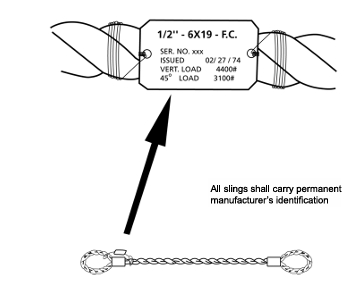
All hardware must have a visible identification marking and rated capacity.
Pre-Use Inspection Checklist
Before any lifting operation, the rigger and Safety Officer should verify:
Inspection Point
Acceptable
Identification tag present
Rated capacity legible
No cracks or deformation
No excessive corrosion
No unauthorized repairs
Safety latches functioning
Sling free from cuts or burns
Correct sling angle selected
Load weight verified
Lift plan reviewed
Safe Working Load and Sling Angles
One of the most common test questions involves sling angle effects.
Important Rule
As the sling angle decreases, the tension in each sling leg increases.
Example: A two-leg sling lifting a 2-ton load may place significantly more than 1 ton on each leg when the sling angle becomes small.
Safety Tip: Avoid sling angles less than 45° whenever possible unless specifically engineered.
Common Rigging Hazards
Overloading
Exceeding rated capacity of slings or hardware.
Shock Loading
Sudden jerking of the load.
Sharp Edges
Cutting synthetic slings.
Side Loading
Loading hooks or shackles improperly.
Improper Hitch
Incorrect basket, choker, or vertical hitch.
Damaged Equipment
Using defective slings or hardware.
Poor Communication
Lack of clear signals between operator and rigger.
Inspection Rejection Criteria
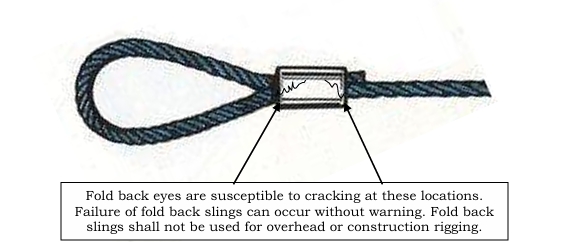
Remove a wire rope sling from service if:
-
Broken wires exceed allowable limits.
-
Kinking is present.
-
Birdcaging is observed.
-
Severe corrosion exists.
-
End fittings are damaged.
Remove a synthetic sling from service if:
-
There are cuts or tears.
-
Stitching is damaged.
-
Melted or charred areas are visible.
-
Chemical attack is evident.
-
Identification tag is missing.
Role of the Safety Officer During Lifting
The Safety Officer should:
-
Verify that certified riggers are assigned.
-
Confirm lifting permits where required.
-
Inspect exclusion zones.
-
Ensure tag lines are used when necessary.
-
Monitor weather conditions.
-
Stop the job if unsafe conditions develop.
-
Ensure emergency response procedures are understood by the crew.
Emergency Response Awareness
Slings and Rigging Safety For test preparation, candidates should understand the general emergency response pattern used by many organizations.
If a load falls or rigging fails:
-
Stop all lifting operations immediately.
-
Secure the area.
-
Account for personnel.
-
Notify supervision and emergency response teams.
-
Provide first aid if safe to do so.
-
Preserve the incident scene for investigation.
-
Report defective equipment.
Confined Space Considerations
Slings and Rigging Safety When rigging operations occur near or inside a confined space, additional precautions may include:
-
Confined space entry permit.
-
Atmospheric testing.
-
Ventilation requirements.
-
Standby attendant.
-
Rescue equipment availability.
-
Communication procedures.
-
Control of suspended loads over personnel.
Scenario-Based Practice Questions
Missing Identification Tag
During inspection, a synthetic web sling has no identification tag. What should you do?
Answer: Remove the sling from service because its rated capacity cannot be verified.
Decreasing Sling Angle
Slings and Rigging Safety A supervisor wants to decrease the sling angle to fit a load. What is the hazard?
Answer: Tension in the sling legs will increase, potentially exceeding the rated capacity.
Shock Loading
The crane operator jerks the load during lifting. What is this called?
Answer: Shock loading.
Birdcaging Found
You observe birdcaging in a wire rope sling. Is the sling acceptable?
Answer: No. The sling must be removed from service.
Load Over Workers
Slings and Rigging Safety Workers are standing under a suspended load. What action should the Safety Officer take?
Answer: Stop the operation and clear personnel from the exclusion zone.
Side Loading a Hook
Why is side loading a hook dangerous?
Answer: Hooks are designed for loading in line with the hook bowl; side loading can cause deformation or failure.
Confined Space Lift
A lift is planned near a confined space opening. What additional document may be required?
Answer: A confined space entry permit.
Spreader Beam Benefit
What is the primary benefit of a spreader beam?
Answer: It distributes the load and helps maintain favorable sling angles.
Quick Revision Notes
Always verify the load weight.
Know the actual weight before selecting slings.
Check sling identification tags.
No tag = remove from service.
Inspect before every use.
Look for damage, wear, and deformation.
Avoid shock loading.
Lift smoothly and steadily.
Protect slings from sharp edges.
Use edge protection when needed.
Maintain proper sling angles.
Prefer 45° or greater unless engineered.
Keep personnel clear of suspended loads.
Enforce exclusion zones.
Remove defective equipment immediately.
Tag and isolate unsafe gear.
Conclusion
Slings and Rigging Safety are among the most important safety-critical elements in lifting operations. A competent Safety Officer must understand equipment types, inspection requirements, load limitations, sling angle effects, and emergency response procedures. The ability to identify defects and stop unsafe lifting operations can prevent catastrophic incidents.
For examination success, focus on practical decision-making: whether equipment should be accepted or rejected, how sling angles affect tension, what actions are required during emergencies, and how to protect workers from suspended-load hazards. Review the scenario questions repeatedly, visualize real job-site conditions, and practice explaining the correct safety action for each situation.
Consistent review of this guide will help build the confidence and technical understanding needed for both the Safety Officer test and real workplace lifting operations.
Be the first to comment