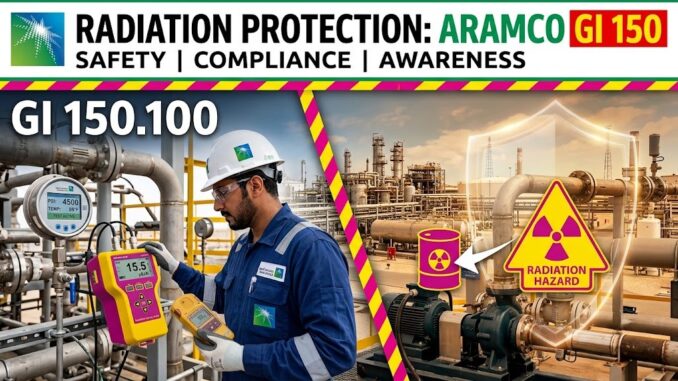
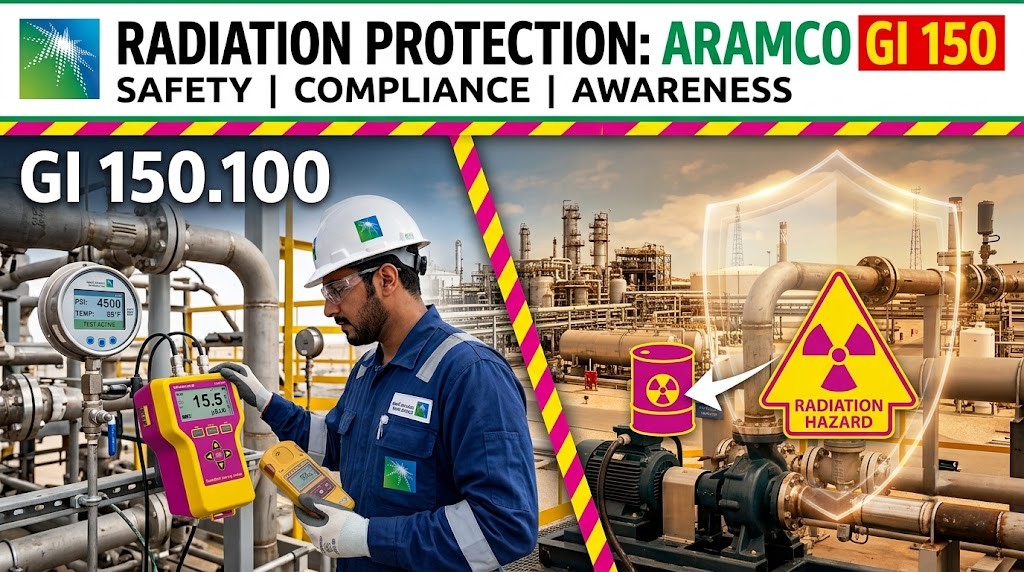
Ionizing radiation protection at Saudi Aramco runs on four source categories, each governed by its own document: medical/dental X-ray units (GI 150.005), analytical X-ray equipment used in labs (GI 150.006), unsealed radioactive sources and contamination control (GI 150.007), and the umbrella policy tying them together (GI 150.003). NORM – the naturally occurring radioactive material found in scale and sludge inside oil and gas equipment – sits outside that GI stack entirely and gets its own engineering procedure, SAEP-358. If a safety officer candidate can’t explain that split in the first thirty seconds of an interview, the assessor already knows the prep was shallow.
This guide walks through the whole document set the way a Saudi Aramco EHS panel actually tests it: what each GI covers, where the scope lines are drawn, how ALARA gets applied on a real jobsite, and how dosimetry, shielding, and incident reporting all interact. It closes with an interview-prep FAQ and links to the primary IAEA, ICRP, OSHA, and NRRC references behind the Saudi framework. If you’re also prepping the mechanical-integrity side of the exam, our companion guide on hydrostatic pressure test safety is worth reading alongside this one.
Note: this article covers non-destructive testing (NDT) radiography only by exclusion – it’s regulated under separate industrial radiography instructions, not the GI 150 series discussed here.
5. Ionizing Radiation
5.1 Purpose
The ionizing radiation chapter of Saudi Aramco’s EHS manual exists to protect workers, patients, the public, and the environment from the health effects of exposure to X-rays, gamma rays, and radioactive sources used across the company’s medical, analytical, and industrial operations.
It does three things at once:
- Sets the licensing and administrative baseline – no radiation-producing equipment or radioactive source gets installed, operated, or moved without an approved radiation protection program and a qualified radiation safety officer (RSO) on record.
- Applies the ALARA principle to every practice involving ionizing radiation – dose reduction isn’t optional once the equipment is justified for use.
- Draws a hard line between source types – medical exposure, analytical exposure, and NORM exposure each carry different risk profiles and different controls, and mixing them up is one of the more common interview stumbles.
It applies from the day a radiation-producing device or radioactive source enters an Aramco facility through decommissioning, transfer, or disposal. Where a specific engineering standard (like SAEP-358) or an international body’s guidance (IAEA, ICRP) sets a stricter number, that stricter figure governs.
5.2 Ionizing Radiation Protection Saudi Aramco: Governing Documents
Six documents make up the ionizing radiation control framework. Two of them – GI 6.001 and GI 6.003 – aren’t radiation-specific; they’re the general incident-management GIs that every radiation event ultimately has to route through.
GI 6.001 – Notification Requirements for Incidents. This is the reporting clock. Any radiation overexposure, lost source, contamination event, or equipment malfunction that could have caused exposure has to be notified within the timeframe this GI sets – typically as soon as practicable and within a fixed number of hours for anything classified as a serious incident. A radiation safety officer who can’t quote the notification trigger points hasn’t read this GI closely enough.
GI 6.003 – Incident Investigation. Once a radiation incident is notified under GI 6.001, this GI governs how it gets investigated: root-cause methodology, who leads the investigation, and what corrective actions get tracked to closure. For radiation events specifically, this usually means pulling dosimetry records, source inventory logs, and area survey data as part of the evidence package.
GI 150.003 – Ionizing Radiation Protection. The core, umbrella GI. It sets the justification, optimization (ALARA), and dose-limitation principles that every other document in this list builds on. It defines who needs an RSO, what a radiation protection program has to contain, and the baseline occupational and public dose limits Aramco facilities work to.
GI 150.005 – Medical Radiation Producing Equipment. Covers X-ray machines used for diagnostic and dental purposes in Aramco medical facilities – general radiography units, dental X-ray sets, mobile C-arms, and similar diagnostic equipment. It sets equipment registration, shielding, operator qualification, and patient-protection requirements specific to a clinical setting.
GI 150.006 – Analytical X-ray Equipment. Covers X-ray diffraction (XRD) and X-ray fluorescence (XRF) units used in Aramco’s research and quality-control labs. These machines produce a narrow, high-intensity beam rather than a diagnostic image, which changes the shielding and interlock requirements compared to medical equipment under GI 150.005.
GI 150.007 – Unsealed Radioactive Sources and Contamination Control. Covers open (unsealed) radioactive material – tracer studies, certain lab reagents, and any application where the radioactive substance itself, not just the radiation it emits, could contaminate a surface, a worker, or the environment. This is where surface contamination limits, decontamination procedures, and personal protective equipment requirements for handling open sources live.
SAEP-358 – Management of NORM. The engineering procedure for Technologically Enhanced Naturally Occurring Radioactive Material – the radium-226 and radium-228 scale that accumulates inside oil and gas production equipment (separators, tanks, piping) over years of operation. NORM isn’t a “radiation source” in the licensing sense; it’s a contamination byproduct of production, and SAEP-358 sets the survey, handling, storage, and disposal rules for it.
Radiation protection sits alongside – but separate from – other mechanical-integrity requirements an interviewer may probe, such as the GI 2.102 pressure testing standards, which govern hydrostatic and pneumatic test procedures rather than radiation source control.
5.3 Scope: What’s Covered and What Isn’t
Covered under the GI 150 series:
- Medical and dental diagnostic X-ray equipment (GI 150.005)
- Analytical X-ray equipment – XRD/XRF units in labs (GI 150.006)
- Unsealed radioactive sources and any resulting surface or personnel contamination (GI 150.007)
- The general ionizing radiation protection program, RSO appointment, and ALARA requirements that apply across all of the above (GI 150.003)
Explicitly excluded:
- Industrial radiography (NDT). Gamma radiography and X-ray radiography used for weld inspection and non-destructive testing is a sealed-source, high-activity practice with its own dedicated radiography procedures and shielding/exclusion-zone rules. It is not governed by GI 150.005, 150.006, or 150.007.
- NORM. Naturally occurring radioactive scale in process equipment is managed under SAEP-358, not the GI 150 series, because the risk profile (long-term, low-level, equipment-embedded contamination) is fundamentally different from a licensed radiation source or piece of radiation-producing equipment.
Knowing this exclusion list cold is one of the fastest ways to show an interviewer you understand the framework rather than having memorized a document title.
5.4 Ionizing vs. Non-Ionizing Radiation, in Plain Terms
Radiation is just energy traveling as waves or particles. The split that matters for safety is whether that energy is strong enough to strip electrons off atoms.
- Ionizing radiation carries enough energy to knock electrons loose from atoms it passes through – that’s what “ionizing” means. X-rays, gamma rays, alpha particles, beta particles, and neutrons all fall into this category. This is the kind that can damage DNA and living tissue, and it’s what GI 150.003 and its supporting documents regulate.
- Non-ionizing radiation doesn’t carry enough energy to strip electrons – visible light, radio waves, microwaves, and most UV radiation sit here. It can still cause harm (a sunburn, a microwave burn), but through heating or photochemical effects, not through ionization. It’s covered by different EHS guidance entirely and isn’t part of the ionizing radiation protection scope.
The KACST-issued national instructions that underpin the Saudi framework state this exclusion explicitly: the regulations apply to X-rays, gamma rays, alpha, beta, neutrons, and other ionizing particles, “to the exclusion of non-ionizing radiations.” That single line is worth memorizing verbatim for an interview.
5.5 The ALARA Principle, With Practical Examples
ALARA stands for As Low As Reasonably Achievable. It’s not a dose limit – it’s a working obligation to keep exposure below the legal limit by every reasonable means available, balancing protection against cost, time, and technical feasibility. The ICRP formalized it back in 1977, and it’s been the backbone of radiation protection ever since.
ALARA runs on three levers, and every practical example on a jobsite maps back to one of them:
- Time. Minimize how long anyone stays near a source. A lab technician running an XRF unit under GI 150.006 sets up the sample, steps back, and lets the automated exposure cycle run rather than standing next to the beam path.
- Distance. Exposure falls off with the inverse-square law – double the distance, and dose drops to a quarter. That’s why radiographers and RSOs push people back from a source rather than just asking them to “be quick.”
- Shielding. Put material between the source and the person. A lead apron on a dental X-ray patient, a leaded-glass viewing window on an analytical X-ray cabinet, or a shielded storage pig for an unsealed source under GI 150.007 – all shielding, just applied to different source types.
A concrete example: an Aramco clinic replacing an old dental X-ray unit with digital sensors cuts patient dose by roughly 60-80% for the same diagnostic image, purely through equipment choice – that’s ALARA working through the “as low as reasonably achievable” lens rather than through a dose-limit mandate.
5.6 Dosimetry: How Exposure Actually Gets Measured
You can’t manage what you don’t measure, and Article 60-type personal monitoring requirements across the GI 150 series exist for exactly that reason. Three dosimetry technologies show up across Aramco radiation work, and knowing the difference is a favorite interview probe:
- Film badges. The oldest method – a small piece of radiation-sensitive film in a badge holder, worn on the torso. It’s cheap and gives a permanent physical record, but it has to be sent off for lab processing, so there’s no real-time reading. Largely phased out in favor of TLDs on most modern programs, though some legacy applications still use it.
- TLDs (Thermoluminescent Dosimeters). A crystal (commonly lithium fluoride) that stores absorbed radiation energy and releases it as light when heated during processing. More accurate and more durable than film, and it’s the standard passive dosimeter for most occupational monitoring programs, typically read out monthly or quarterly.
- Electronic Personal Dosimeters (EPDs). Battery-powered digital devices that give an instant, real-time dose and dose-rate reading, often with audible alarms at pre-set thresholds. These are what an RSO hands to a worker entering a controlled area for a one-off task – anywhere immediate feedback matters more than long-term record-keeping.
Most Aramco radiation workers under GI 150.003 wear a passive dosimeter (film or TLD) for the official personal dose record, and pick up an EPD for specific higher-risk tasks where real-time alarms matter.
5.7 Medical, Analytical, and NORM Sources: What’s Actually Different
This is the distinction that trips people up most in interviews, because on paper “radiation is radiation” – but the controls differ sharply by source type.
| Source type | Governing document | What makes it different |
|---|---|---|
| Medical/dental X-ray | GI 150.005 | Deliberately produced beam, used on patients and staff in a clinical setting; equipment is registered, calibrated, and operators need specific clinical qualifications |
| Analytical X-ray (XRD/XRF) | GI 150.006 | Deliberately produced beam, high-intensity and narrow, used on samples not people; interlocked cabinets and beam-path shielding are the primary control |
| Unsealed radioactive sources | GI 150.007 | The material itself can spread – contamination control, surface wipe tests, and decontamination procedures matter as much as dose from direct exposure |
| NORM (scale/sludge) | SAEP-358 | Not a deliberate source at all – it’s a naturally occurring contaminant that concentrates inside process equipment over years; managed through survey, isolation, and disposal rather than shielding a “device” |
The practical takeaway: medical and analytical sources are about controlling a device. Unsealed sources are about controlling material that can migrate. NORM is about managing contamination that accumulated on its own, with no operator ever “turning it on.”
5.8 Shielding and Penetration Depth: Alpha, Beta, Gamma, Neutron
Not all ionizing radiation needs the same barrier, and getting this wrong is a classic interview red flag.
- Alpha particles – heavy, low-penetration. Stopped by a sheet of paper or a few centimeters of air. Not a hazard from outside the body, but dangerous if inhaled or ingested (which is exactly why NORM contamination control under SAEP-358 focuses on preventing intake, not on shielding a room).
- Beta particles – lighter, more penetrating than alpha. Stopped by a few millimeters of aluminum or plastic, or roughly a centimeter of tissue. Still primarily a skin and eye hazard rather than a deep-tissue one.
- Gamma rays – highly penetrating electromagnetic radiation. Needs dense shielding: several centimeters of lead, or thick concrete, to attenuate meaningfully. This is what a medical X-ray room’s leaded walls and a radiography source’s shielded container are built to stop.
- Neutrons – highly penetrating and not stopped effectively by dense metals alone; they need hydrogen-rich shielding like water, paraffin, or concrete to slow and absorb them. Less common in Aramco’s day-to-day radiation portfolio but relevant in specific analytical or well-logging contexts.
The shorthand an RSO should be able to rattle off: alpha – paper; beta – aluminum; gamma – lead or concrete; neutron – water or concrete.
5.9 How the Documents Interact: A Walk-Through
Here’s how the framework actually plays out on a real Aramco site, document by document:
- GI 150.003 sets the foundation. Before any radiation source or device is installed, the facility needs an approved radiation protection program, a designated RSO, and documented ALARA procedures. This GI is the license to operate, in effect.
- The device-specific GI takes over day-to-day. If it’s a clinic X-ray unit, GI 150.005 governs equipment registration, shielding checks, and operator training. If it’s a lab XRD/XRF unit, GI 150.006 governs interlocks and beam containment. If it’s an unsealed tracer or lab isotope, GI 150.007 governs contamination surveys and PPE.
- Dosimetry and monitoring run continuously underneath all three. Workers under any of these GIs wear the dosimeter type appropriate to their task (Section 5.6), and area surveys get logged per GI 150.003’s monitoring requirements.
- If something goes wrong, GI 6.001 activates first. A dropped source, a contamination spread, an overexposure reading – any of these trigger the notification clock under GI 6.001, independent of which device-specific GI the source falls under.
- GI 6.003 takes it from there. Once notified, the incident investigation process kicks in: root cause, corrective actions, and – critically for radiation events – a review of whether the ALARA controls in GI 150.003 actually held up in practice.
- NORM runs on a parallel track. SAEP-358 doesn’t plug into this chain the same way, because there’s no “device” to register. It runs its own survey-and-isolate cycle at turnarounds, independent of the licensing flow above, but a NORM contamination incident that causes personnel exposure still routes through GI 6.001/6.003 like any other radiation event.
5.10 Document Comparison Table
| Document | Type | One-line purpose |
|---|---|---|
| GI 6.001 | General Instruction | Sets notification timeframes and triggers for reporting any incident, including radiation exposures and contamination events |
| GI 6.003 | General Instruction | Governs how notified incidents – including radiation events – get investigated and closed out |
| GI 150.003 | General Instruction | Umbrella ionizing radiation protection policy: RSO appointment, ALARA, and baseline dose limits |
| GI 150.005 | General Instruction | Controls for medical and dental radiation-producing X-ray equipment |
| GI 150.006 | General Instruction | Controls for analytical X-ray equipment (XRD/XRF) in labs |
| GI 150.007 | General Instruction | Contamination control and handling rules for unsealed (open) radioactive sources |
| SAEP-358 | Engineering Procedure | Survey, isolation, storage, and disposal management of NORM scale in production equipment |
Practical Checklist for the Radiation Safety Officer
Before any radiation source or device is commissioned:
- Radiation protection program approved and RSO formally designated under GI 150.003
- Correct device-specific GI identified (150.005 medical, 150.006 analytical, 150.007 unsealed sources)
- Shielding design matches the radiation type present (Section 5.8)
- Dosimetry program set up – passive badges assigned, EPDs available for higher-risk tasks
During routine operation:
- Area surveys and personal dose records logged on schedule
- Interlocks and warning signage checked on analytical X-ray cabinets
- Contamination wipe tests performed wherever unsealed sources are handled
- NORM survey scheduled ahead of any turnaround under SAEP-358
If something goes wrong:
- Notify per GI 6.001 timeframes – don’t wait to “confirm” before starting the clock
- Preserve dosimetry and survey records for the GI 6.003 investigation
- Isolate any contaminated equipment or area immediately, pending decontamination
FAQ: Radiation Safety Officer Interview Prep
What’s the difference between GI 150.003 and GI 150.005? GI 150.003 is the umbrella document – it sets the general ionizing radiation protection program, RSO requirements, and ALARA principles that apply across the board. GI 150.005 is device-specific: it governs medical and dental radiation-producing equipment specifically, sitting underneath the framework GI 150.003 establishes.
Does GI 150.005/006/007 cover industrial radiography (NDT)? No. Industrial radiography for weld and NDT inspection uses sealed, high-activity sources and follows its own dedicated radiography procedures with different shielding and exclusion-zone rules. It’s explicitly outside the scope of the medical, analytical, and unsealed-source GIs covered here.
What does ALARA mean, and is it a legal dose limit? ALARA means As Low As Reasonably Achievable. It’s not a numeric dose limit – it’s an ongoing obligation to reduce exposure below the legal limit through time, distance, and shielding, balanced against cost and practicality. An interviewer will often ask you to distinguish it from a hard dose limit; get this distinction right.
How is NORM different from a licensed radioactive source? NORM (managed under SAEP-358) is naturally occurring radioactive material – mainly radium-226/228 – that concentrates as scale inside oil and gas equipment over time. Nobody licenses or “installs” it; it accumulates on its own. A licensed source under GI 150.003 is a deliberate, registered radioactive material or device brought onto site for a specific purpose.
What’s the difference between a film badge, a TLD, and an EPD? A film badge uses radiation-sensitive film and needs lab processing – no real-time reading. A TLD uses a crystal that releases stored energy as light when heated during readout – more durable and accurate, and the most common passive badge today. An EPD is a battery-powered digital device giving instant dose and dose-rate readings with alarms, used for real-time monitoring on specific tasks.
Which radiation type needs the thickest shielding? Gamma rays and neutrons need the most substantial shielding – dense material like lead or thick concrete for gamma, and hydrogen-rich material like water or concrete for neutrons. Alpha particles are stopped by paper, and beta particles by a few millimeters of aluminum.
What triggers a GI 6.001 notification in a radiation context? Any overexposure above the applicable dose limit, a lost or damaged source, a contamination spread beyond a controlled area, or equipment malfunction that could have caused exposure. GI 6.001 sets the notification timeframe; it applies regardless of which device-specific GI (150.005/006/007) the source falls under.
Who is responsible for radiation protection on-site – the RSO or the licensee? Both, with different roles. The licensee (facility management) holds overall accountability for compliance and for the radiation protection program’s resourcing. The RSO is the qualified individual who actually runs the day-to-day protection program: monitoring, training, dosimetry, and direct supervision of any practice involving radiation exposure.
Can a facility operate without a designated RSO? No. GI 150.003-style frameworks require a qualified radiation protection officer or expert present for any practice involving radiation exposure, and a licensed substitute must be appointed before an RSO’s role ends – there’s no gap allowed in coverage.
What’s the practical difference between medical and analytical X-ray equipment controls? Medical equipment under GI 150.005 is used on patients, so controls focus on diagnostic dose optimization, clinical operator qualification, and patient shielding. Analytical equipment under GI 150.006 is used on samples, not people, so controls focus on beam containment, cabinet interlocks, and keeping operators out of the direct beam path entirely.
For broader interview readiness beyond radiation topics, see our safety officer interview prep guide, which covers the communication and behavioral questions panels ask alongside the technical ones.
Useful Sources
- IAEA – Radiation Protection
- IAEA – The ALARA Procedure
- ICRP – International Commission on Radiological Protection
- OSHA – Ionizing Radiation
- 29 CFR 1910.1096 – Ionizing Radiation (Cornell Law)
- NRRC – Technical Regulations (Saudi Arabia)
- NRRC-R-01 – Radiation Safety Regulation (PDF)


Be the first to comment