
Safety Officer Test Preparation
Category: General Industrial Safety Standards
Topic: “Onshore Crane Operations Test Preparation”
This guide is designed to help candidates prepare for a Safety Officer certification or interview test focused on onshore crane operations.
Onshore Crane Operations Test Preparation is an important part of Safety Officer Test Preparation for candidates working in construction, oil and gas, industrial maintenance, and heavy lifting operations. Mobile cranes, hydraulic cranes, and lattice boom cranes are widely used on onshore projects, making it essential for every Safety Officer to understand safe crane travel, boom configuration, lifting equipment inspections, flagman responsibilities, and operational safety requirements.
This Onshore Crane Operations Test Preparation guide is designed to help candidates prepare for Safety Officer certification exams and interviews. It explains the most important crane safety principles, provides practical explanations, and includes sample questions and answers to improve understanding and confidence before the examination.
It summarizes the key operational safety principles that are commonly tested, followed by sample questions and answers to reinforce understanding. Use this material as a structured review tool: read through each topic, attempt the questions before checking the answers, and repeat the scenarios until you can answer confidently without hesitation.
Safety Officer exams in the oil, gas, and industrial construction sectors frequently draw from company-specific crane and lifting safety manuals. Rather than reproducing any single organization’s proprietary document, this guide presents the underlying safety concepts in general terms so they can be applied across most company safety management systems.
Topic 1: Highway and Public-Road Travel Configuration – Onshore Crane Operations Test Preparation
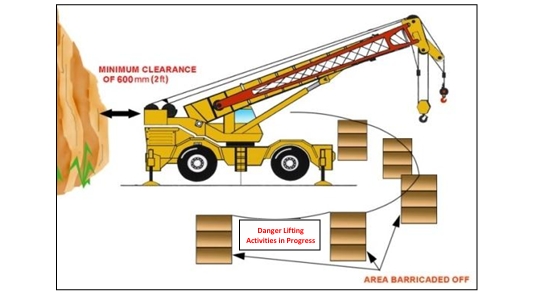
Detail: Candidates preparing When a mobile crane travels on public highways or moves outside the boundaries of a plant or worksite, it must be configured in its safest possible traveling condition. This generally means the crane should only carry its normally mounted boom sections — no additional inserts or extensions. For hydraulic cranes, the boom must be fully retracted, any jib attachments should be removed or properly stowed, and the hook block must be secured so it cannot swing or shift during transport. This reduces the crane’s height, width, and center of gravity risk, and prevents damage to the boom or surrounding structures while in transit.
Sample Q&A:
Q1: When a hydraulic crane travels on a public highway, what condition should the boom be in? A: The boom should be fully retracted, with any jib removed or stowed, and the hook block secured.
Q2: Why is it unsafe to travel with an extended boom on a highway? A: An extended boom raises the crane’s center of gravity, increases the risk of tipping, and creates a hazard to overhead structures, power lines, and other vehicles.
Q3: What is meant by “normally mounted boom sections”? A: This refers to the standard boom configuration installed by the manufacturer for road travel, without additional inserted sections that would only be used for lifting operations at height.
Topic 2: Boom Locking Devices in Onshore Crane Operations Test Preparation
Detail: Candidates preparing A positive locking device must be engaged before a crane travels, regardless of distance. This mechanism prevents the boom from swinging side to side while the crane is in motion. Uncontrolled boom swing during travel can shift the vehicle’s weight distribution suddenly, leading to loss of control or rollover, and can also cause the boom to strike nearby structures, equipment, or personnel.
Sample Q&A:
Q1: What is the purpose of a positive locking device on a crane? A: It prevents the boom from swinging laterally while the crane is traveling.
Q2: At what point should the locking device be engaged? A: Before the crane begins to travel, whether on a highway or inside a facility.
Topic 3: Retractable Suspension Systems – Onshore Crane Operations Test Preparation
Detail: Candidates preparing Some cranes are equipped with retractable or adjustable suspension units, which allow the vehicle’s ride height to be raised or lowered. Before any travel begins, this suspension must be leveled. An uneven or partially retracted suspension can affect the crane’s stability, tire loading, and steering response, particularly on uneven terrain.
Sample Q&A:
Q1: What must be done to a crane’s retractable suspension before it travels? A: The suspension must be leveled.
Q2: What risk does an unleveled suspension create? A: It can compromise the crane’s stability and handling, increasing the risk of an accident during travel.
Topic 4: In-Plant Travel Rules – Onshore Crane Operations Test Preparation
Detail: Inside a plant or facility, hydraulic cranes are sometimes permitted to travel with more than the normally mounted boom sections attached — but only for short, controlled movements between nearby job locations. A common safety limit is that such travel should not exceed approximately 1 kilometer (0.6 miles). Beyond that distance, the crane should be returned to its standard road-travel configuration described in Topic 1.
Sample Q&A:
Q1: What is the maximum recommended distance for a hydraulic crane to travel inside a facility with extra boom sections still attached? A: Approximately 1 km (0.6 miles).
Q2: What should happen if a hydraulic crane needs to move farther than this distance inside the facility? A: It should be reconfigured to its normal highway-travel condition — boom retracted, jib stowed, and hook secured.
Topic 5: Lattice Boom Crane Movement in Onshore Crane Operations
Detail: Candidates preparing Lattice boom cranes are permitted to travel within a facility without disassembling the boom, provided the movement is part of the same job, the distance is less than roughly 1 km (0.6 miles), and the crane is escorted by personnel positioned at both the front and the back of the vehicle during the move. This escort requirement ensures continuous visual monitoring of clearances, obstacles, and surrounding personnel Candidates preparing.
Sample Q&A:
Q1: Under what conditions can a lattice boom crane travel inside a facility without disassembling the boom? A: When the move is part of the same job, the distance is under about 1 km, and the crane is escorted at both the front and back.
Q2: Why is a front-and-back escort required for lattice boom crane movement? A: To provide full visibility around the crane and warn of any obstructions, personnel, or hazards along the travel path in both directions.
Topic 6: Flagman Responsibilities During Onshore Crane Operations
Detail: Candidates preparing When a crane travels inside plant facilities, a flagman (a dedicated ground guide) must assist the operator. The flagman’s main responsibility is to keep the boom tip clear of any obstruction — including overhead piping, structures, electrical lines, or other equipment — since the operator’s view of the boom tip from the cab is often limited or blocked entirely.
Sample Q&A:
Q1: What is the flagman’s primary responsibility during crane travel inside a facility? A: To ensure the boom tip remains clear of any obstruction.
Q2: Why is a flagman necessary even for short in-plant moves? A: Because the crane operator often cannot see the boom tip clearly from the cab, and a flagman provides an external line of sight to prevent collisions with overhead or nearby obstacles.
General Test-Taking Guidance
- The following Onshore Crane Operations Test Preparation tips will help Safety Officer candidates perform better during certification exams and interviews.Read each scenario carefully.
- Many exam questions describe a situation (e.g., “a lattice boom crane is moving 800 meters within the same job site”) and ask you to identify the correct required precaution.
- Know your numbers. Distance limits Candidates preparing (such as the 1 km / 0.6 mile threshold) are commonly tested figures — memorize them precisely.
- Understand the “why,” not just the “what.” Interviewers and written exams often probe the reasoning behind a rule, not just the rule itself.
- Practice with confined space and emergency response scenarios separately. These are usually treated as distinct competency areas from crane travel rules, and most company safety programs test them independently. Review your organization’s specific confined space entry procedures (permit requirements, atmospheric testing, attendant duties) and emergency response/notification procedures (who to contact, evacuation routes, muster points) directly from your company’s own safety manual, since these procedures vary between organizations and sites.
- Repeat until fluent. Go through each topic and its questions multiple times. Try covering the answers and answering from memory, then check yourself.
How to Use This Guide
- This Onshore Crane Operations Test Preparation guide should be studied regularly to improve crane safety knowledge and examination performance.
- Read one topic at a time.
- Attempt to answer the sample questions before looking at the provided answers.
- Note any topic where you hesitated or got the answer wrong, and revisit it the next day.
- Once comfortable with all topics, try creating your own scenario-based questions to test deeper understanding.
- Supplement this general guide with your specific company’s crane and lifting equipment safety manual, since exact figures, escort requirements, and travel limits should always be confirmed against your own organization’s official procedures.
This structured approach — detail, then question and answer, then repetition — is one of the most effective ways to build lasting recall for a Safety Officer certification or interview assessment.
Conclusion
Onshore Crane Operations Test Preparation helps Safety Officer candidates develop a strong understanding of crane travel requirements, boom safety, flagman duties, lifting equipment inspections, and operational risk control. Regular practice of these questions and workplace scenarios will improve confidence for certification exams, interviews, and daily site inspections. Continue reviewing this Onshore Crane Operations Test Preparation guide together with your organization’s lifting procedures to ensure safe crane operations at every job site.
References and Last Reviewed
- OSHA 29 CFR 1926 Subpart CC – Cranes and Derricks in Construction: osha.gov/1926SubpartCC
- OSHA 29 CFR 1926 Subpart H – Materials Handling, Storage, Use and Disposal (rigging equipment): osha.gov/1926SubpartH
Jurisdiction: United States – OSHA construction industry standards (29 CFR 1926). Verify local/site-specific requirements where this differs from your jurisdiction.
Last technically reviewed: September 2026
Reviewed by: EHS Guidelines Editorial Team
This article is educational. Apply current official rules, approved site procedures, manufacturer instructions and competent-person assessment for your actual worksite.



1 Trackback / Pingback