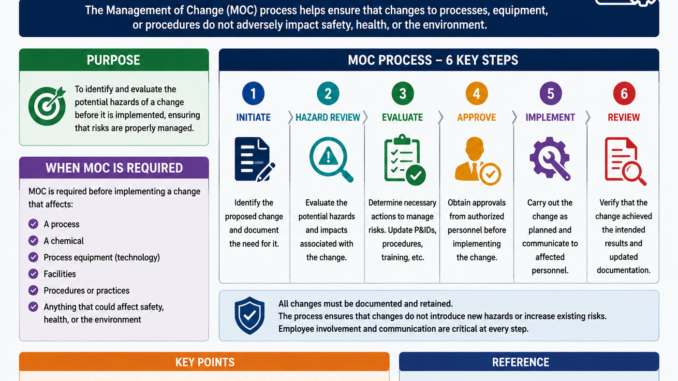
PSM management of change is the written system used to evaluate and control changes before they affect a covered process. Under 29 CFR 1910.119(l), an employer must establish and implement procedures for changes to process chemicals, technology, equipment, procedures, and facilities affecting a covered process. The exception is a true replacement in kind.
The purpose of MOC is not to approve paperwork after work is complete. It is to identify how a proposed change could alter hazards, safeguards, operating limits, procedures, training, maintenance, or emergency arrangements before the changed process or affected part starts up.
Which changes require PSM management of change?
Paragraph (l)(1) identifies five change areas:
- Process chemicals: composition, concentration, feedstock, catalyst, additives, or other chemical changes;
- Process technology: operating limits, chemistry, control logic, production rate, sequence, or process conditions;
- Equipment: vessels, piping, instruments, relief systems, materials of construction, rotating equipment, or protective systems;
- Procedures: operating, maintenance, inspection, emergency, or safe-work practices; and
- Facilities: layouts, structures, access, ventilation, occupied locations, drainage, fire protection, or other facility changes affecting the process.
Changes can be permanent or temporary. A temporary hose, bypass, software override, altered alarm point, portable pump, different raw material, or revised operating step can affect risk even when it will be removed later. The MOC procedure should define how temporary changes are identified, authorized, monitored, extended, PSM Management of Change and restored.
What qualifies as replacement in kind?
OSHA defines replacement in kind as a replacement that satisfies the design specification. The screening decision therefore depends on documented specifications, not visual similarity or a vendor’s statement that an item is “equivalent.” Verify relevant material, dimensions, pressure and temperature ratings, capacity, electrical classification, control action, fail position, software function, and other safety-critical characteristics.
If the replacement differs from the approved design specification or changes how the process operates, it should not be screened out merely because it performs a similar general function. When uncertainty remains, route it through the MOC process so the technical difference can be PSM Management of Change evaluated.
The five considerations required before a change
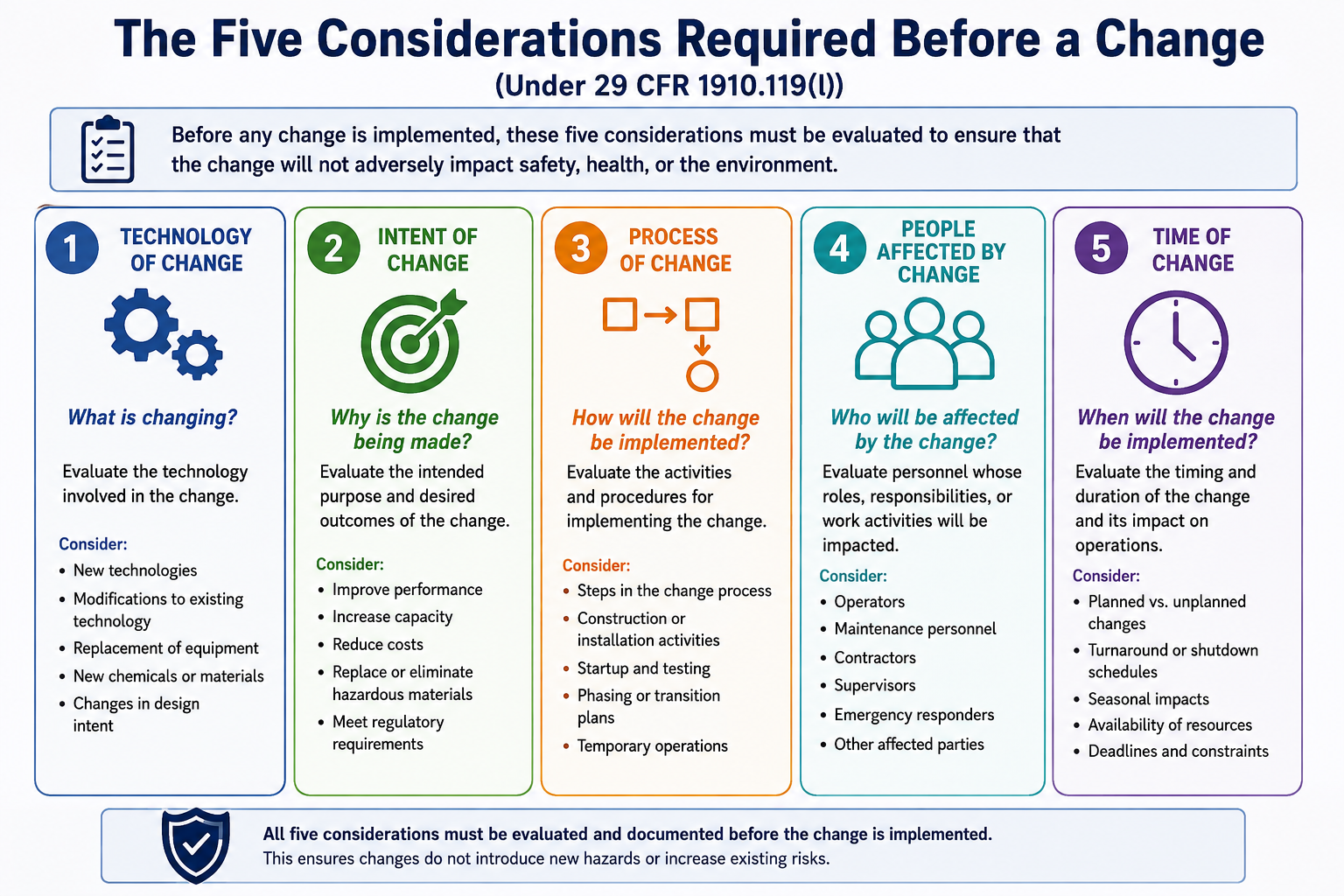
Paragraph 1910.119(l)(2) requires the written procedure to assure that five matters are addressed before the change:
- Technical basis: why the change is proposed and the engineering information supporting it.
- Safety and health impact: new hazards, changed scenarios, safeguard effects, exposure implications, and possible interactions.
- Operating-procedure modifications: which instructions and safe-work practices must change.
- Necessary time period: whether the change is temporary or permanent and, for a temporary change, its approved duration.
- Authorization requirements: the roles that must review and approve the proposal before implementation.
The standard does not prescribe one form or approval hierarchy. The depth of review should match the complexity and potential consequence of the change. A low-complexity instrument replacement that differs in fail action may require fewer reviewers than a new reaction path, but the safety significance can still be PSM Management of Change high.
Training and communication before startup
Employees involved in operating the process, plus maintenance and contract employees whose tasks are affected, must be informed of and trained in the change before startup of the process or affected part. This requirement connects MOC directly to PSM training and contractor safety.
The training should address what changed, why it changed, revised hazards and limits, new safeguards, updated procedures, abnormal or emergency actions, and any changed maintenance or inspection duties. A distribution email can communicate a change, but it may not demonstrate understanding where task competence is necessary.
Update PSI and operating procedures
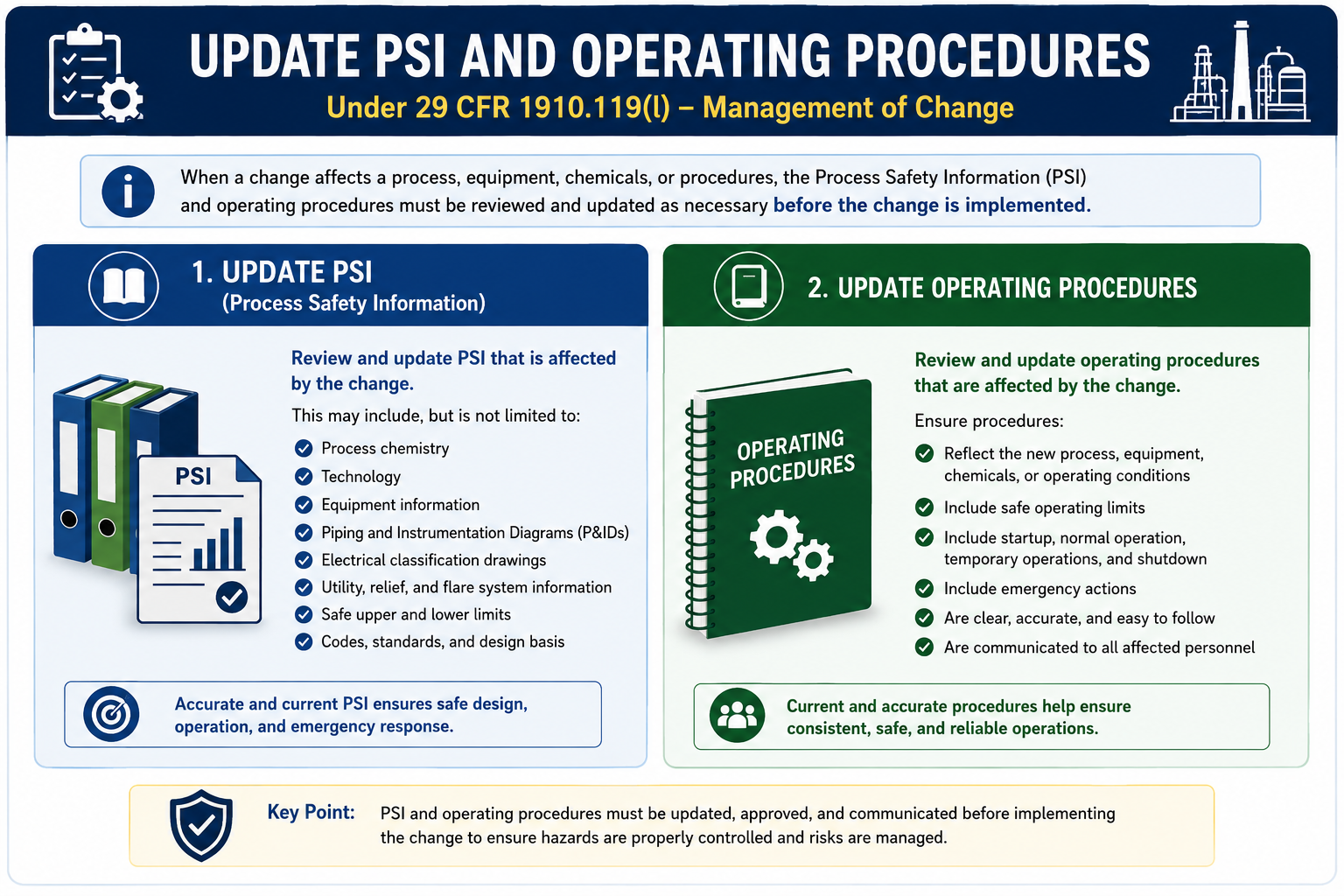
If the change affects information required under paragraph (d), the process safety information must be updated. This can include process chemistry, maximum intended inventory, safe limits, process flow information, materials of construction, relief design, ventilation, electrical classification, design codes, material and energy balances, or safety systems.
If the change affects operating procedures or practices required under paragraph (f), those documents must also be updated. Closeout should verify that approved records match the installed and operating condition. Marked-up drawings can support field execution, but they should enter a controlled as-built update PSM Management of Change process.
Organizational changes can trigger MOC
OSHA’s Management of Organizational Change memorandum explains that staffing, experience, contracting, policy, budget, reorganization, merger, or acquisition changes can trigger MOC when they affect process chemicals, technology, equipment, procedures, or facilities in a covered process. The memorandum does not make every personnel change an MOC.
For example, reducing operator staffing may make an existing procedure impracticable during normal or emergency conditions. A maintenance-budget change may alter inspection frequency or repair timing. When an organizational decision could reasonably cause such process effects, the facility should screen those effects through PSM Management of Change MOC.
A practical MOC workflow
- Describe the proposed change, reason, affected process, and intended duration.
- Determine whether it is a documented replacement in kind.
- Identify affected chemicals, technology, equipment, procedures, facilities, and people.
- Complete the technical and safety review using current PSI and relevant hazard analyses.
- Define required actions, owners, approval authorities, and completion criteria.
- Update design documents, PSI, procedures, inspection plans, and emergency information.
- Inform and train affected operating, maintenance, and contract employees.
- Complete required field verification and the pre-startup safety review.
- Authorize startup only after prerequisites are satisfied.
- Verify the installed change, close supporting records, and track temporary-change PSM Management of Change expiration.
Common MOC failure points
- Treating every same-purpose replacement as replacement in kind;
- Starting physical work before the technical review is complete;
- Ignoring temporary, software, set-point, or organizational changes;
- Using generic risk statements without examining credible process effects;
- Leaving P&IDs, procedures, or equipment records in marked-up form indefinitely;
- Training affected people after startup;
- Allowing temporary changes to remain without reauthorization or restoration;
- Closing the MOC when installation finishes but required actions remain open; and
- Failing to verify that the installed condition matches the approved PSM Management of Change design.
Related PSM requirements
- OSHA Process Safety Management overview
- Process Safety Information
- PSM operating procedures
- Pre-Startup Safety Review

Be the first to comment