
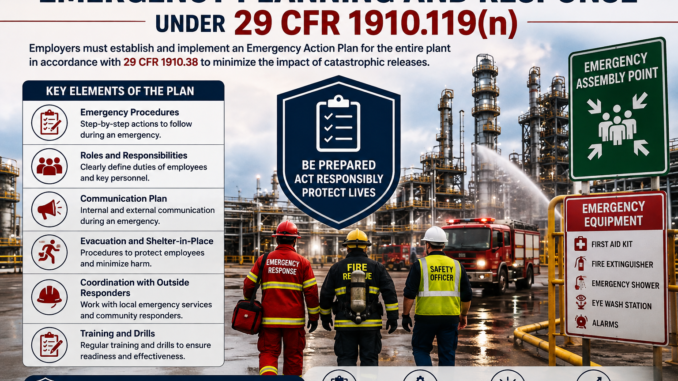
PSM emergency planning and response requires an employer to establish and implement an emergency action plan for the entire plant in accordance with 29 CFR 1910.38. Paragraph 1910.119(n) also requires the plan to include procedures for handling small releases and warns that applicable provisions of 29 CFR 1910.120 may also apply.
The key planning decision is whether employees evacuate, perform limited actions within their normal training and equipment, or respond to an uncontrolled hazardous-substance release. Labels alone do not decide the applicable duties. The employer must evaluate reasonably anticipated emergencies and the actions employees are expected to perform.
What paragraph 1910.119(n) requires
The PSM paragraph is concise but connects three important duties:
- Establish and implement an emergency action plan for the entire plant under 29 CFR 1910.38;
- Include procedures for handling small releases; and
- Determine whether hazardous-waste and emergency-response requirements in 29 CFR 1910.120(a), (p), or (q) apply.
“Entire plant” means the plan cannot be limited to the covered process while ignoring people and operations elsewhere who may be affected by an alarm, evacuation, shelter decision, shutdown, or ergency planning accountability process.
Minimum emergency action plan elements
Under 29 CFR 1910.38(c), an emergency action plan must include at least:
- Procedures for reporting a fire or other emergency;
- Procedures for emergency evacuation, including the type of evacuation and exit-route assignments;
- Procedures for employees who remain to operate critical plant operations before evacuating;
- Procedures to account for all employees after evacuation;
- Procedures for employees performing rescue or medical duties; and
- The name or job title of every employee who may be contacted for further information or explanation of plan duties.
The plan must be available for employee review. An employer must designate and train employees to assist in safe and orderly evacuation and review the plan with employees when it is developed, when responsibilities change, and when the plan ergency planning changes.
Evacuation is different from emergency response
An emergency action plan can support evacuation without authorizing employees to control an emergency release. Emergency response under 29 CFR 1910.120 involves response to an uncontrolled release, or a substantial threat of one, where conditions require more than incidental spill control within normal work duties.
OSHA’s interpretation on PSM emergency planning explains that an employer should determine the potential for an emergency using reasonably predictable scenarios and plan accordingly. Calling employee actions “defensive” does not by itself settle whether HAZWOPER emergency-response provisions apply.
If the facility intends employees only to evacuate and does not permit them to assist in emergency response, the plan and actual practices must reflect that decision. Employees expected to respond need the organization, plan, training, medical, equipment, incident-command, and other protections required by the applicable ergency planning standard.
What is a small release?
Paragraph (n) requires procedures for handling small releases but does not provide one universal quantity. A release that trained employees can control safely as part of normal operations with available equipment may differ from an emergency release requiring an emergency response. Chemical properties, concentration, location, ventilation, pressure, temperature, potential escalation, protective equipment, and employee capability all matter.
The facility should define foreseeable release categories and clear escalation criteria. Procedures should specify who may act, from where, using which equipment, within what limits, and when to stop, alarm, isolate remotely, evacuate, or summon the emergency-response organization. Never use “small” as an after-the-fact label for an uncontrolled ergency planning event.
Connect emergency planning with process hazards
The plan should be informed by current process safety information, PHAs, operating limits, facility siting, detection systems, relief and vent systems, drainage, fire protection, and previous incidents. Planning scenarios may include toxic releases, fires, explosions, loss of containment, incompatible mixing, utility failure, and multiple simultaneous effects.
For each credible scenario, consider alarm methods, protective actions, safe routes, wind or vapor movement, assembly areas, accountability, critical shutdown duties, rescue limitations, medical needs, communication with public responders, and conditions that could make a normal route or assembly ergency planning point unsafe.
Critical operations before evacuation
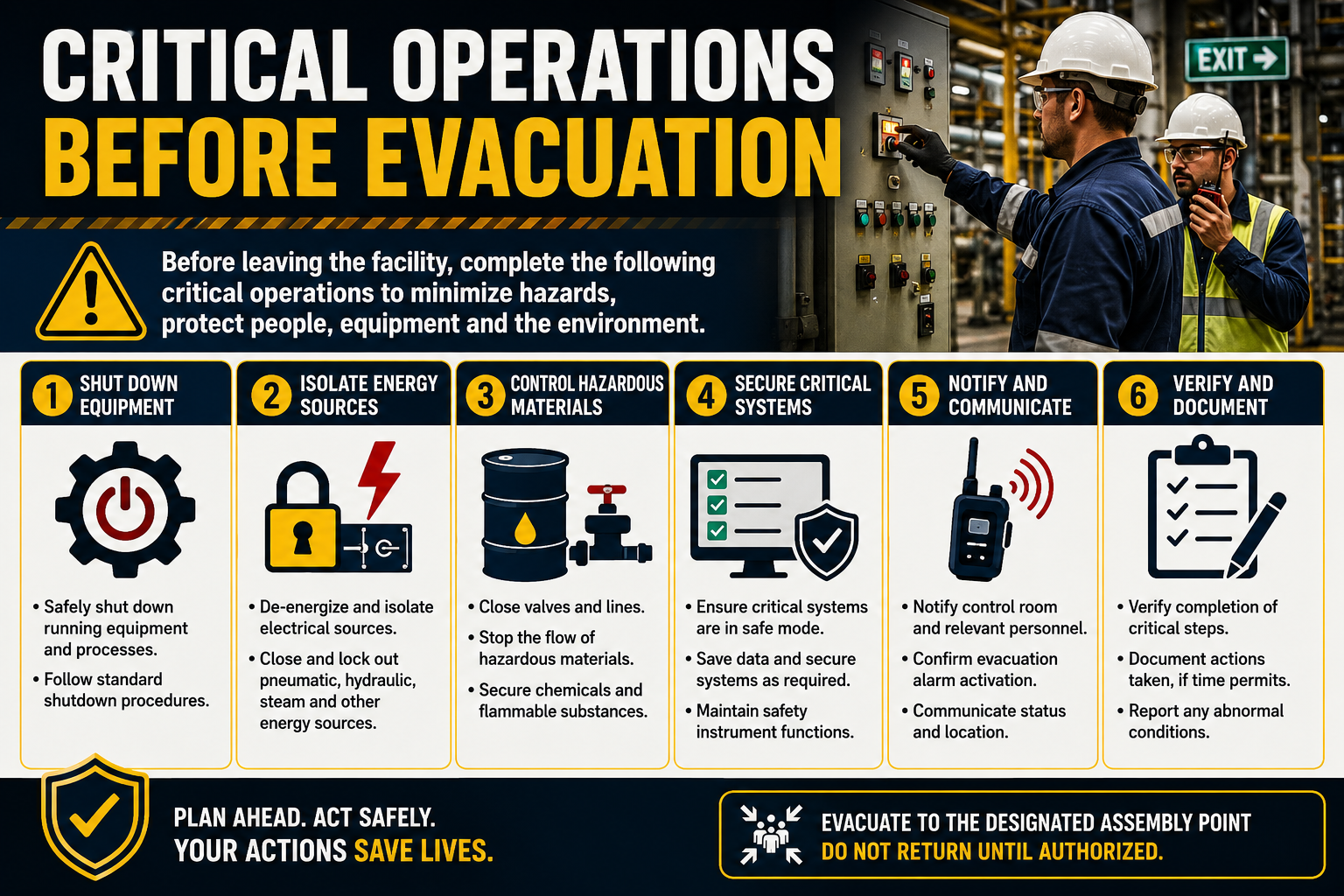
The EAP must address employees who remain to operate critical plant operations before evacuating. This is not permission for improvised response. Identify which operations are critical, the conditions under which they may be performed, who is qualified and authorized, what remote options exist, when the task must be abandoned, and how the employees will evacuate safely.
Emergency shutdown responsibilities should also align with current operating procedures and operator training. Conflicting instructions between the EAP and process procedures can delay action at the ergency planning worst time.
Contractors, visitors, and outside responders
Under paragraph (h), the host employer must explain applicable emergency action plan provisions to contract employers. Contractors should know alarm meanings, reporting methods, protective actions, routes, assembly locations, accountability, and restrictions on response. Crew turnover and subcontracting require a reliable handoff.
Coordinate in advance with fire departments, emergency medical services, hazardous-material teams, mutual-aid partners, and other outside resources expected in the plan. Share accurate site access, chemical, process, isolation, water-supply, command, and contact information appropriate to their role. Do not assume a public agency has the equipment, training, or capacity to perform every ergency planning task.
Training, exercises, and plan maintenance
Employees should understand alarms, reporting, evacuation or shelter actions, accountability, assigned duties, and re-entry restrictions. People assigned critical operations, medical duties, rescue, or response need role-specific training under the applicable requirements.
Use drills and exercises to test practical questions: Was the alarm recognized? Were routes usable? Were all shifts and contractors accounted for? Could the incident lead obtain current chemical and process information? Did communications work? Were outside parties reachable? Record findings, assign actions, and use MOC when corrective changes affect the covered ergency planning process.
Emergency-planning checklist
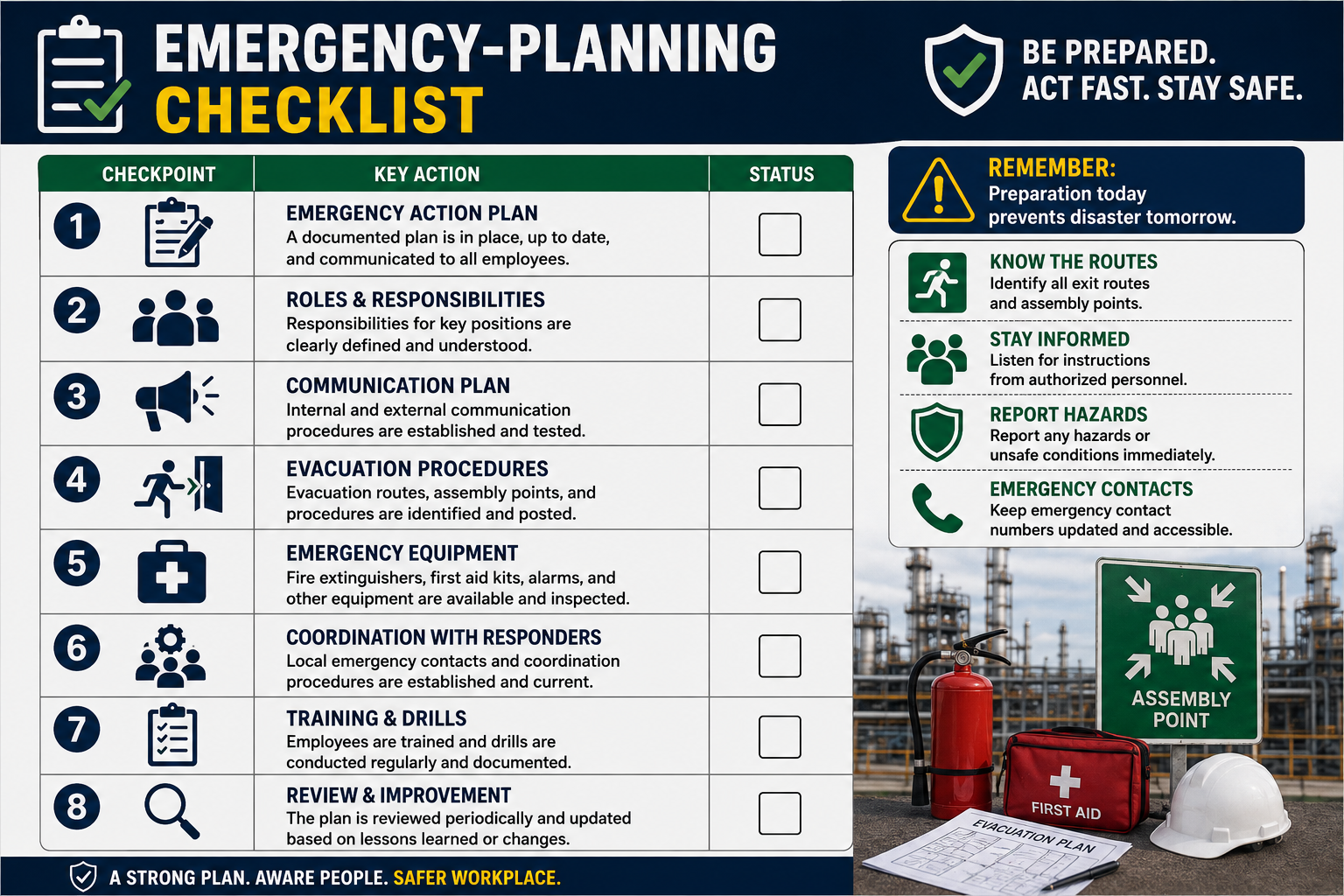
- Does the EAP cover the entire plant and all work shifts?
- Are small-release limits and escalation triggers defined?
- Is the distinction between evacuation and emergency response reflected in actual duties?
- Are alarms, reporting, routes, accountability, rescue, medical, and critical-operation duties addressed?
- Do contractors receive applicable EAP information?
- Are process hazards and current emergency scenarios linked?
- Are outside responders coordinated and their capabilities understood?
- Are drills evaluated and corrective actions tracked?
- Does change management update the plan before ergency planning affected startup?
Related PSM requirements
- PSM operating procedures
- PSM training requirements
- Contractor safety responsibilities
- Incident investigation

Be the first to comment