TL;DR
- A construction safety risk assessment is the employer’s structured process for identifying, evaluating, and controlling jobsite hazards before work begins.
- 29 CFR 1926.20(b) requires frequent and regular inspections by a competent person; 29 CFR 1926.21(b)(2) requires employees to be instructed in hazard recognition and avoidance.
- The four leading causes of construction fatalities – falls, struck-by, caught-in/between, and electrocution – must each be addressed in every site safety assessment.
- A 5×5 risk matrix (Likelihood × Severity) is the standard tool for prioritizing controls using the hierarchy of controls.
- The assessment must be reviewed whenever site conditions, scope, crew, or equipment change – and at minimum on a periodic basis throughout the project lifecycle.
Construction Safety Risk Assessment: OSHA-Compliant Guide for Site Managers
What Is a Construction Safety Risk Assessment?
A construction safety risk assessment is the employer’s systematic process of identifying hazards present on a construction site, evaluating the likelihood and severity of resulting harm, and implementing controls to reduce risk to an acceptable level before and during construction work. Under 29 CFR 1926 Subpart C – the general safety and health provisions governing all construction work subject to OSHA jurisdiction – the employer bears the primary obligation to identify and eliminate or control hazards. 29 CFR 1926.20(b)(1) states that “it shall be the responsibility of the employer to initiate and maintain such programs as may be necessary to comply with this part.” The construction site risk assessment is the foundational document through which that obligation is discharged.
The assessment is not a single form. It is a living process that spans pre-construction planning, active construction phases, and any significant change in scope, crew, or conditions. The risk assessment for a construction project must account for the full range of activities performed on site – from earthwork and structural framing to finishing trades and commissioning – and must be updated as those activities evolve.
OSHA Legal Requirements for Construction Risk Assessments
OSHA does not prescribe a single universal “risk assessment” form for all construction work. Instead, the obligation is embedded across several interconnected provisions of 29 CFR 1926.
29 CFR 1926 Subpart C – General Safety and Health Provisions
Subpart C establishes the baseline framework. Two sections are directly relevant to hazard identification and control.
29 CFR 1926.20 – General Safety and Health Provisions
- 1926.20(b)(1): The employer must initiate and maintain programs necessary to comply with Part 1926.
- 1926.20(b)(2): Those programs must provide for “frequent and regular inspections of the job sites, materials, and equipment” by competent persons designated by the employer. This inspection requirement is the operational core of any construction hazard assessment program.
- 1926.20(b)(3): Any machinery, tool, material, or equipment not in compliance must be tagged, locked out, or physically removed from service.
- 1926.20(b)(4): Only employees qualified by training or experience may operate equipment and machinery.
29 CFR 1926.21 – Safety Training and Education
- 1926.21(b)(2): The employer must instruct each employee in “the recognition and avoidance of unsafe conditions and the regulations applicable to his work environment to control or eliminate any hazards or other exposure to illness or injury.” This instruction obligation presupposes that hazards have been identified through a prior assessment.
- 1926.21(b)(3): Employees handling poisons, caustics, or harmful substances must receive specific instruction on safe handling, personal hygiene, and PPE.
Activity-Specific Assessment Requirements
Beyond Subpart C, specific subparts impose their own hazard assessment obligations:
- 29 CFR 1926 Subpart M (1926.502): Employers must develop and implement a written fall protection plan where conventional fall protection is infeasible.
- 29 CFR 1926 Subpart K (1926.416(a)): Before work begins, the employer must determine whether employees, tools, or equipment could contact energized circuits and implement protective measures accordingly.
- 29 CFR 1926.1101(f): Asbestos exposure assessments are required before disturbing suspect materials.
- 29 CFR 1926.651(k): Competent person inspections of excavations are required daily and after any hazard-altering event.
The employer’s failure to conduct adequate hazard identification is itself a citable violation under the General Duty Clause, Section 5(a)(1) of the OSH Act, independent of any specific standard.
Construction Hazard Categories You Must Assess
OSHA identifies four hazard categories – the “Fatal Four” – as responsible for the majority of construction fatalities. Together, falls, struck-by incidents, caught-in/between events, and electrocutions account for approximately 60–65% of all construction worker deaths annually. Each category carries its own regulatory framework and must be addressed explicitly in the construction safety risk assessment.
Fall Hazards (29 CFR 1926 Subpart M)
Falls are the leading cause of construction fatalities. In 2024, falls accounted for approximately 370 construction worker deaths in the United States.
29 CFR 1926.501 establishes the duty to provide fall protection. The trigger heights are:
- 6 feet or more above a lower level for most construction work (unprotected sides and edges, leading edges, excavations, ramps, runways, and other walkways).
- 10 feet or more for some specific operations such as work on scaffolds (governed separately under 29 CFR 1926 Subpart L).
29 CFR 1926.502 specifies the criteria and practices for acceptable fall protection systems: guardrail systems, safety net systems, and personal fall arrest systems (PFAS). The employer must select the system appropriate to the task and document that selection.
29 CFR 1926.503 requires training for each employee exposed to fall hazards. Training must be performed by a qualified person and must address the nature of fall hazards, correct procedures for erecting and using fall protection systems, and the limitations of each system.
The site safety assessment for fall hazards must identify every elevated work surface, leading edge, floor opening, excavation perimeter, and roof edge on the project. Each must be assigned a control measure from the hierarchy of controls before work begins.
Struck-By Hazards
Struck-by incidents are the second-leading cause of construction fatalities, accounting for approximately 23% of Fatal Four deaths. Struck-by hazards arise from:
- Flying objects: Projectiles from power tools, nail guns, and grinding operations.
- Falling objects: Materials, tools, or debris dropped from elevated work areas.
- Swinging or suspended loads: Crane and rigging operations governed by 29 CFR 1926 Subpart CC.
- Vehicles and mobile equipment: Construction vehicles operating in proximity to workers on foot.
29 CFR 1926.502(j) addresses protection from falling objects. Toeboards, canopies, and barricades must be in place where workers below are exposed to overhead hazards. 29 CFR 1926.601 governs motor vehicle safety on construction sites, including requirements for backup alarms and spotters.
The construction hazard assessment must map all vehicle travel paths, crane swing radii, and overhead work zones. Exclusion zones must be established and enforced.
Caught-In/Between Hazards
Caught-in/between hazards account for approximately 6% of Fatal Four fatalities. They include:
- Unguarded machinery: Rotating parts, belts, pulleys, and gears without machine guards.
- Excavation cave-ins: Workers caught in collapsing trench walls. Governed by 29 CFR 1926 Subpart P, which requires protective systems (sloping, shoring, or trench boxes) for excavations 5 feet or deeper.
- Pinch points: Equipment operating in confined spaces where a worker can be caught between a moving component and a fixed structure.
- Collapse of structures: Formwork, falsework, or partially completed structures.
29 CFR 1926.300(b)(1) requires that all machine guards be in place and functional before equipment is operated. The competent person inspection required by 29 CFR 1926.20(b)(2) must verify guard integrity at each inspection.
Electrical Hazards (29 CFR 1926 Subpart K)
Electrocution accounts for approximately 8–10% of Fatal Four fatalities. Construction sites present unique electrical hazards because temporary wiring, overhead power lines, and energized equipment coexist with wet conditions and metal structures.
29 CFR 1926 Subpart K governs all electrical work in construction. Key provisions include:
- 1926.416(a): Before work begins, the employer must determine whether employees, tools, or machines could contact energized circuits. Warning signs must be posted. Employees must be informed of circuit locations, hazards, and protective measures.
- 1926.416(b): Exposed live parts operating at 50 volts or more must be guarded against accidental contact.
- 1926.417(a): Circuits deenergized for work must be rendered inoperative and tagged at the point where energy could be restored.
- 1926.404(b)(1): Ground fault circuit interrupters (GFCIs) are required for all 120-volt, single-phase, 15- and 20-ampere receptacle outlets on construction sites.
The OSHA construction risk assessment must identify all overhead power line locations, temporary power distribution points, and any work involving electrical systems. Minimum approach distances must be established and communicated to all workers before work begins.
Chemical and Airborne Hazards
Chemical and airborne hazards on construction sites include:
- Silica dust: Generated by cutting, grinding, or drilling concrete, masonry, and stone. Governed by 29 CFR 1926.1153, which requires exposure assessment, engineering controls (wet methods, local exhaust ventilation), and respiratory protection when the action level of 25 µg/m³ (as an 8-hour TWA) is exceeded.
- Lead: Present in paint on older structures. Governed by 29 CFR 1926.62.
- Asbestos: Present in insulation, floor tiles, and roofing on pre-1980 structures. Governed by 29 CFR 1926.1101.
- Carbon monoxide: Generated by internal combustion engines in enclosed or semi-enclosed spaces.
- Isocyanates and solvents: Present in coatings, adhesives, and spray foam insulation.
29 CFR 1926.21(b)(3) requires that employees handling harmful substances receive instruction on safe handling, personal hygiene, and required PPE. The site safety assessment must include an inventory of all hazardous materials on site, with Safety Data Sheets (SDS) accessible under 29 CFR 1926.59 (Hazard Communication).
How to Conduct a Construction Site Risk Assessment
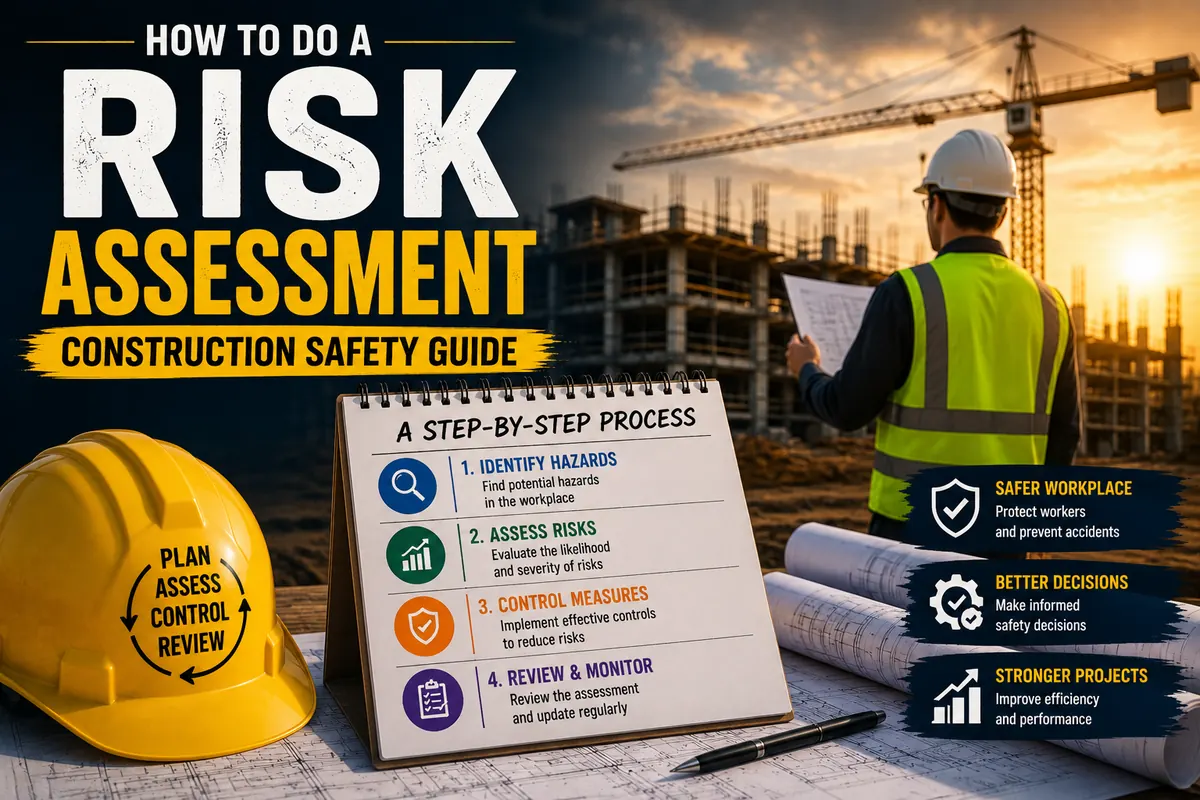
The following six-step process aligns with OSHA’s hazard identification and control framework and the requirements of 29 CFR 1926 Subpart C.
Step 1: Assemble the Assessment Team
Designate a competent person as defined under 29 CFR 1926.32(f): an individual capable of identifying existing and predictable hazards in the surroundings or working conditions that are unsanitary, hazardous, or dangerous to employees, and who has authorization to take prompt corrective measures. Include subcontractor safety representatives, the project superintendent, and trade foremen. Each trade brings hazard knowledge specific to its scope of work.
Step 2: Define the Scope and Work Activities
Break the project into discrete work activities or phases: site preparation, excavation, foundation work, structural steel erection, concrete placement, mechanical/electrical/plumbing rough-in, exterior envelope, interior finishes, and commissioning. Each activity will generate its own hazard profile. The risk assessment for a construction project must address every phase, not only the highest-risk activities.
Step 3: Identify Hazards for Each Activity
For each work activity, identify all hazards using:
- Walkthrough inspections of the site and adjacent areas.
- Review of project drawings, specifications, and the geotechnical report.
- Review of Safety Data Sheets for all materials to be used.
- Review of OSHA inspection records and incident history for similar projects.
- Input from workers performing the tasks.
Classify each hazard by type: fall, struck-by, caught-in/between, electrical, chemical/airborne, ergonomic, or thermal. Document the hazard, the affected population, and the conditions under which exposure occurs.
Step 4: Evaluate Risk Using a Risk Matrix
Assign a Likelihood rating (1–5) and a Severity rating (1–5) to each identified hazard. Multiply to obtain a Risk Score. Use the 5×5 matrix in the following section to classify each hazard as Low, Moderate, High, or Critical. Prioritize controls for Critical and High risks before work begins. Moderate risks must be controlled before the affected activity commences. Low risks must be documented and monitored.
Step 5: Implement Controls Using the Hierarchy of Controls
Apply controls in order of effectiveness:
- Elimination: Remove the hazard entirely (e.g., pre-fabricate structural elements off-site to eliminate elevated work).
- Substitution: Replace the hazardous process or material (e.g., use a water-based coating instead of a solvent-based product to reduce VOC exposure).
- Engineering controls: Install physical barriers, machine guards, guardrails, ventilation systems, or GFCI protection.
- Administrative controls: Establish safe work procedures, permit systems, exclusion zones, and work rotation schedules.
- PPE: Provide hard hats, safety glasses, high-visibility vests, fall arrest harnesses, respirators, and other PPE as required by applicable 29 CFR 1926 subparts. PPE is the last line of defense, not the first.
Document the selected control for each hazard and assign a responsible party and implementation deadline.
Step 6: Review, Communicate, and Update
Communicate the findings of the construction hazard assessment to all affected workers before work begins, consistent with the training obligation under 29 CFR 1926.21(b)(2). Conduct toolbox talks covering the specific hazards and controls for each work phase. Establish a schedule for periodic review. Update the assessment whenever conditions change (see the review frequency section below). Retain all versions of the assessment as part of the project safety file.
Construction Risk Assessment Matrix
The 5×5 matrix below is the standard tool for quantifying risk in a construction site risk assessment. Multiply the Likelihood score (1–5) by the Severity score (1–5) to obtain a Risk Score (1–25). The resulting risk level determines the urgency of control implementation.
Severity Scale
| Score | Severity Level | Description |
|---|---|---|
| 1 | Negligible | First aid only; no lost time |
| 2 | Minor | Medical treatment; restricted duty |
| 3 | Moderate | Lost-time injury; temporary disability |
| 4 | Major | Permanent disability; hospitalization |
| 5 | Catastrophic | Fatality or multiple fatalities |
Likelihood Scale
| Score | Likelihood Level | Description |
|---|---|---|
| 1 | Rare | Could occur only in exceptional circumstances |
| 2 | Unlikely | Could occur but not expected |
| 3 | Possible | Could occur at some time |
| 4 | Likely | Will probably occur in most circumstances |
| 5 | Almost Certain | Expected to occur in most circumstances |
5×5 Risk Matrix (Likelihood × Severity)
| Severity 1 | Severity 2 | Severity 3 | Severity 4 | Severity 5 | |
|---|---|---|---|---|---|
| Likelihood 5 | 5 – Moderate | 10 – High | 15 – Critical | 20 – Critical | 25 – Critical |
| Likelihood 4 | 4 – Low | 8 – Moderate | 12 – High | 16 – Critical | 20 – Critical |
| Likelihood 3 | 3 – Low | 6 – Moderate | 9 – High | 12 – High | 15 – Critical |
| Likelihood 2 | 2 – Low | 4 – Low | 6 – Moderate | 8 – Moderate | 10 – High |
| Likelihood 1 | 1 – Low | 2 – Low | 3 – Low | 4 – Low | 5 – Moderate |
Risk Level Action Requirements
| Risk Level | Score Range | Required Action |
|---|---|---|
| Critical | 15–25 | Stop work. Implement controls before activity commences. Notify site manager immediately. |
| High | 9–14 | Implement controls before activity commences. Competent person verification required. |
| Moderate | 5–8 | Implement controls before activity commences. Monitor throughout task. |
| Low | 1–4 | Document. Monitor. Review at next scheduled assessment. |
Construction Risk Assessment Example
The table below is a worked example for a mid-rise commercial building project. It covers six representative construction activities, each with a realistic hazard, risk rating, control measure, and governing CFR reference. This format satisfies the documentation expectations of 29 CFR 1926.20(b) and supports the training obligation under 29 CFR 1926.21(b)(2).
| Activity | Hazard | Likelihood | Severity | Risk Score / Level | Control Measure | CFR Reference |
|---|---|---|---|---|---|---|
| Structural steel erection at 30 ft | Fall from unprotected leading edge | 4 | 5 | 20 – Critical | Install perimeter cable guardrail system before ironworkers advance; provide full-body harness with 100% tie-off requirement; designate controlled decking zone (CDZ) | 29 CFR 1926.501(b)(1); 1926.502(b); 1926 Subpart R |
| Concrete saw-cutting of existing slab | Silica dust inhalation (respirable crystalline silica) | 5 | 4 | 20 – Critical | Use wet-cutting method with integrated water delivery; provide NIOSH-approved N95 respirator as supplemental control; conduct initial exposure monitoring per Table 1 | 29 CFR 1926.1153(c); 1926.21(b)(3) |
| Excavation – 8-ft deep trench for utility installation | Cave-in / caught-in | 3 | 5 | 15 – Critical | Install timber shoring or use pre-engineered trench box rated for soil type; competent person inspects daily and after any rain event; no worker entry until protective system is in place | 29 CFR 1926.652(a)(1); 1926.651(k) |
| Temporary electrical distribution – outdoor panel installation | Electrocution from energized conductors | 3 | 5 | 15 – Critical | Deenergize circuits before work; apply lockout/tagout per 1926.417; install GFCI on all 120V outlets; post warning signs at panel | 29 CFR 1926.416(a); 1926.417(a); 1926.404(b)(1) |
| Crane lift – precast concrete panels adjacent to overhead 13.8 kV power line | Struck-by / electrocution from crane contact with energized line | 3 | 5 | 15 – Critical | Establish 20-ft minimum approach distance; contact utility to de-energize or install insulating sleeves; designate lift director and signal person; pre-lift meeting required | 29 CFR 1926.1408; 1926.1419; 1926.416(a) |
| Spray application of polyurethane foam insulation in enclosed attic space | Chemical exposure (isocyanates) and oxygen deficiency | 3 | 4 | 12 – High | Classify space as permit-required confined space; conduct atmospheric testing before entry; provide supplied-air respirator (SAR) for applicator; establish attendant and rescue plan | 29 CFR 1926.1201; 1926.21(b)(3); 1926.59 |
Who Is Responsible for the Risk Assessment on a Construction Site?
Responsibility for the construction safety risk assessment is distributed across multiple parties, each with a defined regulatory role.
The Employer (General Contractor or Prime Contractor)
The primary obligation rests with the employer under 29 CFR 1926.20(b)(1). On multi-employer construction sites, OSHA’s Multi-Employer Citation Policy holds that a general contractor can be cited as a controlling employer if it has supervisory authority over the worksite and fails to exercise reasonable care to detect and correct hazardous conditions created by subcontractors.
The Competent Person
29 CFR 1926.20(b)(2) requires that inspections be conducted by a “competent person” designated by the employer. The competent person must have the knowledge to identify hazards and the authority to take corrective action. Many subparts of 29 CFR 1926 impose competent person requirements for specific activities: excavations (1926.651(k)), scaffolding (1926.451(f)(3)), steel erection (1926.752(a)), and fall protection (1926.502(d)(21)).
Subcontractors
Each subcontractor is an employer under the OSH Act and bears independent responsibility for hazards created by its own work. Subcontractors must participate in the site safety assessment process, contribute activity-specific hazard analyses for their scope of work, and ensure their workers receive the training required by 29 CFR 1926.21(b)(2).
The Safety and Health Manager or CSP
On larger projects, a dedicated safety professional – often a Certified Safety Professional (CSP) or Construction Health and Safety Technician (CHST) – leads the risk assessment process, maintains the assessment documentation, and coordinates with the competent persons designated for each subpart. This role does not transfer the employer’s legal obligation but provides the technical competence necessary to discharge it effectively.
Workers
Workers have a right to participate in hazard identification under Section 11(c) of the OSH Act, which prohibits retaliation against workers who report safety concerns. Workers performing the tasks are often the most reliable source of information about actual exposure conditions. Their input must be solicited during Step 3 of the assessment process.
How Often Must a Construction Risk Assessment Be Reviewed?
OSHA does not prescribe a single universal review interval for construction risk assessments. The obligation under 29 CFR 1926.20(b)(2) is for “frequent and regular inspections” – a standard that is defined by the pace of change on the specific jobsite, not by a fixed calendar.
Mandatory Review Triggers
The construction site risk assessment must be reviewed and updated when any of the following occur:
- Change in scope or work method: A new activity, trade, or construction sequence not covered by the existing assessment begins.
- Change in site conditions: Weather events, soil movement, flooding, or adjacent construction activity alters the hazard profile.
- Introduction of new equipment or materials: Any new plant, machinery, or hazardous substance not previously assessed.
- Change in crew composition: New subcontractors, workers unfamiliar with site-specific hazards, or a change in the competent person.
- Incident, near miss, or unsafe condition report: Any event that reveals a gap in the existing assessment.
- Regulatory change: A new or amended OSHA standard applicable to the work.
Minimum Periodic Review
OSHA’s Safety and Health Program Management Guidelines recommend that safety and health programs be evaluated at least annually. For active construction projects – where conditions change daily – the competent person inspection required by 29 CFR 1926.20(b)(2) effectively functions as a continuous review mechanism. Many project safety plans establish formal documented reviews on a weekly or monthly basis as an internal control practice.
Excavation-Specific Requirements
29 CFR 1926.651(k) requires competent person inspections of excavations before each workshift, after any event that could have increased hazard (rain, frost, vibration), and after any indication of possible cave-in. This is the most prescriptive review frequency in 29 CFR 1926 and illustrates the principle that higher-risk activities require more frequent assessment.
Construction Risk Assessment vs. Activity Hazard Analysis (AHA) – Key Differences
Site managers frequently encounter both terms. They are related but not interchangeable. The table below clarifies the distinction.
| Characteristic | Construction Risk Assessment | Activity Hazard Analysis (AHA) |
|---|---|---|
| Scope | Project-wide; covers all phases and all hazard categories | Activity-specific; covers one discrete task or work sequence |
| Purpose | Identify, evaluate, and prioritize all project risks; inform the safety plan | Break a task into steps; identify hazards per step; assign controls and residual risk |
| Output | Risk register; prioritized control schedule; project safety plan | Step-by-step hazard/control worksheet; Risk Assessment Code (RAC) for each step |
| Regulatory basis | 29 CFR 1926.20(b); OSH Act General Duty Clause | USACE EM 385-1-1 (federal construction); incorporated by reference in many project specifications |
| Timing | Completed before project mobilization; updated throughout | Completed before each high-hazard activity begins; updated if task changes |
| Who prepares it | Competent person / safety manager with input from all trades | Foreman or superintendent for the specific trade performing the task |
| Risk quantification | Likelihood × Severity matrix; risk level classification | Risk Assessment Code (RAC): Extremely High, High, Serious, Medium, Low |
| Relationship | The risk assessment is the overarching framework | The AHA is a task-level tool that feeds into the risk assessment |
The construction risk management program requires both documents. The risk assessment establishes project-wide priorities and controls. The AHA operationalizes those controls at the task level, immediately before work begins. Neither document substitutes for the other.
Frequently Asked Questions
What is a construction safety risk assessment?
A construction safety risk assessment is the employer’s documented process of identifying hazards on a construction site, evaluating the likelihood and severity of harm from each hazard, and implementing controls to reduce risk before work begins. It is required by 29 CFR 1926.20(b)(1), which places the obligation on the employer to initiate and maintain programs necessary to comply with OSHA’s construction standards. The assessment covers all phases of the project and all hazard categories, including falls, struck-by, caught-in/between, electrical, and chemical hazards.
Is a construction risk assessment legally required by OSHA?
Yes. While OSHA does not mandate a single universal “risk assessment” form, the obligation to identify and control hazards is embedded throughout 29 CFR 1926. 29 CFR 1926.20(b)(2) requires frequent and regular inspections by a competent person. 29 CFR 1926.21(b)(2) requires employee instruction in hazard recognition and avoidance. Failure to conduct an adequate hazard assessment is citable under the General Duty Clause, Section 5(a)(1) of the OSH Act, and under the specific standard violated when an unassessed hazard results in an injury or fatality.
Who must conduct the construction site risk assessment?
The employer is legally responsible under 29 CFR 1926.20(b)(1). The physical inspection and assessment must be conducted by a competent person designated by the employer, as required by 29 CFR 1926.20(b)(2). On multi-employer sites, each subcontractor employer bears responsibility for hazards created by its own work. The general contractor, as the controlling employer, must exercise reasonable care to detect and correct hazardous conditions across the site.
How is risk level determined in a construction hazard assessment?
Risk level is determined by multiplying two factors: Likelihood (the probability that the hazard will result in harm, rated 1–5) and Severity (the magnitude of harm if the hazard is realized, rated 1–5). The product is a Risk Score between 1 and 25. Scores of 15–25 are Critical; 9–14 are High; 5–8 are Moderate; 1–4 are Low. Critical and High risks require controls to be implemented before the activity commences. The hierarchy of controls – elimination, substitution, engineering controls, administrative controls, and PPE – governs control selection.
What are the four main hazard categories in a construction OSHA risk assessment?
OSHA identifies four categories – the “Fatal Four” – as the leading causes of construction fatalities: (1) Falls, governed by 29 CFR 1926 Subpart M, which requires fall protection at 6 feet or more above a lower level; (2) Struck-by hazards from vehicles, flying objects, and falling materials; (3) Caught-in/between hazards including excavation cave-ins governed by 29 CFR 1926 Subpart P and unguarded machinery; and (4) Electrocution, governed by 29 CFR 1926 Subpart K, which requires GFCI protection, lockout/tagout, and minimum approach distances from energized lines. Together these four categories account for approximately 60–65% of all construction worker fatalities annually.
How often must a construction risk assessment be updated?
OSHA does not specify a single calendar interval. The assessment must be updated whenever site conditions, scope, crew, or equipment change. Mandatory review triggers include: a new work activity or trade, weather or soil events affecting site conditions, introduction of new equipment or hazardous materials, a change in the competent person, or any incident or near miss. The competent person inspection required by 29 CFR 1926.20(b)(2) must occur “frequently and regularly,” which in practice means before each workshift for high-hazard activities such as excavations (29 CFR 1926.651(k)). OSHA’s Safety and Health Program Management Guidelines recommend formal program evaluation at least annually.
Useful Sources
- U.S. Department of Labor, OSHA. 29 CFR 1926.20 – General Safety and Health Provisions. https://www.osha.gov/laws-regs/regulations/standardnumber/1926/1926.20
- U.S. Department of Labor, OSHA. 29 CFR 1926.21 – Safety Training and Education. https://www.osha.gov/laws-regs/regulations/standardnumber/1926/1926.21
- U.S. Department of Labor, OSHA. 29 CFR 1926 Subpart M – Fall Protection. https://www.osha.gov/laws-regs/regulations/standardnumber/1926/1926SubpartM
- U.S. Department of Labor, OSHA. 29 CFR 1926 Subpart K – Electrical. https://www.osha.gov/laws-regs/regulations/standardnumber/1926/1926SubpartK
- U.S. Department of Labor, OSHA. Construction Compliance Assistance Quick Start. https://www.osha.gov/complianceassistance/quickstarts/construction
- U.S. Department of Labor, OSHA. Recommended Practices for Safety and Health Programs. https://www.osha.gov/sites/default/files/publications/OSHA3886.pdf
- Centers for Disease Control and Prevention / NIOSH. Construction Hazard Checklist. https://www.cdc.gov/niosh/docs/2004-101/chklsts/n68con~1.htm
- CPWR – The Center for Construction Research and Training. Focus Four Fatality Data. https://www.cpwr.com/research/data-center/the-construction-chart-book/interactive-7th/injuries-illnesses-health/focus-four/

1 Trackback / Pingback