Safety Officer Test Preparation
Single Post Shores Safety Officer Test Preparation
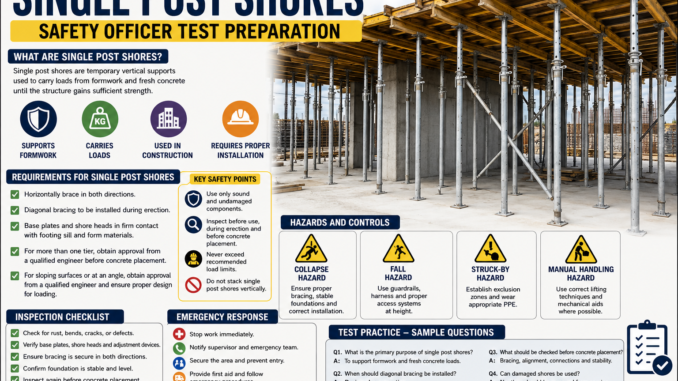
Single Post Shores are temporary support systems used during concrete construction to support formwork and fresh concrete loads until the structure gains sufficient strength. Understanding Single Post Shores requirements is essential for candidates preparing for Safety Officer examinations conducted by companies, organizations, contractors, and construction employers.
This Single Post Shores Safety Officer Test Preparation guide provides important safety requirements, hazard awareness, emergency response considerations, confined space expectations, inspection requirements, and examination-style questions and answers. Candidates should study the material carefully and practice the questions repeatedly to improve confidence and performance during Safety Officer assessments.
What Are Single Post Shores?
Single Post Shores are vertical supports used to carry loads from formwork and freshly placed concrete. These supports help maintain stability and prevent collapse during construction activities.
Single Post Shores are commonly used in:
- Building construction
- Industrial facilities
- Bridge projects
- Elevated slabs
- Concrete decks
- Multi-story structures
Improper installation or inspection of Single Post Shores can lead to serious accidents, structural failures, and worker injuries.
Single Post Shores General Requirements
Single Post Shores Bracing Requirements
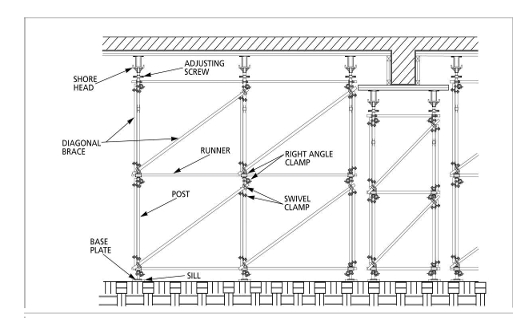
Single Post Shores must be properly braced to maintain stability throughout the construction process.
Important requirements include:
- Horizontal bracing should be installed in both directions.
- Diagonal bracing should be installed during erection.
- Bracing components should remain secure throughout operations.
- Damaged bracing should be replaced immediately.
- Inspections should be conducted before concrete placement.
Proper bracing significantly reduces the risk of collapse.
Single Post Shores Base Support Requirements
Single Post Shores must rest on stable foundations capable of supporting expected loads.
Requirements include:
- Base plates must be installed correctly.
- Shore heads should remain in firm contact with supported materials.
- Settlement should be monitored continuously.
- Supports should remain level and stable.
Poor foundation support can result in shifting or collapse.
Single Post Shores Engineering Review Requirements
In situations involving multiple tiers or special loading conditions, engineering review may be required before construction begins.
Safety officers should verify:
- Design drawings are available.
- Load calculations are completed.
- Qualified engineers review unusual conditions.
- Inspections occur before concrete placement.
- Modifications receive approval before implementation.
Proper planning helps prevent structural failures.
Single Post Shores Inspection Requirements
Pre-Erection Inspection
Before erection begins, all components should be inspected.
Inspection items include:
- Bent components
- Cracks
- Corrosion
- Damaged adjustment devices
- Missing parts
- Structural defects
Defective materials should be removed from service immediately.
During Erection Inspection
Safety officers should monitor:
- Proper alignment
- Correct spacing
- Adequate bracing
- Stable foundations
- Worker safety practices
Continuous inspection helps identify hazards before incidents occur.
Pre-Concrete Placement Inspection
Before concrete placement:
- Bracing should be verified.
- Connections should be checked.
- Foundations should be inspected.
- Load paths should be confirmed.
- Damaged materials should be replaced.
Concrete placement should not begin until all inspections are completed.
Common Hazards Associated with Single Post Shores
Collapse Hazards
Collapse can occur due to:
- Improper installation
- Inadequate bracing
- Excessive loading
- Defective materials
- Foundation failure
Collapse incidents often result in severe injuries and fatalities.
Struck-By Hazards
Workers may be struck by:
- Falling materials
- Collapsing formwork
- Moving equipment
- Dislodged supports
Exclusion zones should be established where necessary.
Fall Hazards
Workers installing Single Post Shores frequently work at elevated locations.
Controls include:
- Guardrails
- Full-body harnesses
- Approved anchor points
- Proper access systems
- Fall protection training
Material Handling Hazards
Manual handling can cause:
- Back injuries
- Muscle strains
- Hand injuries
- Dropped objects
Workers should use proper lifting techniques and mechanical aids whenever possible.
Single Post Shores Emergency Response Preparation
Every organization should establish emergency response procedures before construction begins.
Emergency planning should include:
Medical Emergency Response
- First aid equipment
- Trained first aid personnel
- Emergency contact numbers
- Medical transportation arrangements
Structural Collapse Response
Workers should:
- Stop work immediately.
- Notify supervisors.
- Secure the area.
- Prevent unauthorized entry.
- Follow rescue procedures.
Evacuation Procedures
Emergency evacuation plans should identify:
- Assembly points
- Escape routes
- Communication methods
- Accountability procedures
Safety officers must ensure all personnel understand emergency responsibilities.
Confined Space Awareness for Safety Officers
Although Single Post Shores are commonly used in open construction areas, safety officers may encounter confined spaces during construction activities.
Examples include:
- Utility vaults
- Tanks
- Pits
- Underground chambers
- Service tunnels
Before entry:
- Hazard assessments should be completed.
- Atmospheric testing should be performed.
- Entry permits should be authorized.
- Rescue arrangements should be established.
- Communication systems should be available.
Confined space hazards are frequently included in Safety Officer examinations.
Single Post Shores Safety Officer Test Questions and Answers
Q1. What is the primary purpose of Single Post Shores?
Answer: To support formwork and fresh concrete loads.
Q2. Why is horizontal bracing important?
Answer: It helps maintain stability and prevents movement.
Q3. When should diagonal bracing be installed?
Answer: During shore erection.
Q4. What should support the base of Single Post Shores?
Answer: Stable foundations and properly installed base plates.
Q5. Can damaged shores be used?
Answer: No, damaged shores should be removed from service.
Q6. What hazard results from inadequate bracing?
Answer: Structural collapse.
Q7. What should be verified before concrete placement?
Answer: Bracing, alignment, connections, and overall stability.
Q8. Why are inspections important?
Answer: To identify hazards before incidents occur.
Q9. What is a common fall protection method?
Answer: Full-body harness systems.
Q10. What should workers do after discovering unstable shoring?
Answer: Stop work and report the condition immediately.
Q11. Why are exclusion zones used?
Answer: To protect personnel from falling materials and collapse hazards.
Q12. What type of emergency plan should be available?
Answer: Medical, evacuation, and structural collapse response plans.
Q13. What should be checked during pre-use inspections?
Answer: Defects, damage, corrosion, and missing components.
Q14. Who should review unusual loading conditions?
Answer: Qualified engineering personnel.
Q15. What is one major responsibility of a Safety Officer?
Answer: Ensuring compliance with safety requirements.
Q16. Why should workers avoid unauthorized modifications?
Answer: Modifications may reduce structural integrity.
Q17. What is a common material handling injury?
Answer: Back strain.
Q18. Why is housekeeping important?
Answer: It reduces trip and fall hazards.
Q19. What should happen after a collapse incident?
Answer: The area should be secured and emergency procedures activated.
Q20. What is the first step before confined space entry?
Answer: Hazard assessment and atmospheric testing.
Q21. What should be done with cracked shore components?
Answer: Remove them from service immediately.
Q22. Why are engineering drawings important?
Answer: They provide safe installation guidance.
Q23. What should be inspected before erection?
Answer: All shore components and accessories.
Q24. What is the purpose of emergency drills?
Answer: To improve preparedness and response effectiveness.
Q25. Why should Safety Officers conduct routine inspections?
Answer: To identify hazards and ensure safe operations.
Study Tips for Single Post Shores Safety Officer Tests
Single Post Shores Hazard Recognition
Focus on:
- Collapse hazards
- Fall hazards
- Struck-by hazards
- Material handling hazards
Single Post Shores Inspection Knowledge
Understand:
- Pre-use inspections
- Erection inspections
- Concrete placement inspections
Single Post Shores Emergency Response
Review:
- Emergency communications
- Evacuation procedures
- Rescue planning
- Incident reporting
Single Post Shores Scenario Practice
Practice workplace scenarios regularly. Most Safety Officer examinations test practical understanding rather than memorization alone.
Conclusion
Single Post Shores Safety Officer Test Preparation is an important topic for construction safety professionals. Understanding installation requirements, bracing systems, inspection procedures, hazard controls, confined space awareness, and emergency response expectations will help candidates succeed in Safety Officer examinations and perform effectively on construction projects.
Regular study, repeated review of practice questions, and scenario-based learning will strengthen your knowledge and improve examination performance.
References and Last Reviewed
- OSHA 29 CFR 1926 Subpart Q – Concrete and Masonry Construction: osha.gov/1926SubpartQ
Jurisdiction: United States – OSHA construction industry standards (29 CFR 1926). Verify local/site-specific requirements where this differs from your jurisdiction.
Last technically reviewed: September 2026
Reviewed by: EHS Guidelines Editorial Team
This article is educational. Apply current official rules, approved site procedures, manufacturer instructions and competent-person assessment for your actual worksite.



Be the first to comment