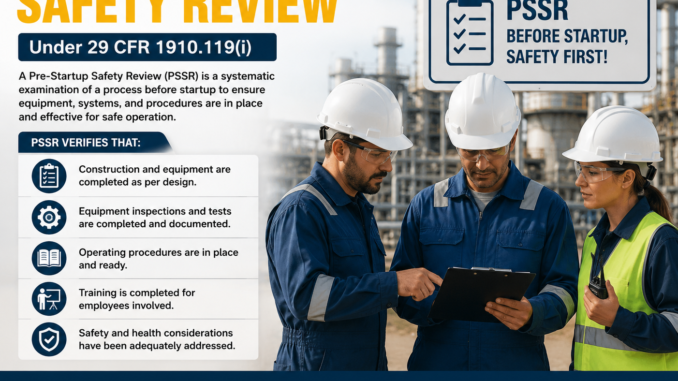
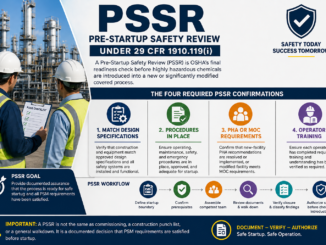
A pre-startup safety review (PSSR) is OSHA’s final readiness check before highly hazardous chemicals are introduced into a new covered process or a significantly modified process. Under 29 CFR 1910.119(i), the review must confirm design conformity, adequate procedures, completion of required PHA or management-of-change actions, and operator training.
A PSSR is not the same as commissioning, a construction punch list, or a general walkdown. It is a documented decision that the conditions specifically required by PSM are satisfied before startup.
When is a PSSR required?
The employer must perform a review for:
- New facilities containing a covered process; and
- Modified facilities when the modification is significant enough to require a change to process safety information.
The second trigger connects the PSSR to management of change. If a modification changes required PSI, startup readiness should not be assumed from the project’s construction Pre-Startup Safety Review completion alone.
The four required PSSR confirmations
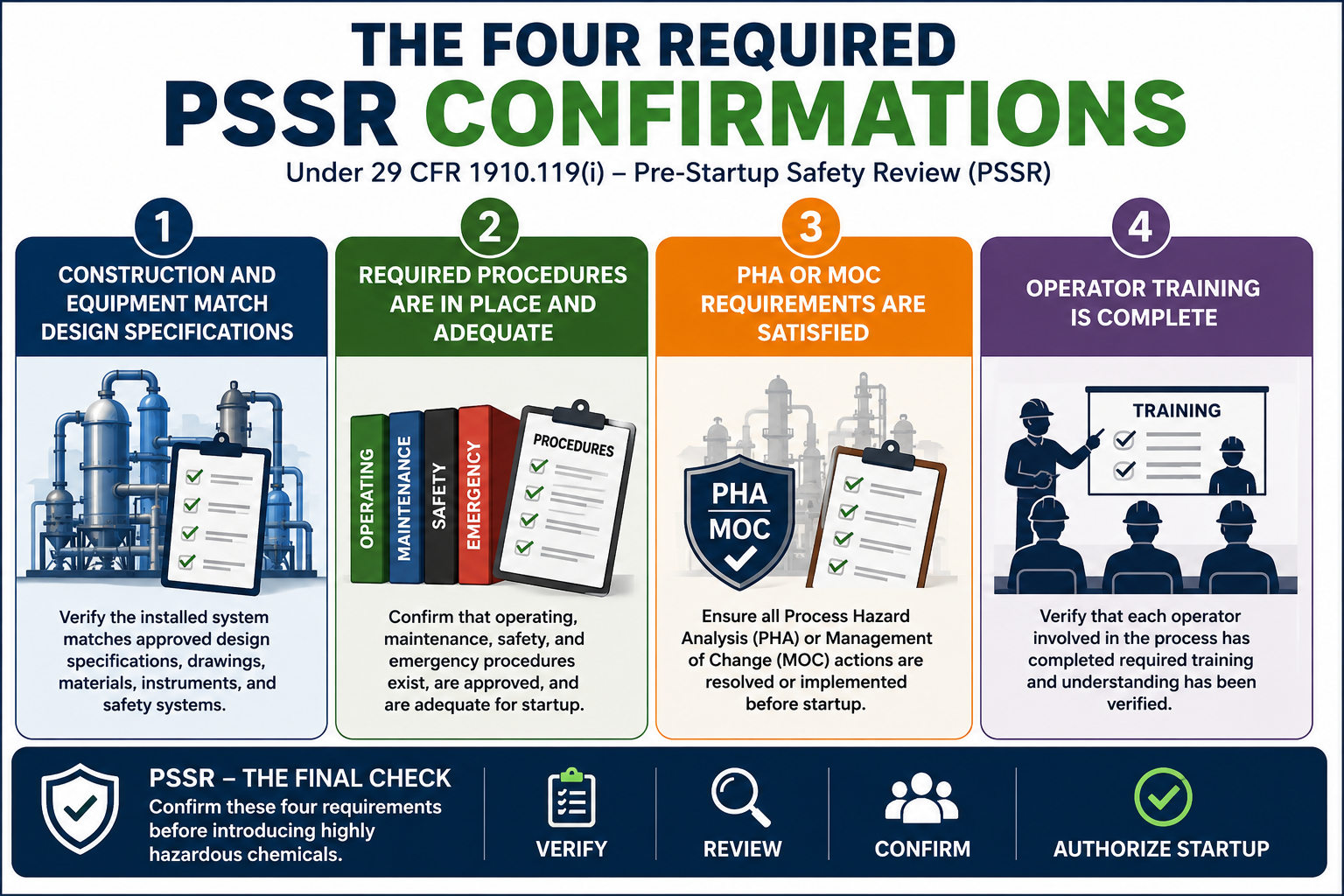
1. Construction and equipment match design specifications
The review should verify the installed system against approved drawings, specifications, equipment data, materials, orientation, relief and vent connections, instruments, alarms, interlocks, electrical classification, and other relevant design requirements. Field walkdowns and inspection records should resolve discrepancies before startup or place them under a technically justified control and authorization Pre-Startup Safety Review process.
2. Required procedures are in place and adequate
Safety, operating, maintenance, and emergency procedures must exist and be adequate. This includes the operating procedures needed for initial startup and foreseeable abnormal conditions. The review should confirm that documents are approved, accessible, consistent with the installed process, and supported by necessary permits and safe work Pre-Startup Safety Review practices.
3. PHA or MOC requirements are satisfied
For a new facility, a process hazard analysis must have been performed and recommendations resolved or implemented before startup. For a modified facility, the change must meet paragraph 1910.119(l) management-of-change requirements.
“Resolved or implemented” should be documented. A recommendation should not disappear from the startup record because it was difficult or delayed. If the organization accepts another resolution, the basis, authorization, and remaining controls should be clear and Pre-Startup Safety Review defensible.
4. Operator training is complete
Training of each employee involved in operating the process must be completed. The training should use the final approved process and procedure information, and the record should show how understanding was verified as required Pre-Startup Safety Review by 29 CFR 1910.119(g).
A practical PSSR workflow
- Define the startup boundary: identify systems, utilities, equipment, chemicals, and project changes included.
- Confirm prerequisites: approved design, current PSI, completed MOC, PHA record, procedures, inspections, tests, and training.
- Assemble a competent team: include operations, engineering, maintenance, safety, project, and other disciplines appropriate to the startup.
- Review documents: verify required records and resolve conflicting revisions.
- Walk down the field installation: compare actual equipment and protective systems with approved information.
- Classify findings: identify items that block chemical introduction and items that can be completed later without compromising safe startup.
- Verify closure: record objective evidence, owner, date, and approver.
- Authorize startup: obtain the required approval before introducing highly hazardous Pre-Startup Safety Review chemicals.
What should be in the PSSR record?
OSHA states the required confirmations but does not prescribe one form. A practical record can include:
- Facility, process, project, and review scope;
- Reason the PSSR is required;
- Team members and disciplines;
- Documents and revisions reviewed;
- Field-verification date and systems checked;
- PHA/MOC action status;
- Procedure and training status;
- Open-item classification and controls;
- Closure evidence; and
- Startup authorization and Pre-Startup Safety Review date.
PSSR and mechanical integrity
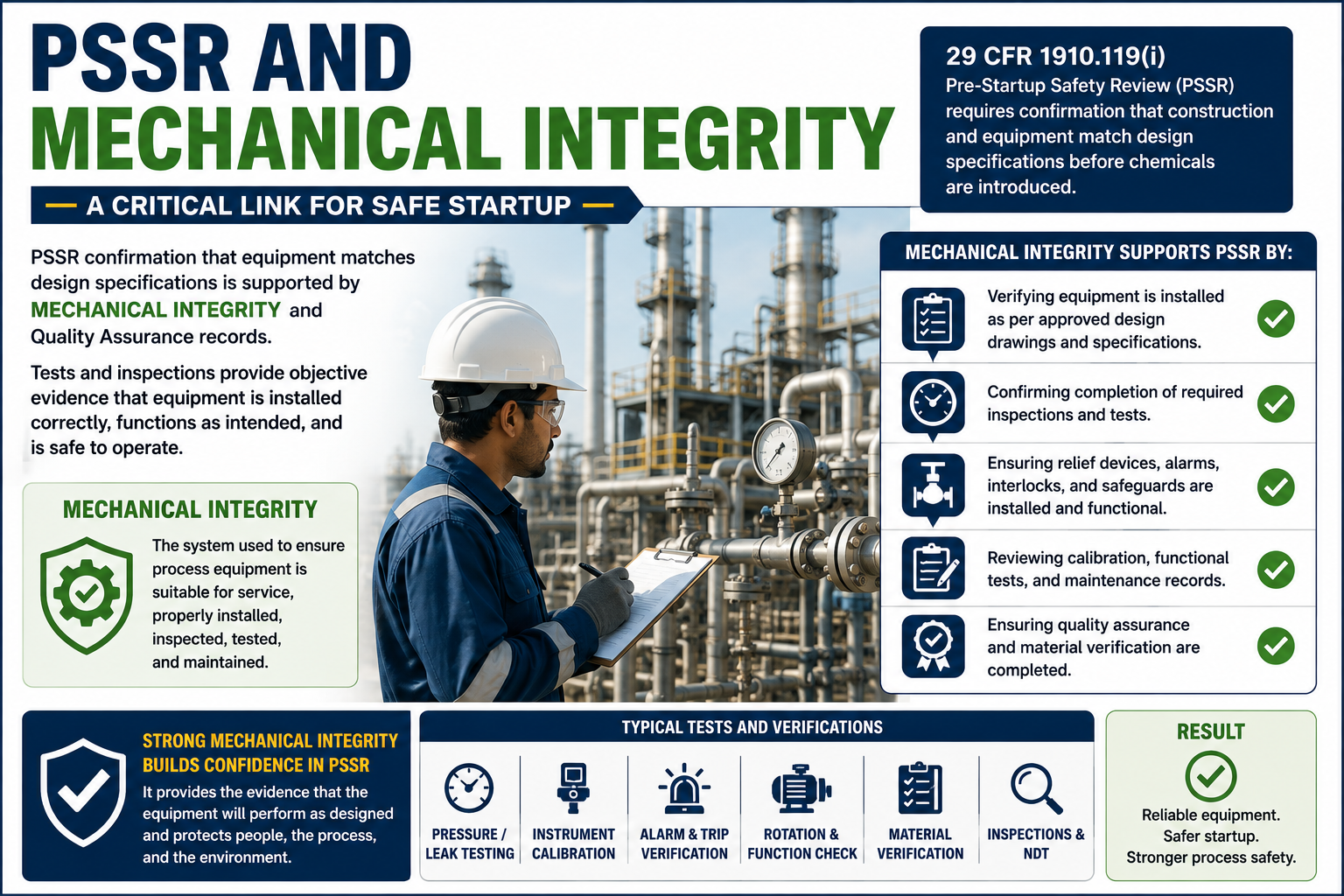
The PSSR confirmation that equipment matches design specifications is supported by mechanical integrity and quality-assurance records. Tests should be appropriate to the equipment and design. Examples may include pressure or leak tests, instrument calibration, alarm and trip verification, rotation checks, inspection of materials, and confirmation of relief-device installation. The applicable engineering basis determines what is Pre-Startup Safety Review required.
Common PSSR failure points
- Starting the process because construction is “substantially complete”;
- Using drawings that do not match the field installation;
- Leaving startup procedures in draft status;
- Deferring PHA recommendations without documented resolution;
- Training operators before final procedures or controls exist;
- Treating every punch item equally instead of identifying startup blockers;
- Failing to verify closure evidence; and
- Allowing schedule pressure to bypass Pre-Startup Safety Review authorization.
PSSR readiness questions
- Does installed equipment match approved design information?
- Are safety systems installed, tested, and available?
- Are operating, maintenance, safety, and emergency procedures approved and accessible?
- Are new-facility PHA recommendations resolved or implemented?
- Does the modified facility meet MOC requirements?
- Has every operator received and understood required training?
- Are startup-blocking findings closed with evidence?
- Has an authorized person approved chemical Pre-Startup Safety Review introduction?
Managing open items before startup
The four confirmations in paragraph (i) should not be reduced to a blanket statement that all construction is complete. A facility may use an open-item list, but each item must be evaluated for its relationship to design specifications, procedures, PHA or MOC requirements, and training. An item that affects containment, safeguards, operating limits, emergency response, or employee readiness should be resolved before highly hazardous chemicals are introduced.
If a minor item is deferred, document its scope, technical basis, temporary control, responsible owner, due date, and approval. The record should make clear why startup can proceed without defeating a required PSSR confirmation. Temporary changes or controls may themselves require MOC review. Do not use administrative labels such as “punch-list item” to bypass a substantive process-safety Pre-Startup Safety Review issue.
Who should participate in the PSSR?
OSHA does not prescribe one team composition in paragraph (i), so the facility should select people capable of verifying the specific change. A practical team may include operations, process engineering, maintenance, instrumentation or electrical specialists, project personnel, and an employee who will operate the process. Specialists in industrial hygiene, fire protection, or emergency response may be needed when their systems are affected.
Define who performs the field walkdown, who resolves discrepancies, and who authorizes introduction of highly hazardous chemicals. Signatures should represent completed verification within each person’s responsibility, not merely attendance at a Pre-Startup Safety Review meeting.

1 Trackback / Pingback