
Safety Officer Test Preparation
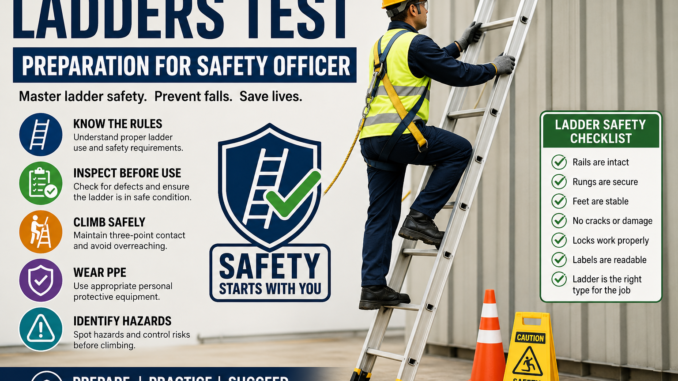
Ladders Test Preparation Guide
If you are preparing for a Ladders Test as part of a Safety Officer assessment, this guide will help you understand ladder safety requirements, inspection procedures, hazard recognition, and safe work practices. Many organizations include ladder safety questions in Safety Officer evaluations because falls from ladders remain one of the most common workplace incidents.
This Ladders Test preparation resource is designed to help candidates review important concepts, practice common questions, and improve confidence before taking a Safety Officer test. Review these questions regularly and use the scenarios to strengthen your understanding of workplace ladder safety.
Why Ladder Safety Matters

Ladders are widely used in construction, maintenance, warehousing, manufacturing, and facility management. Improper ladder selection, poor inspection practices, and unsafe climbing techniques can result in serious injuries.
A Safety Officer must understand:
- Ladder classifications
- Inspection requirements
- Fall prevention methods
- Safe climbing practices
- Hazard identification
- Emergency response procedures
Understanding these topics is essential for success in any Ladders Test.
Types of Ladders
Step Ladder
A self-supporting portable ladder with flat steps and a hinged design.
Extension Ladder
A non-self-supporting ladder that requires a stable surface and can be adjusted to different heights.
Platform Ladder
A ladder equipped with a standing platform near the top.
Fixed Ladder
A permanently attached ladder commonly found on tanks, silos, and structures.
Fiberglass Ladder
Often preferred when electrical hazards exist because fiberglass does not conduct electricity like metal.
Ladder Inspection Requirements
Before use, every ladder should be inspected for:
- Cracks
- Bent rails
- Damaged feet
- Missing rungs
- Loose hardware
- Oil or grease contamination
- Corrosion
- Structural damage
Defective ladders must be removed from service immediately and tagged appropriately.
Inspection Checklist
- Check ladder rails.
- Inspect all rungs.
- Verify anti-slip feet.
- Ensure labels remain readable.
- Check locks and hinges.
- Confirm ladder stability.
Safe Ladder Practices
Three-Point Contact Rule
Always maintain three points of contact:
- Two hands and one foot, or
- Two feet and one hand
Proper Climbing
- Face the ladder.
- Use both hands.
- Avoid carrying heavy tools while climbing.
- Use tool belts or rope systems.
Correct Positioning
For extension ladders, use the 4:1 rule:
- For every 4 feet of height, place the base 1 foot away from the structure.
Avoid Overreaching
Keep your belt buckle between ladder rails. Reposition the ladder if necessary.
Ladders Test Questions and Answers
Q1. What is the first step before using any ladder?
Answer: Conduct a visual inspection to ensure the ladder is safe and free from defects.
Q2. What should be done with a damaged ladder?
Answer: Remove it from service immediately and tag it to prevent use.
Q3. What is the purpose of ladder inspection?
Answer: To identify defects and prevent accidents.
Q4. What is the three-point contact rule?
Answer: Maintaining three points of contact while climbing or descending.
Q5. Why should workers face the ladder when climbing?
Answer: To maintain balance and reduce fall risk.
Q6. Which ladder is suitable near electrical hazards?
Answer: A fiberglass ladder.
Q7. What is a common cause of ladder accidents?
Answer: Improper ladder placement.
Q8. Can the top step of a stepladder be used as a work platform?
Answer: No.
Q9. What should be checked on ladder feet?
Answer: Stability and slip resistance.
Q10. Why is housekeeping important around ladders?
Answer: It prevents slips, trips, and falls.
Q11. What should be done before climbing an extension ladder?
Answer: Ensure locks are fully engaged.
Q12. What is the 4:1 ladder rule?
Answer: One foot out for every four feet of ladder height.
Q13. Why must ladders be placed on stable ground?
Answer: To prevent movement and collapse.
Q14. What PPE may be required when using ladders?
Answer: Safety helmet, gloves, safety shoes, and fall protection when applicable.
Q15. How often should ladders be inspected?
Answer: Before each use and according to company procedures.
Q16. What should a worker do if a ladder becomes unstable?
Answer: Descend immediately and reposition it safely.
Q17. Why should metal ladders not be used near energized equipment?
Answer: They can conduct electricity.
Q18. What should be done if ladder labels are missing?
Answer: Follow company procedures and consider removing the ladder until identification is restored.
Q19. What is overreaching?
Answer: Leaning beyond the ladder’s side rails.
Q20. What is the safest way to transport tools while climbing?
Answer: Use a tool belt or lifting system.
Ladder Hazard Recognition
A Safety Officer should identify hazards such as:
- Wet surfaces
- Uneven ground
- High winds
- Electrical lines
- Poor lighting
- Damaged ladders
- Obstructions
- Falling objects
Recognizing hazards is a major component of any Ladders Test.
Scenario-Based Questions
Scenario 1
A worker places an extension ladder on muddy ground and begins climbing.
Question
What is the hazard?
Answer
Unstable footing may cause ladder movement and a fall.
Scenario 2
A worker stands on the top cap of a stepladder.
Question
What is wrong?
Answer
The top cap is not designed for standing and increases fall risk.
Scenario 3
A worker uses a metal ladder near exposed electrical wiring.
Question
What is the hazard?
Answer
Electrical shock or electrocution.
Scenario 4
A worker leans sideways instead of moving the ladder.
Question
What unsafe action is occurring?
Answer
Overreaching.
Scenario 5
A ladder inspection reveals a cracked side rail.
Question
What action should be taken?
Answer
Remove the ladder from service immediately.
Responsibilities of a Safety Officer
A Safety Officer should:
- Conduct inspections
- Monitor compliance
- Deliver safety training
- Investigate incidents
- Maintain records
- Enforce procedures
- Promote safe work practices
Strong knowledge of these duties can help improve Ladders Test performance.
Common Ladder Safety Rules
Do
✔ Inspect before use
✔ Maintain three-point contact
✔ Use the correct ladder type
✔ Secure extension ladders
✔ Wear appropriate PPE
✔ Follow company procedures
Don’t
✘ Use damaged ladders
✘ Stand on the top step
✘ Overreach
✘ Use metal ladders near electricity
✘ Climb with heavy loads in hand
✘ Place ladders on unstable surfaces
Emergency Response Considerations
In the event of a ladder-related incident:
- Secure the area.
- Contact emergency responders.
- Provide first aid if trained.
- Report the incident.
- Preserve evidence for investigation.
- Conduct root cause analysis.
- Implement corrective actions.
Understanding emergency procedures is often included in Safety Officer evaluations.
Final Preparation Tips for the Ladders Test
To perform well in a Ladders Test:
- Study ladder types.
- Memorize inspection points.
- Learn hazard identification techniques.
- Review scenario-based questions.
- Understand emergency response procedures.
- Practice safety observations.
- Focus on fall prevention measures.
Consistent review and practice will improve your confidence and readiness for a Safety Officer assessment.
Conclusion
This Ladders Test preparation guide provides essential knowledge for Safety Officer candidates. By understanding ladder types, inspection requirements, safe work practices, hazard recognition, and emergency response procedures, you can approach your assessment with confidence. Continue reviewing these questions and answers regularly to strengthen your understanding and improve your chances of success.


Be the first to comment