
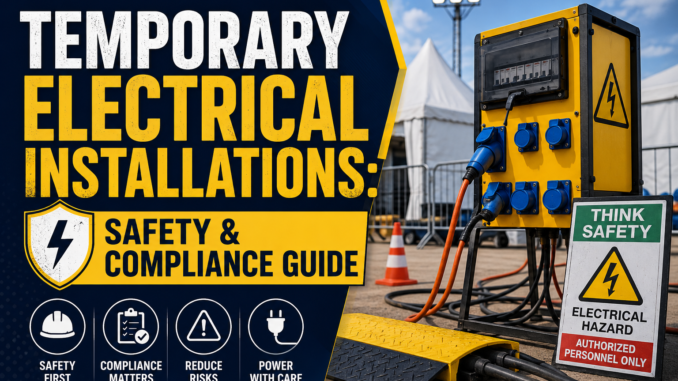
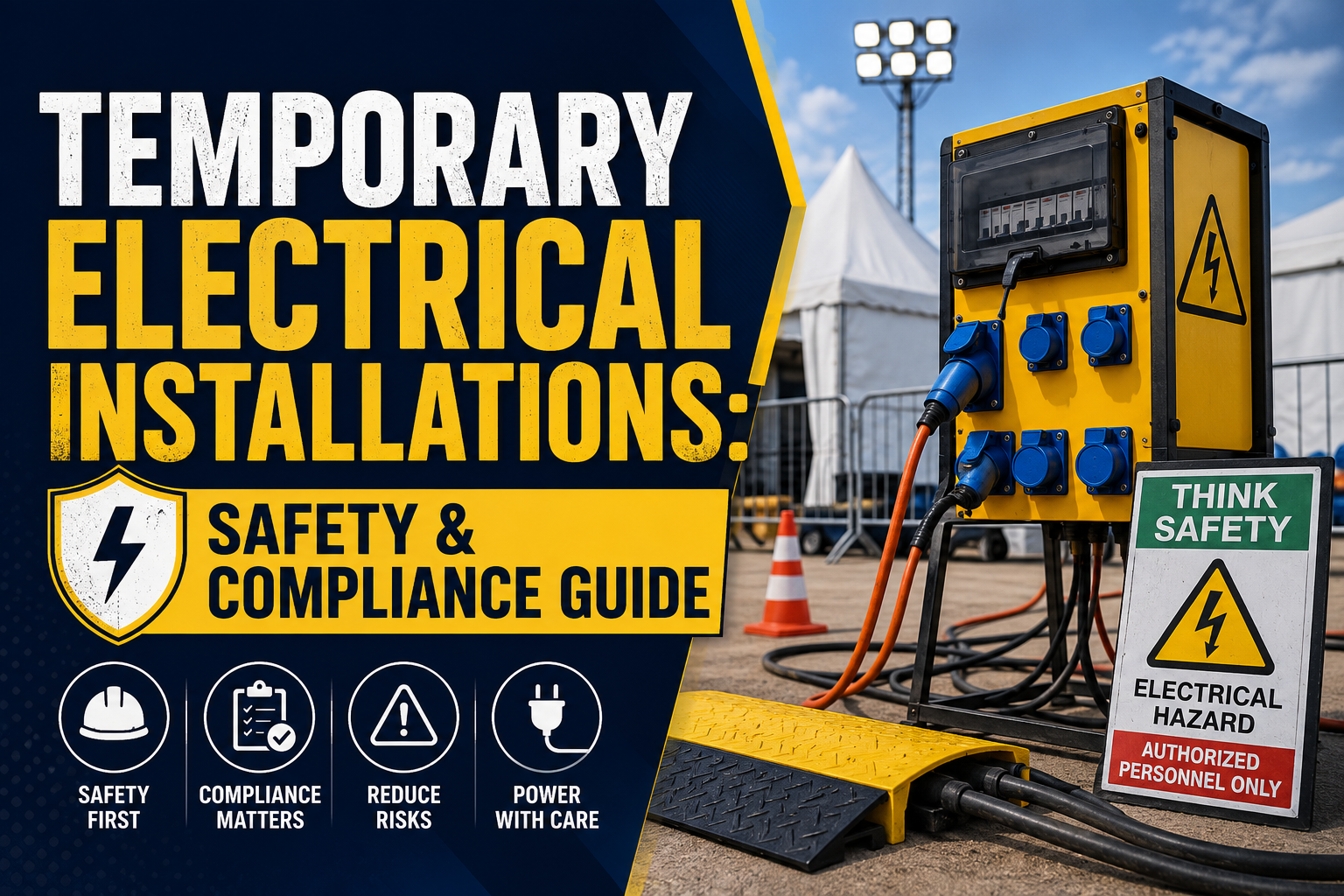
Temporary electrical installations – feeders, panels, lighting strings, and cord drops rigged up for a construction job, a repair, or an event – fall under NEC Article 590, not the general wiring rules for finished buildings. A qualified electrician designs and installs them. Nothing gets tied into an existing circuit without prior written approval. Receptacles never share a circuit with temporary lighting. Every 125V, 15/20/30A receptacle gets GFCI protection, tested and logged. And the whole rig comes down the moment the job it was serving is done – there’s no such thing as “temporary” wiring that quietly becomes permanent. Miss any one of these and you’re looking at an OSHA 1926.404 citation, or worse, a fire.
Temporary Electrical Installations: Complete Safety & Compliance Guide (NEC Article 590)
Walk any active job site and you’ll find it: string lights hanging off a spider box, a 100-foot cord snaking to a chop saw, a panel someone “just tapped into” for the crane. That’s a temporary electrical installation, and it’s governed by a different rulebook than the permanent wiring in the finished building.
Most of the citations we see on site walkthroughs don’t come from exotic code violations. They come from the basics – a missing GFCI, a receptacle sharing a circuit with task lighting, temporary wiring that’s still live four months after the drywall went up. This guide walks through what NEC Article 590 and OSHA actually require, the approval steps before you connect to an existing circuit, and how U.S. rules stack up against the UK’s BS 7671/BS 7909 framework.
What Is a Temporary Electrical Installation (NEC Article 590 + the 90-Day Rule)
A temporary electrical installation is any power, lighting, or feeder circuit put in for a defined job and a defined stretch of time – it isn’t part of the building’s finished, permanent wiring.
NEC Article 590 is the section of NFPA 70 that governs it, and it applies to a wider range of situations than most people assume:
- Construction, remodeling, and demolition power – panels, feeders, and branch circuits run for the length of a build
- Temporary lighting – string lights, task lights, and lighting towers used before permanent fixtures are energized
- Portable tools and equipment – cord sets and extension cords feeding saws, welders, pumps, generators
- Emergency and outage power – generator hookups after a storm or an equipment failure
- Tests, experiments, and developmental work
- Holiday decorative lighting and seasonal displays
Here’s where a lot of site teams get it wrong: the 90-day temporary installation rule does not apply to construction power. Article 590.3(D) caps holiday and decorative lighting at 90 days per year – that’s the only fixed time limit written into the article. For construction, remodeling, maintenance, or demolition, temporary wiring can stay up for as long as the work is genuinely ongoing. There’s no 90-day clock running against your job trailer’s power feed.
What is fixed, for every use case, is this: temporary wiring must be removed immediately once the construction, repair, or purpose it served is complete. A “temporary” run still energized eight months after the punch list closed isn’t temporary anymore – it’s an unpermitted permanent installation, and it’ll fail as one.
Setup Requirements for Temporary Wiring
Designing and installing a temporary electrical service isn’t a task for whoever’s free that morning. It’s electrician’s work, governed by three overlapping standards:
- NEC Article 590 – wiring methods, overcurrent protection, grounding, support
- OSHA 29 CFR 1926.404 – ground-fault protection and wiring design/protection on construction sites
- NFPA 70E – the electrical safety-related work practices that apply while the system is being built and energized
Who installs it: A qualified, licensed electrician handles design, installation, and any modification of temporary wiring. That covers everything from the main disconnect down to the last cord drop – not just the “big stuff.” A facilities tech running “just a quick extension” off a live panel without an electrician’s sign-off is one of the most common – and most serious – findings on temporary power audits.
Load calculation: Before energizing anything, the electrician calculates total demand – every tool, heater, light tower, and piece of equipment expected to run simultaneously – and sizes the feeder, panel, and overcurrent protection to match. Undersized temporary electrical service is how you get nuisance tripping, overheated conductors, and – in the worst case – a fire behind a wall nobody’s watching.
Panelboard and disconnect covers: Every unused breaker slot, knockout, and panel opening gets closed off. An open panelboard is an invitation for debris, moisture, or a stray tool to make contact with live parts. Inspectors flag this constantly, and it’s a five-minute fix.
Baseline setup checklist:
- Wiring methods (NM, SE cable, listed flexible cords) match the environment – indoor, outdoor, wet location, exposed to vehicle traffic
- Cords and cables supported off the ground and protected from physical damage
- Grounding and bonding verified – no neutral doing double duty as a ground
- Equipment rated for the conditions it’ll actually face (temperature, moisture, dust)
- Load calculation documented and matched to the panel/feeder rating
- Disconnects and panelboards fully enclosed, no open slots
Prior Approval Process Before Connecting to Existing Circuits
Nothing gets tied into an existing circuit or building panel without a documented approval step first. On a lot of managed sites, this runs through a Safety and Plant Operations (SAPO)-style function – an internal EHS or facilities sign-off that sits alongside whatever permit your local AHJ requires.
The workflow looks like this:
- Load assessment – calculate what’s already running on the target circuit or panel, then add the proposed temporary load on top.
- Written request submitted to SAPO/EHS – spell out what’s being connected, the expected load, the duration, and the reason.
- Capacity verification – someone qualified confirms the existing service has margin without exceeding breaker or feeder ratings.
- Documented sign-off before energizing – no connection goes live on a verbal “yeah, go ahead.”
- Time-bound authorization – the approval names a removal date or trigger event (“on completion of Phase 2 electrical rough-in”).
- Post-installation verification – someone checks that what got built matches what was approved, before final walk-off.
Skip this and you’re gambling on a circuit that was never sized for the extra draw. That’s how breakers start tripping randomly, conductors run hot, or a fault gets masked until it’s a bigger problem than a nuisance trip. The approval step exists to catch exactly that before it becomes an incident report.
Receptacle & Circuit Separation Rules
Receptacles must not share a circuit with temporary lighting. It sounds like a small detail. On a fast-moving site, it’s one of the easiest rules to break – and one of the fastest to catch on a walkthrough.
The reasoning is straightforward. Lighting loads and receptacle loads behave differently:
- Nuisance tripping – plug a tool into a receptacle sharing a circuit with task lighting, and the surge draw can kill the lights mid-task, leaving crews working in the dark.
- Unpredictable overload – receptacle loads (grinders, heaters, pumps) swing far more than steady lighting loads, which makes it harder to size overcurrent protection correctly when the two are combined.
Separation checklist:
- Lighting circuits are dedicated – no receptacles tapped off the same breaker
- Receptacle circuits are labeled at both the panel and the outlet box
- Circuit directories are current and match what’s physically installed
- The temporary panel schedule is posted and legible on site, not buried in a binder in the trailer
Ground-Fault Protection (GFCI) Requirements
GFCI protection is mandatory on every 125-volt, 15-, 20-, and 30-amp receptacle outlet that isn’t part of the permanent building wiring and is used by personnel. This sits at the intersection of NEC/NFPA 70 and OSHA 1926.404(b)(1) – it’s one of the most frequently cited items in OSHA temporary wiring inspections, and it’s non-negotiable.
What compliant ground-fault protection looks like on site:
- GFCI receptacles or in-line GFCI cord sets on every temporary outlet feeding tools, lighting, or equipment
- Daily testing – hit the test button at the start of each shift; anything that doesn’t trip and reset gets tagged out on the spot
- Monthly documented testing, logged – not a verbal “yeah, checked it”
- Coverage regardless of source – GFCI protection applies whether the power’s coming from utility service or a job-site generator
- Alternative path: where GFCIs genuinely aren’t practical, a written Assured Equipment Grounding Conductor Program (AEGCP) can substitute – daily visual cord/plug inspection plus grounding-continuity tests before first use, after repairs, and at least every three months, run by a designated competent person
In our experience walking sites, this is the single most common finding – usually because a GFCI receptacle got swapped for a standard one during a repair and nobody caught the downgrade. Keep the test log where an inspector can actually find it.
Use & Maintenance
A compliant install on day one doesn’t stay compliant on its own. Temporary power construction setups need active management for as long as they’re in service:
- Inspection logs – document a visual walk of cords, panels, and connections on a set schedule, not just when something looks off
- Lockout/tagout – always de-energize and lock out before extending, repairing, or re-routing any temporary circuit; nobody works a “live” temporary panel to save five minutes
- Circuit directories – kept current every time a circuit is added, moved, or retired, matching what’s actually in the panel
- Environment-rated equipment – cords, panels, and connectors rated for the conditions they’re actually exposed to (wet location, outdoor UV exposure, high-traffic areas), not whatever was in the gang box
- Battery charging stations – if the site charges tool or e-bike batteries off temporary power, keep charging away from combustibles, avoid daisy-chained extension leads feeding chargers, and inspect batteries for swelling or heat damage before every charge cycle. Lithium-ion thermal runaway is a fast-moving, hard-to-extinguish fire risk, and a temporary power drop is often exactly where uncontrolled charging setups show up
Removal Requirements
Temporary wiring comes down immediately once the construction, repair, maintenance, or purpose it supported is finished. That’s not a suggestion – it’s written into Article 590.3(D).
Allowed uses for temporary electrical installations:
- Construction, remodeling, maintenance, repair, or demolition of a structure
- Emergencies, tests, experiments, and developmental work
- Decorative and holiday lighting (capped at 90 days)
- Events, trade shows, and similar short-duration setups
Not allowed: treating a temporary run as a long-term substitute for permanent wiring because pulling a permit felt like more trouble. If a “temporary” circuit is still feeding a workstation, a break room, or a piece of fixed equipment six months after the original job wrapped, it needs a permanent-installation inspection – not a shrug.
US vs UK Comparison Table
Site teams working across both markets often assume the rules line up. They don’t, not exactly. Here’s the side-by-side:
| Requirement | United States (NEC / OSHA) | United Kingdom (BS 7671 / BS 7909) |
|---|---|---|
| Governing code | NEC Article 590 (NFPA 70) + OSHA 1926.404 | BS 7671 (IET Wiring Regulations) + BS 7909 for events |
| Who signs off | Qualified electrician + AHJ / internal EHS approval | Senior Person Responsible (SPR) appointed for the system |
| Fault protection | GFCI on all 125V, 15/20/30A receptacles | 30mA RCD on all final circuits, max 40ms trip time |
| Duration limit | No fixed limit for construction; 90 days for holiday/decorative lighting only | No fixed day count; system classed “small” (under 6kVA) or “complex” and reassessed per event |
| Testing regime | Daily GFCI push-test + monthly documented test log | Pre-use plug-in tester checks; full test certificate for complex systems |
| Documentation | Load calc, approval sign-off, circuit directory | Electrical completion certificate + test results for complex/large systems |
| Removal rule | Immediate removal after project completion | Decommissioning plan built into BS 7909 lifecycle from planning stage |
The core difference: U.S. rules revolve around device-level protection (GFCI) plus a qualified-person sign-off, while the UK’s BS 7909 framework builds a named responsible person and a tiered classification (small vs. complex) into the process from day one – closer to a formal project-management step than a checklist.
Common Violations & Inspection Checklist
The same handful of issues show up on nearly every temporary electrical audit we’ve reviewed:
Recurring violations:
- Extension cords run through walls, doorways, ceilings, or under carpet as a stand-in for permanent wiring
- Missing or bypassed GFCI protection on receptacle outlets
- Non-qualified staff modifying temporary circuits without an electrician
- Temporary wiring still energized weeks or months after the supported work finished
- Receptacles and lighting sharing one circuit
- Damaged cords, cracked plugs, or missing ground pins still in service
- Panels tied into existing circuits with no documented prior approval
- Unused panel openings and breaker slots left uncovered
- Daisy-chained extension leads feeding multiple tools or chargers off one outlet
Printable inspection checklist – run this before every walkthrough:
- System conforms to NEC Article 590 / NFPA 70
- Installed and modified only by a qualified, licensed electrician
- Load calculation documented and matched to panel/feeder rating
- Prior approval on file before any connection to an existing circuit
- Receptacle circuits kept separate from temporary lighting circuits
- GFCI protection present on every applicable outlet, tested daily, logged monthly
- Cords and cables supported and protected from physical damage
- Grounding continuity verified – no neutral used as a ground
- Panelboards and disconnects fully enclosed, no open knockouts
- Circuit directory and panel schedule current, posted, and legible
- Removal date or completion trigger documented and tracked
- Battery charging areas kept clear of combustibles, no daisy-chained leads
Print it, laminate it, clip it to a board – a checklist that lives in a filing cabinet doesn’t stop anything on the floor.
FAQ
Do temporary electrical installations catch fire from battery charging? Yes, and it’s a growing risk. Lithium-ion tool and e-bike batteries can go into thermal runaway from overcharging or physical damage, hitting temperatures over 1,000°C and releasing toxic, flammable gas before ignition. Keep charging stations away from combustibles, off temporary power drops that aren’t rated for it, and never feed chargers through daisy-chained extension leads.
What’s the risk with extension leads (extension cords) on temporary power? Overloading and daisy-chaining. Plugging one extension lead into another – or loading one lead with more amperage than it’s rated for – overheats the cable and its connections, which is a direct fire hazard. High-draw equipment like heaters should go straight into a rated outlet, never through a chained extension lead.
How often should GFCI or RCD protection be tested? In the U.S., push-test every GFCI at the start of each shift, and run a documented test monthly. In the UK, RCDs on temporary event systems typically get checked with a plug-in tester before use, with fuller test certification required for BS 7909 “complex” systems.
Does the 90-day temporary installation rule apply to construction sites? No – that’s a common mix-up. The 90-day cap in NEC Article 590.3(D) applies specifically to holiday and decorative lighting. Construction, remodeling, and repair power can stay up as long as the work is actually ongoing, but it must come down immediately once that work is finished.
Who approves a temporary electrical installation before it connects to an existing circuit? A qualified electrician handles the design and load calculation, but the connection itself needs sign-off from your site’s electrical safety authority – often a SAPO-style internal function or EHS lead – plus any permit your local AHJ requires. No connection should be energized without that documented approval.
Can receptacles and temporary lighting share a circuit? No. They need to be on separate circuits. Combining them risks nuisance tripping – losing lighting the moment a tool draws a surge on the same circuit – and makes it much harder to size overcurrent protection correctly for both loads.
Useful Sources
- NFPA 70 – National Electrical Code
- OSHA 1926.404 – Wiring Design and Protection
- ESFI – Temporary Power Safety
- National Safety Council – Temporary Electrical Construction Wiring Methods
- BBC – Temporary Electrical Systems Guidance
- jadelearning.com – NEC Article 590 Temporary Installations




2 Trackbacks / Pingbacks