Introduction
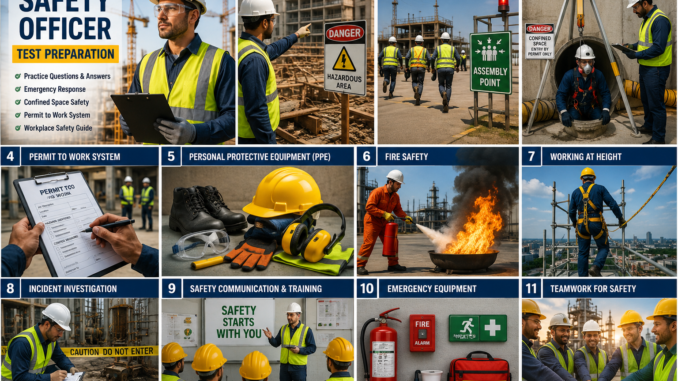
Safety Officer Test Preparation is essential for candidates who want to build a strong career in industrial safety and pass competitive safety officer exams in a company or organizational environment.
This guide is designed as a structured preparation resource for candidates preparing for a Safety Officer Test. Since many industrial safety exams are based on real-world procedures, this material focuses on practical understanding rather than memorization.
The goal is to help you understand emergency response systems, especially in high-risk areas such as confined spaces. You will also learn how organizations expect safety officers to respond during emergencies and manage contractor personnel effectively.
This guide also provides guidance on how to take the test, what to prepare for, and what kind of scenarios you may encounter. Each topic includes explanations followed by relevant questions and answers to strengthen your understanding.
Use this guide as a structured preparation resource, review the questions repeatedly, and build confidence through scenario-based practice.
Safety Officer Test Preparation
1. Role of a Safety Officer
Safety Officer Test Preparation A Safety Officer plays a critical role in maintaining workplace safety. The main responsibility is to ensure that all employees and contractors follow safety procedures and comply with organizational policies.
Key duties include:
- Conducting safety inspections
- Identifying hazards
- Implementing control measures
- Conducting toolbox talks
- Investigating incidents
- Ensuring compliance with safety standards
A safety officer must be proactive rather than reactive. Preventing incidents is always better than dealing with consequences.
Questions & Answers
Q1: What is the primary responsibility of a Safety Officer?
A: To ensure a safe working environment by identifying hazards and implementing control measures.
Q2: Why is hazard identification important?
A: Because it helps prevent accidents before they occur.
2. Hazard Identification and Risk Assessment
Safety Officer Test Preparation Hazard Identification and Risk Assessment (HIRA) is a core concept in safety management. It involves identifying potential hazards and evaluating the risks associated with them.
Steps include:
- Identify hazards
- Assess risk (likelihood and severity)
- Implement control measures
- Monitor and review
Types of hazards:
- Physical hazards
- Chemical hazards
- Biological hazards
- Ergonomic hazards
- Environmental hazards
Control measures follow the hierarchy:
- Elimination
- Substitution
- Engineering controls
- Administrative controls
- Personal Protective Equipment (PPE)
Questions & Answers
Q1: What is risk?
A: Risk is the combination of likelihood and severity of a hazard.
Q2: What is the most effective control measure?
A: Elimination of the hazard.
3. Emergency Response System
Safety Officer Test Preparation Every organization has an emergency response system to handle unexpected situations such as fire, gas leaks, or medical emergencies.
Typical emergency response pattern includes:
- Raising alarm
- Notifying emergency team
- Evacuating personnel
- Providing first aid
- Coordinating with emergency services
Safety officers must be familiar with:
- Emergency exits
- Assembly points
- Alarm systems
- Communication procedures
Questions & Answers
Q1: What is the first step in an emergency?
A: Raising the alarm.
Q2: Why are assembly points important?
A: To ensure all personnel are accounted for.
4. Confined Space Safety
Safety Officer Test Preparation Confined spaces are high-risk areas such as tanks, vessels, pits, and silos. These spaces have limited entry and exit points and may contain hazardous atmospheres.
Hazards in confined spaces:
- Oxygen deficiency
- Toxic gases
- Flammable gases
- Limited ventilation
Safety requirements:
- Work permit
- Gas testing
- Ventilation
- Standby person
- Rescue plan
Questions & Answers
Q1: What is a confined space?
A: A space with limited entry/exit and not designed for continuous occupancy.
Q2: Why is gas testing important?
A: To ensure safe oxygen levels and absence of toxic gases.
5. Permit to Work System
Safety Officer Test Preparation A Permit to Work (PTW) system is a formal authorization required before performing hazardous tasks.
Types of permits:
- Hot work permit
- Cold work permit
- Confined space permit
- Electrical permit
- Work at height permit
Purpose:
- Ensure proper planning
- Identify hazards
- Implement control measures
- Assign responsibilities
Questions & Answers
Q1: What is the purpose of a work permit?
A: To control hazardous activities safely.
Q2: What is a hot work permit?
A: A permit for activities involving fire or sparks.
6. Personal Protective Equipment (PPE)
PPE is the last line of defense against hazards. It should be used when other control measures are not sufficient.
Common PPE:
- Helmet
- Safety shoes
- Gloves
- Goggles
- Respirators
- Ear protection
Safety officers must ensure:
- Proper selection
- Correct usage
- Regular inspection
Questions & Answers
Q1: Is PPE the most effective control?
A: No, it is the last line of defense.
Q2: Why is PPE important?
A: It protects workers from injury.
7. Fire Safety and Prevention
Safety Officer Test Preparation Fire is a major hazard in industrial environments. Understanding fire prevention and control is essential.
Fire triangle:
- Heat
- Fuel
- Oxygen
Types of fire:
- Class A (solid materials)
- Class B (liquids)
- Class C (gases)
- Class D (metals)
- Electrical fires
Fire control methods:
- Remove heat
- Remove fuel
- Remove oxygen
Questions & Answers
Q1: What are the elements of fire?
A: Heat, fuel, and oxygen.
Q2: What extinguisher is used for electrical fires?
A: CO₂ extinguisher.
8. Working at Height
Working at height includes any work performed above ground level where there is a risk of falling.
Safety measures:
- Use of scaffolding
- Fall protection systems
- Safety harness
- Guardrails
Common risks:
- Falls
- Falling objects
- Structural failure
Questions & Answers
Q1: What is considered working at height?
A: Any work above ground level with fall risk.
Q2: What is the most important safety equipment?
A: Safety harness.
9. Incident Investigation
Incident investigation helps identify root causes and prevent future occurrences.
Steps:
- Secure the scene
- Collect evidence
- Interview witnesses
- Identify root cause
- Recommend corrective actions
Types of causes:
- Unsafe acts
- Unsafe conditions
Questions & Answers
Q1: Why investigate incidents?
A: To prevent recurrence.
Q2: What is root cause?
A: The main reason behind an incident.
10. Safety Communication and Training
Effective communication is essential for maintaining safety standards.
Methods:
- Toolbox talks
- Safety meetings
- Training sessions
- Signage
A safety officer must:
- Clearly communicate risks
- Provide proper instructions
- Encourage reporting of hazards
Questions & Answers
Q1: What is a toolbox talk?
A: A short safety meeting before work.
Q2: Why is training important?
A: To ensure workers understand safety procedures.
How to Prepare for the Test
To succeed in a Safety Officer Test Preparation:
- Understand concepts instead of memorizing
- Practice scenario-based questions
- Revise regularly
- Focus on practical applications
- Study emergency response patterns
- Learn safety standards and procedures
Preparation Tips
- Study daily with consistency
- Review questions multiple times
- Practice real-life scenarios
- Focus on weak areas
- Stay confident
Conclusion
Safety Officer Test Preparation requires a strong understanding of workplace safety principles, hazard identification, and emergency response systems. By focusing on practical knowledge and regularly practicing questions, candidates can build confidence and improve their chances of success.
This guide provides a structured approach to learning, helping you prepare effectively for your test. Continue revising, stay consistent, and focus on real-world applications to become a competent safety professional.
Be the first to comment