Hazard Identification Plan (HIP) – Complete Safety Officer Test Guide
The Hazard Identification Plan (HIP) is a critical component of workplace safety and a key topic in Safety Officer test preparation. This guide explains the Hazard Identification Plan (HIP) with practical examples, structured learning, and scenario-based questions to help you succeed.
1. Introduction to Safety Officer Role
A Safety Officer ensures workplace safety by applying systems like the Hazard Identification Plan (HIP).
Responsibilities:
- Identifying hazards
- Conducting risk assessments
- Implementing safety policies
- Monitoring compliance
- Training workers
- Managing emergencies
Sample Questions:
Q: What is the primary responsibility of a Safety Officer?
A: To ensure a safe environment through hazard control and compliance.
2. Hazard Identification Plan (HIP)
The Hazard Identification Plan (HIP) is a structured process used to identify and control workplace hazards before incidents occur.
Key Elements of Hazard Identification Plan (HIP):
- Hazard identification
- Risk evaluation
- Control measures
- Documentation
Types of Hazards:
- Physical
- Chemical
- Biological
- Ergonomic
Sample Questions
Q1: What is the first step in a Hazard Identification Plan?
Answer: Identifying potential hazards in the workplace.
Q2: Name three types of hazards.
Answer: Physical, chemical, and ergonomic hazards.
Q3: What is risk assessment?
Answer: Evaluating the likelihood and severity of harm from identified hazards.
3. Risk Assessment and Control Measures in HIP
The Hazard Identification Plan (HIP) includes risk assessment to evaluate hazards.
Hierarchy of Controls:
- Elimination
- Substitution
- Engineering controls
- Administrative controls
- PPE
Most effective: Elimination
Least effective: PPE
The most effective method is always elimination, while PPE is considered the last line of defense.
Sample Questions
Q1: What is the most effective control measure?
Answer: Elimination of the hazard.
Q2: Give an example of an engineering control.
Answer: Installing machine guards.
4. Emergency Response Pattern
The Hazard Identification Plan (HIP) supports emergency preparedness.
Steps:
- Recognize emergency
- Raise alarm
- Evacuate
- Provide first aid
- Contact emergency services
Safety Officers must be familiar with emergency plans, evacuation routes, and communication protocols.
Sample Questions
Q1: What is the first step in an emergency?
Answer: Recognizing the emergency.
Q2: Why is evacuation important?
Answer: To protect personnel from danger and reduce casualties.
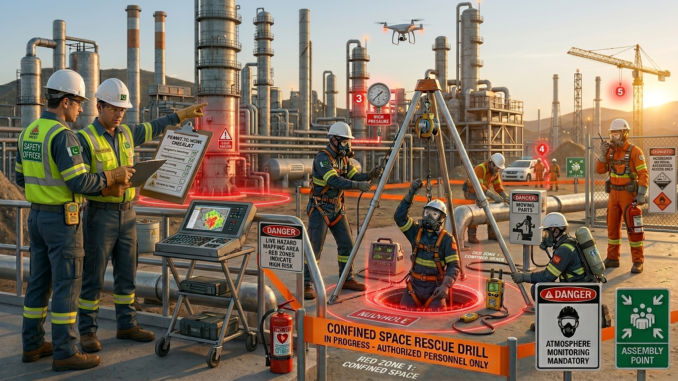
5. Confined Space Safety
Confined spaces are high-risk areas covered under the Hazard Identification Plan (HIP).
Examples:
- Tanks
- Silos
- Pipelines
- Manholes
Hazards:
- Oxygen deficiency
- Toxic gases
- Fire risk
Safe Oxygen Level:
19.5% – 23.5%
Sample Questions
Q1: What is a confined space?
Answer: A space with limited entry/exit not intended for continuous occupancy.
Q2: What is the safe oxygen level?
Answer: Typically 19.5% to 23.5%.
Q3: Why is gas testing required?
Answer: To ensure the atmosphere is safe before entry.
6. Personal Protective Equipment (PPE)
PPE is part of the Hazard Identification Plan (HIP) control measures.
Examples:
- Helmets
- Gloves
- Safety glasses
- Respirators
Sample Questions
Q1: What does PPE stand for?
Answer: Personal Protective Equipment.
Q2: Is PPE the most effective control?
Answer: No, it is the last line of defense.
7. Work Permit System
The Hazard Identification Plan (HIP) ensures permit systems are followed.
Types:
- Hot work permit
- Cold work permit
- Confined space permit
- Electrical permit
Sample Questions
Q1: What is a hot work permit?
Answer: A permit for activities involving fire or heat, such as welding.
Q2: Why are permits required?
Answer: To ensure safety precautions are followed before starting work.
8. Incident Investigation
Incident investigation supports improvement of the Hazard Identification Plan (HIP).
Steps:
- Secure area
- Collect evidence
- Identify root cause
- Recommend actions
Sample Questions
Q1: What is the purpose of the incident investigation?
Answer: To identify causes and prevent future incidents.
Q2: What is the root cause?
Answer: The underlying reason for an incident.
9. Fire Safety
Fire hazards are managed under the Hazard Identification Plan (HIP).
Fire Triangle:
- Heat
- Fuel
- Oxygen
Extinguishers:
- Water
- Foam
- CO₂
- Dry powder
Sample Questions
Q1: What are the three elements of fire?
Answer: Heat, fuel, and oxygen.
Q2: Which extinguisher is used for electrical fires?
Answer: CO₂ extinguisher.
10. Safety Training and Communication
Training strengthens the Hazard Identification Plan (HIP).
Methods:
- Toolbox talks
- Safety meetings
- Drills
Sample Questions
Q1: What is a toolbox talk?
Answer: A short safety discussion conducted before work.
Q2: Why is training important?
Answer: It improves awareness and reduces accidents.
11. Scenario-Based Practice
Scenario 1:
Worker enters confined space without testing
Action: Stop work, evacuate, test gas, ensure permit
Scenario 2:
Fire in workshop
Action: Raise alarm and evacuate
12. Tips for Test Preparation
- Study Hazard Identification Plan (HIP) concepts
- Practice MCQs
- Focus on real scenarios
- Revise regularly
- Focus on hazard identification and emergency response
Use this guide as a structured preparation resource. Review the questions repeatedly and practice scenarios to build confidence.
Conclusion
Preparing for a Safety Officer test requires a solid understanding of safety principles, hazard identification, and emergency response procedures. By focusing on key topics such as HIP, confined spaces, PPE, and incident management, candidates can improve their chances of success.
Consistent practice, revision, and scenario-based learning will help you perform well in the test and apply your knowledge effectively in real workplace situations.
References and Last Reviewed
- OSHA 29 CFR 1926 Subpart C – General Safety and Health Provisions: osha.gov/1926SubpartC
Jurisdiction: United States – OSHA construction industry standards (29 CFR 1926). Verify local/site-specific requirements where this differs from your jurisdiction.
Last technically reviewed: September 2026
Reviewed by: EHS Guidelines Editorial Team
This article is educational. Apply current official rules, approved site procedures, manufacturer instructions and competent-person assessment for your actual worksite.
Related Guides
- Isolation and Lockout Tagout System in Safety Officer Confined Space Lockout Guide
- Pre-Startup Safety Review Under 29 CFR 1910.119(i)
- Process Hazard Analysis Under 29 CFR 1910.119(e): Methods and Requirements
- Traffic and Vehicle Safety Test Preparation Guide
- Backfilling and Compaction Method Statement | Procedure, Equipment & Standards

1 Trackback / Pingback