Introduction
Preparing for a Safety Officer examination requires more than memorizing answers. This Safety Officer Test Preparation Emergency Response Under Confined Space guide helps candidates understand hazard recognition, rescue planning, permit systems, and emergency command principles.
Under our Safety Officer Test Preparation category, the topic Emergency Response under Confined Space is one of the most critical subjects for examination and field competency.
Emergency response failures in confined spaces remain one of the leading causes of multiple fatalities in construction and industrial projects. In many incidents, workers entering to rescue others without planning become secondary victims. For that reason, examinations for safety officers place strong emphasis on atmospheric hazards, entry permits, rescue planning, communication systems, and emergency command responsibilities.
This guide helps candidates understand what to study, what to expect in the test, and how emergency response patterns are commonly structured in major construction projects.
Understanding Confined Space Emergencies
A confined space is an enclosed or partially enclosed area not intended for continuous occupancy and having limited entry or exit. Examples include:
- Storage tanks
- Excavation shafts
- Sewers and manholes
- Vessels and silos
- Utility vaults
- Pipelines
- Process pits
These spaces may contain serious hazards such as:
- Oxygen deficiency
- Toxic gas accumulation
- Flammable atmosphere
- Engulfment hazards
- Mechanical energy risks
- Heat stress
- Restricted rescue access
Because hazards can escalate rapidly, emergency response planning must exist before entry begins.
Emergency Response Pattern for Confined Space
A typical emergency response pattern includes several stages that safety officers should know for exams.
1. Hazard Assessment Before Entry
Emergency planning begins during risk assessment.
The safety officer verifies:
- Job Hazard Analysis completed
- Confined Space Entry Permit approved
- Atmospheric tests recorded
- Isolation and lockout applied
- Rescue arrangements verified
- Emergency equipment inspected
A common exam point is that rescue planning must be established before entry, not after an incident.
2. Atmospheric Monitoring
Continuous gas monitoring is often mandatory.
Testing generally checks:
- Oxygen content
- Flammable gases (LEL)
- Toxic gases such as H2S or CO
Typical safe sequence taught in examinations:
- Oxygen test first
- Flammable gases second
- Toxic contaminants third
Safety officers are often asked why sequence matters.
Answer: Because atmospheric conditions affect instrument interpretation and worker survival.
3. Emergency Communication System
Reliable communication must exist between:
- Entrants
- Standby attendant
- Entry supervisor
- Rescue team
- Site emergency control center
Communication methods may include:
- Radio systems
- Hardline communication
- Hand signals
- Alarm activation systems
Loss of communication may require suspension of work.
4. Rescue Readiness
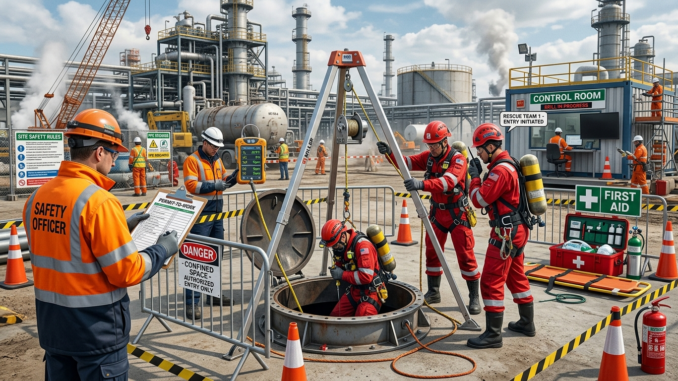
A major test topic is distinguishing self-rescue, non-entry rescue, and entry rescue.
Self-Rescue
Workers evacuate themselves upon alarm activation.
Examples:
- Gas detector alarm
- Fire signal
- Oxygen drop
Non-Entry Rescue
Preferred rescue method.
Uses:
- Tripod systems
- Retrieval lines
- Mechanical winches
This avoids exposing rescuers.
Entry Rescue
Used only when non-entry rescue is impossible.
Requires:
- Authorized rescue team
- Breathing apparatus
- Rescue permit controls
- Backup rescuers
- Medical response coordination
A common exam principle:
Unauthorized rescue attempts are prohibited.
Role of Safety Officer During Emergency
Safety officer responsibilities may include:
Before Emergency
- Verify permit controls
- Confirm rescue equipment availability
- Conduct emergency drill reviews
- Validate worker competency
- Ensure attendants understand duties
During Emergency
- Raise emergency alarm
- Activate response protocol
- Control scene access
- Coordinate responders
- Support incident command
- Prevent secondary casualties
After Emergency
- Support incident investigation
- Preserve evidence
- Recommend corrective actions
- Review emergency response effectiveness
These duties often appear in written and interview tests.
Confined Space Emergency Equipment
Candidates should know equipment commonly associated with emergency response:
Rescue Equipment
- Full body harness
- Tripod and davit systems
- Retrieval winch
- Escape breathing devices
- SCBA sets
- Rescue stretchers
Emergency Support Equipment
- Portable gas detectors
- Fire extinguishers
- First aid kits
- Emergency eyewash
- Ventilation blowers
- Lighting systems
Communication Equipment
- Intrinsically safe radios
- Alarm systems
- Emergency phones
Examiners may ask equipment identification questions from practical scenarios.
Common Emergency Response Triggers
Know what can trigger emergency evacuation:
- Gas detector alarms
- Fire or explosion risk
- Ventilation failure
- Worker collapse
- Flooding risk
- Toxic release
- Structural instability
Many tests ask:
What should occur immediately after atmospheric alarm activation?
Correct answer: Stop work, evacuate personnel, raise alarm, and initiate response procedure.
Incident Command During Emergency
Most major construction emergency systems follow an incident command structure.
Typical positions include:
- Incident Commander
- Rescue Team Leader
- Safety Officer
- Medical Coordinator
- Communication Coordinator
The safety officer must understand command escalation and reporting routes.
Potential exam question:
Who normally coordinates overall emergency actions?
Answer: Incident Commander or designated emergency coordinator.
What to Prepare for in Safety Officer Test
Candidates should study these subjects carefully:
Technical Topics
Prepare:
- Permit to Work system
- Gas testing limits
- Rescue hierarchy
- Lockout and isolation
- Emergency evacuation sequence
- Standby attendant duties
Practical Questions
Expect scenario-based questions such as:
- Worker collapses in vessel—what is first action?
- Gas detector alarms during hot work in confined space—what next?
- Rescue team unavailable—can permit remain active?
Interview Questions
Possible oral questions:
- Difference between attendant and entrant?
- What is non-entry rescue?
- Why is unauthorized rescue dangerous?
- What gases are checked before entry?
These are common competency questions.
Safety Officer Test Questions and Answers
Question 1
What is the first priority in confined space emergency response?
Answer: Protect life by initiating alarm, stopping work, and beginning emergency response according to procedure.
Question 2
Who should perform rescue inside a confined space?
Answer: Only trained and authorized rescue personnel.
Question 3
Which rescue method is preferred?
Answer: Non-entry rescue.
Question 4
What document confirms hazards and controls before confined space entry?
Answer: Confined Space Entry Permit supported by risk assessment.
Question 5
Why is a standby attendant required?
Answer: To monitor entrants, maintain communication, and initiate emergency actions.
Question 6
Name three atmospheric hazards.
Answer: Oxygen deficiency, toxic gases, flammable atmosphere.
Question 7
Should a co-worker enter immediately to rescue a collapsed worker?
Answer: No. Unauthorized rescue can create additional fatalities.
Question 8
What equipment may support non-entry rescue?
Answer: Tripod, retrieval line, and mechanical winch.
Question 9
When should a confined space permit be suspended?
Answer: When unsafe conditions develop or emergency triggers occur.
Question 10
Who has authority to stop unsafe work?
Answer: Safety officer or authorized responsible supervision according to procedure.
Safety Officer Test Preparation Scenario Questions and Answers
Scenario 1
An entrant inside a tank reports dizziness and communication stops.
What should happen?
Correct response:
- Raise alarm
- Do not allow unauthorized entry
- Start non-entry rescue if possible
- Activate rescue team
- Notify emergency command
Scenario 2
LEL rises above acceptable limits during confined space welding.
Correct response:
- Stop hot work
- Evacuate personnel
- Suspend permit
- Investigate source
- Re-test atmosphere before restart
Frequent Mistakes in Safety Officer Exams
Candidates often miss these concepts:
Confusing Rescue Types
Remember:
- Self rescue = worker exits independently
- Non-entry rescue = external retrieval
- Entry rescue = trained rescuers enter
Forgetting Permit Suspension Rules
Unsafe conditions can invalidate permits.
Ignoring Standby Attendant Duties
Attendants must not leave post or perform other tasks.
This is a common exam trap.
Emergency Response Best Practices
Strong answers in interviews often mention best practices such as:
- Pre-entry emergency drills
- Rescue team availability verification
- Continuous gas monitoring
- Clear rescue communication plans
- Incident command coordination
- Periodic response exercises
Mentioning these can strengthen oral interviews.
Quick Revision Checklist for Test Day
Review these before exam:
✓ Confined space definitions
✓ Permit requirements
✓ Gas testing sequence
✓ Emergency alarm steps
✓ Rescue hierarchy
✓ Attendant responsibilities
✓ Incident command roles
✓ Emergency equipment
✓ Permit suspension conditions
✓ Scenario-based response logic
Final Preparation Tips
For Safety Officer examinations, do not study questions only.
Understand why controls exist.
When answering scenario questions:
Use this pattern:
- Stop work
- Raise alarm
- Protect personnel
- Initiate response
- Escalate through command system
This pattern often aligns with expected emergency response logic.
Practice discussing confined space incidents aloud before interviews. Many candidates know written answers but struggle in verbal assessment.
Conclusion
Safety Officer Test Preparation Emergency Response Under Confined Space remains one of the most important exam subjects for safety professionals. Understanding atmospheric hazards, permit controls, rescue methods, and emergency command structures improves both examination success and field competency.
Use this Safety Officer Test Preparation Emergency Response Under Confined Space guide for revision, interview practice, and scenario preparation.
References and Last Reviewed
- OSHA 29 CFR 1926 Subpart AA – Confined Spaces in Construction: osha.gov/1926SubpartAA
- OSHA 29 CFR 1926.35 – Employee Emergency Action Plans: osha.gov/1926.35
Jurisdiction: United States – OSHA construction industry standards (29 CFR 1926). Verify local/site-specific requirements where this differs from your jurisdiction.
Last technically reviewed: September 2026
Reviewed by: EHS Guidelines Editorial Team
This article is educational. Apply current official rules, approved site procedures, manufacturer instructions and competent-person assessment for your actual worksite.

1 Trackback / Pingback