Introduction
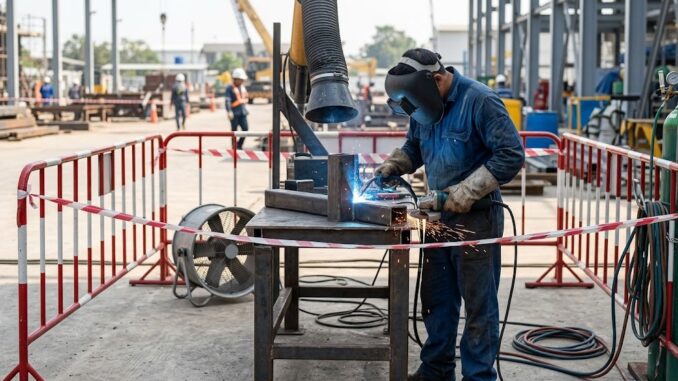
First, executing a robust JSA welding and grinding protocol guarantees the safety of all site personnel during hazardous operations. Furthermore, hot works introduce severe risks, including fires, electrocution, and hazardous fumes. Therefore, you must establish stringent control measures before initiating any tasks on the construction site. Specifically, this documented procedure empowers safety officers to mandate proactive oversight across all workfronts. To integrate this effectively into your broader site management, review our comprehensive structural safety guidelines.
Consequently, workers rely on this detailed JSA welding and grinding framework to navigate high-risk industrial environments securely. Moreover, proactive hazard identification drastically reduces lost-time incidents and prevents catastrophic equipment damage. Additionally, engineering teams must consistently verify equipment integrity, manage permits, and monitor environmental conditions. Finally, adhering strictly to these safety frameworks ensures total operational compliance and safeguards human lives, fully aligning with OSHA hot work standards.
1. Permit Preparation for JSA Welding and Grinding
| Hazards | Risks Issue | Existing Controls Checklist | Risk Reduction Action Plan |
| Miscommunication | Personal injury |
• First, mandate the permit receiver to undergo specialized mandatory training.
• Furthermore, execute proper communication and planning prior to arranging the work permit. |
• Routine monitoring and compliance |
2. Checking Power Tools for Hot Works
| Hazards | Risks Issue | Existing Controls Checklist | Risk Reduction Action Plan |
| Exposed cable | Electrocution / Electrical shock |
• First, secure the required permit prior to starting the activity.
• Furthermore, conduct a toolbox meeting to delineate associated hazards to the workers.
• Consequently, unplug power tools before conducting any inspections.
• Moreover, wear proper hand gloves before handling or checking tools.
• Specifically, utilize only inspected and color-coded tools.
• Next, finalize all tool inspections prior to initiating the work.
• Additionally, mandate the proper grounding and insulation of all equipment and power tools.
• Also, enforce the use of proper eye protection, including safety glasses and face shields.
• Therefore, equip leather hand gloves while executing the task.
• Similarly, inspect all hand tools rigorously before utilization.
• Finally, strictly prohibit the use of homemade hand tools. |
• Routine monitoring and compliance |
3. Cutting and Grinding Work Execution
| Hazards | Risks Issue | Existing Controls Checklist | Risk Reduction Action Plan |
| Used uninspected tools; Spark projectile; Unforeseen projectile of cracked disk | Personnel injury; Bodily injury; Burn injury |
• First, maintain proper body positioning throughout the activity.
• Always enforce the use of proper eye protection, including safety glasses and face shields.
• Additionally, wear leather gloves, long-sleeved shirts, and long pants.
• Furthermore, equip grinders exclusively with a compliant ‘dead man switch’.
• Specifically, mount only disks that precisely match the grinder’s specifications.
• Consequently, verify that the disk RPM exceeds the grinder’s maximum RPM.
• Finally, strictly prohibit abrasive wheels or discs lacking manufacturer maximum RPM markings. |
• Routine monitoring and compliance |
4. Fit-up and Welding Work Controls
| Hazards | Risks Issue | Existing Controls Checklist | Risk Reduction Action Plan |
| Heat produce on grinding; Contact with electrical parts; Fumes emitted; Welding arc; Pressurized cylinders; Uninspected scaffolding | Fire; Burn injury; Electrical shock; Asphyxiation; Explosion; Fall from height |
• First, permit only competent, trained personnel to operate portable grinders.
• Next, strictly prohibit the removal of safety devices from power tools.
• Additionally, deploy water sprays or fire extinguishers directly in the work area.
• Furthermore, provide fire blankets promptly at the site.
• Consequently, station a fully trained fire watch on site during operations.
• Moreover, remove all combustible materials entirely from the vicinity.
• Specifically, earth all electrical equipment and panels securely.
• Therefore, mandate a competent person to inspect welding machines and cables.
• Similarly, strictly avoid operating in wet or contaminated areas.
• Also, inspect and tag the active welding machine prior to use.
• Next, wear appropriate respirators tailored to the metal content and its coatings.
• Subsequently, provide proper ventilation for the entire activity area.
• Further, utilize local or dilution ventilation to collect hazardous fumes effectively.
• Additionally, issue all mandatory PPE, including aprons, safety helmets, welding screens, and welding gloves.
• Consequently, keep your body positioned safely away from the welding torch.
• Moreover, follow the Work Permit System rigorously for all precautionary measures.
• Specifically, erect appropriate barricades and display clear safety signage.
• Therefore, ensure an adequate number of inspected and color-coded DCP Fire Extinguishers.
• Next, mandate the use of spark arrestor tools in all commissioning areas.
• Furthermore, strictly ban mobile phones, lighters, and spark-producing items from the zone.
• Also, supply chained trolleys for all pressurized cylinder tanks.
• Subsequently, prevent direct sunlight exposure on gas cylinders.
• Similarly, prohibit rolling or transferring cylinders without a designated trolley.
• Next, separate pressurized cylinders from empty ones securely.
• Additionally, check cylinder hoses meticulously for any signs of leakage.
• Consequently, install flash back arresters on all hoses and gauges.
• Moreover, compel all personnel to complete mandatory working at heights training.
• Specifically, inspect scaffold tags meticulously prior to access.
• Therefore, immediately stop work and summon an inspector if you discover scaffolding defects.
• Always utilize a full body harness, maintain 100% tie-off, and verify anchorage points.
• Similarly, attach retaining strings to all elevated tools.
• Next, lock mobile scaffold wheels securely during utilization.
• Furthermore, station a flagman when operating man lifts on site.
• Also, provide safe cans to contain small and scrap welding rods.
• Subsequently, barricade the area and explicitly display “hot work ongoing” signage.
• Additionally, inspect man lifts comprehensively prior to site mobilization.
• Consequently, authorize only competent personnel to operate heavy equipment.
• Moreover, sprinkle water to suppress dust before cutting cement.
• Specifically, deploy blowers to minimize dust accumulation efficiently.
• Finally, supply proper N95 dust masks equipped with adequate filters. |
• Routine monitoring and compliance |
5. Activity in Energy Sources Area
| Hazards | Risks Issue | Existing Controls Checklist | Risk Reduction Action Plan |
| Flying object; High temp. exposure; Exposed cable | Fall, trip, and slip; Stampede; Physical injury; Pinch point; Electrical shock |
• First, execute pre-checks for underground utilities using updated utility maps.
• Next, accurately locate and identify all buried services.
• Furthermore, isolate the area and apply LOTO if live cables exist in the excavation zone.
• Consequently, ensure workers possess valid LOTO and commissioning permit training.
• Moreover, strictly prohibit work in commissioning areas marked by blue and white barricades.
• Specifically, lock out, tag out, and verify the isolation of all hazardous energy sources.
• Therefore, never attempt to alter the status of equipment tagged with “Danger” or “do not operate”.
• Additionally, mandate continuous glove usage to prevent pinch point injuries.
• Subsequently, forbid operations in energized areas without explicit HSE authorization.
• Also, maintain robust coordination between LOTO coordinators, supervisors, and safety personnel.
• Next, educate workers clearly on first aider locations and emergency contact numbers.
• Finally, execute mandatory gas tests when operational conditions require them. |
• Routine monitoring and compliance |
6. Effective Housekeeping
| Hazards | Risks Issue | Existing Controls Checklist | Risk Reduction Action Plan |
| Environmental impact | Slip, trip, and fall |
• First, enforce high-standard housekeeping continuously across the working area.
• Furthermore, deposit all refuse strictly in designated bins.
• Finally, relocate all tools and equipment from the test area to their designated storage locations. |
• Routine monitoring and compliance |
7. Emergency Response Planning
| Hazards | Risks Issue | Existing Controls Checklist | Risk Reduction Action Plan |
| Miss Communication & Lack Of Knowledge | Stampede; Slip, trips, and fall; Physical injury |
• First, clear all emergency routes of any obstructions or closures immediately. • Furthermore, direct personnel to walk calmly but swiftly to the nearest safe assembly area. • Finally, execute a strict headcount and await further official instructions. |
• Routine monitoring and compliance |
Be the first to comment