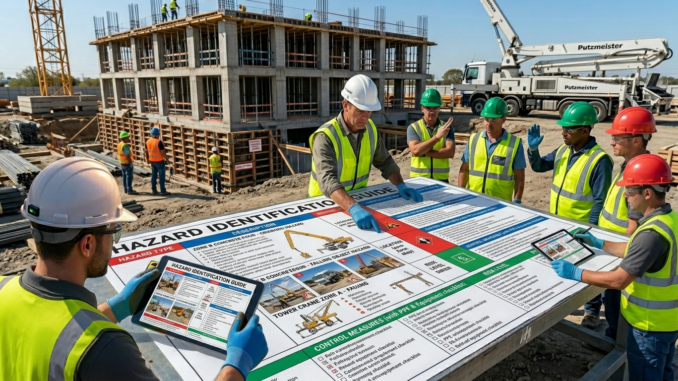
Welcome to our highly specific safety protocol document. Specifically, executing structural base operations safely requires targeted planning. Therefore, this document provides the exact Hazard Identification & Risk Assessment (HIRA) for Rebar Fixing & Assembly Work. Consequently, site managers actively use this framework to pinpoint structural dangers before they cause harm on the work site.
Furthermore, this assessment outlines the exact control measures you need to prevent severe injuries. For additional regulatory context, please visit the OSHA Construction Standards outbound link, or explore our Internal Scaffolding Protocols for related internal site rules.
Safety Index
-
Initial Project Baseline Data
-
Phase 1: ATA Setup for Rebar Fixing & Assembly Work
-
Phase 2: Equipment Mobilization and Positioning
-
Phase 3: Core Hazards in Rebar Fixing & Assembly Work
-
Phase 4: Working at Heights During Assembly
-
Phase 5: Site Housekeeping and ATA Closure
-
Phase 6: Mandatory PPE for Rebar Fixing & Assembly Work
Initial Project Baseline Data
To begin with, we must establish the core baseline for this specific project. This precise Risk Assessment targets the exact physical tasks involved in constructing heavy steel frameworks. Ultimately, understanding these variables ensures the Hazard Identification & Risk Assessment (HIRA) for Rebar Fixing & Assembly Work functions correctly.
HAZARD IDENTIFICATION & RISK ASSESSMENT
| Operating Area | 5-STAR SAFETY | Project Name | Terminal Compound |
| Contractors | Base Project | Project Type | HVDC |
| Task/Activity | Rebar Fixing & Assembly Work | Department | SE Division |
Phase 1: ATA Setup for Rebar Fixing & Assembly Work
Initially, managing administrative controls actively prevents unauthorized personnel from entering dangerous zones. Moreover, you must acquire the proper ATA (Authorization to Act) before starting any structural tasks related to Rebar Fixing & Assembly Work.
| Work Activity | Hazards | Risk Issue | Existing Controls | Risk Rating (C/L/R) |
| 1. Obtain ATA (Authorization to Act) | Unauthorized work to be performed within a defined location. | Accident resulting in serious injury or death. |
• First, you must obtain the ATA as a pre-requisite.
• Furthermore, supervisors must not start work until they have the approved ATA and finish the Toolbox meeting.
• Consequently, the Manager must train the ATA Receiver.
• Keep a Safe Distance from overhead lines (6.5m) and underground energized lines. |
3 / 2 / 6 |
| Uncontrolled personnel entering restricted location. | Loss of production, property damage. |
• Specifically, supervisors must display the ATA at the worksite.
• The ATA Receiver must never leave the active area.
• Finally, the Receiver and Issuer must visit the site together to identify hazards adequately. |
3 / 2 / 6 |
Phase 2: Equipment Mobilization and Positioning
Subsequently, bringing heavy machinery to the assembly area introduces massive mechanical risks. Therefore, supervisors must inspect all hauling equipment constantly. This step remains vital for the Hazard Identification & Risk Assessment (HIRA) for Rebar Fixing & Assembly Work.
| Work Activity | Hazards | Risk Issue | Existing Controls | Risk Rating (C/L/R) |
| 2. Mobilization of hauling equipment | Construction equipment malfunctioning. | Accident result in physical injury or death. |
• First, operators must ensure Heavy Equipment holds a valid third-party inspection certification (TUV).
• Next, maintenance teams must conduct monthly inspections and apply color coding.
• Furthermore, you must mount a 20 lbs fire extinguisher on the unit. |
4 / 2 / 8 |
| Reversing trailer and crane without spotter. | May collide resulting in property damage. | • Consequently, site managers must provide an equipment spotter wearing an orange highly reflective vest. | 3 / 2 / 6 | |
| 3. Positioning of equipment | Property damage of adjacent structure. | Injuries to operator or personnel. |
• Therefore, foremen must designate a safe location for unloading materials.
• Provide a trained flagman utilizing Red and Green flags.
• Ultimately, strictly enforce the “No flagman, no movement” policy. |
4 / 2 / 8 |
Phase 3: Core Hazards in Rebar Fixing & Assembly Work
The most critical phase involves the manual manipulation of heavy steel. Consequently, dangers peak during this stage. Workers face severe ergonomic strains and mechanical dangers while performing Rebar Fixing & Assembly Work.
| Work Activity | Hazards | Risk Issue | Existing Controls | Risk Rating (C/L/R) |
| 4. Rebar Fixing and assembly | The workers working on an incomplete scaffolding platform. | Steel fixer may slip and fall resulting in serious injury. |
• First, erectors must build the scaffolding platform with complete components (railings, bracing, boards).
• Next, the scaffolding supervisor must perform a rigorous inspection.
• Furthermore, all personnel must pass working at height training before climbing. |
4 / 3 / 12 |
| The machine (Rebar cutter and bender) has no Emergency Stop button. | Personnel may entangled once machine jerks. |
• Specifically, mechanics must inspect all machines periodically.
• Test Emergency Stop buttons (Red color) to ensure they work properly with covers.
• Consequently, supervisors must prohibit loose clothing for all machine operators. |
3 / 3 / 9 | |
| Awkward posture and bending during manual handling of long steel rebar. | Musculoskeletal disorder, muscle strain, lower back pain. |
• First, workers must avoid awkward postures when laying and fixing steel rebar.
• Furthermore, foremen must implement reshuffling and regular job rotation.
• Next, safety officers must provide ergonomic training sessions to all personnel.
• Finally, assign only skilled workers for heavy lifting tasks. |
3 / 3 / 9 |
Phase 4: Working at Heights During Assembly
In addition, assembly often requires reaching elevated structures. Consequently, working at heights amplifies the danger significantly. Site teams must actively manage fall risks as directed by this Hazard Identification & Risk Assessment (HIRA) for Rebar Fixing & Assembly Work.
| Work Activity | Hazards | Risk Issue | Existing Controls | Risk Rating (C/L/R) |
| 5. Working at height (above 1.8m) | Workers have no personal fall arrest system. | Slip and fall resulting in fatality. |
• First, the storekeeper must strictly issue personal fall arrest systems.
• Next, supervisors must ensure all workers wear their respective systems correctly.
• Furthermore, safety teams must periodically replace all defective systems. |
3 / 3 / 9 |
| Personnel has no walkway on top of the reinforcement steel rebar matting. | Slip and fall into the rebar gap. |
• Therefore, carpenters must provide wooden walkways on top of the rebar matting.
• Specifically, tie-off walkways properly to handle two-way traffic safely.
• Finally, the supervisor must guarantee daily walkway maintenance. |
2 / 3 / 6 | |
| 6. Workplace inspection for working at height | Handling of scaffold standards & loose tools. | Fall of materials causing injury. |
• First, workers must use pull bags when hoisting materials upward.
• Next, supervisors must ensure no personnel stand below lowering pipes.
• Furthermore, workers must tie off all tools to their belts. |
4 / 3 / 12 |
Phase 5: Site Housekeeping and ATA Closure
Furthermore, maintaining a spotless worksite actively stops accidents. Loose metal offcuts create dangerous trip hazards. Therefore, daily cleaning remains essential.
| Work Activity | Hazards | Risk Issue | Existing Controls | Risk Rating (C/L/R) |
| 7. Housekeeping, clearing the area | Protruding objects / materials at the site. | Accident resulting injury to worker. |
• First, teams must conduct daily housekeeping routines.
• Next, workers must remove all unwanted protruding materials at the site immediately.
• Furthermore, logistics teams must provide waste skips in strategic locations. |
3 / 2 / 6 |
| 8. Closing of ATA (Authorization to Act) | Unsecured electrical equipment. | Property and appurtenances damage. |
• First, the ATA Receiver must verify housekeeping finishes completely.
• Next, electricians must close and padlock all electrical distribution boards. |
3 / 2 / 6 |
| Unaccounted workers. | Accident resulting serious injury. |
• Furthermore, the ATA Receiver must account for all workers under the active ATA.
• Finally, supervisors must ensure all personnel sign out on the attendance sheet before leaving. |
3 / 2 / 6 |
Phase 6: Mandatory PPE for Rebar Fixing & Assembly Work
Above all, Personal Protective Equipment acts as your final defense against physical trauma. In fact, managers must demand absolute compliance with these gear standards during all Rebar Fixing & Assembly Work. For more equipment details, explore our Safety Gear Inventory.
| Work Activity | Hazards | Risk Issue | Existing Controls | Risk Rating (C/L/R) |
| 9. Required and Usage of PPEs | Hit against, Falling material, Sharp objects, Penetration. | Headaches, Injury, Fatality, lacerations. |
• First, procurement must provide standard PPEs: Hardhat-Class G Type-I, Safety shoe with Steel Toe, Safety spectacle, and Leather Gloves.
• Furthermore, provide Dust Masks and Disposable Corded earplugs to all active workers.
• Next, safety officers must conduct a PPE matrix for each distinct activity.
• Consequently, trainers must educate workers on using hard hats properly.
• Ultimately, supervisors must check that employees fix their hard hats tightly.
• Finally, workers must return defective items to the storekeeper immediately. |
3 / 2 / 6 |
Be the first to comment