
First Aid: Definition
is the immediate support or treatment provided to injured or suddenly taken ill by doctor or other qualified person, before the arrival of an ambulance.
Approach to a Conscious Causality
- Re assure
- Head to toe survey
- First Aid to the specific injury
- Move to secured place
What to find out?
- Deformities
- Open Injuries
- Tender
- Swell
Principles of First Aid
DRABC (danger, response, airway, breathing, circulation)
D: danger
R: response
A: airway
B: breathing
C: circulation (incase no breathing)
Tongue blocks the airway, when the person is unconscious.
Airway:
- Check
- open the airway
- title head and lift chin
Breathing:
- Check the breathing by Look, Listen and Feel
- Look for the rise and fall of the chest
- Listen to the sound of breath at nose and mouth
- Feel the warm breath on your cheeks
First Aid: Cardio Pulmonary Resuscitation (CPR)
Definition
Use of artificial breathing (mouth-to- mouth breathing) and external heart compression (rhythmic pressure on the breast bone) on an unconscious causality with no breathing and no circulation
Approach to CPR
Check response by shake, shout and pinch
Provide artificial breathing
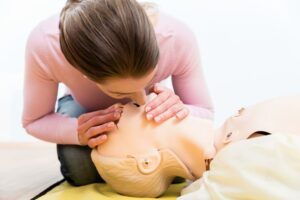
- Hold his/her chin and lift it up
- Keep his/her mouth open by your thumb
- Place hand on his/her forehead, pinch his/her nose with index finger and thumb
- Take a breath, seal his/her open mouth with your mouth
- Blow into his/her mouth for one second
Provide Artificial Circulation

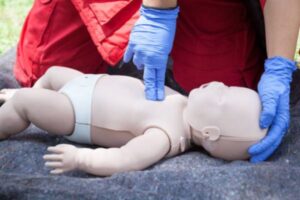
CPR for infant under 12 months
1. Assess the Situation
Ensure safety: is area secure for entrance
Check for response: check needy respond
Call medical help: call ambulance
2. Open airway
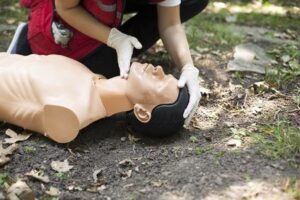
Head tilt chin Lift: Hold his/her chin and lift it up
Check breath: look listen and feel
Position: on a firm surface
Hand placement: place your two fingers on lower half of breastbone
Compression depth: push your hand down straight about 1/3 of its depth
Compression Rate: 100 to 120 compressions/minute
Continue Compression: until medical team arrives or shows recovery
CPR for Adults
1. Assess the Situation
Ensure safety: is area secure for entrance
Check for response: check needy person respond
Call medical help: call ambulance
2. Open airway
Head tilt chin Lift: Hold his/her chin and lift it up
Check breath: look listen and feel
Position: on a firm surface
Hand placement: place your palm on lower half of breastbone
Compression depth: push your hand down straight about 2 inches
Compression Rate: 100 to 120 compressions/minute
Continue Compression: until medical team arrives or shows recovery
Continue with cycles of 30 chest compressions and 2 rescue breaths until emergency help arrives or the person begins to breathe normally
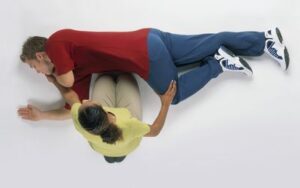
Recovery Position
Termination of CPR
Under normal circumstances CPR may be terminated under four circumstances:
- The victim is revived.
- A more qualified person takes over.
- The person performing CPR becomes exhausted.
- A doctor pronounces the victim is dead.
First Aid: Heat Exhaustion
Heat exhaustion can occur after long term exposure to high temperature & high humidity
Sign and Symptoms
- slightly above normal
- Pale skin
- sweat
- Tired
- Dizzy
- Headache
- Nausea
- Muscle cramps
- Vomit
- Faint
First Aid treatment
- Loose or remove clothes
- cool down by using a cold-water spray
- apply a cool, wet clothes on skin
- Have a cool shower
- apply crushed ice in a towel on the neck
- Drink water.
First Aid: Heat Stroke
- Heatstroke is life-threaten Situation
- It is a disturbance in body’s heat regulating system
- due to exposure to heat, from an inability of the body to cool itself
Sign and symptoms
- Extremely high body temperature (often 105.F/41 or 42C or higher).
- Red, hot, and dry skin. Sweating usually absent
- Rapid and strong pulse
- Possible unconsciousness or confusion
- Death
First aid of heat Stroke
- Apply rapid cooling method based on resources
- Apply cold, wet clothes to skin
- Apply ice packs and provide fan
- Take a cold shower
Frost bite
Cold injury when body tissue freezes
Sign and symptoms:
- At first pins and needles
- Pallor, followed by numbness
- Hardening and stiffness of the skin
Symptoms of frostbite include:
- Numbness
- Tingling
- color of affected skin indicates how serious frostbite is
- Cold, hard, waxy-looking skin
- Clumsiness due to joint stiffness
- Pain
- Blistering after rewarming
First aid of frostbite
For first aid of frostbite, move the person to a warm place, gently remove wet clothing, and rewarm the affected area using warm water (not hot) or body heat, avoiding rubbing or breaking blisters, and seek medical attention.
Building a Workplace First Aid Response
An effective workplace first-aid response depends on more than a stocked kit: it requires trained first-aiders present during working hours, a clear reporting chain so an injured worker’s status reaches the right people quickly, and periodic review of near-miss and injury data to identify recurring hazards before they cause a more serious incident.
Recognizing When to Escalate
Not every injury can or should be managed with workplace first aid alone. Workers and first-aiders should be trained to recognize red-flag signs — heavy or uncontrolled bleeding, loss of consciousness, difficulty breathing, suspected fracture or spinal injury, chemical exposure to eyes or skin — that require calling emergency services immediately rather than attempting to manage the situation on site. First aid buys time; it is not a substitute for professional medical care in a serious incident.
Related Guides
- JSA: Sand Blasting Operation Safety
- Piling Operations and Cofferdams Safety Officer Test Prep
- Machine Guarding Safety Officer Test Preparation Guide 2026
- Confined Space safety: A Serious Concern
- Grinding and Welding Risk Assessment: Safety Checklist

Be the first to comment