Risk Assessment: Plumbing Activity
First, integrating a comprehensive plumbing activity risk assessment into your daily operations is absolutely vital for maintaining a secure construction environment. Furthermore, executing standardized, safe plumbing operations actively mitigates severe workplace hazards. Therefore, safety engineers and site managers must deploy this plumbing activity risk assessment rigorously to prevent accidents and costly damages completely.
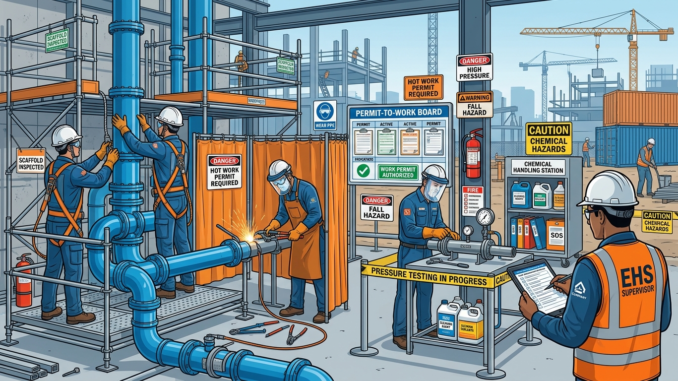
Next, this detailed plumbing activity risk assessment guide systematically outlines essential hazard identification and control strategies. Specifically, it thoroughly addresses critical areas such as material handling, electrical risks, and safe work at heights. Moreover, you can explore our internal guide on Comprehensive EHS Site Audits for additional safety compliance frameworks. Additionally, immediately check the latest industry guidelines at the OSHA Construction Industry Standards to ensure your site maintains full regulatory compliance.
Finally, strictly enforce these established controls to comprehensively protect your workforce on the ground. Consequently, proactive risk management through a structured plumbing activity risk assessment guarantees smoother project execution. Based on common search intent, we have also included critical guidelines for pressure testing and solvent handling, which users frequently seek when completing a plumbing activity risk assessment. Let us review the primary safety checklist below.
Core Components of a Plumbing Activity Risk Assessment
1. Obtain Permit to Work for Plumbing Activity Risk Assessment
| Hazards | Risks Issue | Existing Controls Checklist | Risk Reduction Action Plan |
|
Unauthorized work to be performed within a defined location and boundary . Uncontrolled personnel entering a restricted location . Unidentified hazards with unplanned safety mitigating measures . Inadequate coordination and area control protocol.
|
Accident resulting serious injury or death to worker . Significant property and appurtenances damage . Loss of production Significant cost due to damages . Governmental violation . Environmental complaint. |
First, obtain the Permit to Work as a prerequisite to perform work . • Furthermore, verify the approved Permit to Work is available at site and ensure you conduct a Safety Toolbox meeting before starting . • Next, implement a safe work practice immediately to reduce the possibilities of an accident or incident . • Additionally, mandate that the Permit Receiver and Permit Issuer visit the site together to adequately identify workplace hazards and establish mitigating measures . • Moreover, display the Permit to Work clearly at the worksite . • Consequently, require that the Permit Receiver shall not leave the area for the whole duration of work . • Lastly, halt all work strictly without the presence of an approved Permit to Work with the Permit Receiver overseeing the activity. |
• Firstly, designate a Permit Receiver competent enough to take responsibility in securing the Permit to Work . • Subsequently, authorize and train the Permit Receiver through the Manager to receive a Permit to Work . • Furthermore, assign the Permit Receiver the responsibility to oversee the safety of all workers under his Permit to Work . • Moreover, command the Manager, Supervisor, Foreman, and all workers to adhere to all requirements set forth in the Permit to Work, Risk Assessment, Method Statement, Job Safety Procedure, and other safety practices . • Finally, require all workers to attend the daily toolbox meeting and mandate they sign the attendance sheet attached to the specific Permit to Work.
|
2. Material Handling in Plumbing Activity Risk Assessment
| Hazards | Risks Issue | Existing Controls Checklist | Risk Reduction Action Plan |
|
Manual handling injuries.
|
Strain or sprain injuries . Shoulder dislocation from lifting heavy pipes overhead . Chronic musculoskeletal disorders from repetitive manual handling.
|
• First, provide manual handling training to all workers emphasizing correct lifting techniques, such as bending knees and keeping the back straight . • Next, utilize mechanical aids like forklifts, trolleys, or hoists for transporting heavy or awkward materials to minimize physical strain . • Additionally, assess the weight and center of gravity before lifting to plan the safest handling method .
• Furthermore, designate clear walking paths strictly free of trip hazards to allow safe, uninterrupted movement .
• Finally, limit manual lifts to below 23 kg per person unless mechanical or team lifting is actively used.
|
• Firstly, rotate workers on lifting tasks frequently to reduce the risk of overuse injuries and fatigue . • Moreover, encourage workers aggressively to report early symptoms of musculoskeletal disorders so interventions can happen early . • Additionally, provide PPE like back support belts when lifting heavy loads manually . • Consequently, compel supervisors to monitor manual handling activities daily and intervene immediately if unsafe practices are observed.
|
3. Slips, Trips, and Falls Prevention
| Hazards | Risks Issue | Existing Controls Checklist | Risk Reduction Action Plan |
|
Slipping on wet or oily floors .
Tripping over loose pipes.
|
Twisting an ankle on uneven surfaces.
|
• Initially, keep all floors and walkways clean, dry, and free from obstructions to actively prevent slipping accidents . • Next, mark all trip hazards clearly using warning signs or barriers . • Furthermore, store tools and materials properly after use and never leave them lying around walkways . • Additionally, inspect the site daily for housekeeping issues and correct hazards immediately . • Finally, secure cables, hoses, and pipes properly so they do not cross walkways.
|
• First, apply anti-slip coatings or mats on slippery surfaces, especially in wet or oily areas .
• Moreover, conduct regular safety walks by supervisors to proactively identify and fix slip and trip risks .
• Lastly, install guardrails and toe boards securely near elevated work areas and open edges.
|
4. Cuts from Sharp Edges Mitigation
| Hazards | Risks Issue | Existing Controls Checklist | Risk Reduction Action Plan |
|
Puncture wounds from broken or cracked fittings . Infection risk from dirty equipment.
|
Finger or palm injuries.
|
• First, mandate wearing cut-resistant gloves when handling sharp materials like metal pipes and fittings . • Next, inspect materials thoroughly upon delivery for sharp burrs, cracks, or jagged edges and report defects immediately . • Furthermore, provide reliable edge protection or covers on sharp parts when transporting or storing . • Additionally, train workers comprehensively on the safe handling of sharp-edged tools and materials . • Finally, ensure that workers work slowly and deliberately around sharp edges to avoid sudden injuries.
|
• Firstly, provide immediate first aid facilities strategically to treat cuts or punctures . • Moreover, label areas or items with sharp edges clearly using signs or colored tape .
• Lastly, authorize only trained personnel to perform cutting tasks using appropriate PPE.
|
5. Fire Hazard Management
| Hazards | Risks Issue | Existing Controls Checklist | Risk Reduction Action Plan |
|
Fire outbreak from ignition of stored materials.
|
Burns .
Explosion . Property damage . Personal injury.
|
• First, store flammable materials strictly in designated, well-ventilated areas far from ignition sources . • Next, post clear ‘No Smoking’ and ‘Flammable Material’ signs aggressively around storage zones . • Furthermore, keep fire extinguishers readily available at multiple points around the laydown and site areas . • Additionally, assign a trained fire watcher during any hot work near flammable materials . • Moreover, obtain hot work permits prior to any operation involving heat or sparks . • Finally, keep storage areas systematically clean, removing combustible debris regularly. |
• Initially, inspect fire extinguishers and fire-fighting systems monthly to rigidly ensure readiness .
• Furthermore, utilize only explosion-proof equipment near flammable storage areas . • Lastly, train workers extensively in the location and correct use of firefighting equipment.
|
6. Poor Stacking Causing Collapse
| Hazards | Risks Issue | Existing Controls Checklist | Risk Reduction Action Plan |
|
Poor Stacking Causing Collapse.
|
Falling material injuring workers . Crushing injuries .
Damage to pipes causing leaks.
|
• First, stack materials securely on firm, level ground to completely prevent leaning or collapse .
• Next, utilize pallets, shelves, or frames specifically designed to hold plumbing materials .
• Additionally, ensure heavier materials are always placed at the bottom and lighter items securely on top .
• Moreover, inspect stacks strictly daily for any signs of shifting or instability .
• Furthermore, keep a definitively safe distance between stacked materials and active walkways . • Finally, designate stacking zones completely away from overhead hazards.
|
• Firstly, train workers systematically in safe stacking and unstacking procedures . • Next, restrict stack heights tightly according to material type and site guidelines .
• Lastly, utilize clear signage to visibly mark maximum stacking heights and rules at the site.
|
7. Pipe Cutting and Preparation Safety
| Hazards | Risks Issue | Existing Controls Checklist | Risk Reduction Action Plan |
|
Sharp Tool Injuries.
|
Personal injury .
Infection from open wounds .
Permanent disability.
|
• Initially, use only sharp, well-maintained tools to aggressively reduce the risk of slips during cutting .
• Next, mandate wearing cut-resistant gloves at all times when actively handling cutting tools .
• Furthermore, inspect tools rigorously daily before starting work to check for defects or damage . • Additionally, enforce a strict prohibition on using damaged or makeshift cutting tools . • Finally, assign only comprehensively trained and certified workers for cutting operations.
|
• First, provide fully stocked first aid kits close to cutting stations for immediate treatment of minor injuries .
• Moreover, train all workers continuously in safe cutting techniques and precise tool handling .
• Lastly, conduct regular, standardized training for all workers.
|
8. Sparks from Cutting Tools
| Hazards | Risks Issue | Existing Controls Checklist | Risk Reduction Action Plan |
|
Sparks from Cutting Tools.
|
Fire .
Eye injury from flying sparks .
Burns on exposed skin .
Property damage from fire.
|
• First, keep an ABC fire extinguisher permanently within immediate reach of the cutting zone . • Next, obtain a documented Hot Work Permit before starting any spark-producing activity . • Furthermore, assign a trained fire watcher actively during cutting and for 30 minutes after cutting ends . • Additionally, set up spark barriers or fire blankets to strictly confine sparks to the work area .
• Moreover, remove all flammable materials systematically within a 15-meter radius before starting cutting . • Finally, wear flame-retardant clothing comprehensively to protect against accidental spark burns.
|
• Initially, verify that fire alarm and emergency shutdown systems are fully functional before work starts . • Next, guarantee that a trained fire watcher must be assigned continuously during and for 30 minutes after welding . • Lastly, install fire-resistant curtains or welding screens securely around the work zone.
|
9. Damaged Power Cords and Electrical Safety
| Hazards | Risks Issue | Existing Controls Checklist | Risk Reduction Action Plan |
|
Damage Power Cord/poor electrical connection.
|
Electrocution .
Severe burns .
Secondary injuries from shock (cuts, fractures).
|
• First, operate only double-insulated or properly grounded electrical tools on site .
• Next, inspect cords and plugs meticulously for damage before every use .
• Furthermore, provide functional GFCI (Ground Fault Circuit Interrupters) protection for temporary power supplies .
• Additionally, guarantee equipment is safely switched off before plugging or unplugging .
• Moreover, prohibit strictly the use of electrical equipment in wet or damp conditions unless correctly rated for it .
• Finally, position highly visible signage warning of electrical hazards.
|
• Firstly, train workers thoroughly on precise electric shock first aid procedures .
• Lastly, securely tag any faulty equipment immediately and clearly report it.
|
10. Poor Ventilation Fumes Control
| Hazards | Risks Issue | Existing Controls Checklist | Risk Reduction Action Plan |
|
Poor Ventilation Fumes.
|
Inhalation of toxic gases .
Respiratory diseases .
Long-term lung damage.
|
• Initially, deploy mechanical ventilation systems like fume extractors directly at cutting points .
• Furthermore, mandate that workers wear appropriate respiratory protection, such as half-mask or full-face respirators .
• Additionally, prohibit cutting indoors completely unless adequate ventilation is verified .
• Moreover, shut down cutting operations instantly if oxygen levels fall below safe limits .
• Next, install high-capacity fans to ensure a constant fresh air supply .
• Finally, train workers aggressively on the signs of fume inhalation, such as dizziness or nausea.
|
• Firstly, consistently keep MSDS (Material Safety Data Sheets) available for quick reference regarding the materials being cut.
|
11. Eye Injuries from Debris
| Hazards | Risks Issue | Existing Controls Checklist | Risk Reduction Action Plan |
|
Eye Injuries from Debris.
|
Penetration injury to the eye .
Permanent blindness .
Eye infections.
|
• First, strictly enforce the mandatory use of safety goggles or face shields effectively rated for impact resistance .
• Next, position cutting tools deliberately away from the body and face direction .
• Furthermore, limit cutting speed mechanically to actively reduce the amount of airborne debris .
• Additionally, guarantee dust extraction systems are fully operational when cutting produces fine particles .
• Finally, mandate regular cleaning and structured replacement of protective eyewear.
|
• First, confirm workers are extensively trained on how to wear and adjust eye protection correctly .
• Moreover, restrict unauthorized personnel completely from entering the cutting area .
• Lastly, sustain clear vision zones with proper lighting to easily spot flying debris.
|
12. Installation of Pipes and Fixtures at Heights
| Hazards | Risks Issue | Existing Controls Checklist | Risk Reduction Action Plan |
|
Installation of Pipes and Fixtures.
|
Head injuries from falling .
Broken bones (arms, legs) .
Fatalities from severe falls.
|
• First, compel workers to wear full-body harnesses connected tightly to certified anchor points when working above 1.8 meters . • Next, insist that scaffolding must be erected and comprehensively inspected by a certified scaffolding inspector before use . • Furthermore, verify ladders must be secured at both the top and bottom and extend at least 1 meter above landing points . • Additionally, require workers to maintain three points of contact when utilizing ladders at all times . • Moreover, conduct documented daily inspections for all ladders, scaffolds, and work platforms . • Consequently, restrict access securely to elevated work areas to authorized personnel only . • Finally, deploy clear warning signage entirely around elevated work zones.
|
• Firstly, execute toolbox talks daily to reinforce safe work at heights practices aggressively .
• Lastly, ensure emergency rescue plans strictly must be in place and rehearsed in case of fall incidents.
|
13. Tool Drop from Height
| Hazards | Risks Issue | Existing Controls Checklist | Risk Reduction Action Plan |
|
Tool Drop from Height.
|
Skull fractures .
Eye injuries .
Equipment damage .
Foot injuries.
|
• First, anchor all hand tools securely with lanyards when working at height . • Next, install sturdy toe boards and mesh guards on scaffolds and work platforms to catch falling items . • Furthermore, barricade and prominently mark danger zones below elevated work areas clearly . • Additionally, enforce that workers below must wear hard hats at all times in active areas . • Moreover, stipulate that only essential personnel should be allowed under work-at-height zones . • Consequently, mandate tool belts and toolboxes must be used to safely organize and carry tools . • Finally, perform regular, rigorous checks to ensure tools are properly tied off and safety nets must be installed under high-risk elevated work areas.
|
• First, conduct meticulous visual inspections before starting work to completely ensure there is no risk of tool drop .
• Lastly, maintain unbroken communication between workers above and below to correctly warn about tool handling activities.
|
14. Strain from Awkward Postures and Ergonomics
| Hazards | Risks Issue | Existing Controls Checklist | Risk Reduction Action Plan |
|
Strain from Awkward Postures (Ergonomic Injuries).
|
Chronic back pain .
Shoulder dislocation .
Knee injuries .
Muscle tears.
|
• Initially, rotate tasks frequently to definitively avoid overuse of the same muscle groups . • Next, deploy adjustable scaffolding or platforms to reliably bring work to waist height when possible . • Furthermore, provide effective mechanical aids such as lifting equipment and pipe rollers . • Additionally, train workers comprehensively in safe lifting techniques and body mechanics . • Moreover, equip teams with tools containing ergonomic grips and designs to structurally reduce hand strain . • Finally, encourage workers strongly to take micro-breaks during prolonged tasks.
|
• First, conduct thorough ergonomic assessments for high-risk tasks and redesign operations if needed .
• Lastly, establish a mandate to report early signs of musculoskeletal discomfort for timely, effective intervention.
|
15. Fire Risk from Welding and Brazing Joints
| Hazards | Risks Issue | Existing Controls Checklist | Risk Reduction Action Plan |
|
Fire Risk from Welding/Brazing Joints.
|
Explosions . Burns . Smoke inhalation . Equipment damage . Personal injury . Property damage.
|
• First, issue official hot work permits before any welding or brazing activity starts . • Next, station a comprehensively trained fire watcher during and for 30 minutes after welding . • Furthermore, clear flammable materials completely from the area or shield them effectively with fire-resistant blankets . • Additionally, mount welding curtains to strongly protect adjacent areas from sparks and UV radiation . • Moreover, secure gas cylinders upright and completely away from hot work areas . • Finally, compel workers strictly to wear flame-retardant clothing, welding helmets, and gloves. |
• First, inspect all hot work equipment diligently daily for leaks, wear, or defects . • Furthermore, install adequate ventilation or extraction directly to remove fumes and smoke . • Lastly, place correctly rated fire extinguishers (suitable for electrical and flammable materials) securely within 3 meters.
|
16. Site Housekeeping and Material Storage
| Hazards | Risks Issue | Existing Controls Checklist | Risk Reduction Action Plan |
|
Housekeeping, clearing the area with all used materials, tools and equipment . Materials lying on the ground . Protruding object/materials at the site .
Uncollected/scattered rubbish.
|
Manual handling can lead to musculoskeletal disorder . Fire . Property damage .
Accident resulting injury to worker.
|
• First, facilitate extensive training focused on manual handling . • Next, enforce strictly observing proper posture during manual lifting, pushing, or pulling .
• Furthermore, provide designated storage boxes exclusively for cables . • Additionally, remove all unwanted or protruding materials and objects constantly from the site .
• Moreover, ensure the provision of waste skips directly in strategic locations at the site with clear marking .
• Consequently, distribute color-coded waste bins visibly at the site . • Finally, guarantee the reliable provision of standby fire extinguishers and execute periodical inspection and color coding for them.
|
• Firstly, execute accurate labeling of storage boxes (e.g., good items, scrap/damage items, by capacity) . • Next, order immediate disposal or send the damaged ones directly to the store keeper . • Furthermore, conduct a precise daily inventory of the equipment . • Additionally, establish continuously good housekeeping uniformly at the site . • Moreover, mandate an informative daily toolbox meeting .
• Consequently, deliver clear training and awareness strongly regarding the segregation of waste . • Finally, update strict records and registries daily for the quantity of waste disposed and fire extinguisher conditions.
|
17. Closing of Permit to Work and Final Walkthrough
| Hazards | Risks Issue | Existing Controls Checklist | Risk Reduction Action Plan |
|
Poor housekeeping . Undisposed waste materials.
|
Significant property and appurtenances damage . Governmental violation . Environmental complaint .
Loss of production . Accident resulting serious injury or death to worker .
Significant cost due to damages.
|
• First, direct the Permit Receiver precisely to ensure that housekeeping is done before, during, and after the work . • Next, dispose of all waste materials generated from the work properly and verify they shall not be left unattended at the worksite . • Furthermore, park mobile equipment properly and strictly on a designated equipment laydown .
• Additionally, store all materials used at the site such as chemicals, flammable, and combustible materials firmly at the designated storage at the end of each day .
• Finally, secure electrical equipment properly, ensuring the distribution board is closed and padlocked securely.
|
• First, demand that the Permit Receiver shall account for all workers under his Permit to Work and ensure all have signed out on the attendance sheet and are entirely clear of the area . • Furthermore, require the Supervising Engineer and Foreman to adhere strictly to the proper housekeeping and storage of materials at the designated location . • Additionally, assign the Site Manager firmly to be responsible for the effective implementation of the Permit to Work . • Lastly, compel the Permit Issuer specifically to visit the work location to completely verify good housekeeping was conducted before closing the Permit to Work.
|
18. Site Communication and Personnel Tracking
| Hazards | Risks Issue | Existing Controls Checklist | Risk Reduction Action Plan |
|
Unaccounted workers .
Inadequate communication.
|
Governmental violation . Loss of production . Accident resulting serious injury or death to worker . Significant property and appurtenances damage . Significant cost due to damages.
|
• First, mobilize site security personnel and guards adequately . • Next, implement a rigid log-in and out protocol, establishing that a log book must be provided and always available . • Furthermore, ensure tight coordination happens between HR and PMT for new workers, guaranteeing induction should be provided . • Finally, execute regular coordination meetings strictly for streamlined communication.
|
• Firstly, orchestrate TBTs robustly for all the workers supported by proper monitoring . • Next, facilitate targeted training exclusively for the security guard pertaining to log-in and out procedures . • Additionally, decree that the Site Manager shall be responsible completely for the effective implementation of the log-in/log-out system .
• Lastly, practice constant, proactive communication seamlessly between PMT.
|
19. Chemical Management and Equipment Security
| Hazards | Risks Issue | Existing Controls Checklist | Risk Reduction Action Plan |
|
Poor storage of chemical, flammable and combustible materials .
Unattended unsafe condition .
Unsecured electrical equipment, energized equipment.
|
Significant property and appurtenances damage .
Governmental violation . Environmental complaint . Loss of production .
Accident resulting serious injury or death to worker . Significant cost due to damages.
|
• First, force the Permit Receiver strictly to ensure that proper storage of chemicals is done before, during, and after the work . • Next, post critical Safety Information prominently regarding how to handle chemical materials .
• Furthermore, enforce that all materials used at the site such as chemicals, flammable, and combustible materials shall be stored safely at the designated storage at the end of each day . • Additionally, require the safety rep directly to identify and rectify all unsafe conditions right away . • Moreover, mark any area specifically containing unattended unsafe conditions . • Finally, verify that electrical equipment shall be properly secured, with the distribution board completely closed and padlocked.
|
• First, mandate the site strictly must have a chemical holder with proper training . • Next, ensure the SDS emphatically must be available on hand . • Furthermore, establish unyielding supervision and monitoring by the supervisor . • Additionally, conduct a TBT decisively where all pending, unsafe conditions must be openly discussed . • Moreover, task the Supervising Engineer and Foreman actively to adhere to the proper rectification of open observations . • Consequently, assign the Site Manager strictly to be responsible for the effective implementation . • Furthermore, establish definitively that the LOTO procedure should be available and implemented properly . • Additionally, deploy a structured monthly inspection and color code protocol . • Lastly, update the electrical equipment checklist and registry continuously.
|
20. Pressure Testing Safety (Search Intent Addition)
| Hazards | Risks Issue | Existing Controls Checklist | Risk Reduction Action Plan |
|
High-pressure pipe blowouts. Uncontrolled water release. |
Severe impact injuries. Water damage to surrounding structures. |
• First, enforce strict exclusion zones around any piping undergoing pressure or hydro-testing.
• Next, verify all fittings and joints are properly secured before introducing testing media.
• Furthermore, utilize properly calibrated pressure gauges to monitor thresholds accurately. |
• Firstly, establish an emergency depressurization protocol before testing begins.
• Lastly, ensure all workers involved wear high-impact face shields and protective aprons. |
21. Hazardous Solvents and Glues (Search Intent Addition)
| Hazards | Risks Issue | Existing Controls Checklist | Risk Reduction Action Plan |
|
Exposure to toxic PVC/CPVC cement fumes. Chemical contact with skin. |
Chemical burns. Acute respiratory distress. |
• First, require workers to apply solvents only in well-ventilated spaces or with forced air extraction.
• Next, mandate the use of chemical-resistant nitrile gloves during all gluing operations.
• Furthermore, keep all solvent containers tightly sealed immediately after use to prevent vapor release. |
• Firstly, provide portable eye-wash stations adjacent to any solvent application zone.
• Lastly, maintain strict inventory controls for all hazardous adhesives used on site. |
Be the first to comment