Introduction of Electronic Permit to Work System
Table of Contents
- Introduction to e-PTW Governance
- Job Hazard Analysis (JHA) in the Electronic Permit to Work System
- Core Personnel Roles and Responsibilities
- Work Permit Classifications and Validities
- Supplementary Certificates Integration
- De-isolation Procedures
- Permit Suspension, Handover, and Closure
- Monitoring and System Audits
1. Introduction to e-PTW Governance
The fundamental objective of the Permit to Work (PTW) Governance Procedure is to ensure that work carried out under work permits is properly planned, controlled, coordinated, communicated, safely executed, and recorded. Implementing a highly reliable electronic permit to work system is the definitive means of providing formal approval and authorization through an electronic process for personnel to carry out such work safely.
Work must only be executed if it has been planned and agreed upon 24 hours in advance. The only exception is breakdown nature or priority unplanned work requiring immediate action. For broader workplace safety frameworks, ensure compliance with international directives such as the OSHA Safety Management Guidelines.
2. Job Hazard Analysis (JHA) in the Electronic Permit to Work System
Hazard identification is a non-negotiable prerequisite in any electronic permit to work system. It is mandatory to attach a JHA to each permit application.
- Level 1 JHA: This assessment applies to tasks where the assessed risk level is low. The Permit Applicant (PAP) carries out this JHA without requiring additional personnel. It must be validated by the appropriate supervisory level prior to e-PTW authorization.
- Level 2 JHA: This is required for higher-risk work activities that are complex or involve multiple trades. It requires a team of at least three members properly trained in the JHA process. The Permit Authority (PA) must revalidate a Level 2 JHA.
3. Core Personnel Roles and Responsibilities
Strict role delineation ensures the electronic permit to work system functions without overlapping authority or gaps in supervision.
Permit Applicant (PAP)
- Ensure the work description and scope in the permit text box are entirely accurate.
- Verify that correct information including date, time, location, and discipline is inserted in the system.
- Clearly identify job-related hazards and necessary precautions directly from the Job Hazard Analysis (JHA).
- Identify all tools and equipment used for the job.
Permit Controller (PC)
- Ensure all hazards associated with the proposed work are clearly identified.
- Verify that all precautions, controls, and Personal Protective Equipment (PPE) are properly identified.
- Identify gas test requirements, system isolations, or other activity requirements and assign the relevant person.
- Verify that all isolations have been carried out and the Isolation Certificate (IC) is authorized prior to permit issue.
Permit Authority (PA)
- Operate the e-PTW system on site and authorize the work permit.
- Ensure equipment preparation and safety precautions are in place before work begins.
- Specify applicable restrictions, constraints, and limitations on the duration of the work permit.
Area Authority (AA)
- Visit the active worksite to ensure all permit conditions and equipment preparations are in place before work begins.
- Verify that all required isolations are applied exactly as specified in the IC.
- Conduct a worksite inspection upon work completion to ensure normal operations have resumed and housekeeping is maintained.
Worksite Supervisor (WS)
- Ensure specific work is never started until the e-PTW is officially issued and in live status.
- Conduct a formal toolbox meeting with the workforce.
- Maintain close and continuous supervision. If the WS leaves the site, all work shall be suspended.
Firewatcher
- Verify that firefighting equipment is available, ready for immediate use, and maintain operational competence.
- Ensure that sparks and welding spatter are kept fully contained by use of a hot work blanket or habitat.
- Remain at the site for an uninterrupted 30 minutes after completion of the hot work activity to monitor for fire potential.
(Review our Site EHS Pre-Task Checklist to streamline your daily field requirements).
4. Work Permit Classifications and Validities
Integrating correct permit categories is vital for managing risk via the electronic permit to work system.
- Hot Work Permit (Red): Valid for 7 Days. Used for activities involving naked flames or visible sparks where a flammable atmosphere potential exists (e.g., welding, mechanical excavation). The maximum permissible limit for authorized Hot Work is 0% LEL and 0 ppm H2S.
- Spark Potential Work Permit (Orange): Valid for 14 Days. Controls activities involving an ignition source in potentially flammable zones, such as using non-intrinsically safe equipment or concrete chipping.
- Cold Work Permit (Blue): Valid for 28 Days. Required for work without naked flames or ignition sources, such as scaffolding works.
- Cold Work Breaking Containment Permit (Black): Valid for 7 Days. Used when disconnecting equipment or pipework containing hazardous or pressurized fluids, or inserting spades.
- Radiation Work Permit (Yellow): Valid for 7 Days. Demands a designated 3-dimensional controlled area marked by barriers. All other work permits within the controlled area must be suspended.
- Diving Work Permit (Light Blue): Valid for 7 Days. Required for offshore facility, diving boat, or remote wellhead jacket operations.
- Low Risk Work Permit (Light Purple): Valid for 12 Hours. Restricted to single-shift cold work by competent personnel that does not require isolation, excavation, lifting, or scaffolding.
5. Supplementary Certificates Integration
To handle localized technical constraints, the electronic permit to work system utilizes supplementary certificates.
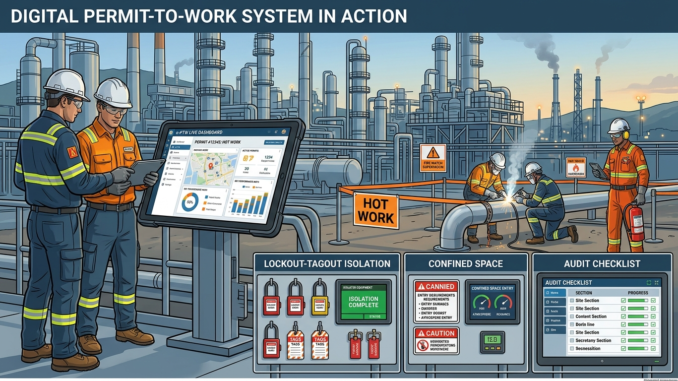
- Isolation Certificate (IC) (Gray): Details lock-out tag-out (LOTO) arrangements and is valid strictly for the duration of the e-PTW.
- Electrical Work Certificate (EWC) (White & Black): Issued for high voltage equipment exceeding 1000V AC or 1500V DC.
- ATA Certificate (Pink): Defines the limits of low voltage equipment on which work may be carried out. The ATA must be cancelled and a new certificate issued at each personnel or shift change.
- Sanction For Test Certificate (SFT) (Purple): Issued to specify the equipment to be tested and conditions for high voltage plant testing.
- Confined Space Entry Certificate (CSE) (Green): Controls entry into confined spaces, including trenches deeper than 1.25m. Gas testing results are valid for a maximum of one shift, and a new test is strictly required if the space is vacated for two hours.
- Excavation Certificate (EXC) (Brown): Required for any man-made cut or trench, automatically issued after confirming the location using GIS coordinates.
- 33KV Overhead Clearance Certificate (Maroon): Must be issued before carrying out any excavation work within 10 meters of an overhead HV electrical transmission line.
- Vehicle Entry Certificate (VEC): Controls vehicle movements within hazardous areas. Requires a scanned copy of a valid driver’s license to be attached.
6. De-isolation Procedures
- Partial Permanent De-isolation (PPD): Used when there is a requirement to de-isolate part of an isolation covered by an IC to enable reinstatement for operational equipment testing.
- De-isolation for Test (DIT): Used to de-isolate all or part of an isolation covered by an IC to perform a specialized operational or integrity test.
7. Permit Suspension, Handover, and Closure
Maintaining strict temporal control over authorizations is a core feature of an optimized electronic permit to work system.
- Validity Limitations: Permits shall be valid for use for a maximum period of one shift. Continuation into additional shifts requires endorsement by the PC and AA. A permit automatically expires if suspended for five consecutive days or if it remains unissued for seven days post-authorization.
- Emergency Work Stoppage: All work shall stop immediately following the facility emergency alarm sounding. The WS must ensure worksites are left in a safe condition and evacuate. Following alarm clearance, suspended permits may be re-issued if they remain within the valid period, requiring re-endorsement by the AA and PC.
- Mandatory Suspensions: Permits must be immediately suspended due to condition violations, lack of supervision, incidents, gas/oil leaks, or if work is delayed for more than 4 hours. Every individual has the right to stop work immediately in the event of unsafe acts.
- Shift Handovers: Active permits not formally handed over are automatically suspended at shift end. Incoming shifts must re-issue continuing permits. Signatures are governed by a maximum 60 minutes prior to shift end rule.
- Permit Closure: Upon completion, the WS must check the worksite to guarantee all materials and tools are removed, verify housekeeping, and return the work permit to the Area Authority for final endorsement.
8. Monitoring and System Audits
- Site management shall conduct a minimum of two e-PTW audits per week.
- Audits must be conducted by trained personnel, forming a team of at least three persons. The Safety representative acts as a permanent member, alongside at least one representative from Operations.
- A formal Permit Compliance Audit must be executed, with findings endorsed by the audit team leader. All completed reports are subsequently reviewed by the HSE Department.
Be the first to comment