
Introduction
Scaffolding is widely used in construction, maintenance, and industrial projects, but it also presents significant fall and structural hazards if not properly managed. Because of these risks, the Occupational Safety and Health Administration (OSHA) has established strict regulatory requirements for scaffold use under 29 CFR 1926 Subpart L.
A common question among construction workers, supervisors, and contractors is: Who is responsible for scaffold safety on a job site?
While scaffold safety is a shared responsibility, the employer holds the primary legal duty. The employer shall ensure that scaffolds are designed, erected, inspected, and used safely. Furthermore, the employer shall designate a competent person to inspect scaffolds and supervise their safe use.
Understanding the distinct responsibilities of employers, competent persons, qualified persons, and workers is essential for maintaining compliance and preventing scaffold-related accidents.
OSHA Scaffold Safety Standard (29 CFR 1926 Subpart L)
OSHA regulates scaffold safety under 29 CFR 1926 Subpart L, which establishes mandatory requirements for:
- Scaffold Design and Construction (OSHA 1926.451(a))
- Scaffold Erection and Dismantling (OSHA 1926.451(f)(7))
- Fall Protection Systems (OSHA 1926.451(g))
- Scaffold Inspection Procedures (OSHA 1926.451(f)(3))
- Worker Training (OSHA 1926.454)
- Load Capacity Requirements (OSHA 1926.451(a)(1))
These regulations apply to most scaffolds used in construction, including:
- Supported scaffolds
- Suspended scaffolds
- Mobile scaffolds
- Aerial lifts used as scaffolding systems
The fundamental purpose of these standards is to ensure that scaffolds shall safely support their own weight and at least four times the maximum intended load applied or transmitted to them, without creating fall hazards or structural instability.
The Employer’s Primary Responsibility for Scaffold Safety
Under OSHA regulations, the employer holds the primary legal liability for scaffold safety on the job site. The employer shall ensure that scaffolds are properly designed, erected, inspected, and maintained in strict accordance with OSHA standards.
To maintain compliance and protect workers, the employer’s responsibilities shall include:
- Providing Compliant Equipment: Ensuring all provided scaffolds meet strict OSHA safety and design requirements.
- Ensuring Load Capacity: Verifying that scaffolds and scaffold components are capable of supporting, without failure, their own weight and at least four times the maximum intended load applied or transmitted to them (OSHA 1926.451(a)(1)).
- Designating Authority: Designating a competent person to direct and supervise all scaffold erection, dismantling, and alteration work (OSHA 1926.451(f)(7)).
- Supplying Fall Protection: Providing the required fall protection systems, such as Personal Fall Arrest Systems (PFAS) or guardrails, for all employees working 10 feet or more above a lower level (OSHA 1926.451(g)(1)).
- Mandating Worker Training: Ensuring that each employee receives proper scaffold safety training from a qualified person to recognize associated hazards (OSHA 1926.454(a)).
- Providing Safe Access: Maintaining safe access to scaffold platforms, such as portable ladders or stair towers, when a platform is more than 2 feet above or below a point of access (OSHA 1926.451(e)(1)).
Furthermore, employers shall ensure that scaffolds are formally inspected before each work shift and after any event that could affect their structural integrity. Failure to meet these mandatory responsibilities exposes the employer to severe OSHA violations, significant financial penalties, and an increased risk of workplace fatalities.
The Competent Person: Key Individual Responsible for Scaffold Safety
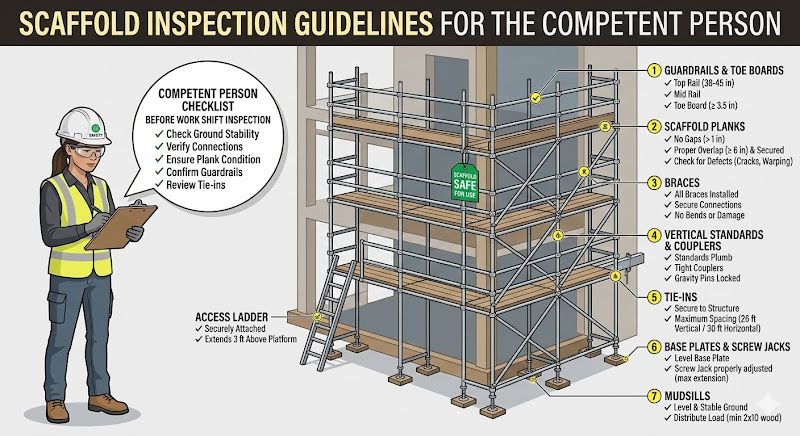
OSHA requires that employers shall designate a competent person to actively oversee scaffold safety on construction sites.
According to OSHA’s official definitions (OSHA 1926.32(f)), a competent person is someone who:
“Is capable of identifying existing and predictable hazards in the surroundings or working conditions which are unsanitary, hazardous, or dangerous to employees, and who has authorization to take prompt corrective measures to eliminate them.”
The competent person plays the most critical, hands-on role in ensuring daily scaffold safety.
Responsibilities of the Competent Person
To maintain site safety and regulatory compliance, the competent person shall:
- Conduct Daily Inspections: Inspect scaffolds and scaffold components for visible defects before each work shift (OSHA 1926.451(f)(3)).
- Monitor Weather and Impacts: Inspect scaffolds immediately after severe storms, impacts, or any other events that could negatively affect structural stability (OSHA 1926.451(f)(3)).
- Identify Defects: Actively identify any damaged, weakened, or defective scaffold components.
- Supervise Structural Changes: Direct and supervise all scaffold erection, moving, dismantling, or altering (OSHA 1926.451(f)(7)).
- Enforce Safety Procedures: Ensure that all workers on the scaffold strictly follow established safety procedures and utilize provided fall protection.
- Halt Unsafe Work: Immediately stop work if hazardous conditions exist.
If any part of a scaffold is found to be unsafe or defective, the competent person shall ensure it is immediately repaired, replaced, braced, or entirely removed from service (OSHA 1926.451(f)(4)).
The Qualified Person and Scaffold Design Responsibility
For complex scaffold systems, OSHA requires involvement from a qualified person.
A qualified person is someone who has:
- recognized degrees or certifications
- extensive experience
- specialized knowledge in scaffold design and structural integrity
The qualified person is responsible for:
- designing complex scaffolds
- evaluating load calculations
- approving scaffold modifications
- ensuring structural stability of engineered scaffold systems
This role becomes particularly important for large or unusual scaffold structures, such as suspended scaffolds or scaffolds exceeding certain height thresholds.
Competent Person vs. Qualified Person
| Role | Main Responsibility |
| Competent Person | Inspects scaffolds and identifies hazards on-site |
| Qualified Person | Designs scaffolds and ensures structural safety |
| Employer | Provides safe scaffolding systems and worker training |
| Workers | Follow safety procedures and report hazards |
This distinction is important because OSHA assigns different responsibilities to each role.
Worker Responsibilities for Scaffold Safety
Although employers carry the primary responsibility, workers also play an important role in scaffold safety.
Workers must:
- Follow scaffold safety training instructions
- Use fall protection equipment when required
- Avoid overloading scaffold platforms
- Report damaged scaffold components immediately
- Follow safe access procedures when climbing scaffolds
Workers should never modify scaffolds or remove guardrails unless authorized by a competent person.
Scaffold Inspection Requirements
OSHA requires that scaffolds be inspected regularly to ensure safe operation.
A competent person must inspect scaffolds:
- before each work shift
- after storms or severe weather
- after any modification to the scaffold
- after extended periods of inactivity
Inspection typically includes checking:
- base plates and mudsills
- guardrails and midrails
- scaffold planks
- braces and supports
- tie-ins and anchors
- access ladders and platforms
If defects are found, the scaffold must not be used until the hazard has been corrected.
Scaffold Tagging Systems Used on Construction Sites
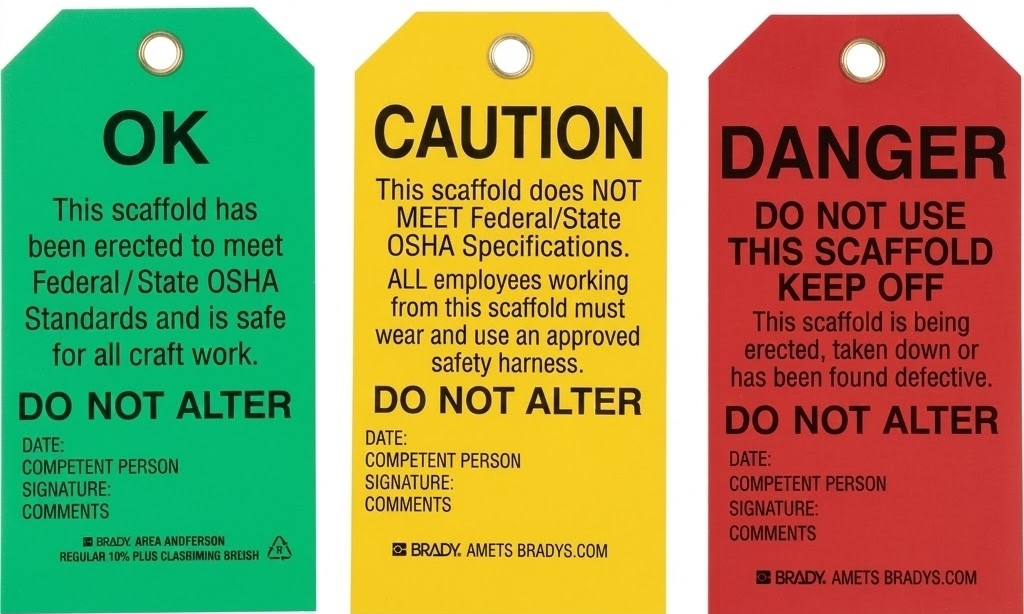
Many construction sites use scaffold tagging systems to communicate inspection status.
Typical scaffold tag colors include:
| Tag Color | Meaning |
| 🟢 Green Tag | Scaffold is safe for use |
| 🟡 Yellow Tag | Use with caution or restrictions |
| 🔴 Red Tag | Scaffold is unsafe and must not be used |
Tagging systems help workers quickly identify whether a scaffold has been inspected and approved for use.
Legal Liability in Scaffold Accidents
In the event of a scaffold accident, determining responsibility may involve multiple parties.
Potentially responsible parties may include:
- the employer
- the general contractor
- subcontractors
- scaffold erection contractors
- equipment rental companies
Liability often depends on factors such as:
- who erected the scaffold
- who inspected the scaffold
- who controlled the worksite
- whether OSHA regulations were followed
Because scaffold accidents can result in serious injuries or fatalities, maintaining proper safety procedures and documentation is essential.
Frequently Asked Questions
How often must scaffolds be inspected?
OSHA requires scaffolds to be inspected by a competent person before each work shift and after any occurrence that could affect structural integrity.
Can a foreman be the competent person for scaffolding?
Yes. A foreman may serve as a competent person if they have the knowledge, experience, and authority to identify hazards and take corrective action.
Is the building owner responsible for scaffold safety?
In most construction projects, the employer or contractor controlling the worksite is responsible for scaffold safety. However, legal liability may vary depending on contracts and local laws.
What is the most common scaffold safety violation?
One of the most common OSHA scaffold violations is lack of proper fall protection, particularly missing guardrails or personal fall arrest systems.
Conclusion
Scaffold safety is a shared responsibility on construction sites, but OSHA clearly places the primary responsibility on the employer to ensure that scaffolds are safe for worker use.
Employers must designate a competent person to inspect scaffolds and supervise safe work practices, while qualified persons may be required for scaffold design and engineering.
By following OSHA regulations under 29 CFR 1926 Subpart L, employers, supervisors, and workers can reduce scaffold hazards and create safer work environments.
Proper training, regular inspections, and adherence to safety standards remain the most effective ways to prevent scaffold accidents and maintain compliance with workplace safety regulations.
Be the first to comment