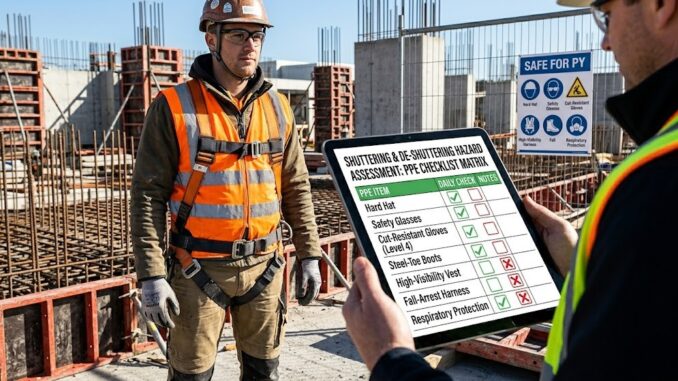
Consequently, this method statement clearly defines the Shuttering and De-shuttering Hazard Assessment. First, review the necessary permits. Next, inspect all required equipment. Furthermore, ensure supervisors communicate all hazards to the workers. Finally, maintain strict adherence to these active controls. Review our Internal Link: general site safety procedures for internal guidelines, and always consult Outbound Link: OSHA Construction Standards for global compliance.
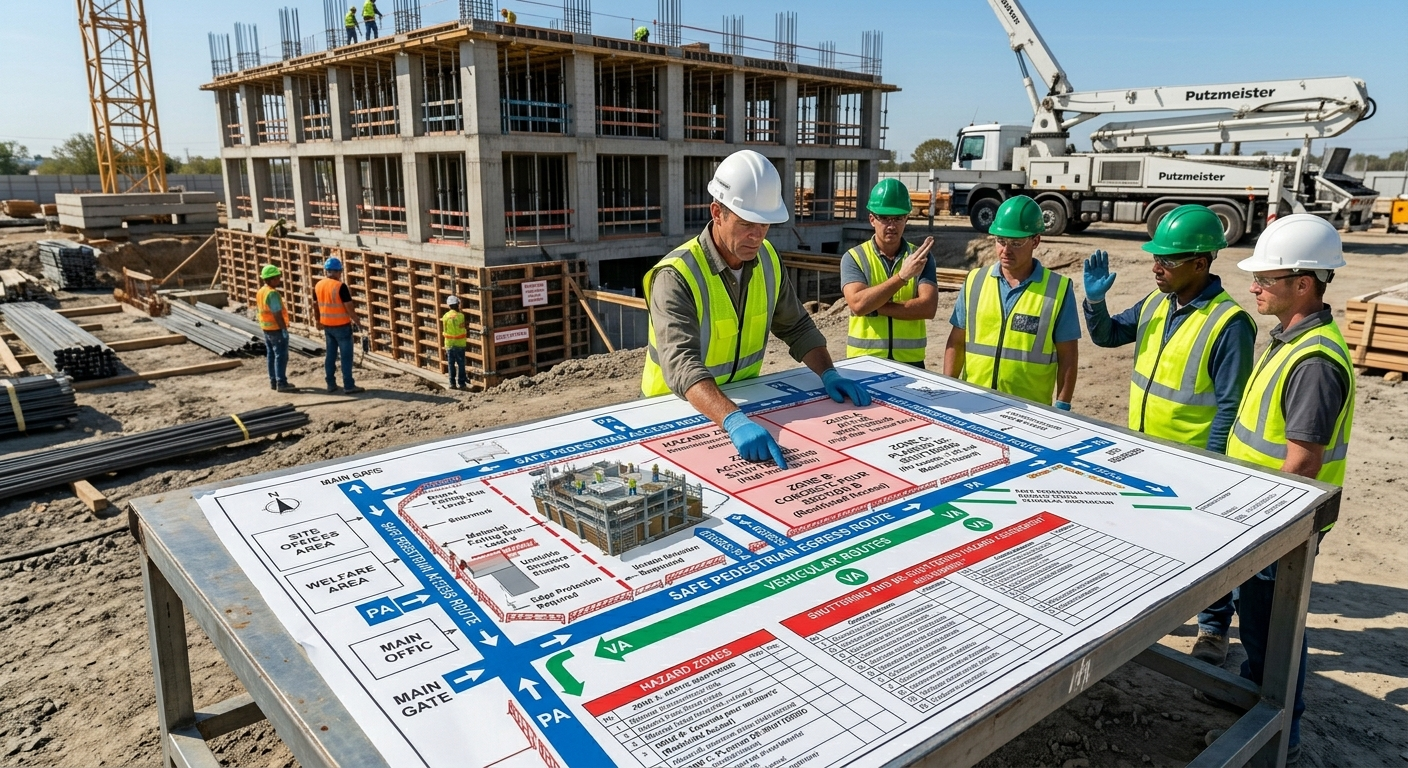
[Image: Construction site layout showing safe access and egress routes. Alt: Site layout for a Shuttering and De-shuttering Hazard Assessment.]
Phase 1: Preparation for Shuttering and De-shuttering Hazard Assessment
| Work Activity | Hazards | Risk Issue (Possible Incident) | Existing Controls | Action Plan (Follow Up) |
| 1. Obtain ATA | Unauthorized work to be performed within a defined location | Accident resulting in serious injury or death to worker |
• Obtain LOA as a pre-requisite to perform work.
• Do not start work until you have a duly approved ATA.
• Train and authorize the ATA Receiver.
• Hold the ATA Receiver responsible to oversee the safety of all workers. |
• Inspections
• Close Supervision
• Safe work procedure |
| Unidentified hazards with unplanned safety mitigating measures | Governmental violation / Environmental complaint |
• Adhere strictly to all requirements set forth in the ATA, Risk Assessment, Method Statement, and Job Safety Procedure.
• Designate a competent ATA Receiver. |
• Inspections
• Close Supervision
• Training |
|
| 2. Mobilization and preparation of materials, hauling equipment | Construction equipment malfunctioning | Accident result in physical injury or death |
• Use only heavy equipment with a valid third-party inspection certificate.
• Conduct monthly equipment inspections and color coding.
• Provide a fire extinguisher on the unit.
• Isolate the area and provide signboards. |
• Inspections
• Close Supervision
• Training |
| Reversing trailer and crane without spotter | May collide to anything on the area resulting to Property damaged |
• Inspect equipment daily.
• Conduct a spot inspection of all tools and equipment prior to commencing work.
• Provide an equipment spotter wearing an orange high-reflective vest. |
• Inspections
• Close Supervision |
|
| Positioning of equipment | Accident causing injuries to the operator or driver once struck the structure |
• Orient drivers and operators to the site condition.
• Provide a trained flagman with a reflective vest and Red/Green flags.
• Fasten seat belts at all times.
• Enforce a strict “no flagman, no movement” policy. |
• Inspections
• Close Supervision
• Training |
Phase 2: Fabrication and Material Handling
| Work Activity | Hazards | Risk Issue (Possible Incident) | Existing Controls | Action Plan (Follow Up) |
| 3. Cutting and bending of steel reinforcement bars (Fabrication) | Use of electrical steel cutter machine | Physical injury due to contacts from rotating and cutting part of the equipment |
• Equip all rotating parts with adequate machine guarding.
• Provide an emergency stop button.
• Inspect and color code all tools.
• Issue appropriate PPE such as safety shoes and rubberized hand gloves.
• Keep the equipment manual available.
• Keep hands and fingers away from trapping/pinch points.
• Inspect moving parts protection periodically. |
• Inspections
• Close Supervision
• Training |
| Energized electricity | Electric shock due to contact with energized electricity |
• Allow only qualified and competent persons to work on electrical equipment.
• Inspect power tools, plugs, and cables prior to use.
• Apply lock out / tag out if necessary.
• Secure cables by hanging them to avoid obstructing the access way. |
• Inspections
• Close Supervision
• Training |
|
| Incorrect manual handling / lifting of material | Muscular injuries (Back pain, strain, fractures) / Pinch/crash points resulting hand injuries |
• Plan correct manual lifting procedures and body positioning before the actual lift.
• Limit individual lifting to 20 kg.
• Use the buddy system if the load exceeds limits.
• Use hand protection (cotton gloves minimum).
• Provide material handling equipment to transport heavy and large materials. |
• Inspections
• Close Supervision
• Training |
|
| 4. Shifting of fabricated steel materials into the work area | Poor Access/Egress | Physical injury from slip, trips & fall |
• Keep access pathways clear from any obstruction.
• Conduct housekeeping before, during, and after work.
• Provide proper work access (i.e., ladder or scaffold).
• Move any obstructions and keep materials away from access points. |
• Inspections
• Close Supervision
• Training |
| Use of electrical tools (bending machine) | Physical injury due to pinch point and crushed by moving part of the machine |
• Equip all rotating parts with a mechanical cover.
• Provide an emergency stop button.
• Inspect and color code all tools.
• Keep hands and fingers away from trapping/pinch points.
• Avoid loose clothing and remove all jewelry. |
• Inspections
• Close Supervision
• Training |
|
| Sharp & protruding materials/ objects | Hand injuries due to contacts with sharp tools and object |
• Provide all workers with required hand gloves.
• Monitor activities closely to ensure safe operations.
• Use rubberized gloves for this specific activity. |
• Inspections
• Close Supervision
• Training |
[Image: PPE inspection and matrix checklist application. Alt: Equipment checklist for Shuttering and De-shuttering Hazard Assessment.]
Phase 3: Execution of Shuttering and De-shuttering Hazard Assessment
| Work Activity | Hazards | Risk Issue (Possible Incident) | Existing Controls | Action Plan (Follow Up) |
| 5. Cutting of ply wood materials for formworks | Use of electrical tools with Rotating/moving parts | Property damage, fatality or injuries during the operation |
• Refer to the equipment manual prior to operation.
• Register the equipment properly.
• Verify the operator has experience using the equipment.
• Use rubberized gloves.
• Keep eyes on the task.
• Designate a specific area for nailing and de-nailing cut plywood.
• Inspect cutting equipment periodically. |
• Inspections
• Close Supervision
• Training |
| 6. Installation of formworks and bracing even working at height | Hot works(cutting) | Fire & explosion / Inhalation of fumes |
• Provide an adequate fire extinguisher.
• Remove or protect all combustible/flammable materials in the working area.
• Equip all portable cutting machines with mechanical guards.
• Assign a standby firewatcher to monitor hot work activity.
• Use a fire blanket to contain flying sparks.
• Provide clear glass under the Helmet-mounted face shield. |
• Inspections
• Close Supervision
• Training |
| Contact with sharp & protruding materials/ objects | Hand injuries due to contacts with sharp tools and object |
• Provide all workers with required hand gloves.
• Remove existing protruding nails from the wood before use and installation.
• Use rubberized gloves for this activity.
• Clear all wood with jagged sides and edges.
• Arrange a lifeline to hook up the full-body harness if a proper anchor is unavailable. |
• Inspections
• Close Supervision
• Training |
|
| 7. Stripping of formworks and removal of panels | Fall from height, contact from falling object | Serious injury to personnel / Temporary to permanent disability |
• Wear a Full-body Harness Belt while working above 1.8 Meters.
• Secure proper working ATA.
• Wear Helmet, Leather Safety Shoes, Uniform/Coverall, and Rubberized gloves.
• Conduct working at height training for all workers in elevated areas.
• Erect working platforms according to international safety standards. |
• Inspections
• Close Supervision
• Safe work procedure |
| Unsafe working scaffold platform | Collapse of scaffold, fall from height |
• Approve and tag the scaffold by a certified scaffold supervisor before use.
• Conduct regular weekly inspections. |
• Inspections
• Close Supervision
• Safe work procedure |
|
| Falling tools and materials | Struck by falling objects |
• Tie off all tools to worker belts to prevent falling.
• Strictly prohibit parallel working where one person works directly above another.
• Install top boards on working platforms to avoid falling materials from the edge. |
• Inspections
• Close Supervision
• Safe work procedure |
Phase 4: Closing Procedures and Housekeeping
| Work Activity | Hazards | Risk Issue (Possible Incident) | Existing Controls | Action Plan (Follow Up) |
| 8. Removal of bracing support (de-shuttering) at ground level | Protruding nails and sharp edges | Head bump, hand and foot injuries |
• Wear mandatory PPE while working.
• Use rubberized gloves.
• Keep eyes on the task.
• Inspect hand tools regularly.
• Remove all remaining nails from the forms before carrying them manually to the storage area. |
• Inspections
• Close Supervision
• Safe work procedure |
| Unorganized materials and access | Property damage to equipment or materials |
• Barricade all material locations and provide adequate signage.
• Designate dedicated personnel familiar with the site management plan to guide loading and unloading. |
• Inspections
• Close Supervision
• Safe work procedure |
|
| 9. Housekeeping, Cleaning of excess materials | Waste accumulation | Physical injury from slip & trip |
• Remove all materials, tools, and generated waste immediately after work finishes.
• Provide waste bins nearby to maintain good housekeeping.
• Conduct daily good housekeeping inspections. |
• Inspections
• Close Supervision
• Safe work procedure |
| 10. Closing of ATA | Unsecured electrical equipment, energized equipment | Significant property and appurtenances damage |
• Ensure housekeeping is done before, during, and after the work.
• Secure electrical equipment properly, and close and padlock the distribution board. |
• Inspections
• Close Supervision
• Safe work procedure |
| 11. Required and Usage of PPEs | Inappropriate Helmets/ Hard Hats / Inappropriate Foot protection | Head aches, injury or Fatality / Injury, Fatality due to fall of material |
• Purchase and issue only Standard PPEs.
• Conduct a PPE matrix for each activity to ensure correct hard hat usage.
• Conduct training on using hard hats before work starts.
• Provide a separate storage area for hard hats.
• Inspect the storage area periodically.
• Return all defective or damaged items to the storekeeper and place them in the PPE REJECTED box. |
• Inspections
• Close Supervision
• Safe work procedure |
| 12. Workplace inspection for working at height | Unauthorized Erection/ Dismantling/ Modification | Unauthorized erection, dismantling and modification of scaffolds may affect on-going activities and endanger nearby workers |
• Secure a ATA prior to any erection/dismantling of scaffolds.
• Announce work to all affected areas beforehand.
• Train the ATA Issuer & Receiver.
• Erect scaffolds strictly in compliance with standards.
• Monitor the activity closely using Safety personnel, Supervisors, and Site Managers. |
• Inspections
• Close Supervision
• Safe work procedure |
By following this exact Shuttering and De-shuttering Hazard Assessment, teams ensure a safe, efficient, and compliant work environment.
Be the first to comment