Document Details (Generic)
-
Discipline: Civil
-
Trade: Roads & Pavements
-
Document Type: Method of Statement (MOS)
1. Purpose & Scope
The primary objective of this method statement is to provide a standardized, documented procedure for asphalt works. This procedure covers all asphalt-related activities and ensures proper execution across construction sites.
2. Definition & Abbreviation
-
Bench mark/Reference point: A surveyor’s mark established on a stationary object of known position and elevation, utilized as a construction reference.
-
IFC: Issued for Construction drawings
-
ITP: Inspection Test Plan
-
CAR: Corrective Action Request
-
NSL: Natural Surface Level
-
PTS: Project Technical Specification
-
MC: Medium Curing
-
RC: Rapid Curing
3. References
-
IFC Drawings
-
Approved Material Submittals
-
PTS (Project Technical Specifications)
-
AASHTO-M20: Aggregate for Concrete
-
AASHTO-M43: Standard Specification for Sizes of Aggregate for Road and Bridge Construction
-
AASHTO-M81: Coarse Aggregate for Portland Cement Concrete
-
AASHTO-M140: Cement
-
AASHTO-M283: Coal Fly Ash and Raw or Calcined Natural Pozzolan for Use in Concrete
-
ASTM 0692: Standard Test Method for Specific Optical Density of Smoke Generated by Solid Materials
-
ASTM 01073: Standard Test Methods for Analysis of Calcium Chloride
-
ASTM 01241: Standard Test Method for Slake Durability of Shales and Other Similar Weak Rocks
-
BS1707 or IS:217: Specification for Copper and Copper Alloy Ingots and Castings
-
IS:454: Code of Practice for General Construction of Plain and Reinforced Concrete for Dams and Other Massive Structures
-
IS:8887: Specification for Water for Making Concrete
4. Responsibilities
-
Project/Construction Manager: Bears overall responsibility for the implementation and continuous monitoring of all asphalt-related activities outlined in this method statement.
-
Site Manager: Responsible for overarching direction, coordination, and monitoring of all site execution activities related to asphalt works.
-
Site Engineer: Directly plans and executes field activities. Responsible for preparing the asphalt plan, developing the safe work plan, and applying for work permits prior to excavation/paving.
-
QA/QC Engineer: Conducts monitoring tests in compliance with the approved ITP. Coordinates with independent testing laboratories and verifies that asphalt works align with the IFC drawings and ITP.
-
Foremen: Directs the physical execution of asphalt works. Issues instructions to the workforce, ensures proper use of tools/equipment and PPE, and maintains housekeeping around the active work area.
-
Surveyor: Establishes site benchmarks and monitors grade elevations. Assesses asphalt surface smoothness, maintains daily logs, records as-built deviations, and conducts the final survey for handover documentation.
-
HSE Engineer/Supervisor: Reviews the Safe Work Plan and work permits before activity commencement. Prepares and submits necessary HSE documentation to the client/customer.
5. Tools & Equipments

-
Dozer
-
Bitumen Sprayer vehicle
-
Pressure Distributes Roller
-
Loader
-
Motor Grader
-
Dump Truck
-
Vibrator Roller
-
Plate compactor
-
Paver Machine
-
Water Boozer
-
Theodolite with tripod
-
Automatic level with tripod and staff rod
-
Metal detector / Cable detector
6. Procedure
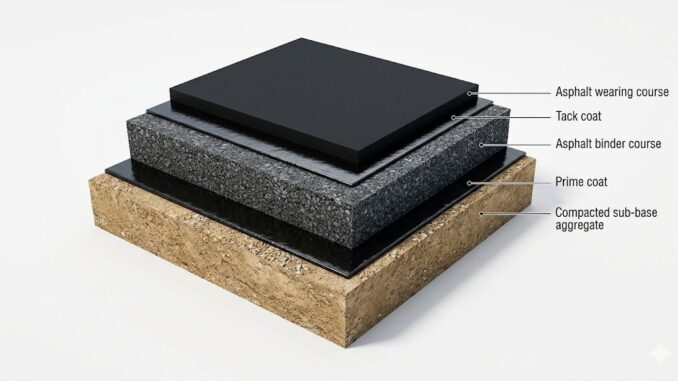
The execution of asphalt procedures is categorized into the following sequential stages: Sub-Base, Prime Coat, Binder Course, Tack Coat, and Wearing Course.
6.1 Sub-Base Preparation
-
Execute grading to achieve the proposed grades as indicated on the approved IFC drawings.
-
Check and verify all final levels.
-
Conduct density tests at randomized locations, with frequency dictated by specifications, to determine the degree of compaction.
-
Ensure aggregate sub-base material is tested and approved by an independent laboratory.
-
Place approved sub-base material in layers not exceeding 30 cm, or strictly according to company specifications.
-
Spread, level, and compact the sub-base layer using steel-wheel tandem vibratory rollers and pneumatic-tired rollers.
-
Verify finalized dimensions and levels on the compacted layer.
-
Execute third-party density and compaction tests as specified.
6.2 Prime Coat Application
-
Thoroughly clean the full width of the surface using compressed air immediately prior to application.
-
Ensure the prime coat material has received preliminary approval.
-
Apply bituminous material via spray tankers in a single, uniform layer.
-
Maintain an application rate between 0.7 to 1.5 liters/sq.m, adhering to company specifications.
-
Keep application temperature below 70°C.
-
Allow the sprayed area to cure for more than 24 hours until all excess prime coat has completely evaporated.
6.3 Binder Course Application
-
Verify binder quality adheres to AASHO-T182 or IS:73, IS:217, IS:454, and IS:8887.
-
Clean the primed surface with compressed air, ensuring it is completely dry before paving.
-
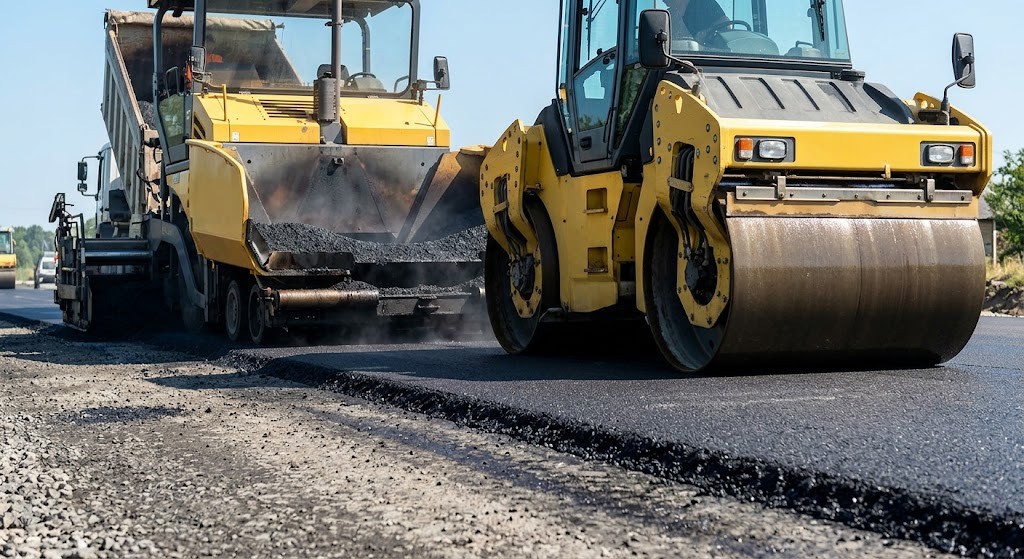
Transport hot asphalt mix from the mixing plant using wheel trucks and dump it directly into the asphalt paver.
-
Lay the material to the specified thickness and level.
-
Commence compaction immediately after spreading.
-
Execute breakdown rolling at a temperature of 110-120°C using tandem rollers, followed by pneumatic-tired rollers.
-
Begin rolling from the outer edges and proceed toward the center, ensuring each trip overlaps the previous pass by at least 30 cm.
-
Keep roller wheels moistened and operate smoothly without backlash to prevent surface tearing.
-
Eliminate any waves using heavy tandem rollers.
-
Achieve full compaction before the asphalt temperature drops to 100°C.
-
Prepare construction joints by vertically cutting the layer with an asphalt saw or jackhammer. Clean the joint, apply compressed air, and coat with tack material on vertical/horizontal surfaces for optimal bonding.
-
Compact inaccessible areas using plate compactors or hand tampers.
-
Once the base course reaches the top level, dump suitable fill material (dune sand) on the road shoulders, level it, shape it to a 1:6 ratio, and compact to 90% maximum dry density.
6.4 Tack Coat Application
-
Apply primarily approved tack coat material at a rate of 0.3 to 0.6 liters/sq.m.
-
Maintain temperature not exceeding 54°C above the binder temperature (or per manufacturer specifications).
-
Cure the surface until a tacky, sticky surface is visible.
6.5 Wearing Course Application
-
Spread the hot asphalt mix over the cured tack coat using an automatic asphalt paver according to the approved profile and thickness.
-
Compact the mix as soon as possible after spreading.
-
Conduct breakdown rolling at 110-120°C using tandem rollers.
-
Continue compaction with self-propelled and tandem rollers starting from the sides and moving toward the center, overlapping previous trips by at least 30 cm.
-
Maintain moistened roller wheels, reverse without backlash, and utilize heavy tandem rollers to eliminate any surface waves.
-
Complete full compaction before the surface temperature reaches 80°C.
-
Restrict all traffic on the newly paved layer for a minimum of 12 hours until it is adequately cooled.
-
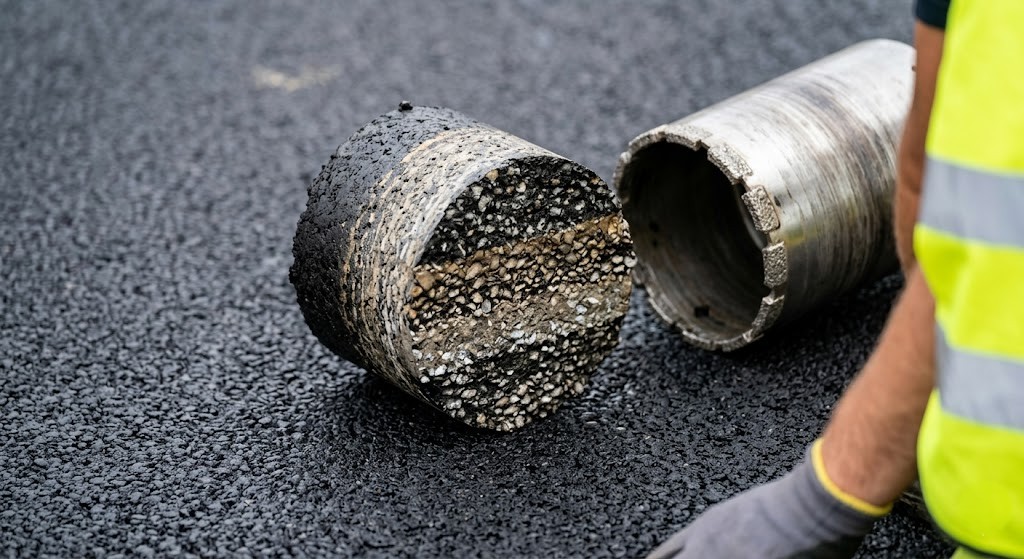
Repair any core test holes with hot asphalt mix and compact thoroughly using a Marshal Hammer.
7. Inspection & Testing
-
Ensure all testing is conducted by an approved, independent third-party site laboratory.
-
Carry out all field inspection and testing activities in strict alignment with the approved ITP.
-
Maintain and prepare all relevant QC records through the Contractor’s QC Engineer.
Be the first to comment