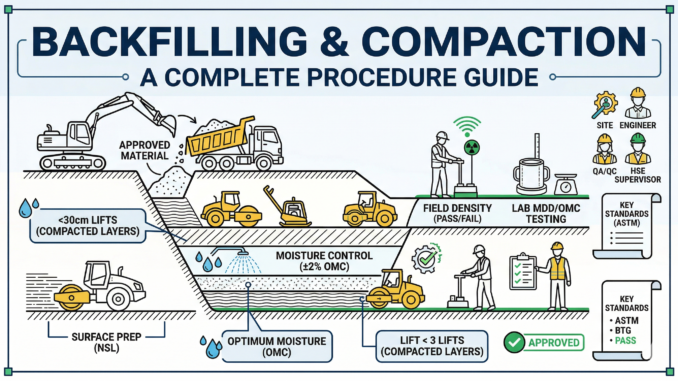

Backfilling and compaction are critical activities in civil engineering construction, particularly in earthworks associated with foundations, trenches, and underground structures. These processes ensure that excavated areas are refilled with suitable material and compacted to achieve the required strength, stability, and load-bearing capacity.
This method statement provides a comprehensive and structured procedure for carrying out backfilling and compaction work in accordance with project technical specifications, approved drawings, and applicable international standards. Proper implementation of this procedure minimizes settlement risks, improves soil performance, and ensures long-term structural integrity.
1. Purpose and Scope

The purpose of this method statement is to define the documented procedure for backfilling and compaction activities applicable throughout the project. It establishes a standardized approach to ensure that all activities are performed safely, efficiently, and in compliance with project requirements.
The scope of this method statement includes execution of backfilling operations in excavated areas, compaction of soil layers to specified density requirements, inspection and testing in accordance with the Inspection Test Plan (ITP), and compliance with Project Technical Specifications (PTS) and applicable standards. This procedure applies to all civil works involving earthworks and soil compaction within the project.
2. Definitions and Abbreviations

The following abbreviations are used throughout this method statement:
IFC (Issued for Construction): Approved drawings used for execution of works
ITP (Inspection Test Plan): Document outlining inspection and testing requirements
CAR (Corrective Action Request): Issued when non-conformance is identified
NSL (Natural Surface Level): Original ground level before excavation
PTS (Project Technical Specification): Governing technical requirements of the project
MDD (Maximum Dry Density): Maximum density achieved by soil under standard compaction
OMC (Optimum Moisture Content): Ideal moisture level required to achieve maximum compaction
Understanding these terms is essential for proper execution and quality control of backfilling operations.
3. Standards and References

Issued for construction drawing (IFC),
Project technical specification (PTS)
Inspection and test plan (ITP)
Maximum dry density (MDD)
Optimum moisture content (OMC)
ASTM C136: Sieve Analysis of Fine and Coarse Aggregate
ASTM D 3017: Test Method for Moisture Content of Soil and Soil Aggregate
ASTM D 1883: Test Method for CBR of Laboratory Compacted Soil.
ASTM D 4253: Test Method for Maximum Index Density.
ASTM D 4254: Test Method for Minimum Index Density.
ASTM D 2937: Test Method for Density.
ASTM D 698: Test Method for Moisture Index Density.
ASTM D 2292: Nuclear Test Method for Soil Moisture Density.
ASTM D 1557: Test Method of Moisture Density Relations.
ASTM D 2487: Classification of Soil for Engineering Purpose.
ASTM D 422: Particle Size Analysis of Soils.
These references guide execution and ensure compliance with technical requirements.
4. Roles and Responsibilities
Over-all direction, monitoring, coordination and control of all the constructions activities related to the backfilling and compaction works.
This ensures that all activities are properly supervised and aligned with project requirements.
Site Engineer Duties
The Site engineer is responsible for planning and execution of the activities involved in the backfilling and compaction.
The site engineer manages execution, prepares plans, and ensures work permits and safety measures are in place.
QA/QC Engineer Duties
Responsible for the necessary inspection tests to be carried out for all activities involved in the backfilling and compaction as per the approved ITP.
The QA/QC engineer ensures quality through inspections and coordination with testing laboratories.
Foremen Responsibilities
Responsible for the direct execution of works involved in the backfilling and compaction activities according to the plan.
Foremen supervise labor, equipment usage, and ensure proper safety practices.
Testing Laboratory Role
The independent testing laboratory technician is responsible for all relevant tests in the field.
They conduct field tests, maintain records, and verify compaction quality.
HSE Responsibilities
HSE engineer / Supervisor is responsible to conduct JHA prior to start of the compaction and backfilling activities.
They ensure safety compliance and risk control before starting work.
5. Tools and Equipment

Front end loader, shovel, Dump truck, Grader, Bobcat, Roller Compactor, Jumper, plate compactor, Wheelbarrows, Hand tools
These tools are used for material handling, leveling, and achieving proper compaction.
6. Backfilling and Compaction Procedure

ITP is produced either on provided by customer/client.
The Inspection Test Plan defines inspection and testing requirements during execution.
Material Approval as per PTS
Source of required backfill material is located as per PTS and drawings and get it approved by customer/client.
Only approved materials are used to ensure quality and compliance.
MDD and OMC Testing
M.D.D and O.M.C/Proctor value is establish for the material in the laboratory and get it approved by customer.
Laboratory testing determines compaction characteristics of soil.
Surface Preparation Before Backfilling
- A) Areas to be free of roots, trash, or other foreign material
All unwanted materials must be removed to ensure proper compaction. - B) All areas shall be rolled and compacted after clearing and inspection shall be done for soft spots or loose zone.
Initial compaction helps identify weak areas. - C) All observed soft spot or loose zone shall be compacted or replaced with properly compacted soil.
Weak zones must be treated to avoid settlement.
Moisture Control
Mix the water uniformly with backfill material so that it does not exceeds +/- 2% of O.M.C or as specified in the PTS.
Maintaining proper moisture content ensures maximum compaction.
Layer Placement
Backfill material shall be placed in layers not exceeding 30 cm (uncompacted).
Layering ensures uniform compaction and stability.
Compaction and Testing

Backfill material is compacted and tested after each layer to achieve required density.
Each layer must pass compaction tests before proceeding.
Failure and Re-Compaction
In case of compaction test failure, re-compact the area and resubmit for approval.
Failed areas must be corrected and retested.
Final Approval

Submit each layer for approval and repeat until required levels are achieved.
Approval ensures compliance with project specifications.
Conclusion
Backfilling and compaction work requires proper planning, testing, and execution. Following this method ensures structural stability, safety, and compliance with engineering standards.
What is backfilling in construction?
Backfilling is the process of refilling excavated areas with soil or material to support structures and maintain ground stability.
What is compaction in civil engineering?
Compaction is the process of increasing soil density by reducing air voids using mechanical equipment.
What is the standard layer thickness for compaction?
Typically 300 mm (uncompacted), or as per project specifications.
Be the first to comment