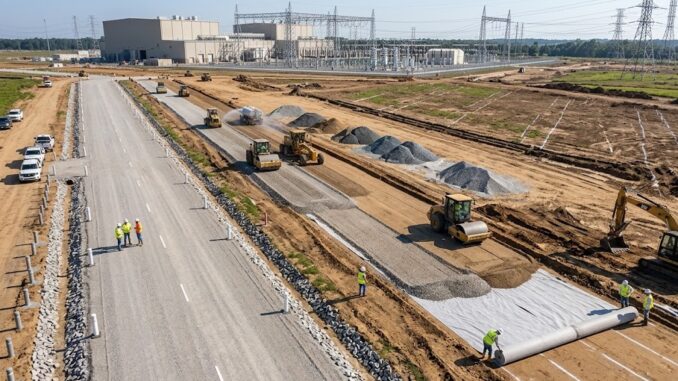
If you are managing a new site build, drafting a comprehensive access road method statement is an absolute necessity. Establishing a secure, durable pathway ensures that heavy vehicles and equipment can enter the site safely without causing environmental damage or experiencing delays. Therefore, this complete guide breaks down the exact procedures, responsibilities, and safety protocols required to build a reliable compacted gravel access route.
Typically, this methodology covers standard temporary or permanent access roads, such as a 200-meter long by 6-meter wide path extending from the main entry gate down to a designated parking or staging area.
1. Purpose and Scope of the Access Road Method Statement
First and foremost, the primary purpose of an access road method statement is to outline the safe execution of roadworks. It provides a clear blueprint for site teams to construct a reliable route for construction traffic. Consequently, heavy equipment can move efficiently across the site without bogging down in soft soils.
This specific guide focuses on constructing a highly stable road utilizing compacted gravel, from the point of entry straight to the active construction zones.
2. Essential Definitions and Terminology
Understanding the terminology within this document ensures that all site personnel fully grasp the technical requirements. Therefore, review the following essential terms:
-
Access Road: A temporary or permanent road built to allow construction vehicles to enter a site.
-
Subgrade: The natural or mechanically prepared soil underneath the pavement layer.
-
Geotextile Fabric: A permeable textile material that improves soil stability, prevents erosion, and provides vital drainage.
-
Density: The measure of material compactness, which directly determines the road’s load-bearing capacity.
-
Gravel Layer: Crushed rock utilized to provide a stable, durable driving base.
-
Heavy Machinery: This encompasses the Excavator (for digging), the Grader (for surface leveling), and the Roller (for material compaction).
(For more comprehensive definitions of standard civil engineering terminology, you can always refer to guidelines published by the American Society of Civil Engineers (ASCE).)
3. Key Personnel Responsibilities
A successful infrastructure project relies heavily on clear delegation. Consequently, site management must assign the following roles:
-
Project Manager: Plans, coordinates, and executes the overall project according to strict technical specifications.
-
Site Manager: Oversees daily physical activities to ensure the team works safely and efficiently on the ground.
-
Site Engineer: Supervises all technical aspects and guarantees the work meets the required quality standards.
-
Health and Safety Officer: Enforces strict site compliance with all protective regulations and hazard prevention protocols.
-
Quantity Surveyor: Manages the project budget to prevent financial overruns.
-
Procurement Manager: Sources and purchases all necessary construction materials and heavy machinery.
-
Construction Workers: Execute the manual labor and operate the machinery on site.
4. Required Tools and Equipment
To properly execute this procedure, the procurement team must provide the following equipment:
-
Excavator
-
Motor Grader
-
Heavy-duty Roller (Compactor)
-
Water Tanker
-
High-quality compacted gravel
-
Marking paint and surveying tools
5. Executing the Access Road Method Statement: Step-by-Step
Building a durable access road requires strict adherence to several sequential phases. Following these exact steps guarantees long-term structural integrity.
a. Initial Site Preparation
-
First, the earthworks team will clear all vegetation, topsoil, and debris from the proposed road alignment.
-
Next, surveyors will mark the exact road alignment using bright marking paint.
-
Then, an excavator operator will dig out the topsoil to a depth of 150 mm along the marked pathway.
b. Subgrade Preparation and Stabilization
-
After the excavation, workers will compact the exposed subgrade using a heavy roller.
-
If the team identifies any soft spots or depressions, they will fill them with suitable soil and compact the area again.
-
Finally, the crew will install a geotextile fabric directly on top of the subgrade. This crucial step prevents the native soil from mixing with the imported gravel layer. (To learn more about related earthworks, explore our comprehensive internal guide to site preparation techniques).
c. Gravel Layer Installation
-
To begin the base construction, trucks will dump the gravel, and workers will spread it evenly over the geotextile-lined subgrade to an initial depth of 150 mm.
-
Next, the operator will compact this first gravel layer using a roller.
-
Subsequently, the team repeats this layering and rolling process until the gravel foundation reaches a final thickness of 300 mm.
d. Surface Grading and Water Application
-
Following the installation of the aggregate, an operator uses a motor grader to smooth and profile the surface of the gravel layer.
-
Meanwhile, a water tanker strategically sprays the surface. Adding moisture helps the gravel particles bind together and settle efficiently.
e. Final Compaction
-
After wetting the surface, the team utilizes a roller to heavily compact the gravel layer.
-
They repeat this continuous rolling process until the road achieves the exact target density required to support heavy construction traffic.
f. Finishing Touches and Traffic Infrastructure
-
Lastly, workers install reflective road markers at regular intervals to guide drivers safely.
-
Additionally, the team excavates drainage ditches on either side of the road to prevent rainwater from pooling on the surface.
-
To conclude the physical build, crews install bollards or concrete barriers to stop vehicles from accidentally leaving the designated driving area.
6. Mandatory Safety Precautions
Safety remains the top priority in any civil works project. Therefore, site management must strictly enforce the following rules to remain compliant with international safety bodies like the Occupational Safety and Health Administration (OSHA):
-
First, all personnel involved in the access road construction must wear appropriate Personal Protective Equipment (PPE), including high-visibility vests, hard hats, and steel-toed boots.
-
Second, maintenance teams must keep all heavy equipment in excellent working condition and conduct daily pre-start checks.
-
Furthermore, safety officers must implement adequate traffic control measures, such as signage and flaggers, to protect both workers and visiting motorists.
-
Ultimately, the contracting company must conduct all works in strict accordance with local and national occupational safety guidelines.


Be the first to comment