
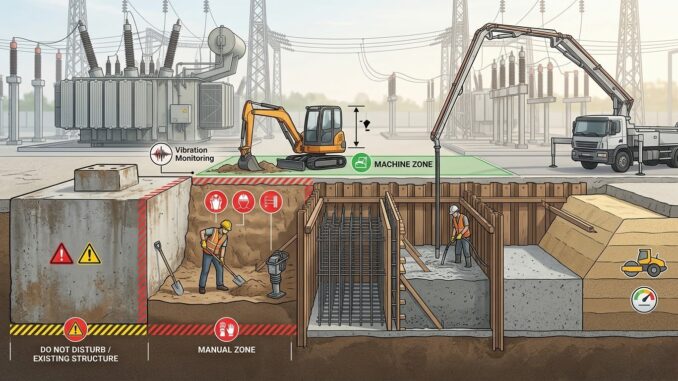
Writing a detailed method statement for substation foundations protects workers and ensures structural integrity when building near active power grids. Furthermore, it gives your construction team a clear roadmap for safely completing cable trenches and concrete bases. This complete guide covers every critical step, from initial excavation to final quality inspection.
1. Purpose and Objective
First, this document defines the exact execution method for constructing new foundations and cable trenches adjacent to existing concrete structures.
Specifically, our primary objectives include:
-
Achieving the design intent through high-quality execution.
-
Establishing maximum safety during all construction activities.
-
Preventing damage to existing underground utilities.
-
Coordinating work smoothly between civil crews and other trades.
2. Definitions and Abbreviations
To keep communication clear, site personnel must understand these standard abbreviations:
-
OMS: Quality Management System
-
QA/QC: Quality Assurance / Quality Control
-
MST: Method Statement
-
ITP: Inspection and Test Plan
-
CL: Checklist
-
QMP: Quality Management Plan
-
OHSP: Occupational Health and Safety Plan
-
EMS: Environmental Management System
-
IFC: Issued for Construction drawings
-
PTS: Project Technical Specification
3. Key References
Consequently, supervisors must refer to the following approved documents before starting work:
-
Project Contract Document
-
Approved Shop Drawings
-
Approved ITP
-
PTS-23KN002
-
Project HSE and Environmental Requirements
4. Tools, Tackles, and Equipment
Because heavy vibrations threaten existing structures, the team must use specific, size-restricted equipment. Therefore, operators rely on the following tools:
-
Mini excavators (maximum height 3m) to limit soil vibration.
-
Manual excavation tools for working directly next to old foundations.
-
Concrete pumps and mechanical vibrators.
-
Rebar cutting and bending tools.
-
Leveling instruments (Level / Total Station).
-
Bobcat (maximum height 2m).
-
Roller (maximum height 3m).
-
Dump truck (maximum height 6m).
-
Asphalt cutters.
5. Roles and Responsibilities
Assigning clear duties prevents dangerous errors. Next, we outline the primary responsibilities for the site crew:
-
Project Manager: Oversees all project activities. Furthermore, they guarantee the team meets timeline, quality, and safety contract requirements.
-
QA/QC Manager: Enforces all quality compliance standards. They check materials against applicable codes.
-
Construction Manager: Directs the daily work. Crucially, they secure all permits before initiating any work.
-
QA/QC Engineer: Performs physical field inspections, evaluates materials, and closes out non-conformances.
-
Site Engineer: Supervises the physical implementation of this method statement on the ground.
-
Heavy Equipment Operator: Drives machinery carefully. They must hold active certifications to avoid destroying existing facilities.
-
Land Surveyor: Marks all lines, elevations, and setting-out works.
-
HSE Officer: Guarantees total compliance with project safety rules.
-
Permit Management: The Area Authority (AA) confirms worksite controls. Subsequently, the Permit Receiver (PR) communicates hazards via Toolbox Talks, and the Work Permit Issuer verifies “Zero Energy” status.
6. Scope of Work for the Method Statement for Substation Foundations
Ultimately, the project encompasses five major construction phases. The crew executes:
-
Excavating soil for foundations, tunnels, and cable trenches.
-
Constructing new concrete foundations using approved drawings.
-
Installing reinforcement and wooden formwork. For advanced steel techniques, review our internal guide on rebar installation methods.
-
Pouring ready-mix concrete.
-
Backfilling and finalizing the site leveling.
7. Step-by-Step Construction Procedure
7.1 Site Preparation
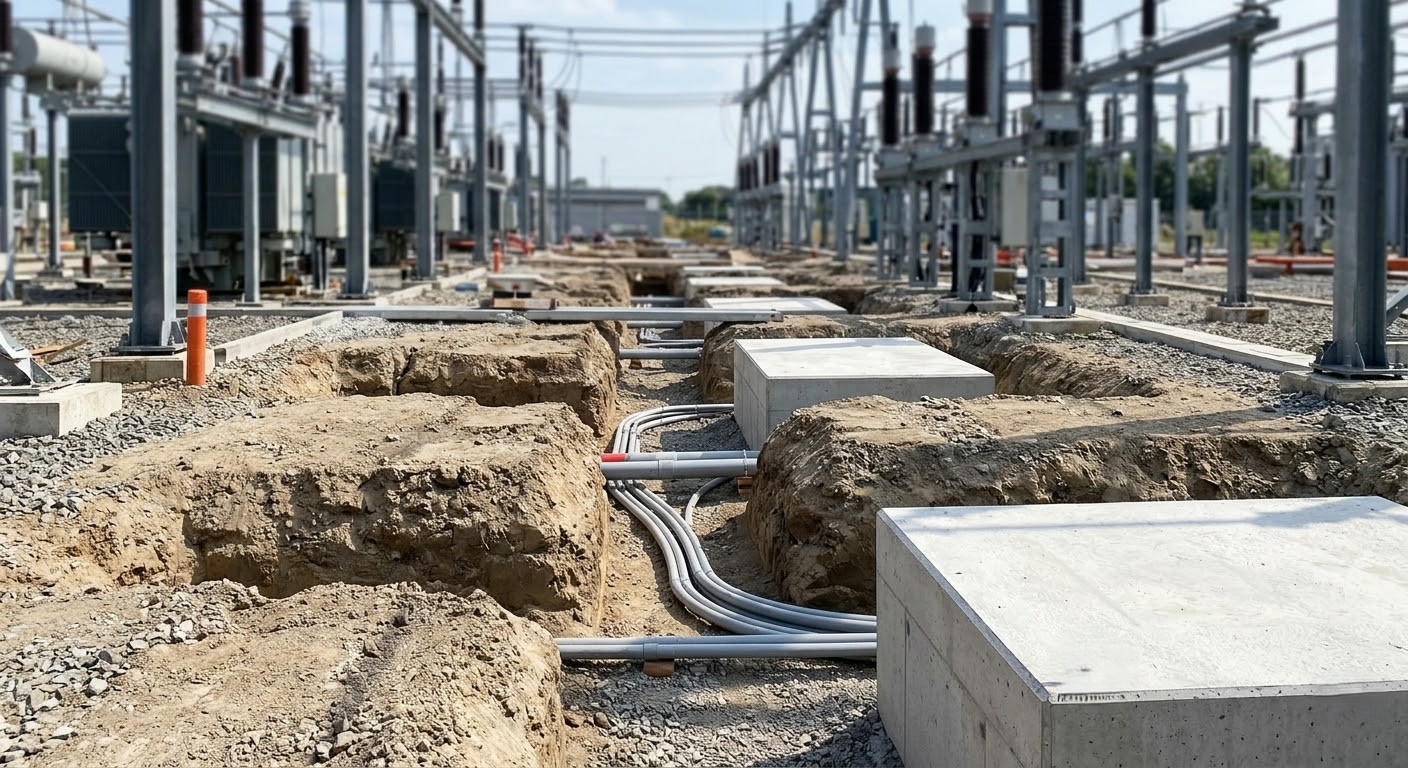
First, engineers review the drawings to confirm exact trench locations. Next, they identify sensitive zones near existing foundations. Finally, workers place wooden boards or polyethylene sheets over old concrete to protect it from damage.
7.2 Excavation
Crucially, excavator operators maintain a strict 0.5m to 1.0m safety distance from existing structures. Because machines cause heavy vibrations, laborers perform all manual excavation near old concrete. Subsequently, carpenters install shoring to support deep trench walls, and drivers remove excavated dirt to approved disposal areas.
For additional compliance on trench stability, safety officers should review the OSHA standards for trenching and excavation.
7.3 Formwork and Reinforcement
After digging, laborers clean the foundation bed and pour blinding concrete. Once the base sets, steel fixers install the reinforcement. Carpenters then build the formwork while strictly checking the final alignment and dimensions.
7.4 Concrete Pouring
Before the pump arrives, inspectors verify the rebar and formwork. Next, the team pumps approved ready-mix concrete into the forms. Simultaneously, a worker uses a mechanical vibrator to compact the wet cement. Finally, the team cures the concrete with water or curing compound for at least 7 days.
7.5 Backfilling and Finishing
Lastly, workers backfill the empty spaces using clean, approved sand. They pack the sand tightly in thin layers. Testers conduct compaction tests on each layer to prevent future sinking. Finally, the crew levels the surface to the required site elevation.
8. Safety Requirements
Because active substations feature high-voltage hazards, the site demands extreme caution. Therefore, the team implements these rules:
-
Workers barricade the area and hang warning signage.
-
Supervisors strictly forbid mechanical excavation near old foundations without direct engineer supervision.
-
Safety officers monitor vibration levels continuously during excavation.
-
Guards restrict unauthorized personnel from entering the site.
-
Foremen ensure all workers wear appropriate Personal Protective Equipment (PPE).
9. Inspection and Quality Assurance
To guarantee structural strength, the QA/QC team monitors the entire process. First, they conduct an excavation inspection prior to laying concrete. Next, they verify all reinforcement and formwork dimensions. During the pour, technicians take wet concrete samples for compressive strength testing. Ultimately, they perform compaction tests for every single backfilling layer to secure a perfect finish.
Be the first to comment